The Hermit Who Sparked a Holy Reform
Saint Peter Damian did not live in a golden age. He lived in a time when Church life could look painfully human, even scandalous, and yet he never stopped believing that Christ was still the Head of His Church. Born around the year 1007 and dying in 1072, Peter Damian became one of the great reforming voices of the eleventh century, not because he loved conflict, but because he loved Jesus Christ and refused to treat sin like a small problem. He is honored as a bishop, a cardinal, and a Doctor of the Church, but at heart he always remained a monk who wanted God more than comfort, more than reputation, and more than control.
What made him compelling is that he did not try to fix the Church by acting like a political operator. He tried to fix the Church by calling souls back to the Cross, back to truth, and back to the kind of integrity that makes the Gospel believable again. One of his most famous lines cuts straight to the point, and it still lands like a punch to the chest: “Those who do not love the Cross of Christ do not love Christ.” That sentence is not a slogan. It is a diagnosis. If the Cross is avoided, then Christ is kept at arm’s length.
An Orphan and a Soul God Would Not Let Go
Peter Damian’s story begins with hardship. He was born in Ravenna, and he lost his parents while still young. In those days, being an orphan could mean being invisible, and for a time his life reflected that. Accounts from Catholic tradition describe seasons of neglect and harsh treatment in the care of a brother, the kind of experience that can either make a man bitter or make him cling to God. Peter did not become sentimental. He became serious.
Eventually, another brother, Damian, took him in and provided education and stability. Peter never forgot that kindness. It is widely remembered that he adopted the name “Damian” out of gratitude, almost like carrying a family scar and a family blessing at the same time. He studied in places known for learning, and he became a gifted teacher of rhetoric while still young. He had the kind of mind that could have built a comfortable career. He could have stayed in the world and done well.
But something in him was restless. The more he tasted success, the more he realized it did not satisfy the deepest hunger. Catholic tradition preserves a couple of small but telling moments from his youth that reveal his heart. There is a story of him finding a coin and choosing not to spend it on himself, but instead arranging for Masses for the souls of his parents. There is another story where he experiences a frightening choking incident and is shaken into repentance and deeper seriousness. These are not flashy stories. They are the kind of quiet turning points that show how God forms saints through conscience, humility, and the fear of offending Love.
When he finally left the academic world, it was not because he hated learning. It was because he wanted something greater than applause. Around the mid 1030s he went to the hermitage at Fonte Avellana, embracing a life of prayer, fasting, and simplicity. He would later describe the hermit’s cell in a way that makes modern people uncomfortable because it is so direct: it is not a bunker, it is not escapism, it is not aesthetic self care. It is, in his words, “the parlour in which God converses with men.” That is what he wanted most, and it became the secret source of everything he did after.
The Monastic Furnace That Forged a Reformer
Fonte Avellana shaped Peter Damian like fire shapes iron. The community’s life was intense. Prayer was not an accessory. It was the rhythm of everything, especially the night office, the long chanting of the Psalms, and the steady struggle to put God first when the body wants ease. Peter Damian did not treat penance as a performance. He treated it as training in love. This is the kind of sainthood that does not sell well in modern marketing because it asks for real conversion. But it is also the kind of sainthood that actually changes people.
He eventually became prior, and this is where a deeper dimension of his character shows up. He was austere, but he was not stupid. He wanted holiness, not burnout. He strengthened the community’s discipline and expanded its influence, but he also moderated excesses when he saw them. Catholic accounts describe him balancing strict practices with practical wisdom, even allowing rest when the intensity of night prayer demanded it. That combination is one reason he became so influential. He understood that the spiritual life is not built on vibes. It is built on daily fidelity.
Peter Damian also wrote constantly. He composed spiritual letters, sermons, treatises, and a famous life of Saint Romuald, the holy founder connected to the eremitical tradition that influenced Fonte Avellana. His writing was not meant to entertain. It was meant to heal souls. Even when he addressed difficult moral issues, he wrote like a man convinced that eternity is real and that sin destroys charity if it is treated casually.
His reforming zeal grew out of this monastic furnace. He did not become a critic because he enjoyed being harsh. He became a critic because he was convinced the Church could not be renewed unless pastors lived like pastors. In his day, two problems were especially poisonous. One was simony, the buying and selling of spiritual things. The other was widespread clerical immorality and a refusal to live discipline. Peter Damian attacked these sins with language that sometimes shocks modern ears, but his goal was not scandal for its own sake. His goal was to protect the faithful, defend the sacraments, and call the clergy back to integrity.
The Church’s moral teaching helps make sense of his urgency. The Christian life is not a self designed spirituality. It is a life of conversion, truth, and charity. The Catechism of the Catholic Church teaches plainly about simony in CCC 2121, and the broader call to holiness and continual conversion runs throughout the section on the Christian life. Peter Damian was fighting for a Church where spiritual goods are not treated like a marketplace and where shepherds do not live double lives.
Catholic tradition also associates him with a remarkable healing in his own life. He endured a severe illness for weeks, and he recovered suddenly in a way he believed was a mercy granted through divine intervention. It fits his whole pattern. He was not a man chasing signs. He was a man who received God’s mercy and then worked harder for God’s house.
A Cardinal Who Got Sent into Storms
Peter Damian did not chase power. Power chased him. The popes of his day needed men who were holy and fearless, and his reputation could not stay hidden in the mountains. He was summoned into the Church’s most turbulent disputes and eventually made Cardinal Bishop of Ostia. Sources describe him resisting this, because he wanted to remain a monk. That reluctance matters because it shows his heart. He did not see authority as a prize. He saw it as a cross.
From that point on, his life became a cycle of prayer, travel, confrontation, and reluctant diplomacy. He was sent as a papal legate to deal with major conflicts, including unrest and reform in Milan. He intervened in disputes in France. He worked to prevent a royal divorce that threatened to scandalize the faithful and destabilize Christian order. He was sent to Ravenna to help heal a rupture connected to schism and rebellion. These were not safe missions. They involved angry crowds, political pressure, and the constant risk of being misunderstood.
Here is another surprising detail that reveals his pastoral instinct. In an era when many were furious about simony, some wanted to claim that sacraments and ordinations connected to corrupt ministers were invalid. Peter Damian argued for a more careful approach, defending the Church from falling into chaos and despair. He could be fierce in moral clarity while also protecting the faithful from spiritual panic. That is a rare combination. It shows he cared about truth, but also about unity, sacramental confidence, and the stability of souls.
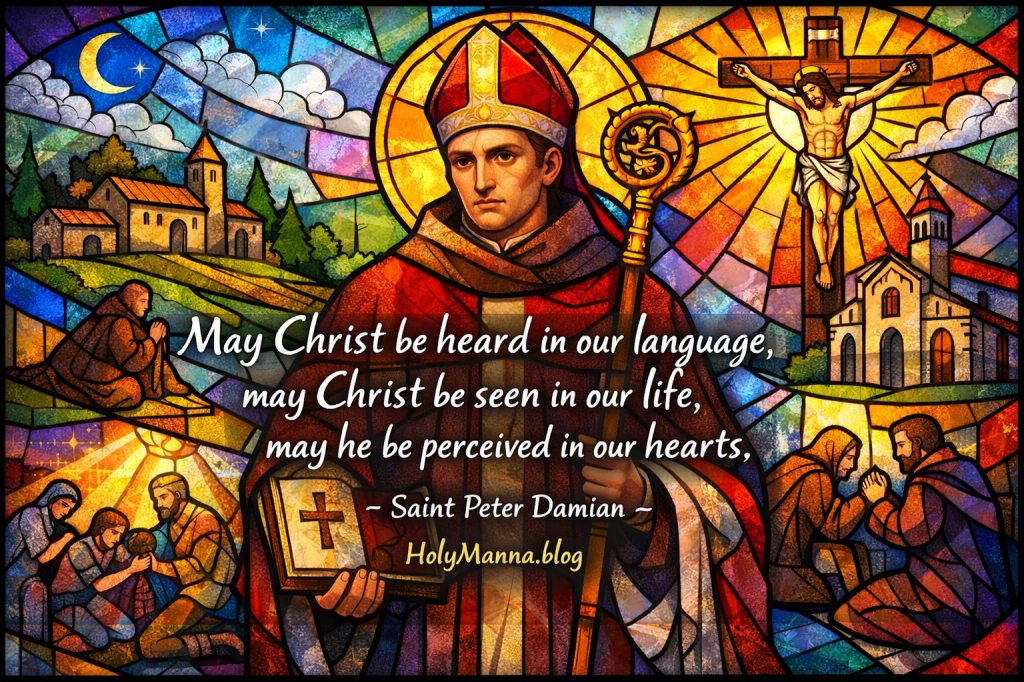
Even in public life, he kept returning to his core spiritual obsession: the Cross. He called himself, with striking humility, “Peter, servant of the servants of the Cross of Christ.” He wanted reform, but not reform as an abstract idea. He wanted reform as a return to crucified love. He also left a line that sounds like a prayer for every Christian household: “May Christ be heard in our language, may Christ be seen in our life, may he be perceived in our hearts.” That is not just for monks. That is for parents, workers, students, and anyone trying to live the Gospel without pretending.
Obedience That Felt Like Exile
Peter Damian was not killed by persecutors, so he is not remembered as a martyr of blood. But his life absolutely contained martyrdom in the old Christian sense of witness. He endured the slow death of self that obedience demands. He sacrificed the quiet life he loved in order to serve the Church when she needed him most. That kind of suffering rarely gets dramatic music behind it, but it is real. It is also one of the most convincing forms of sanctity, because it is chosen day after day without applause.
He faced resistance from powerful people who preferred comfort to repentance. He had to navigate clerics who wanted reform without conversion, and politicians who wanted Church authority without Church teaching. He carried the strain of being a contemplative forced into controversy. And yet he kept his interior compass steady: prayer, truth, the Cross, and the salvation of souls.
His final days reveal what kind of man he was. After returning from a mission meant to reconcile and restore peace, he fell ill and died in Faenza, cared for by Benedictines. Catholic tradition remembers him dying as a man still rooted in prayer, surrounded by the liturgical life he loved. There is something fitting about that. The monk who was dragged into storms finally returned to the peace of the Church’s prayer, as if God allowed him to end where he began: with the Psalms, the altar, and surrender.
A Legacy That Outlived His Century
After his death, devotion to Peter Damian spread quickly. In the medieval world, that kind of devotion did not always depend on a modern canonization process. The faithful recognized holiness, and the Church’s liturgical remembrance confirmed it over time. His relics were honored, and his remains were translated more than once, reflecting continuing veneration. He became closely associated with the places that formed him and received him, especially Fonte Avellana and Faenza.
His posthumous legacy also became intellectual and cultural. He was eventually declared a Doctor of the Church, a recognition that his teaching was not merely useful for his moment, but valuable for the whole Church. His writings continued to shape reform movements and spiritual renewal long after the eleventh century ended. Even Western Christian literature carried his memory. Dante placed him among the blessed, portraying him as a contemplative voice in the company of saints who lived close to God. That kind of appearance is not accidental. It shows that Peter Damian was remembered not only as a reformer with sharp words, but as a holy man with a luminous interior life.
Popular Catholic devotion has also connected him to the struggles of sleeplessness, likely because of traditions about the intensity of his prayer and asceticism. Whether someone leans into that devotion or not, it highlights something true: he understood the cost of prayer and the need to put God first, even when the body complains.
As for miracles after death, the major Catholic biographies tend to emphasize his enduring veneration, the honor given to his relics, and the Church’s recognition of his sanctity more than a catalog of specific posthumous healings. That itself is instructive. Sometimes the biggest miracle is a life that keeps converting souls centuries later, and a voice that still calls Christians to stop negotiating with sin.
The Reform God Wants Starts in the Soul
Saint Peter Damian teaches that the Church is renewed the same way a soul is renewed: by repentance, by truth, by discipline, and by love that embraces the Cross. He is a saint for anyone tired of shallow Christianity. He is also a saint for anyone tempted to despair about the Church’s wounds. His life proves that Christ does not abandon His Church, and that God raises up saints in ugly seasons precisely to remind the faithful that holiness is still possible.
His example also corrects two temptations that show up in every generation. One temptation is to be angry at corruption while ignoring personal conversion. The other temptation is to chase a personal spiritual life while refusing the responsibilities of charity and obedience. Peter Damian held both together. He fought for holiness in the Church, and he fought for holiness in the heart.
A practical way to imitate him starts small but real. It begins with serious prayer, even if it is short, and a refusal to treat the Cross like a problem to avoid. It includes regular confession and a clean conscience. It includes reverence at Mass, because the Eucharist is not an accessory to community life. It is Jesus Christ giving Himself. It includes integrity in daily habits, especially when nobody is watching, because hypocrisy is the seedbed of scandal.
His words can be carried into daily life like a compass. “May Christ be heard in our language, may Christ be seen in our life, may he be perceived in our hearts.” If that becomes true in one home, one workplace, one parish, then reform has already begun.
Engage with Us!
Share your thoughts and reflections in the comments below. What part of Saint Peter Damian’s story hit home, and why?
- Where is God calling for deeper integrity right now: in speech, purity, money, or humility?
- How can a “hermit’s parlor” be created in daily life, meaning a small space of silence where God is truly heard?
- What does it look like to love the Cross in a practical way, without drama, but with real obedience?
- Is there one concrete act of reform that can begin today, starting with repentance and confession?
Keep going. Live a life of faith. Do everything with the love and mercy Jesus taught us and let holiness begin where it always begins: in the heart that finally stops negotiating with sin.
Saint Peter Damian, pray for us!
Follow us on YouTube, Instagram and Facebook for more insights and reflections on living a faith-filled life.

 Holy Manna!
Leave a comment