Saturday after Ash Wednesday – Lectionary: 222
When Mercy Becomes Light
Some days in Lent feel like standing in a quiet room before dawn, waiting for the first hint of light to break through the window. The Church places these readings together to teach that the light does not rise from willpower alone, but from conversion that becomes mercy. Isaiah 58:9-14 promises something almost shocking in its tenderness: “Then you shall call, and the Lord will answer … ‘Here I am!’” (Is 58:9). That is the heartbeat of today’s liturgy. God draws near when the heart stops performing religion and starts living it.
The central theme tying the day together is this: true repentance is revealed in merciful love, and merciful love opens the soul to God’s presence. That is why the reading from Isaiah confronts a fasting that stays shallow and self-focused. The prophet speaks to a people returning from exile who are rebuilding not only walls and homes, but their identity as God’s covenant family. In that fragile season, it would have been easy to treat worship as a badge and fasting as a ritual, while still keeping cruelty, gossip, and oppression alive in daily life. God refuses that compromise. The Lord describes a fast that lifts burdens, feeds the hungry, and heals wounds, and then makes a promise that sounds like sunrise: “Then your light shall rise in the darkness, and your gloom shall become like midday.” (Is 58:10). Even Sabbath rest becomes part of the same lesson, because worship is not meant to be a cold obligation but a renewed love, a day called “a delight.” (Is 58:13).
That is exactly the mood of Psalm 86, which sounds like the prayer of someone who finally stopped pretending to be strong. The Psalmist speaks as one who is “poor and oppressed,” trusting that God is “good and forgiving.” (Ps 86:1, 5). The plea is not for a religious makeover but for a real change of heart: “Teach me, Lord, your way that I may walk in your truth, single-hearted and revering your name.” (Ps 86:11). The Church puts that line on the lips of the faithful today because Lent is not mainly about showing discipline. Lent is about becoming single-hearted, so that mercy can flow without hypocrisy and prayer can become honest.
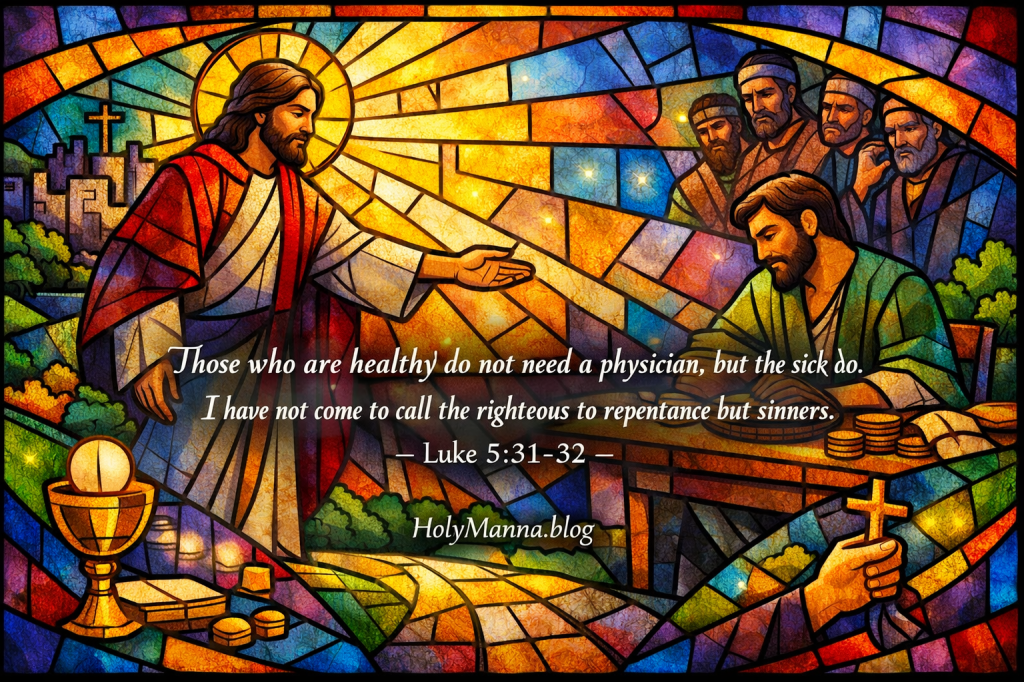
Then the Gospel arrives like a scene from the street, simple and direct. In Luke 5:27-32, Jesus spots Levi at the customs post and speaks two words that change everything: “Follow me.” (Lk 5:27). Levi stands up, leaves everything behind, and then hosts a banquet where Jesus sits with tax collectors and sinners. The religious critics cannot handle it, but Jesus answers with the key that unlocks the whole day: “Those who are healthy do not need a physician, but the sick do.” (Lk 5:31). The prophet’s “true fast” and the psalm’s “single-hearted” prayer find their fulfillment here, because the Lord is not searching for the impressive. The Lord is searching for the repentant. The Physician comes close, not to approve sin, but to heal sinners and call them into a new life.
This is the kind of Lent that rebuilds ancient ruins, not only out in the world but inside the human heart. It is a Lent where fasting becomes mercy, mercy becomes light, and light becomes communion with the God who answers the cry of His people with a simple, saving promise: “Here I am!” (Is 58:9).
First Reading – Isaiah 58:9-14
When the Fast Turns into Light
Lent can be misunderstood as a spiritual self improvement project, as if holiness is mainly about grit, clean habits, and private discipline. Isaiah 58 steps into that misunderstanding like a prophet with his sleeves rolled up. This passage comes from a section where God confronts a people who are serious about religious practices but tempted to keep their conversion shallow. The wider chapter addresses fasting that looks impressive on the outside but leaves injustice untouched, relationships strained, and speech unhealed. In the background stands a wounded community learning how to live again as God’s covenant people, rebuilding identity after national catastrophe and spiritual compromise.
Today’s theme is not complicated, but it is demanding. True repentance becomes mercy, and mercy becomes light. In this reading, God promises closeness to the one who stops hiding behind pious routines and starts living charity with integrity. The Lord even teaches that worship is not meant to be sterile or joyless. Sabbath observance, which is meant to form a people who belong to God, becomes a “delight” only when the heart stops serving itself and begins to reflect the Lord’s own goodness.
Isaiah 58:9-14 – New American Bible (Revised Edition)
9 Then you shall call, and the Lord will answer,
you shall cry for help, and he will say: “Here I am!”
If you remove the yoke from among you,
the accusing finger, and malicious speech;
10 If you lavish your food on the hungry
and satisfy the afflicted;
Then your light shall rise in the darkness,
and your gloom shall become like midday;
11 Then the Lord will guide you always
and satisfy your thirst in parched places,
will give strength to your bones
And you shall be like a watered garden,
like a flowing spring whose waters never fail.
12 Your people shall rebuild the ancient ruins;
the foundations from ages past you shall raise up;
“Repairer of the breach,” they shall call you,
“Restorer of ruined dwellings.”Authentic Sabbath Observance That Leads to Blessing
13 If you refrain from trampling the sabbath,
from following your own pursuits on my holy day;
If you call the sabbath a delight,
the Lord’s holy day glorious;
If you glorify it by not following your ways,
seeking your own interests, or pursuing your own affairs—
14 Then you shall delight in the Lord,
and I will make you ride upon the heights of the earth;
I will nourish you with the heritage of Jacob, your father,
for the mouth of the Lord has spoken.
Detailed Exegesis
Verse 9: “Then you shall call, and the Lord will answer, you shall cry for help, and he will say: ‘Here I am!’”
This is the first promise, and it is breathtaking in its simplicity. God is not describing a distant deity who rewards performance. God is describing the covenant Lord who draws near to a converted heart. Lent aims at this intimacy, a life where prayer is not a formality but a real cry and a real response. The phrase “Here I am!” signals God’s readiness to act, but it also exposes the human problem: often the heart is unavailable, distracted, and divided. This verse frames the rest of the passage as a path toward communion with God.
Verse 9: “If you remove the yoke from among you, the accusing finger, and malicious speech;”
The promise of closeness is paired with conditions that sound like moral realism. The “yoke” refers to burdens laid on others, whether through oppression, exploitation, or hard hearted control. God then moves straight to the sins of the tongue and posture: the accusing finger that points with contempt and the malicious speech that tears down. Lent is not only about what is avoided in the kitchen. Lent is also about what is removed from the mouth and the mind. Malicious speech can make a household feel like a prison, a workplace feel hostile, and a parish feel cold. God names it because it contradicts the covenant life.
Verse 10: “If you lavish your food on the hungry and satisfy the afflicted;”
This is the turning point. The fast God desires does not collapse inward into self focus. It expands outward in mercy. The language is generous, not minimal. It does not say “share scraps.” It says “lavish your food” and “satisfy” the afflicted. Charity here is not a gesture for appearances. It is a real act that costs something and changes someone’s day. This is also why the Church always pairs fasting with almsgiving, because sacrifice without love can become another form of pride.
Verse 10: “Then your light shall rise in the darkness, and your gloom shall become like midday;”
God’s promise shifts into imagery that feels like sunrise after a long winter. Darkness and gloom are not only external circumstances. In Scripture they often represent confusion, sin, despair, and spiritual dryness. God teaches that mercy is not merely social ethics. Mercy becomes spiritual illumination. When charity becomes real, the soul changes. Light rises because the person begins to resemble the Lord, who is light.
Verse 11: “Then the Lord will guide you always and satisfy your thirst in parched places, will give strength to your bones.”
Here the promise becomes personal and enduring. Guidance “always” suggests a steady relationship, not occasional religious moments. “Parched places” describes seasons of weariness, temptation, loneliness, and uncertainty. God does not promise that the desert disappears. God promises presence in the desert, satisfaction in the desert, and strength even when the bones feel tired. In Lent, the enemy often whispers that sacrifice leads only to emptiness. God replies that sacrifice joined to mercy becomes a channel of grace.
Verse 11: “And you shall be like a watered garden, like a flowing spring whose waters never fail.”
This is not the image of a harsh religion. This is the image of fertility, life, and beauty. A watered garden is not frantic. It is rooted. A flowing spring is not exhausted. It gives because it is connected to a source. The reading teaches that conversion is not mainly about becoming more impressive. It is about becoming more alive in God, so that life can spill outward to others.
Verse 12: “Your people shall rebuild the ancient ruins; the foundations from ages past you shall raise up; ‘Repairer of the breach,’ they shall call you, ‘Restorer of ruined dwellings.’”
Conversion is never purely private. When a people return to covenant fidelity, they rebuild what sin and neglect have broken. “Repairer of the breach” suggests mending what separates, reconciling what is divided, restoring what is ruined. In a culture trained to burn bridges quickly, this verse feels like a mission from heaven. Lent is meant to rebuild marriages, heal friendships, restore trust, and re knit communities. God’s mercy makes repair possible.
Verse 13: “If you refrain from trampling the sabbath, from following your own pursuits on my holy day;”
The passage turns toward worship. Sabbath observance is not an arbitrary rule. It is a covenant sign. God forms a people who do not belong to work, profit, entertainment, or self. “Trampling” the sabbath implies treating holy time as ordinary, using it for selfish pursuits, and refusing God the worship that is due. Lent reminds the heart that salvation is not produced by human effort. Salvation is received through relationship with God, and worship is a central expression of that relationship.
Verse 13: “If you call the sabbath a delight, the Lord’s holy day glorious;”
This is the surprise. God wants worship to become delight. The Christian heart is not meant to view the Lord’s day as a burden. A holy day becomes glorious when it is not reduced to obligation but embraced as encounter. Delight does not mean laziness. It means love. It means recognizing that God is not a rival to joy, but the source of joy.
Verse 13: “If you glorify it by not following your ways, seeking your own interests, or pursuing your own affairs”
This verse names the core struggle: self direction versus God’s direction. To “glorify” the day is to choose God’s ways over personal obsession, God’s interests over self centered goals, and God’s priorities over endless busyness. It is a call to let worship re order the week. It is also a warning that even good things can become idols if they crowd out God.
Verse 14: “Then you shall delight in the Lord, and I will make you ride upon the heights of the earth; I will nourish you with the heritage of Jacob, your father, for the mouth of the Lord has spoken.”
The final promise is not small. God offers joy in Himself, spiritual elevation, and the nourishment of covenant inheritance. “Heritage of Jacob” recalls God’s faithfulness to His promises, His fatherly care, and His desire to bless His people. The phrase “for the mouth of the Lord has spoken” seals it. This is not motivational talk. This is covenant speech from the God who keeps His word.
Teachings
This reading expresses the Church’s Lenten wisdom with prophetic force: repentance is not only interior regret, but a change that bears fruit in mercy and worship. The Catechism teaches that conversion shows itself through concrete practices, not vague feelings, and it highlights the classic triad that echoes Isaiah 58: “Jesus’ call to conversion and penance, like that of the prophets before him, does not aim first at outward works, ‘sackcloth and ashes,’ but at the conversion of the heart, interior conversion. Without this, such penances remain sterile and false; however, interior conversion urges expression in visible signs, gestures and works of penance.” (CCC 1430).
The Catechism then describes the traditional forms of penance that the Church recommends, and the connection to today’s reading is unmistakable: “The interior penance of the Christian can be expressed in many and various ways. Scripture and the Fathers insist above all on three forms, fasting, prayer, and almsgiving, which express conversion in relation to oneself, to God, and to others.” (CCC 1434).
When Isaiah speaks of feeding the hungry and satisfying the afflicted, it sounds like what the Church calls the corporal works of mercy. The Church even lists them plainly: “The works of mercy are charitable actions by which we come to the aid of our neighbor in his spiritual and bodily necessities. Instructing, advising, consoling, comforting are spiritual works of mercy, as are forgiving and bearing wrongs patiently. The corporal works of mercy consist especially in feeding the hungry, sheltering the homeless, clothing the naked, visiting the sick and imprisoned, and burying the dead.” (CCC 2447).
The reading’s insistence on worship also aligns with the Church’s teaching that the Lord’s day is meant to be holy and life giving, not a leftover slot. While the passage speaks of the sabbath, the Christian fulfillment is found in the Lord’s Day, the day of the Resurrection, which remains oriented to worship and mercy. The Church teaches: “Sunday is expressly distinguished from the sabbath which it follows chronologically every week; for Christians its ceremonial observance replaces that of the sabbath. In Christ’s Passover, Sunday fulfills the spiritual truth of the Jewish sabbath and announces man’s eternal rest in God.” (CCC 2175).
The saints consistently warn against a Lent that stays external. St. John Chrysostom famously preached that fasting from food while devouring a neighbor with words is a contradiction. That is exactly what Isaiah exposes when it condemns malicious speech. St. Augustine likewise insisted that the purpose of fasting is to train love, not inflate ego, because any sacrifice not ordered to charity becomes noise. This is the steady Catholic logic: penance is meant to free the heart for God and neighbor, not to create a new identity built on spiritual pride.
Reflection
This reading asks a hard but healing question: Is Lent producing a kinder, more truthful, more merciful person, or is it only producing a more disciplined person. Discipline is good, but discipline without charity can become a polished form of selfishness. God’s promise “Here I am!” is offered to the one who stops using religion as cover and starts living mercy as a way of life.
A practical way to live this out is to let fasting touch speech first. The accusing finger and malicious words show up everywhere, including in sarcasm at home, impatience in traffic, contempt in political conversations, and gossip disguised as “concern.” Lent can become real quickly when the tongue is restrained and replaced with blessing, encouragement, and silence when silence is wiser.
Another step is to make mercy concrete. The hungry are not only statistics. The afflicted are not only distant problems. Mercy becomes real when someone is fed, visited, checked on, or helped without being made to feel small. This is also where the heart discovers light. Charity does not simply help the other person. Charity heals the giver, because it reconnects the soul to the Lord’s own way of seeing and loving.
Worship also matters here, because the reading ends with delight in the Lord. The goal is not to become grim. The goal is to become faithful and joyful. When the Lord’s day becomes glorious again through prayer, Mass, rest, and mercy, life starts to reorder itself around God instead of around personal pursuits.
Where has religious practice become a substitute for real conversion? Who has felt the weight of a yoke through harshness, impatience, or control, and what would it look like to lift that burden this week? What kind of speech has been tolerated because it felt normal, even though it is poisoning the heart? If God promised to help rebuild ruins through a changed life, what broken place is being quietly placed in the Lord’s hands today?
Responsorial Psalm – Psalm 86:1-6, 11
The Prayer That Sounds Like Lent
A person does not have to know much about ancient Israel to recognize this voice. It is the voice of someone who has been pushed to the edge and finally stops pretending to be self-sufficient. Psalm 86 is traditionally attributed to David, and it carries the tone of Israel’s worship: a covenant people crying out to the covenant God, convinced that the Lord is not distant, not irritated by weakness, and not bored by repetition. In the Temple and later in synagogue prayer, psalms like this shaped the faithful to speak to God with honesty, humility, and trust.
This Psalm fits today’s theme perfectly because it shows what happens when the “true fast” of Isaiah 58 becomes interior. When pride softens, when the accusing finger drops, when mercy becomes real, the heart starts praying like a poor man who believes God is actually listening. The Psalm does not present a polished performance. It presents a child of God calling “all the day,” not because life is easy, but because the Lord is good. That is the kind of prayer that makes room for the promise “Here I am!” (Is 58:9) and prepares the soul to meet Christ the Physician who sits at table with sinners (Lk 5:31-32).
Psalm 86:1-6, 11 – New American Bible (Revised Edition)
Prayer in Time of Distress
1 A prayer of David.
Incline your ear, Lord, and answer me,
for I am poor and oppressed.
2 Preserve my life, for I am devoted;
save your servant who trusts in you.
You are my God; 3 be gracious to me, Lord;
to you I call all the day.
4 Gladden the soul of your servant;
to you, Lord, I lift up my soul.
5 Lord, you are good and forgiving,
most merciful to all who call on you.
6 Lord, hear my prayer;
listen to my cry for help.11 Teach me, Lord, your way
that I may walk in your truth,
single-hearted and revering your name.
Detailed Exegesis
Verse 1: “Incline your ear, Lord, and answer me, for I am poor and oppressed.”
This opening line sets the posture for everything that follows. The Psalmist does not bargain with God or advertise personal achievements. The Psalmist admits need. In Scripture, “poor” often means more than lacking money. It can mean being lowly, exposed, and dependent, the kind of person who has nowhere else to go. Lent trains the heart to speak this way, because repentance begins when the soul stops negotiating and starts surrendering.
Verse 2: “Preserve my life, for I am devoted; save your servant who trusts in you.”
The Psalmist claims devotion, but not as self-congratulation. Devotion here is loyalty to the covenant. The crucial word is “trust.” The Psalm does not say, “Save me because the servant is impressive.” It says, “Save your servant who trusts in you.” This echoes the steady biblical rhythm: God saves not because humans are strong, but because God is faithful, and the faithful cling to Him.
Verse 3: “You are my God; be gracious to me, Lord; to you I call all the day.”
This verse is the heartbeat of persistent prayer. It names God personally, “my God,” then pleads for grace, which is exactly what sinners need when the Physician shows up. The phrase “all the day” reveals constancy, not obsession. It describes a life turned toward God again and again, like a compass needle that keeps returning north. Lent is meant to form this habit, because temptation rarely attacks once. Temptation returns all the day, so prayer must return all the day too.
Verse 4: “Gladden the soul of your servant; to you, Lord, I lift up my soul.”
This is not shallow happiness. It is the request for a restored interior life. “Gladden the soul” means the servant believes God can give joy without denying reality. The lifting up of the soul is a beautiful image for prayer itself: the heart rises toward God, even when circumstances remain heavy. This fits the promise in Isaiah: gloom can become like midday when the heart returns to the Lord (Is 58:10).
Verse 5: “Lord, you are good and forgiving, most merciful to all who call on you.”
Here the Psalmist preaches to his own heart. This is not a generic statement about a vague deity. This is covenant confidence: the Lord is good, forgiving, and merciful to those who call. That word “forgiving” matters today because the Gospel shows Jesus eating with sinners, not to excuse sin, but to draw sinners into repentance and healing (Lk 5:32). The mercy of God is not permissiveness. It is power to restore.
Verse 6: “Lord, hear my prayer; listen to my cry for help.”
The Psalmist repeats the request, and repetition is not a lack of faith. Repetition is often faith under pressure. A child repeats because the need is real. The Church’s prayer does this constantly, especially in Lent, because the faithful know that conversion is not finished in one moment. The cry continues, and the Lord continues to listen.
Verse 11: “Teach me, Lord, your way that I may walk in your truth, single-hearted and revering your name.”
This verse is the destination. The Psalmist is not merely asking for rescue from trouble. The Psalmist is asking for transformation. “Teach me your way” is discipleship language, the same kind of surrender Levi shows when he rises to follow Jesus (Lk 5:28). “Walk in your truth” means truth is not only believed, but lived. “Single-hearted” is the opposite of hypocrisy. It is a heart no longer split between God and self, a heart that reveres the Lord rather than using religion to prop up personal agendas. This is a perfect Lenten prayer because it asks for a unified life.
Teachings
The Church teaches that prayer is inseparable from humility, and this Psalm is basically humility in song. The Catechism gives a simple definition that matches the Psalmist lifting up his soul: “Prayer is the raising of one’s mind and heart to God or the requesting of good things from God.” (CCC 2559). That line captures what is happening in Psalm 86. The mind and heart rise, and good is requested, but always from the posture of dependence.
This Psalm also teaches the Catholic instinct to appeal to God’s goodness rather than personal worthiness. The line “Lord, you are good and forgiving, most merciful to all who call on you” (Ps 86:5) sounds like the Gospel’s logic: Christ comes for the sick, not because sickness is acceptable, but because mercy is real and healing is possible (Lk 5:31-32). Lent becomes dangerous when it turns into self-righteousness, because self-righteousness stops calling on mercy. This Psalm keeps the soul safely low to the ground, where grace can reach it.
The Fathers loved the Psalms because they are Christ’s prayer on the lips of His Body. St. Augustine often taught that the Psalms form the Church to pray in Christ, with Christ, and through Christ. When the Psalmist says he is “poor and oppressed,” it can echo the suffering of Christ Himself and the suffering of His members. This is why the Church prays the Psalms in the Liturgy of the Hours. The Psalms teach the faithful how to speak to God when emotions are messy, when repentance hurts, and when hope needs words.
Historically, this Psalm has been cherished as a prayer in distress, precisely because it holds together two truths that modern people often separate. It admits weakness without despair, and it proclaims God’s mercy without pretending sin is harmless. That is the balance Lent demands.
Reflection
This Psalm offers a clean spiritual test for the day: does prayer sound like a performance, or does it sound like a real cry. The Psalmist does not hide behind spiritual language. The Psalmist says, in effect, “Life hurts, the heart is poor, and God must help.” That is not weakness. That is the doorway to grace.
A practical way to live this Psalm is to borrow its sentences during moments of stress. When irritation rises, the heart can quietly repeat “Be gracious to me, Lord” (Ps 86:3). When temptation feels relentless, the soul can cling to “to you I call all the day” (Ps 86:3). When the day feels dry, the prayer can become “Gladden the soul of your servant” (Ps 86:4). This is how the Psalms rewire the inner life. They replace spiraling thoughts with faithful speech.
The most important move is the one in verse 11, because “single-hearted” is what Lent is trying to produce. A divided heart prays with one hand while clinging to sin with the other. A single-hearted person prays like Levi rising from the customs post, leaving what must be left behind, and walking in a new direction.
Where does the heart still pretend to be strong instead of admitting it is poor and in need of God? What would change if prayer became less polished and more honest, especially in the moments of weakness that usually lead to sin? Is the soul asking only for relief, or is it also asking, “Teach me your way,” so life can actually change?
Holy Gospel – Luke 5:27-32
The Doctor Walks into the Sinner’s House
The scene in today’s Gospel feels almost too ordinary to be revolutionary. Jesus walks along, sees a man at work, speaks a simple command, and everything changes. Levi is a tax collector, which in first century Jewish society meant more than having an unpopular job. Tax collectors were often viewed as collaborators with Rome, associated with greed, and treated as ritually suspect because of constant contact with Gentiles and questionable money. Many religious people did not merely dislike them. Many considered them outside the circle of the faithful. That is why this passage matters so much during Lent. It shows that Jesus does not wait at a safe distance for sinners to crawl into respectability. He steps directly into the places where shame, compromise, and brokenness live.
This Gospel ties perfectly into today’s theme from Isaiah 58 and Psalm 86. God promises closeness when repentance becomes real and mercy becomes concrete. Jesus embodies that promise. He is the Lord who effectively says, “Here I am!” (Is 58:9) by showing up at Levi’s table. The same God who rejects performative religion in Isaiah now rejects performative righteousness in the Pharisees. Lent is not a season for pretending to be healthy. Lent is a season for letting the Physician diagnose the soul and heal it through repentance.
Luke 5:27-32 – New American Bible (Revised Edition)
27 After this he went out and saw a tax collector named Levi sitting at the customs post. He said to him, “Follow me.” 28 And leaving everything behind, he got up and followed him. 29 Then Levi gave a great banquet for him in his house, and a large crowd of tax collectors and others were at table with them. 30 The Pharisees and their scribes complained to his disciples, saying, “Why do you eat and drink with tax collectors and sinners?” 31 Jesus said to them in reply, “Those who are healthy do not need a physician, but the sick do. 32 I have not come to call the righteous to repentance but sinners.”
Detailed Exegesis
Verse 27: “After this he went out and saw a tax collector named Levi sitting at the customs post. He said to him, ‘Follow me.’”
Jesus “went out,” which is a quiet detail with loud meaning. He leaves the familiar circles and steps into the messy edges of society. Levi is “sitting,” a posture of settled routine, the posture of someone planted in a way of life. Jesus interrupts that routine with two words that carry a whole new identity: “Follow me.” This is not a suggestion. It is a call to discipleship, a call to leave an old life and enter a new one. In Lent, this is the voice the Church keeps placing before the faithful, not as a threat, but as an invitation to freedom.
Verse 28: “And leaving everything behind, he got up and followed him.”
Levi’s response is immediate and total. The Gospel does not describe a negotiation or a slow transition. It describes a break. “Leaving everything behind” does not mean Levi never had to face consequences or make repairs. It means he chose Jesus over the security of his former life. This is repentance in motion. It is also the “single-hearted” prayer of Psalm 86 made visible: a divided heart stays seated. A converted heart gets up.
Verse 29: “Then Levi gave a great banquet for him in his house, and a large crowd of tax collectors and others were at table with them.”
Levi’s first instinct is not to hide. It is to host. The banquet is not just a party. It is a public statement that allegiance has changed. Jesus is welcomed into Levi’s home, and Levi’s social circle is exposed to Christ. The “others” at table matter because grace rarely moves in isolation. God saves individuals, but He builds a people. The table becomes a place of encounter, and encounter becomes the beginning of conversion. This verse also shows something Catholic to the core: salvation is not abstract. It enters the home, the habits, the relationships, and the ordinary spaces where life is lived.
Verse 30: “The Pharisees and their scribes complained to his disciples, saying, ‘Why do you eat and drink with tax collectors and sinners?’”
The complaint reveals a mentality that still tempts religious people today. The Pharisees and scribes define holiness by separation, as if purity is mainly about avoiding contamination. There is a legitimate biblical instinct behind that, because Israel was called to be holy. The problem is that they cannot recognize holiness when it comes in the form of mercy. They treat Jesus like He is lowering Himself, when in reality He is raising sinners up. Notice that they complain to the disciples, not directly to Jesus. Grumbling often prefers side conversations. It avoids direct encounter with the truth.
Verse 31: “Jesus said to them in reply, ‘Those who are healthy do not need a physician, but the sick do.’”
Jesus answers with an image everyone understands. The physician is not scandalized by illness. The physician goes toward it. This line does not romanticize sin. It names sin as sickness. It also reveals the mission of Christ: He comes to heal. A false religion pretends to be healthy and therefore refuses the Doctor. A true faith admits sickness and asks for healing. This is why Lent is so merciful. It gives permission to stop pretending.
Verse 32: “I have not come to call the righteous to repentance but sinners.”
This is not Jesus rejecting truly righteous people. It is Jesus exposing the self righteous attitude that refuses repentance. The “righteous” here are those who see no need to change, those who believe they are fine because they keep external rules while the heart stays hard. Jesus does not call that health. He calls it blindness. The line is also full of hope. The sinner is not disqualified from the call. The sinner is the target of the call. Repentance is the door, and Jesus is the one opening it.
Teachings
This Gospel sits at the center of Catholic teaching on conversion and mercy. The Church never teaches that sin is harmless. The Church teaches that sin wounds, enslaves, and kills. At the same time, the Church teaches that Christ seeks the sinner with a love that is both truthful and saving. The Catechism even cites this exact theme in the mission of Jesus: “Jesus’ invitation to enter his kingdom comes in the form of parables, a characteristic feature of his teaching. Through his parables he invites people to the feast of the kingdom, but he also asks for a radical choice: to gain the kingdom, one must give everything; words are not enough, deeds are required.” (CCC 546). This fits Levi perfectly, because Levi does not offer words only. Levi rises and leaves everything behind.
The Church also speaks directly about Christ’s choice to eat with sinners as a sign of the Kingdom’s mercy: “Jesus invites sinners to the table of the kingdom: ‘I came not to call the righteous, but sinners.’ He invites them to that conversion without which one cannot enter the kingdom, but by word and deed he shows them his Father’s boundless mercy for them and the vast ‘joy in heaven over one sinner who repents.’” (CCC 545). This is the Catholic heart of the Gospel today. Jesus eats with sinners not to affirm sin, but to call sinners into conversion and to reveal the Father’s mercy.
The saints and Fathers loved this passage because it destroys despair and pride at the same time. St. John Chrysostom points out the immediacy of Levi’s obedience as a sign of grace working powerfully, because grace can turn a compromised life into a holy life without delay. St. Augustine often warns that the greatest danger is not obvious sin but hidden pride, because pride refuses the Physician. In practical terms, the scandal is not that Levi is sick. The scandal is that the Pharisees cannot admit their own need.
This Gospel also connects to the sacramental life. Lent is not a self directed rehab plan. Lent points toward confession, reconciliation, and Eucharistic communion. Jesus sits at table with sinners and calls them to repentance, and the Church continues that mission through the sacraments. The same Christ who said “Follow me” still calls, and the same Physician still heals.
Reflection
Levi’s story is a mirror. Every soul has a “customs post,” some place where life got comfortable even though it was not holy. It might be a habit, a secret compromise, a relationship dynamic, a pattern of anger, or a way of numbing pain. The Gospel does not begin with Levi cleaning himself up. It begins with Jesus looking at Levi and calling him. Lent is meant to let that call land without excuses.
There is a practical path hidden in the scene. Levi gets up, leaves what must be left, and then brings Jesus into the home. That is a simple spiritual program. The first step is honesty about what keeps the soul seated. The second step is action, because repentance without movement becomes self deception. The third step is hospitality to Christ, which means letting the Lord into real life, not just into religious moments. This includes prayer, confession, and a deliberate turning away from what makes the heart sick.
The Pharisees also appear as a warning. It is possible to keep religious habits and still lose the Gospel. When people begin to feel disgust toward sinners rather than compassion, something has gone wrong. When people forget their own need for mercy, they stop understanding Jesus. The Church does not ask anyone to celebrate sin. The Church asks the faithful to love sinners the way Christ does, which always includes truth and always aims at repentance and healing.
Where is the “customs post” that keeps the heart seated when Jesus is calling it to rise? What would “leaving everything behind” look like in one concrete choice today, not as drama but as obedience? Does the soul run from the Physician out of shame, or does it approach Him with the humility of the sick who want to be healed? Is there more interest in spotting other people’s sins than in repenting of personal sin, and what would change if mercy became the first instinct?
Rise, Be Healed, Become Light
Today’s readings land like one clear invitation repeated three different ways. God does not want a Lent that stays on the surface. God wants a Lent that changes the heart, repairs what is broken, and turns repentance into mercy that other people can actually feel.
Isaiah 58:9-14 reveals the kind of conversion God recognizes. It is not religious performance, not empty sacrifice, and not a fast that leaves cruelty untouched. The Lord promises closeness with words that sound like a personal vow: “Then you shall call, and the Lord will answer … ‘Here I am!’” (Is 58:9). That promise is tied to concrete love, to lifting burdens, feeding the hungry, rejecting malicious speech, and learning to treat holy time as a “delight” instead of an inconvenience. When mercy becomes real, God says light rises, strength returns, and the faithful become “Repairer of the breach” (Is 58:12), the kind of people who rebuild what sin has ruined.
Psalm 86 shows the interior posture that makes that mercy possible. It is the prayer of someone who is done pretending. The Psalmist admits need, pleads for grace, and clings to the truth that God is “good and forgiving, most merciful to all who call on you” (Ps 86:5). Then the Psalm gives the line that can carry an entire Lent: “Teach me, Lord, your way that I may walk in your truth, single-hearted and revering your name.” (Ps 86:11). A divided heart stays stuck. A single-hearted heart becomes free.
Then Luke 5:27-32 puts flesh and blood on everything the prophet and the psalm prayed for. Jesus walks straight to the sinner, looks him in the eye, and says “Follow me.” (Lk 5:27). Levi rises, leaves everything behind, and opens his home. The religious critics complain, but Jesus reveals the mission of His mercy with a sentence that should stop every soul in its tracks: “Those who are healthy do not need a physician, but the sick do.” (Lk 5:31). The Gospel does not flatter sin. It heals sinners. It does not excuse sickness. It brings the Doctor to the table.
This is the call to action today. Let Lent become honest again. Let prayer sound like a real cry, not a performance. Let fasting become mercy, not moodiness. Let the tongue be cleansed of accusation and malice. Let someone else’s burden get lighter because conversion is happening for real. Most of all, let the heart stop hiding from Jesus as if healing is only for better people. The Physician came for the sick, which means this is the perfect day to rise, follow, and let God’s promise become personal: “Here I am!” (Is 58:9).
Engage with Us!
Readers are invited to share reflections in the comments below, especially any insight, conviction, or consolation that stood out in today’s readings. Lent is not meant to be lived alone, and it helps to hear how God is speaking to others through His Word.
- First Reading, Isaiah 58:9-14: Where is God asking for a “true fast” that goes beyond personal sacrifice and becomes mercy for someone else? What specific “yoke,” accusing finger, or pattern of malicious speech needs to be removed so that light can rise in the darkness? How can the Lord’s day become a real “delight” instead of an afterthought?
- Responsorial Psalm, Psalm 86:1-6, 11: In what area of life does the heart need to pray with more honesty and humility, like someone who is “poor and oppressed”? What would change if the soul repeated throughout the day the truth that God is “good and forgiving”? What does it look like right now to become “single-hearted” and walk in the Lord’s truth?
- Holy Gospel, Luke 5:27-32: What is the “customs post” that keeps the heart seated when Jesus says, “Follow me”? What does “leaving everything behind” look like in one concrete act of repentance this week? How can the soul approach Jesus more like the sick seeking a physician, and less like the self-satisfied who do not think they need healing?
Keep walking forward with confidence. God’s mercy is not fragile, and Jesus does not call the perfect. Jesus calls sinners to repentance, heals what is sick, and teaches His people to become light through real love. Live these days with faith, stay close to the sacraments, and do everything with the love and mercy Jesus taught, so that others can glimpse the Lord through a life being made new.
Sacred Heart of Jesus, we trust in You!
Immaculate Heart of Mary, pray for us!
Saint Michael the Archangel, defend us in battle!
Follow us on YouTube, Instagram and Facebook for more insights and reflections on living a faith-filled life.

 Holy Manna!
Leave a comment