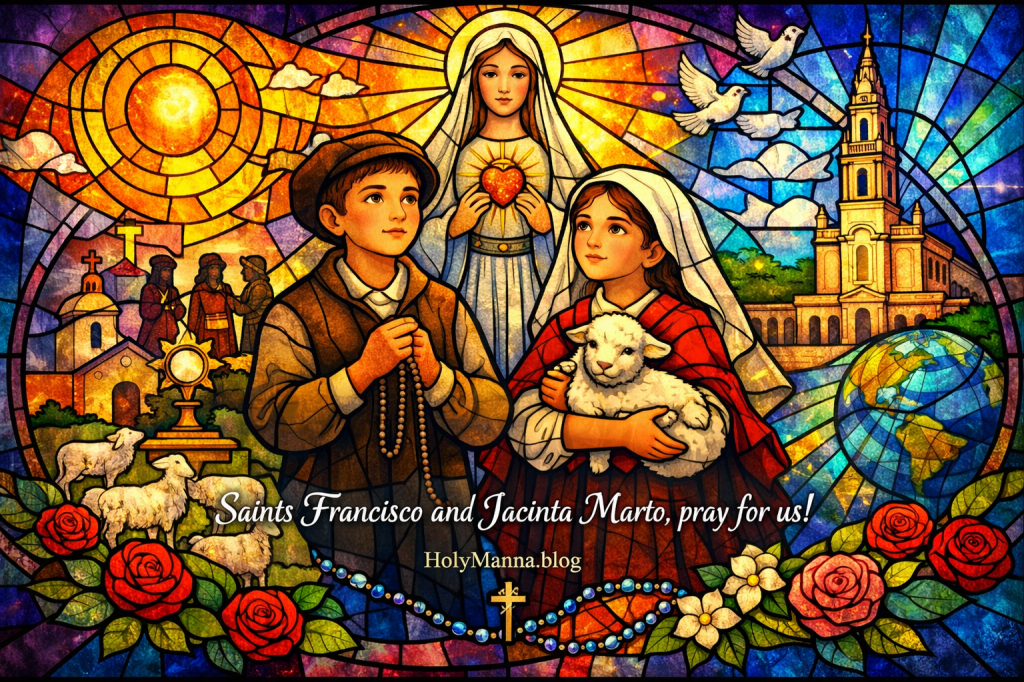
Two Shepherd Saints Who Lit Up the World
In a quiet corner of Portugal, in the tiny hamlet of Aljustrel near Fátima, God chose two ordinary children to deliver an extraordinary reminder to the Church. Saints Francisco Marto and Jacinta Marto were not famous because they were powerful, educated, or influential. They were shepherd kids who learned that Heaven is real, sin is serious, mercy is stronger than sin, and holiness is possible right now, even in the smallest life.
Their importance in Catholic tradition is not mainly that they witnessed the events of Fátima. Their importance is that they responded with heroic virtue. They prayed with focus, they sacrificed with love, and they let grace reshape their hearts. Their story fits perfectly with what The Catechism teaches about the universal call to holiness, because sanctity is not reserved for priests, religious, or the spiritually talented. It is the normal path for every baptized soul who takes Jesus seriously (CCC 2012 to 2014).
Their story also teaches a healthy Catholic balance about private revelation. Even when the Church recognizes an apparition as worthy of belief, it never replaces the Gospel or adds new doctrine. Private revelation helps believers live the Gospel more fully, and it always points back to Christ, conversion, prayer, and the sacraments (CCC 67). That is exactly what these two little saints did with their lives.
A Simple Catholic Home in Rural Portugal
Francisco was born in 1908 and Jacinta in 1910, the youngest children in a large, hardworking family. Their home was not wealthy, but it was rich in the everyday habits that shape Catholic souls. Life was built around work, family, the parish, and the seasons. They learned prayers the way most Catholic children do, through repetition, example, and the steady rhythm of the Church’s life.
Their personalities were different in a way that makes their sainthood feel even more real. Francisco was quiet and reflective, often drawn toward silence. Jacinta was lively and expressive, with a strong heart that felt things deeply. Their cousin Lúcia, a little older, often led them while they watched sheep in the fields. Nothing about their early years looked dramatic, and that is part of the beauty. God loves to plant saints in plain soil.
Their faith deepened through a series of encounters that awakened them to the seriousness of God. In 1916, before the Marian apparitions, they reported three visits from the Angel of Peace. The prayers taught by the Angel formed their souls around adoration, repentance, and love for Jesus in the Eucharist. This foundation matters because it shows that the spirituality of Fátima is not sentimental. It is deeply Catholic, centered on worship and conversion.
Then came the monthly apparitions of Our Lady in 1917, from May through October. The call remained steady and unmistakably Catholic. Pray the Rosary, offer sacrifices in union with Christ, and plead for the conversion of sinners and peace in the world. This was not a new religion. It was Christianity taken seriously.
One surprising detail is often overlooked. Francisco could see Our Lady, but he could not hear her words. He relied on Lúcia and Jacinta to repeat the message. Instead of making him bitter, that silence shaped him into a contemplative. His path was not to talk endlessly about Heaven. His path was to adore the God who had touched him.
Grace Turned Childhood Into Heroic Virtue
Many people hear the word miracle and expect dramatic healings during a saint’s lifetime. Francisco and Jacinta were not known as public wonder workers while alive. The extraordinary signs associated with them were tied to the events of Fátima, culminating in the phenomenon traditionally called the Miracle of the Sun in October 1917. Even then, the Church does not canonize saints because of spectacle. The Church canonizes saints because of holiness.
The deeper miracle is what grace did to them. They became serious about prayer, especially the Rosary. They embraced sacrifices, not as a performance, but as hidden offerings of love. In Catholic teaching, this is not about earning God’s love. God’s love is already given. Sacrifice is how love responds, and it is one way a Christian shares in Christ’s saving work (CCC 618).
Francisco’s holiness leaned toward adoration. He would slip away to the parish church and remain there quietly, close to the tabernacle, drawn to Jesus in the Eucharist. His interior life was shaped by a desire to console the Heart of Christ. His words capture that mystery with childlike clarity: “We were burning in that light which is God and we were not consumed. What is God like? It is impossible to say.”
Jacinta’s holiness leaned toward compassion and urgency. She felt the tragedy of sin and the beauty of mercy with a depth that still surprises people. Her interior fire often spilled out in unforgettable lines. She lamented for the Holy Father and for sinners with simple intensity: “Poor Holy Father, I am very sad for sinners!” She also spoke of Heaven with a tenderness that feels like sunlight: “In Heaven I will love Jesus very much and the Immaculate Heart of Mary.”
Their lives matter because they show how fast a soul can grow when it stops negotiating with God. They teach that prayer is not a hobby. Prayer is a lifeline. They teach that holiness is not delayed until life becomes comfortable. Holiness begins the moment the heart says yes.
The Hidden Cost of Truth
Hardships arrived quickly, and they were not imaginary. In August 1917, local authorities detained the children and pressured them to deny what they had reported. They were threatened and manipulated. They were treated like troublemakers, even though they were only shepherd children. The pressure was intense because adults in power wanted the story to disappear.
Their response was not political. It was moral. They remained faithful to the truth as they understood it, even while afraid. That courage was part of their sanctity. It showed that they were not chasing attention, because attention brought them suffering. In a world where many people fold under social pressure, these children held their ground with a quiet strength that looks a lot like grace.
Their greatest hardships, though, came through illness. Both were struck by the influenza epidemic that swept through Europe. Francisco’s suffering increased into 1919. He prepared for death in a deeply Catholic way, receiving confession and Holy Communion as Viaticum. He died at home on April 4, 1919, still only ten years old. His death did not look like triumph to the world, but to Catholics it looks like a child who learned how to die with Jesus.
Jacinta’s suffering was longer and more isolating. She endured hospitalizations, surgery, and severe physical pain. She faced loneliness and separation from family, which can be terrifying for a child. Yet she offered her suffering with a steadiness that feels almost impossible without grace. She received the Sacrament of Reconciliation on the evening she died and died in Lisbon on February 20, 1920, at about nine years old.
There was no formal martyrdom by execution, but there was a martyr-like fidelity in how they carried suffering without bitterness. Their story teaches an uncomfortable truth. Holiness is not proven when life is easy. Holiness is proven when life hurts.
Heaven Confirmed Their Mission
After their deaths, devotion to Francisco and Jacinta grew, especially as the message of Fátima spread throughout the Catholic world. The Church does not declare saints because people feel inspired. The Church declares saints after careful investigation of their virtues and after confirmation of miracles attributed to their intercession.
A miracle was recognized in connection with their beatification, and another miracle was recognized for their canonization, widely known as the healing of a young boy in Brazil after a severe accident. In Catholic understanding, this is not magic and it is not superstition. It is the fruit of the Communion of Saints, because those who live in Christ do not stop loving when they die. They continue to intercede for the Church on earth (CCC 956).
Their relics became places of veneration, especially at the Shrine of Our Lady of Fátima. Pilgrims come there to pray, confess, attend Mass, and renew a serious Catholic life. Their legacy has helped revive devotion to the Rosary, reverence for the Eucharist, and a sober sense of repentance that does not lead to despair, but to mercy.
Their canonization in 2017 also delivered a message the modern world desperately needs. Children can be saints. God can form heroic virtue in small hearts. The Kingdom does not wait for adulthood.
Living Fátima at Home
Francisco and Jacinta make a strong case for simple Catholic habits lived with real conviction. Their example does not ask for dramatic gestures that turn faith into performance. Their example asks for faithful consistency that turns faith into life.
Their first lesson is prayer, especially the Rosary. The Rosary is not meant to be mindless repetition. It is meditation on the life of Christ with Mary leading the heart deeper into the Gospel. Their second lesson is sacrifice. They offered small discomforts without advertising them, and they offered them for sinners and peace. That kind of hidden offering is deeply Catholic, because it unites daily life to the Cross with love rather than complaint.
Their third lesson is Eucharistic love. Francisco’s desire to console Jesus challenges the modern habit of treating the tabernacle like background furniture. If Jesus is truly present, then time with Him is never wasted. A few minutes of silence before the Lord can reshape a week, especially when the heart is distracted and worn down.
Their story also teaches a sober Catholic view of private revelation. Even when the Church approves an apparition, it does not add doctrine. It calls believers back to what is already essential: conversion, prayer, sacraments, and charity (CCC 67). That keeps devotion grounded and keeps it centered on Jesus.
What would change if the Rosary became as normal as checking a phone every day?
What would change if confession became a steady habit instead of an emergency plan?
What would change if even ten quiet minutes with Jesus in the Eucharist became a weekly priority?
Engage With Us!
Share your thoughts and reflections in the comments below. Saints Francisco and Jacinta have a way of waking up sleepy faith, not by guilt, but by clarity and hope.
- What part of their story feels most challenging to live out right now: prayer, sacrifice, or trust?
- How can the Rosary become more than a routine and turn into real conversation with God?
- What is one small sacrifice that can be offered this week for someone else’s conversion or healing?
- If Eucharistic adoration is possible, what would it look like to spend even ten minutes a week with Jesus in silence?
- How can devotion to Our Lady lead more directly to love for Jesus and fidelity to His Church?
May their example push every soul toward a life of real faith, steady repentance, and joyful perseverance. Keep walking with Jesus, keep clinging to His mercy, and keep doing everything with the love and mercy He taught us.
Saints Francisco and Jacinta Marto, pray for us!
Follow us on YouTube, Instagram and Facebook for more insights and reflections on living a faith-filled life.

 Holy Manna!
Leave a comment