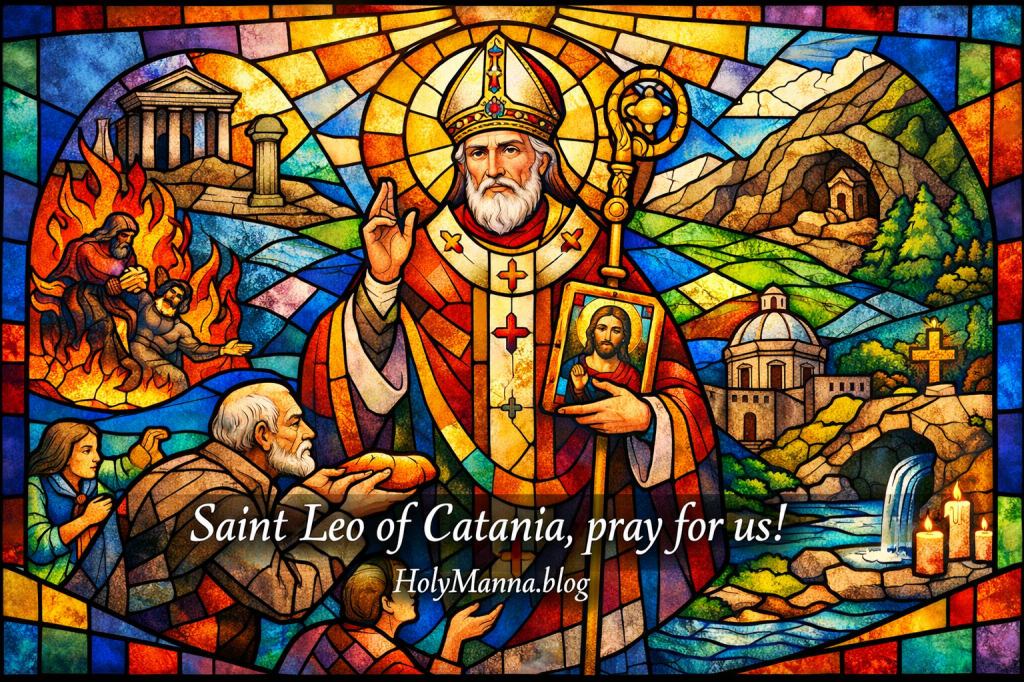
The Wonderworker Bishop
Saint Leo of Catania stands out as a bishop from the early medieval world whose story is carried more by the Church’s memory than by piles of surviving documents. That is not unusual for saints of his era, and it is worth saying out loud because it helps keep devotion honest and grounded. Even with limited historical detail, the Church’s liturgical memory preserves what matters most about him: he was a shepherd who poured himself out for Christ’s people, especially the poor.
The Roman Martyrology captures his legacy with a line that is as simple as it is powerful: “At Catania, Saint Leo, bishop, who with singular commitment provided for the care of the poor.” This is not the kind of praise that belongs to someone chasing attention. It sounds like a man who quietly lived the Gospel until the Gospel was written into his reputation.
A Quiet Beginning That God Turned Into a Calling
Catholic tradition places Leo’s origins in Ravenna and remembers him as a man formed in the Benedictine way of life. That background matters because it explains the steady, disciplined spirit that shows up in the stories about him. A monk learns to obey, to pray, to fast, and to keep going even when no one is clapping. Those habits are not flashy, but they produce strong pastors.
Tradition also says he lived for a time in Reggio Calabria, where his holiness became known beyond his local community. When Catania needed a bishop, the story goes that the faithful were directed to seek him out, and Leo hesitated out of humility. That reluctance is a familiar mark in saintly lives because holy men tend to fear leadership more than they desire it. In time, he accepted, not as a career move, but as obedience to what the Church needed.
A Bishop Under Pressure
Leo’s episcopate is commonly connected with the era of iconoclasm, when sacred images were attacked and people who defended them could be punished. In a Roman Catholic perspective, the defense of sacred images is not a side issue, because it touches the heart of the Incarnation. The Son of God truly took flesh, and that is why Christian art can point to Him without becoming an idol. The Church teaches that veneration of sacred images is ordered to the Person depicted, not to the material object, and that this flows from the mystery of Christ made visible in the flesh, as taught in The Catechism (CCC 1159–1162; CCC 2131–2132).
But Leo was not the kind of bishop who fought for doctrine while ignoring suffering people. The Church remembers him above all as a father to the poor, and that emphasis is not accidental. In The Gospel of Matthew, Jesus gives the standard that cuts through every excuse: “Whatever you did for one of these least brothers of mine, you did for me.” (Mt 25:40). Saint Leo lived as if that verse were a daily assignment, and that is exactly why he still speaks to the Church today.
A Clear Warning
Saint Leo is often called a wonderworker in tradition, and stories of miracles cluster around his name. The most famous episode involves Heliodorus, described in the tradition as an apostate and a practitioner of occult deception who disturbed the people and even disrupted worship. The accounts vary in how they narrate the climax, but the central point remains consistent: Leo confronted spiritual deception publicly, and Heliodorus was defeated by fire. Some tell it as a sentence imposed by the bishop, while others describe Leo entering the flames and being preserved by God while the deceiver perished.
This story should not be treated like a modern police report, but it should not be dismissed as meaningless either. The Catholic takeaway is not entertainment. The Catholic takeaway is clarity: the people of God are not meant to flirt with occult practices, superstitions, or spiritual shortcuts. The Church still speaks with the same firmness, and The Catechism says it plainly: “All practices of magic or sorcery… are gravely contrary to the virtue of religion.” (CCC 2117). Saint Leo’s memory serves as a warning that what looks “mystical” can easily become a trap, and that Christ alone sets people free.
Tradition also links Leo to the destruction of an ancient pagan shrine, sometimes associated with a temple of Ceres. Some retellings describe a sudden destruction tied to his presence, while others suggest he ordered its removal as a pastoral act against idolatry. Either way, the symbolism matches the Church’s mission: a bishop leads people away from idols and toward the living God. That is not about hating culture, but about protecting souls.
Exile in the Mountains
Because Leo resisted iconoclastic pressure, tradition says he faced threats of arrest and was forced to flee. Stories place him for years among the mountains and forests of northeastern Sicily, where ordinary Christians protected him and kept his memory alive. This is the kind of hidden suffering that reveals real spiritual strength, because exile strips away comfort and leaves only conviction. Leo’s holiness did not depend on being safe or celebrated, and that is why his witness still lands today.
Tradition describes him living like a hermit near places tied to his devotion, including Longi, Sinagra, and Rometta. There is even a strong local memory of him dwelling in a grotto and enduring the hard simplicity of that life. Eventually, he returned to Catania and resumed his pastoral work, continuing his care for the poor and his defense of the faith. He is not remembered as a martyr in the strict sense, but his exile and endurance are a kind of lived martyrdom, the steady suffering that comes from refusing to bend.
The Saint Who Keeps Helping
Catholic tradition holds that Leo’s help did not end with his death on February 20. One story says a woman from Syracuse was healed after touching his garment when he lay dead, and that account is often repeated as part of his posthumous reputation. Another tradition speaks of a spring of water associated with the grotto near Rometta, remembered as a place where the faithful sought help. These stories are not meant to replace the sacraments or the Gospel, but to point back to God’s mercy working through His friends.
His legacy also includes communal gratitude for protection in times of danger. A later tradition remembers Longi being spared from a landslide in 1885 after prayers offered through Saint Leo’s intercession. These local memories show how devotion works in real Catholic life: not as superstition, but as family confidence in the communion of saints. The Catechism teaches that the saints do not stop interceding for the Church and that their charity strengthens the whole Body of Christ (CCC 956). That is why Catholics ask for prayers from saints with the same faith they bring to a friend in the pew.
Mercy Without Weakness, Truth Without Fear
Saint Leo teaches a balance that modern Catholics need to recover. He shows that charity and courage belong together, and that truth is never meant to be cold. He served the poor without turning the Gospel into a political slogan, and he defended sacred images without turning devotion into superstition. He confronted spiritual deception without turning the faith into paranoia, because real Catholic confidence is rooted in Jesus Christ, not in fear.
A practical way to live his example is to keep the spiritual life clean and the heart generous. It means rejecting occult curiosity and choosing prayer, the sacraments, and obedience to Christ’s Church. It also means treating care for the poor as an essential part of discipleship, not a seasonal hobby. When the heart needs a simple anchor, the apostolic instruction says it best: “Whatever you do, in word or in deed, do everything in the name of the Lord Jesus.” (Col 3:17).
Engage with Us!
Share your thoughts and reflections in the comments below. Saint Leo’s story has drama, but it also has a very practical call to holiness in everyday life. This is the kind of saint who challenges the mind and the conscience at the same time, because his life refuses to separate worship from mercy or courage from love.
- Where does daily life tempt the heart to compromise the faith, even in small ways?
- What is one concrete act of mercy toward the poor that can be done this week, with no desire for recognition?
- Are there any “harmless” spiritual habits that actually pull the soul away from trust in Christ and the sacraments?
- How can sacred images, icons, and crucifixes be used at home to strengthen prayer without falling into superstition?
- What would it look like to return to a hard responsibility with peace, the way Saint Leo returned to his flock?
May this story inspire a steadier faith and a warmer charity. Live a life of faith with courage and tenderness, and do everything with the love and mercy Jesus taught.
Saint Leo of Catania, pray for us!
Follow us on YouTube, Instagram and Facebook for more insights and reflections on living a faith-filled life.

 Holy Manna!
Leave a comment