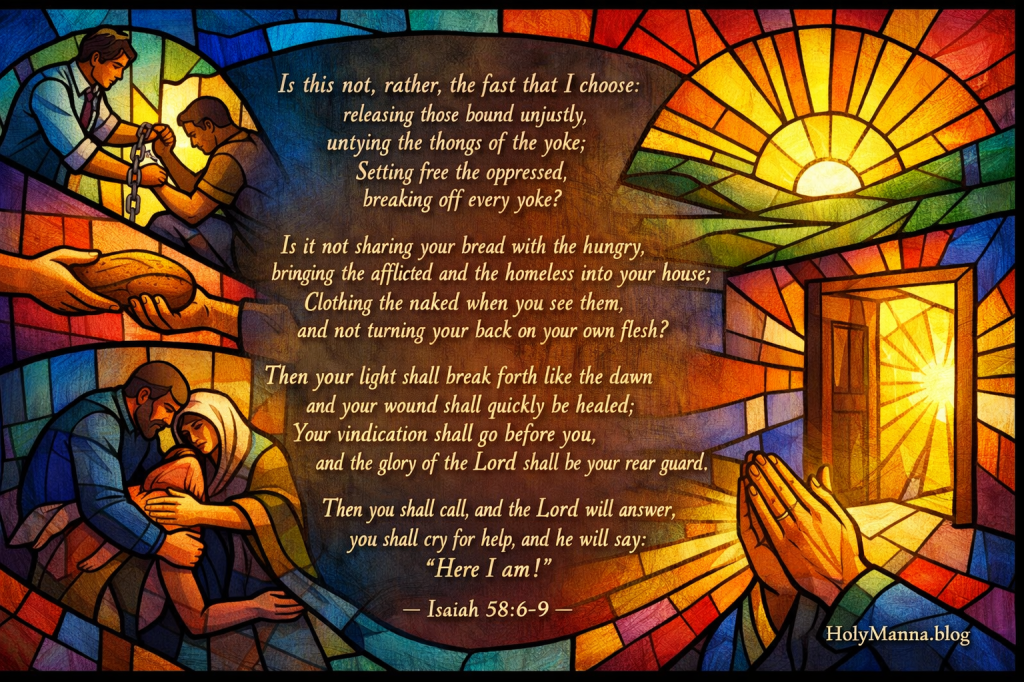
Friday after Ash Wednesday – Lectionary: 221
When Fasting Becomes Love
Lent begins the way real conversion usually begins, with a little discomfort and a lot of truth. The Church places these readings on the Friday after Ash Wednesday to make sure penance does not turn into religious theater. This is the season when ashes are still fresh on foreheads, when the routines of fasting and self-denial are still new, and when God gently but firmly asks what the heart is really doing underneath the outward practice.
The central theme running through today’s readings is simple and piercing: true fasting is not about looking holy, but about becoming holy through repentance that blossoms into mercy. In Isaiah 58:1-9, the Lord confronts a people who keep the external motions of religion while their daily choices remain sharp, self-serving, and unjust. The prophet speaks into a world shaped by communal worship and public fasting, where it was possible to perform devotion while ignoring the neighbor. God refuses that split life. The Lord defines authentic penance with words that still land like a wake-up call: “Is this not, rather, the fast that I choose”, a fast that breaks chains, feeds the hungry, shelters the afflicted, and stops the accusing finger.
That interior truth is echoed by Psalm 51, the Church’s great prayer of repentance. God is not impressed by sacrifice that bypasses the soul. God receives the offering that cannot be faked: “A contrite, humbled heart, O God, you will not scorn”. This is exactly what The Catechism teaches when it insists that penance begins with interior conversion before it becomes any outward act of discipline, whether fasting, prayer, or almsgiving, because the heart must turn back to the Father before the hands can truly do His work, CCC 1430-1431.
Then The Gospel of Matthew reveals the deepest reason Christian fasting matters at all. Jesus calls Himself the Bridegroom and describes a love story, not a self-improvement plan. While the Bridegroom is present, it is a wedding feast. When He is taken away in the Passion, the disciples will fast, not to earn attention, but because love longs for the beloved. Jesus says it plainly: “The days will come when the bridegroom is taken away from them, and then they will fast”. Lent teaches the soul how to miss Christ in a holy way, and how to let that longing reshape habits, priorities, and compassion.
Is today’s fasting forming a contrite heart, or only creating a religious mood? Is Lent making the soul more merciful, more patient, and more willing to serve, especially when nobody notices?
First Reading – Isaiah 58:1-9
When God Says, “That Is Not a Fast”
This passage comes from the later chapters of Isaiah, spoken to a people who had plenty of religion on the outside, but not enough repentance on the inside. The community knew the rhythms of worship, public fasting, and sacred days. They could recite prayers and show the signs of devotion. Yet the Lord exposes a brutal contradiction: they tried to draw near to God while pushing their neighbor down. In the background is a society where the vulnerable could be exploited, laborers could be driven, debts could crush families, and the strong could use their power to win disputes. God does not allow fasting to become a costume for a hard heart.
This reading fits perfectly with today’s Lenten theme because it defines the kind of fasting God actually wants. True penance is not performative sadness. True penance turns into justice, mercy, and a healed tongue. When fasting becomes love, the light of God breaks through.
Isaiah 58:1-9 – New American Bible (Revised Edition)
Reasons for Judgment
1 Cry out full-throated and unsparingly,
lift up your voice like a trumpet blast;
Proclaim to my people their transgression,
to the house of Jacob their sins.
2 They seek me day after day,
and desire to know my ways,
Like a nation that has done what is just
and not abandoned the judgment of their God;
They ask of me just judgments,
they desire to draw near to God.
3 “Why do we fast, but you do not see it?
afflict ourselves, but you take no note?”
See, on your fast day you carry out your own pursuits,
and drive all your laborers.
4 See, you fast only to quarrel and fight
and to strike with a wicked fist!
Do not fast as you do today
to make your voice heard on high!
5 Is this the manner of fasting I would choose,
a day to afflict oneself?
To bow one’s head like a reed,
and lie upon sackcloth and ashes?
Is this what you call a fast,
a day acceptable to the Lord?Authentic Fasting That Leads to Blessing
6 Is this not, rather, the fast that I choose:
releasing those bound unjustly,
untying the thongs of the yoke;
Setting free the oppressed,
breaking off every yoke?
7 Is it not sharing your bread with the hungry,
bringing the afflicted and the homeless into your house;
Clothing the naked when you see them,
and not turning your back on your own flesh?
8 Then your light shall break forth like the dawn,
and your wound shall quickly be healed;
Your vindication shall go before you,
and the glory of the Lord shall be your rear guard.
9 Then you shall call, and the Lord will answer,
you shall cry for help, and he will say: “Here I am!”
If you remove the yoke from among you,
the accusing finger, and malicious speech;
Detailed Exegesis
Verse 1: “Cry out full-throated and unsparingly, lift up your voice like a trumpet blast; Proclaim to my people their transgression, to the house of Jacob their sins.”
God tells the prophet to speak loudly and clearly, like a trumpet that gathers people for battle or worship. The image is intentional. Sin is not treated as a private quirk or a minor mistake. It is a spiritual emergency that needs truth spoken out loud. Lent begins with honesty, because healing does not happen in denial.
Verse 2: “They seek me day after day, and desire to know my ways, Like a nation that has done what is just and not abandoned the judgment of their God; They ask of me just judgments, they desire to draw near to God.”
The Lord describes a people who look serious about God. They show up. They ask questions. They want “just judgments.” The sting is in the comparison: they act like a righteous nation while not actually living righteous lives. Religious interest becomes self-deception when it is detached from obedience.
Verse 3: “Why do we fast, but you do not see it? afflict ourselves, but you take no note?”
This is the complaint of a heart that treats God like a scoreboard. The people assume fasting automatically earns a response. When nothing changes, they feel ignored. The Lord is about to reveal why: their fasting is not conversion, so it cannot bear the fruit they demand.
Verse 3: “See, on your fast day you carry out your own pursuits, and drive all your laborers.”
God points to ordinary life. Fasting does not matter if the same day is spent chasing selfish goals and crushing others. The phrase about driving laborers suggests exploitation, harsh treatment, or using power to squeeze more out of workers. Penance that ignores injustice is not penance at all.
Verse 4: “See, you fast only to quarrel and fight and to strike with a wicked fist! Do not fast as you do today to make your voice heard on high!”
This fasting did not produce humility. It produced irritation, conflict, and violence. Some people become “religious” as a way of feeling superior, and then they weaponize that superiority in arguments. God rejects that fasting because it becomes a tool for ego, not a surrender to grace.
Verse 5: “Is this the manner of fasting I would choose, a day to afflict oneself? To bow one’s head like a reed, and lie upon sackcloth and ashes? Is this what you call a fast, a day acceptable to the Lord?”
God names the external signs of penitence, the bowed head, the sackcloth, the ashes. These signs can be good, because the body participates in repentance. But external signs become hollow when the heart remains proud. Lent is not about looking crushed. Lent is about being changed.
Verse 6: “Is this not, rather, the fast that I choose: releasing those bound unjustly, untying the thongs of the yoke; Setting free the oppressed, breaking off every yoke?”
Now the Lord defines authentic fasting. It breaks chains. It loosens what is unjust. It refuses to cooperate with oppression. The “yoke” is any system, habit, or relationship that burdens others wrongly. God is not asking for vague sentiments. God is demanding concrete freedom.
Verse 7: “Is it not sharing your bread with the hungry, bringing the afflicted and the homeless into your house; Clothing the naked when you see them, and not turning your back on your own flesh?”
Fasting is not merely subtraction. It is reorientation. The hunger in the stomach is meant to awaken compassion for the hungry person. The phrase “your own flesh” expands the obligation beyond polite charity. It is a reminder that the neighbor is not an inconvenience. The neighbor is kin in the human family, and, for believers, a brother or sister meant to be loved.
Verse 8: “Then your light shall break forth like the dawn, and your wound shall quickly be healed; Your vindication shall go before you, and the glory of the Lord shall be your rear guard.”
God attaches promises to real conversion. Light and healing are not cosmetic. They are the result of returning to God’s ways. The “rear guard” image echoes the Lord protecting His people, like in the story of the Exodus where God’s presence guarded Israel. When a person turns from sin to mercy, God does not merely applaud. God draws close and protects.
Verse 9: “Then you shall call, and the Lord will answer, you shall cry for help, and he will say: ‘Here I am!’ If you remove the yoke from among you, the accusing finger, and malicious speech;”
The goal of fasting is communion. The promise is stunning: God answers with presence, “Here I am!” But the path includes repentance that touches speech and relationships. The “accusing finger” points to blame, contempt, and public shaming. “Malicious speech” points to gossip, slander, and the kind of talk that poisons communities. Lent is not finished until the tongue is converted.
Teachings
The Church has always taught that penance is real only when it is interior, and that interior conversion must show itself in outward actions of charity and justice. The Catechism describes conversion as a movement of the whole life back to God, not a religious performance: CCC 1431 says, “Interior repentance is a radical reorientation of our whole life, a return, a conversion to God with all our heart, an end of sin, a turning away from evil.” This is why Isaiah’s message feels so direct. A fast that leaves oppression intact has not reoriented the heart.
This reading also explains why Lent is filled with practices like fasting, almsgiving, and works of mercy. The Catechism connects these directly to conversion: CCC 1434 says, “The interior penance of the Christian can be expressed in many and various ways. Scripture and the Fathers insist above all on three forms, fasting, prayer, and almsgiving, which express conversion in relation to oneself, to God, and to others.” Isaiah 58 is essentially that teaching in prophetic form. True fasting changes how a person treats God, self, and neighbor.
The Church also teaches that works of mercy are not optional decorations on a holy life. They belong to the heart of the Gospel. The Catechism states in CCC 2447, “The works of mercy are charitable actions by which we come to the aid of our neighbor in his spiritual and bodily necessities.” Isaiah names several of those bodily necessities directly: feeding the hungry, housing the homeless, clothing the naked, and lifting burdens from the oppressed. This is not a separate “social message” competing with spiritual life. It is what spiritual life looks like when it becomes real.
Saint John Chrysostom preached with Isaiah’s same fire when Christians tried to fast without charity. He challenged his people with words that fit Lent perfectly: “Do you fast? Give me proof of it by your works. If you see a poor man, take pity on him. If you see an enemy, be reconciled to him. If you see a friend gaining honor, do not be jealous of him. Let not the mouth only fast, but also the eye, and the ear, and the feet, and the hands, and all the members of our bodies.” The point is not to reduce fasting. The point is to complete it. The body learns discipline so the soul can learn love.
Reflection
This reading asks for an honest audit of Lent while it is still early. It is easy to give up food and keep the sharp tongue. It is easy to skip dessert and keep the accusing finger. It is easy to wear ashes and still carry resentment like a cherished possession. Isaiah does not allow that kind of Lent, because God does not allow it.
A practical way to live this reading is to let fasting create space for mercy. If food is being reduced, then something should be increased, generosity, patience, prayer, or service. If a person is abstaining from comforts, then someone else should be comforted. If the body is being trained to say no, then the heart should be trained to say yes to the neighbor who is inconvenient.
This reading also invites a tough but freeing decision about speech. Malicious words can undo a whole Lent in one afternoon. Gossip can starve a soul faster than skipping lunch. The “accusing finger” can become a habit, especially online, where judgment feels cheap and righteousness feels addictive. Isaiah’s Lent looks different. It tells the truth without cruelty, and it chooses reconciliation over winning.
Where has religious effort become a way of feeling superior instead of becoming humble? Who is being “driven” or burdened in daily life, whether at work, at home, or in the heart, and what would it look like to loosen that yoke? What would change if fasting included silence from gossip, restraint from sarcasm, and a deliberate choice to speak mercy?
Responsorial Psalm – Psalm 51:3-6, 18-19
The Prayer God Always Hears
If Isaiah 58:1-9 exposes false fasting, Psalm 51 teaches the voice of true repentance. This psalm rises from one of the most sobering moments in Israel’s story, King David’s collapse into grave sin and his painful return to God. In Israel’s worship, this became the classic penitential prayer, not because it is poetic, but because it is honest. It does not bargain with God. It does not blame circumstances. It does not pretend the damage is small. It simply throws the sinner into the mercy of the Lord.
The Church places Psalm 51 on the Friday after Ash Wednesday because it gives Lent its true tone. External penance is good, but it is not the center. The center is a heart that stops defending itself and starts confessing. This psalm fits today’s theme perfectly: the fast God wants begins with contrition, and contrition always leads to a new life.
Psalm 51:3-6, 18-19 – New American Bible (Revised Edition)
3 Have mercy on me, God, in accord with your merciful love;
in your abundant compassion blot out my transgressions.
4 Thoroughly wash away my guilt;
and from my sin cleanse me.
5 For I know my transgressions;
my sin is always before me.
6 Against you, you alone have I sinned;
I have done what is evil in your eyes
So that you are just in your word,
and without reproach in your judgment.18 For you do not desire sacrifice or I would give it;
a burnt offering you would not accept.
19 My sacrifice, O God, is a contrite spirit;
a contrite, humbled heart, O God, you will not scorn.
Detailed Exegesis
Verse 3: “Have mercy on me, God, in accord with your merciful love; in your abundant compassion blot out my transgressions.”
This verse begins with mercy, because that is where salvation begins. The psalmist appeals to God’s character, not his own resume. The phrases “merciful love” and “abundant compassion” describe the Lord as faithful and tender, the God who does not give up on His people. Lent is not a season for despair. Lent is a season for running back to the Father.
Verse 4: “Thoroughly wash away my guilt; and from my sin cleanse me.”
The images are physical: washing and cleansing. Sin is not treated as a mild flaw. It is treated as a stain that clings and a sickness that needs healing. This is why the Church insists that conversion is not self-therapy. Conversion is surrender to the God who can purify what cannot be purified by willpower alone.
Verse 5: “For I know my transgressions; my sin is always before me.”
Real repentance is not vague. It is specific and personal. The psalmist does not say, “Mistakes were made.” He admits what happened and feels the weight of it. This is not unhealthy shame. This is the clarity that opens the door to grace. When sin is named, it can be forgiven. When sin is hidden, it keeps ruling.
Verse 6: “Against you, you alone have I sinned; I have done what is evil in your eyes So that you are just in your word, and without reproach in your judgment.”
This verse shocks modern ears, because sin always hurts other people. Yet the psalmist goes to the root: every sin is ultimately against God because it rejects His love and breaks communion with Him. The psalmist also defends God’s justice. God is not the problem. God is not unfair. God’s judgment is clean and true, and that truth is what makes mercy so astonishing.
Verse 18: “For you do not desire sacrifice or I would give it; a burnt offering you would not accept.”
This is not a rejection of worship. Israel’s sacrifices were commanded by God and pointed toward obedience and faith. This is a rejection of empty ritual. Sacrifice without conversion becomes a way of paying God off, as if religion could be used to cover a heart that refuses to change. Lent rejects that mindset completely.
Verse 19: “My sacrifice, O God, is a contrite spirit; a contrite, humbled heart, O God, you will not scorn.”
Here is the heart of the psalm. God receives the offering that cannot be faked: contrition and humility. This is why this psalm is so central to the Church’s life of penance. The Lord does not despise the repentant sinner. The Lord draws near. When the heart is humbled, grace has room to work.
Teachings
This psalm shines a bright light on what the Church teaches about repentance. The Catechism describes contrition in a way that fits Psalm 51 exactly. CCC 1451 says, “Among the penitent’s acts contrition occupies first place. Contrition is ‘sorrow of the soul and detestation for the sin committed, together with the resolution not to sin again.’” This is not just feeling bad. It is hating the sin because it offends God, and choosing to turn away from it.
The Church also teaches that when contrition is born from love of God, it is called perfect contrition. CCC 1452 says, “When it arises from a love by which God is loved above all else, contrition is called ‘perfect’.” Psalm 51 pushes the soul toward that love. It is not primarily fear of consequences. It is grief over broken communion.
Saint Augustine often spoke about this psalm as the medicine of humility. He taught that God does not reject the repentant because humility itself is already the work of grace. He preached that a person should not despair after sin, but should bring the wound to the Physician. His tone is firm but fatherly: sin must be confessed, pride must be crushed, and mercy must be trusted.
This psalm also prepares the heart for the Sacrament of Penance. The Church teaches that confession is not a medieval invention or a spiritual trend. It is Christ’s gift for real cleansing and reconciliation. The Catechism describes the sacrament as a true encounter with God’s mercy. CCC 1422 says, “Those who approach the sacrament of Penance obtain pardon from God’s mercy for the offense committed against him, and are, at the same time, reconciled with the Church.” Psalm 51 is the interior language of that sacrament: mercy asked for, guilt admitted, cleansing desired, and a humbled heart offered.
Reflection
Lent can become performative fast. It can become a checklist. It can become a contest of discipline. This psalm refuses all of that. It teaches the simplest and strongest Lenten posture: a sinner on his knees, trusting mercy more than excuses.
A practical way to pray this psalm is to slow down and let the words become personal without becoming dramatic. God does not need theatrics. God wants honesty. The heart should name the sin, not to drown in it, but to hand it over. The soul should ask for cleansing, not as a vague hope, but as a serious desire to change habits and repair what has been damaged.
This psalm also teaches that repentance must be humble, not harsh. Some people punish themselves but never truly repent. They stay stuck in self-anger and call it holiness. Psalm 51 is different. It is sorrow mixed with hope, because mercy is real. A contrite heart is not a heart that spirals. A contrite heart is a heart that returns.
Is the soul trying to impress God with sacrifices, or is it letting God heal what is broken? What sin keeps showing up “always before” the conscience, and what would it look like to bring it into the light through confession and accountability? If God truly will not scorn a contrite heart, what is stopping the heart from surrendering completely today?
Holy Gospel – Matthew 9:14-15
Fasting as Longing for the Bridegroom
In the world of first century Judaism, fasting was a recognized sign of repentance, mourning, and humble dependence on God. Many devout Israelites fasted regularly, and the Pharisees were known for frequent fasting as part of a disciplined religious life. The disciples of John the Baptist also embraced a strong penitential spirit, because John preached urgent conversion and prepared the people for the coming Messiah. In that setting, Jesus and His disciples looked surprising. They did not behave like a movement defined by constant austerity. They looked, at times, like men living in a feast.
That is exactly the point. Jesus does not reject fasting. Jesus reveals what fasting truly means when it becomes Christian. Today’s theme comes into focus here: real fasting is not performative misery, and it is not a way to pressure God into paying attention. Real fasting is the ache of love that wants to be closer to Christ, and the humility that admits the heart needs to be changed. The Bridegroom has come, and that changes everything.
Matthew 9:14-15 – New American Bible (Revised Edition)
The Question About Fasting. 14 Then the disciples of John approached him and said, “Why do we and the Pharisees fast [much], but your disciples do not fast?” 15 Jesus answered them, “Can the wedding guests mourn as long as the bridegroom is with them? The days will come when the bridegroom is taken away from them, and then they will fast.
Detailed Exegesis
Verse 14: “Then the disciples of John approached him and said, ‘Why do we and the Pharisees fast [much], but your disciples do not fast?’”
This question is not just curiosity. It is a challenge. John’s disciples and the Pharisees share a visible mark of seriousness: frequent fasting. They assume holiness should look the same in every faithful life, so they measure Jesus’ disciples by that yardstick. The Gospel quietly exposes a temptation that still shows up in Lent: comparing sacrifices, ranking devotion, and assuming holiness equals one recognizable style. Jesus does not let the conversation stay at the level of appearances. He goes straight to identity, because the meaning of fasting depends on who Jesus is.
Verse 15: “Jesus answered them, ‘Can the wedding guests mourn as long as the bridegroom is with them? The days will come when the bridegroom is taken away from them, and then they will fast.’”
Jesus answers with a wedding image because weddings mean joy, communion, and the beginning of a covenant. In Israel’s Scriptures, God’s relationship with His people is often described with spousal language, and the hope of salvation is often pictured as a feast. By calling Himself the Bridegroom, Jesus is not giving a cute metaphor. He is revealing His role in God’s saving plan. While the Bridegroom is present, the disciples are not meant to act like mourners. They are meant to receive the gift of His presence with joy.
Then Jesus speaks of a coming separation: “The days will come when the bridegroom is taken away”. This points toward the Passion, when Christ will be seized, suffer, and die. At that moment, fasting will return, but now it will have a new soul. Christian fasting is not just discipline. It is love that misses Christ, repentance that wants to be purified, and a heart that learns to hunger for God more than for comfort. That is why Lent is powerful: the Church lives in that holy tension, rejoicing in Christ’s presence yet longing for perfect communion.
Teachings
The Church reads this Gospel through the mystery of Christ and His Bride, the Church. The Catechism speaks clearly about this bridal meaning: CCC 796 says, “The unity of Christ and the Church, head and members of one Body, also implies the distinction of the two within a personal relationship.” It continues with the classic image that fits today’s Gospel: “This aspect is often expressed by the image of bridegroom and bride.” When Jesus calls Himself the Bridegroom, He is not only explaining fasting. He is announcing a covenant love that will be sealed in His Blood.
The Church also teaches that penitential practice is not random or optional, because it keeps the heart awake to Christ’s Cross. The Catechism describes why Fridays and seasons like Lent matter: CCC 1438 says, “The seasons and days of penance in the course of the liturgical year (Lent, and each Friday in memory of the death of the Lord) are intense moments of the Church’s penitential practice.” Jesus’ words, “then they will fast”, are lived in the Church’s calendar as a steady rhythm of love, remembrance, and conversion.
Saint John Chrysostom often warned that fasting without charity becomes spiritual noise, but fasting with love becomes a weapon against sin. His preaching matches the logic of Jesus’ Bridegroom image: fasting is not meant to make a person gloomy and proud. It is meant to make the heart humble, generous, and hungry for God. In other words, the point is not to feel holy. The point is to belong to Christ more completely.
Reflection
This Gospel keeps Lent from becoming a self-improvement project. Fasting is not a technique for building willpower. It is a response to a Person. Christian fasting is the language of love that says Christ is worth more than comfort, worth more than distraction, and worth more than being right in every argument. If the heart does not love Christ, fasting becomes a diet with religious branding. If the heart loves Christ, fasting becomes a doorway to joy, because it clears space for the Bridegroom.
A practical way to live this reading is to connect every small sacrifice to a concrete act of turning toward Jesus. When hunger shows up, it can become a quiet prayer instead of a complaint. When irritation rises, it can become a moment to choose patience and mercy. When the mind wants entertainment, it can become a choice to sit with the Lord in silence. This is how fasting becomes longing instead of performance.
This Gospel also corrects the habit of comparing Lents. Some people fast loudly and love quietly, while others fast quietly and love loudly. Jesus is not asking for a competition. Jesus is asking for wedding guests who recognize the Bridegroom and live accordingly. The best Lent is the one that makes the soul kinder, more repentant, more faithful in hidden duties, and more eager for Confession and the Eucharist.
Is fasting creating room for Jesus, or is it creating a mood of pride and irritation? What comfort has become a substitute bridegroom, something the heart runs to for rescue, and what would change if that desire were redirected toward Christ? If the Bridegroom was truly “taken away” on the Cross out of love, what is one concrete sacrifice that could be offered today as love in return?

 Holy Manna!
Leave a comment