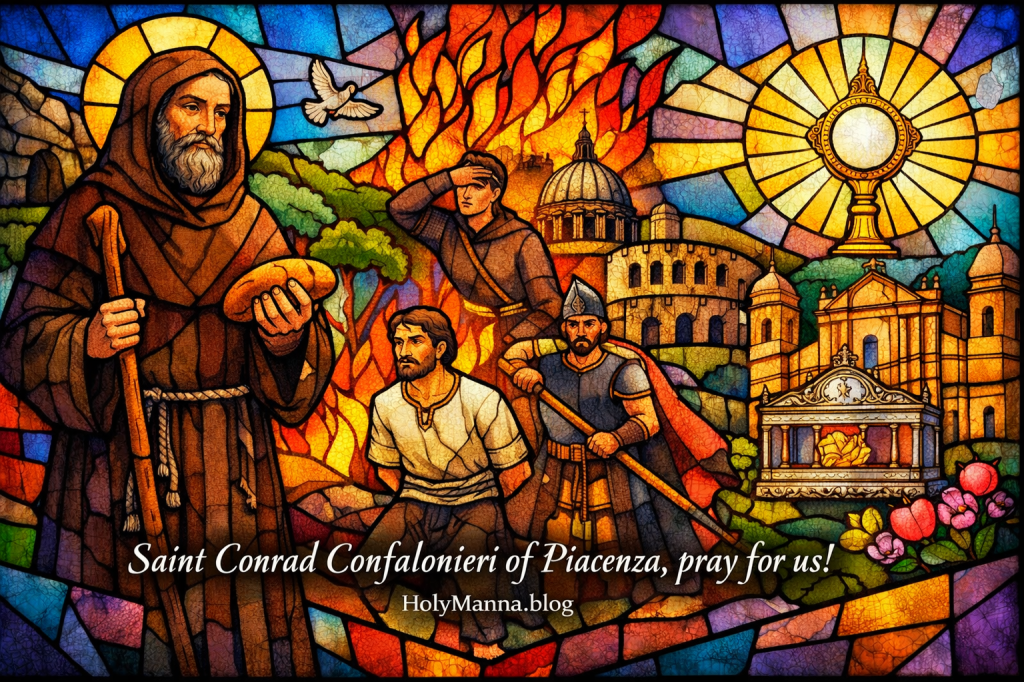
From Wildfire to Holiness
Saint Conrad Confalonieri is the kind of saint who makes people pause because his life begins in comfort and ends in radical surrender. He was born into nobility and lived with the privileges that come with a respected name, but he is honored because he chose truth over self-protection when it mattered most. Conrad is remembered as a Franciscan tertiary and hermit whose long years in Sicily were shaped by prayer, austerity, and mercy toward the poor and the sick. He is especially beloved in Noto, where he is honored as patron and where his relics are venerated with deep affection. His story matters because it shows that holiness is not reserved for the already perfect. Holiness belongs to the repentant who let God rebuild their lives from the inside out.
When Comfort Meets the Truth
Conrad was born near Piacenza in northern Italy into a noble family, and he entered adult life with the expectations of honor and reputation that shaped his world. He married young and moved among people who understood status as something to protect at all costs. That background makes his fall and his conversion feel even more dramatic, because grace met him through a moment of fear, shame, and moral collapse.
During a hunt, Conrad ordered brushwood to be set on fire to flush out game, and the flames spread beyond control. The destruction was serious, and panic set in fast, and Conrad fled and stayed silent instead of taking responsibility. An innocent poor man was accused, condemned, and suffered for a crime he did not commit, and that is the detail that makes this story pierce the conscience. Conrad’s conversion was not only about private guilt. It was about injustice that he could no longer tolerate.
Conrad stepped forward and confessed publicly, accepting the consequences so an innocent man could live. He then made restitution so extensive that he sold off his possessions and became poor. This is the kind of repentance the Church means when she teaches that conversion must include repairing harm when possible. The Catechism puts it plainly: “Many sins wrong our neighbor. One must do what is possible in order to repair the harm.” CCC 1459. Conrad did not treat that line as a nice religious idea. He treated it like a command that demanded his whole life.
Tradition holds that his wife entered the Poor Clares, and Conrad embraced a penitential path as a layman in the Third Order of Saint Francis. He did not become a priest, and he did not build a public platform, but he became something many people forget is possible. He became a lay Catholic who took the Gospel seriously enough to reorder everything around it. In Sicilian Catholic memory, Conrad is remembered as a man shaped by the Gospel and by the Fathers, drawn to pilgrimage and then to a hidden life of penance. His conversion was not a single emotional moment. It was a new direction, and it stayed that way.
A Hermit Who Could Not Stay Hidden
After years of penitential living and pilgrimage, Conrad settled in Sicily near the region of Noto and lived for decades as a hermit. His solitude was not escapism, because the hermit life in Catholic tradition is a way of placing everything under God’s gaze so the heart can become simple, truthful, and free. Conrad’s days were marked by prayer, fasting, and radical poverty, and people noticed, because holiness has a way of drawing attention even when it tries to remain unseen.
Local tradition also ties him to charity among the sick, and memories of his compassion remained strong in the area. The poor and the suffering were drawn to him for counsel, prayer, and help, and Conrad repeatedly sought deeper solitude to guard his vocation and remain faithful to the interior life. This pattern shows up again and again in the saints. The more they belong to God, the more they become a sign of God’s goodness to others.
Conrad became known as a powerful intercessor for physical healing, especially for those suffering hernia, and the faithful learned to call on him in ordinary pain that most people carry quietly. His miracles were never treated as proof that Conrad was impressive. They were treated as signs that Jesus is alive, attentive, and generous, and that He loves to lift burdens through the prayers of His friends.
One of the most beloved wonders connected to Conrad is the miracle of bread. Catholic tradition remembers that warm bread was provided to visitors in a way that did not match his poverty, and there is also a local remembrance of Conrad forgiving young men who mistreated him and offering them warm bread instead of retaliation. It is hard to miss the Gospel logic there. Mercy is not merely avoiding revenge. Mercy is actively doing good. It is exactly what Christ commands when He teaches, “Love your enemies and pray for those who persecute you.” The Gospel of Matthew 5:44. Conrad’s holiness looked like Jesus because it was shaped by forgiveness, not by pride.
It is also hard to hear about providential bread without thinking of the Lord’s promise that He feeds His people. Catholics hear these stories and are naturally led to the deeper hunger that only Christ satisfies. “I am the living bread that came down from heaven.” The Gospel of John 6:51. Conrad’s bread miracles have always been remembered as signs that point beyond Conrad himself to the God who provides and to the Eucharistic life of the Church.
The Slow Martyrdom of Humility and Penance
Saint Conrad did not die under a sword, but he endured a kind of martyrdom that modern people rarely admire, the daily martyrdom of humility and self-denial. He faced the public shame of confession, the collapse of reputation, and the real poverty that followed restitution. He also endured the hardships of the hermit life, including loneliness, physical discomfort, and the constant temptation to return to easier living.
He also faced the burden that often comes with holiness, which is attention. As his reputation grew, more people sought him out, and he was forced to choose again and again between comfort and fidelity to the hidden life God had given him. That is why tradition remembers him withdrawing into deeper solitude. It was not because he despised people. It was because he knew that prayer is the root of charity, and he wanted to remain faithful.
The stories of harassment and hostility preserved in local memory matter less for the drama and more for the response. Conrad endured hostility without bitterness and chose forgiveness instead of vengeance. This kind of patience is not personality. It is grace, and it is part of what The Catechism calls interior conversion, a reorientation of the whole life toward God. “Interior repentance is a radical reorientation of our whole life.” CCC 1431. Conrad’s life shows what that looks like when it is lived for decades.
Conrad died on February 19, 1351, and tradition holds that he died in prayer, kneeling before a crucifix. That ending fits the whole story, because the saint who once fled from responsibility ended his life steady and faithful, grounded in Christ.
A Patron Still Honored
After Conrad’s death, devotion did not fade. It intensified, and miracles were attributed to his intercession, especially healings. Sicilian Catholic memory preserves the belief that at a later examination his body was found intact, and his relics were placed with honor in a silver urn or ark. These details mattered to the faithful not because they wanted a spectacle, but because relics in Catholic tradition are a reminder that the body is not disposable and that holiness touches the whole human person. The saints are not ghosts. They are members of the Body of Christ, and the Church honors them because God’s grace truly transforms human life.
Conrad’s veneration also became stable in the Church’s public life through papal permissions that extended liturgical celebration, especially within Sicily and the Franciscan family. This is why he is honored with such confidence as Saint Conrad, particularly in the places where his memory has been loved for centuries. In Noto, his relics are carried in processions through the city, and the celebrations are not quiet or private. They are joyful, communal, and unmistakably Catholic, like a whole city remembering that God still raises up saints.
His feast on February 19 remains central, and Noto also holds a major summer celebration, traditionally on the last Sunday of August. The devotion includes traditional public expressions of faith, including votive offerings and the kind of reverence that feels like a living catechesis. There is also a continued connection to blessed bread, which fits his legacy perfectly. It is a simple sign that preaches a serious message. God provides, and God invites His people to become providers for the poor.
As for famous quotations, Saint Conrad does not have a widely preserved collection of verified sayings. Still, local Sicilian tradition holds a proverb-like line associated with him that has been remembered for generations: “When you draw water with a basket,” preserved in dialect as “quannu tiri l’acqua cò panaru.” It is a way of saying that with God, what looks impossible can become a sign of providence, and that the Lord can surprise a heart that trusts Him.
A Saint Who Teaches How to Repent With Courage
Saint Conrad’s life is a wake-up call in an age that loves excuses. He teaches that repentance is not self-hatred, and it is not image management, and it is not making spiritual speeches while avoiding responsibility. Repentance is telling the truth, accepting consequences, and repairing harm when possible. That is why his story lands so strongly, because it feels like the Gospel lived out in real time.
He also teaches that holiness is possible for lay Catholics living ordinary lives. The Catechism is clear that the call to holiness is not reserved for clergy and religious. “All Christians in any state or walk of life are called to the fullness of Christian life and to the perfection of charity.” CCC 2013. Conrad shows what that looks like when a person stops negotiating with sin and starts surrendering to grace.
There is a practical way to imitate him without turning the spiritual life into theater. Confession should be taken seriously, not casually, and it should include honesty without excuses. Restitution should be made where possible, especially in relationships, because justice and charity belong together. Humility should be practiced in speech, especially when pride wants to protect reputation. Small penances should be embraced, because the heart does not become disciplined by accident. The Catechism reminds Catholics that conversion is lived daily through concrete acts. “Conversion is accomplished in daily life by gestures of reconciliation, concern for the poor, the exercise and defense of justice and right.” CCC 1435. Conrad’s life is proof that these teachings are not abstract. They are meant to be lived.
What part of Conrad’s story hits closest to home right now, the fear that kept him silent or the courage that finally made him speak? What would it look like to choose truth this week, even if it costs pride? Conrad’s story insists that it is never too late to return to God, as long as truth is embraced and mercy is chosen.
Engage with Us!
Share thoughts and reflections in the comments below. What part of Saint Conrad’s story feels most personal right now, and what seems hardest to live out?
- Where has fear tempted silence when truth was needed, even in small ways?
- Is there anyone who deserves an apology or a real attempt at restitution, even if it is uncomfortable?
- What would a more penitential and focused Catholic life look like in the daily routine, without becoming gloomy or extreme?
- How can trust in God’s providence become more concrete this week, especially around money, work, or reputation?
- When was the last honest, thorough Confession, and what step could make the next one more sincere and fruitful?
Keep walking forward with faith. A life with Jesus does not need to be spotless to become holy, because it needs to be honest, repentant, and willing to love. Do everything with the love and mercy Jesus taught us, and trust that God can turn even the worst fire into the beginning of a new life.
Saint Conrad Confalonieri of Piacenza, pray for us!
Follow us on YouTube, Instagram and Facebook for more insights and reflections on living a faith-filled life.

 Holy Manna!
Leave a comment