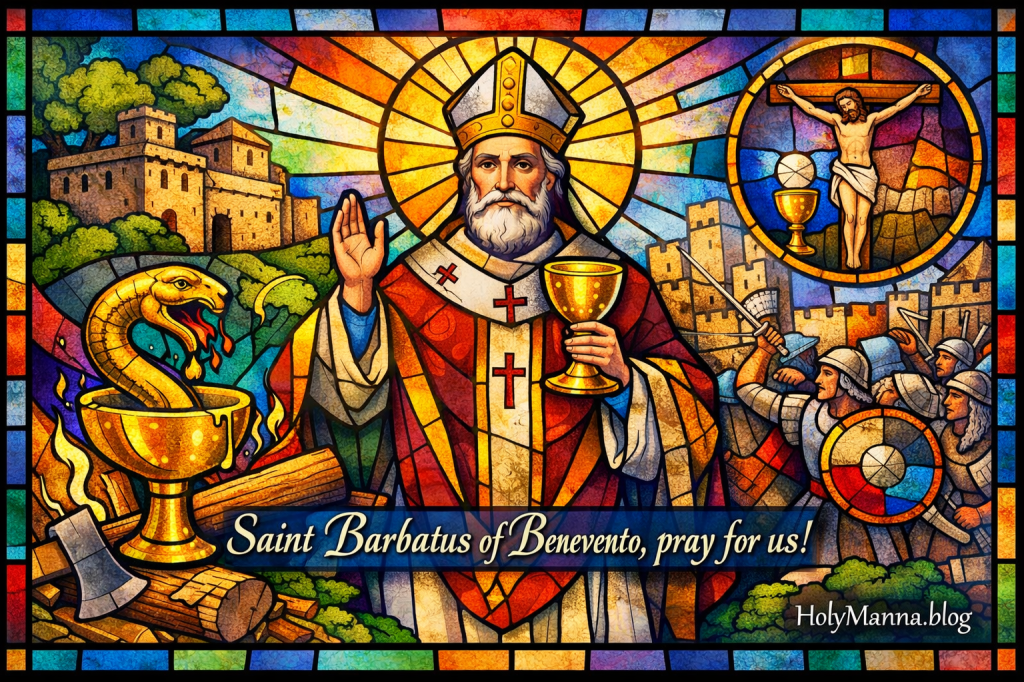
First Commandment, No Compromises
Saint Barbatus of Benevento is the kind of saint who makes the faith feel concrete, because his holiness was lived in the middle of real spiritual mess. He served in seventh century southern Italy, in a place that called itself Christian while still flirting with fear-based rituals and old pagan habits. The Church honors him as a confessor bishop, which means he was not martyred, but he still carried the weight and courage of a true witness.
The Roman Martyrology sums up his legacy in a line that says everything without trying to impress anyone: “Near Benevento, Saint Barbato, bishop, who is said to have converted the Lombards and their leader to Christ.” That reputation is why Catholics keep his memory alive. He is remembered as a shepherd who refused to let baptism be mixed with superstition. He wanted a people to belong to Jesus Christ completely, not halfway.
A Priest Formed by Scripture and Fire
The details of Barbatus’ childhood are not preserved in a full modern biography, but Catholic tradition consistently portrays him as a man formed by prayer and the Scriptures. He was ordained a priest while still young and became known as a preacher who did not soften the call to repentance. That kind of preaching often wakes up sincere souls, but it also threatens comfortable ones. In Barbatus’ early ministry, opposition did not stay quiet.
Tradition says he served in a town outside Benevento, often identified as Morcone, and his efforts to reform Christian life stirred up resistance and even slander. Eventually he withdrew and returned to Benevento, and that experience became part of his spiritual training. God often allows a servant to be misunderstood so pride can be stripped away and courage can mature into humility. The Catechism describes conversion as ongoing and demanding, because the heart must keep turning back to God in real choices, not just good intentions: CCC 1427–1430.
The Golden Viper and the Tree of Superstition
By the time Barbatus’ mission centered on Benevento, many people were outwardly Christian, but old religious instincts were still alive underneath the surface. Tradition remembers two practices that became symbols of the problem: devotion to a golden viper idol and rituals tied to a sacred tree. These were not treated like harmless folklore in the Christian conscience. They were treated like a rival religion hiding inside a baptized community.
This is exactly why the Church speaks so clearly about superstition and idolatry. Superstition is not just being a little quirky or nervous about luck, because it distorts religious feeling and tries to control what should be received in trust. Idolatry goes even deeper, because it gives to created things the fear, trust, and devotion that belongs to God alone. Barbatus’ mission makes sense when read through The Catechism, which warns that these sins are spiritual counterfeits that damage the soul: CCC 2110–2114. He did not confront these practices because he disliked people. He confronted them because he loved them enough to want them free.
The Siege That Shook a City Awake
The story reaches a turning point in 663, when Emperor Constans II attacked and besieged Benevento. In moments like that, the masks come off, because fear forces a person to discover what is really being trusted. Catholic tradition says Barbatus had warned the people that trouble was coming and urged repentance. When the siege arrived, the crisis finally cracked open hearts that had been stubborn.
According to the traditional account, the people renounced the superstitions, and Barbatus assured them the siege would be lifted. The danger passed, and the city was spared, which later Christians remembered as a providential sign tied to his pastoral authority and prayer. This is the miracle shaped moment most often associated with him, not as a magic trick, but as a shepherd calling a people back to God and watching God answer. It is the same spiritual pattern seen throughout Scripture, where repentance is met with mercy and deliverance.
Melted Gold, Reclaimed Worship
After the crisis, Barbatus did something that still feels bold even today. He did not leave the old objects in place as a compromise or a museum piece, because he understood how easily the heart slips back into fear and ritual. Tradition says he cut down the tree linked to superstition and had the golden viper destroyed. Then the story takes on a symbolic force that is hard to forget.
The metal from the idol was melted down and reworked into sacred vessels for the altar, commonly remembered as a chalice and, in some retellings, also a paten. That detail matters because it shows what conversion looks like in Catholic life. Sin is renounced, and the very matter of life is reordered toward God. The Eucharist sits at the center of that new order, because it is the worship that places the true God where idols used to sit: CCC 1324.
A Bishop Who Confronted Courts
When the bishop of Benevento died around that same period, Barbatus was chosen as his successor and became bishop in 663. That role placed him right at the crossroads of faith, culture, and politics, especially among a people still being evangelized at depth. He continued his reforms not only among ordinary households, but also where power lived. Catholic tradition emphasizes that he challenged lingering superstition even in the ruler’s circle, because public Christianity means little if private life still bows to false gods.
Barbatus is also connected to the wider doctrinal life of the Church. The most secure historical point is his presence at the Roman council of 680 under Pope Agatho, in the context of the Church’s struggle against Monothelitism. That matters because it shows he was not only cleaning up popular religion. He stood with the Church in guarding the truth about Jesus Christ, because a confused Christ leads to a confused salvation. Bishops exist to teach, sanctify, and govern in fidelity to the apostolic faith, and Barbatus is remembered as a man who took that responsibility seriously: CCC 1555–1561.
Courage Without Applause
Saint Barbatus is not remembered as a martyr, but that does not mean his life was easy or safe. He endured slander as a priest and carried the heavy burdens of leadership as a bishop in unstable times. Reform always creates enemies, especially when it exposes comfortable compromises. A saint who confronts superstition is not just fighting ideas, because he is fighting the fear and pride that keep those ideas alive.
This kind of endurance is its own long martyrdom of the heart. It looks like courage that does not need a spotlight. It looks like fidelity that keeps going when the work is slow and the resistance is constant. That is why his witness lands so well with ordinary Catholics who are trying to live the faith steadily in a culture full of distractions and spiritual counterfeits.
Relics Rediscovered and a Memory That Endured
Saint Barbatus died in 682, and his commemoration is kept on February 19. Over time, the exact place of his burial in the cathedral was forgotten, which is not unusual in the long history of the Church. Centuries later, his relics were rediscovered during work at the cathedral in the early 1100s, and devotion to him strengthened again. Later tradition remembers his relics being honored with solemn reverence, including association with the high altar.
This is not about treating relics like lucky charms. Catholics venerate relics because the body matters, the Incarnation is real, and God is glorified in His saints. The Catechism teaches that popular piety, including honoring saints, should lead believers toward Christ and the sacramental life, not away from it: CCC 1674. The Church also teaches that the saints continue to intercede for us, because charity does not stop at death: CCC 956. Barbatus is remembered not only as a historical figure, but as a living brother in the Communion of Saints.
A Saint for Modern Superstitions
Saint Barbatus feels surprisingly modern because superstition never really goes away. People may not bow to a golden viper today, but they still chase control through horoscopes, omens, charms, and spiritual shortcuts that promise power without repentance. The saint’s lesson is not paranoia. The saint’s lesson is purity of worship, because the First Commandment protects love by putting God back at the center.
Barbatus’ story also shows that repentance has to become concrete. It is not enough to feel bad while keeping the same doors open to the same false comforts. The saint helped a whole community remove what was spiritually poisonous and replace it with true worship centered on the altar. CCC 2110–2117 warns that superstition and occult practices are not harmless, and Barbatus’ life is a lived sermon on those paragraphs.
Where has a baptized life made room for fear, control, or spiritual shortcuts?
What attachment needs to be melted down and turned into an offering to God?
How would daily life change if trust in Providence became more than a slogan?
Engage with Us!
Share your thoughts and reflections in the comments below. Saint Barbatus has a way of exposing the subtle superstitions that slip into ordinary life, and it helps to talk about those temptations honestly. Honest conversation can become a real act of humility, and humility is where grace loves to work.
- What is one modern form of superstition that feels socially normal, but quietly competes with trust in God?
- What practical step could be taken this week to honor the First Commandment more seriously, in thought and in daily habits?
- What would it look like to make the Eucharist the center again, not just an obligation but the source of strength and clarity?
Keep walking forward in faith, even when the culture treats superstition like entertainment and worship like an accessory. Choose the narrow road that leads to life, because Jesus Christ is worth a whole heart, not leftovers. Do everything with the love and mercy Jesus taught, and let that love become the clearest proof that God is real and still saving souls.
Saint Barbatus of Benevento, pray for us!
Follow us on YouTube, Instagram and Facebook for more insights and reflections on living a faith-filled life.

 Holy Manna!
Leave a comment