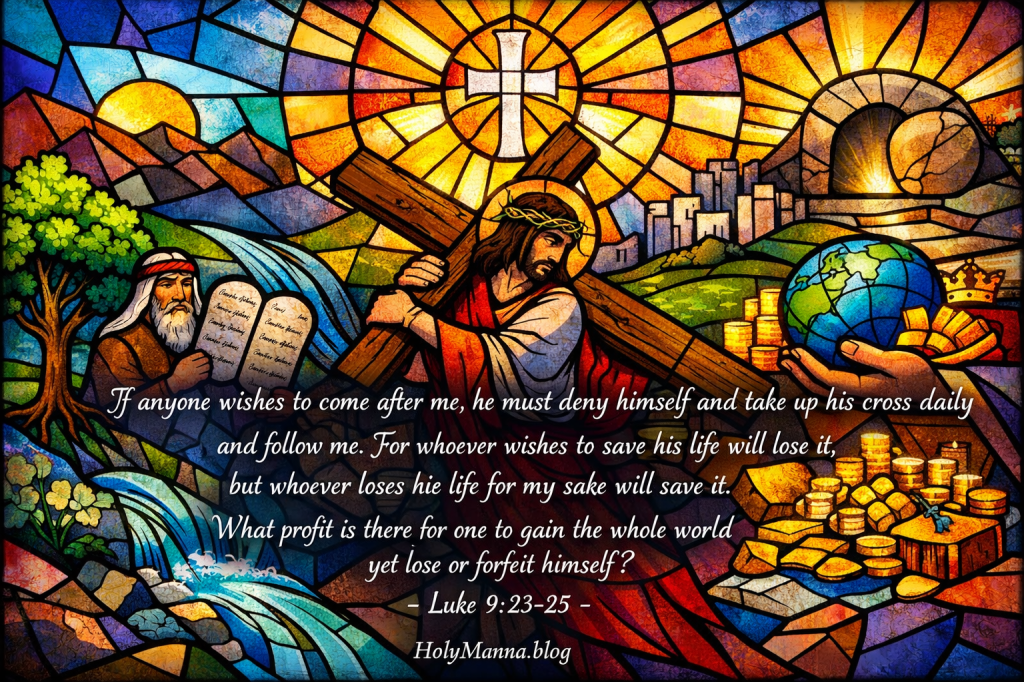
Thursday after Ash Wednesday – Lectionary: 220
The Daily Choice That Saves a Soul
Lent begins with a question that refuses to stay theoretical: What kind of life is being chosen right now? The Church places these readings side by side on the Thursday after Ash Wednesday because they all press the same truth into the heart: God does not treat human freedom like a toy or an illusion. God sets a real path before His people, and the path has a destination.
In Deuteronomy 30:15-20, Moses speaks to Israel at a threshold moment, with the Promised Land in view and the covenant on the line. This is not merely ancient history. It is the spiritual pattern of every serious conversion. Israel is told that life and death are not random outcomes but the fruit of worship, love, and obedience. Moses makes it plain with the kind of clarity modern ears often resist: “I have set before you life and death, the blessing and the curse. Choose life” (Dt 30:19). The choice is not only about rules. It is about relationship, because choosing life means “loving the LORD… obeying his voice, and holding fast to him” (Dt 30:20).
Psalm 1 then paints the same crossroads in the language of wisdom. One person becomes steady as a living tree because his roots go down into God’s law, while another becomes weightless like chaff because he refuses to be planted anywhere holy. The psalm quietly reveals how a life is shaped over time: not only by one dramatic decision, but by what is listened to, loved, and repeated day and night.
Then The Gospel of Luke 9:22-25 brings the choice into sharp focus by placing it in front of Jesus Christ Himself. He announces the Cross as the road to resurrection, and then He turns to everyone and makes discipleship personal and daily: “If anyone wishes to come after me, he must deny himself and take up his cross daily and follow me” (Lk 9:23). The world promises life through self-protection and self-assertion, but Jesus tells the deeper truth: “Whoever wishes to save his life will lose it, but whoever loses his life for my sake will save it” (Lk 9:24). Lent, then, is not a gloomy season for religious people who like spiritual challenges. Lent is the Church walking her children back to reality, where choosing life means choosing God, and choosing God means following Christ, even when the road passes through the Cross.
First Reading – Deuteronomy 30:15-20
God Places a Real Choice in Human Hands
Moses is speaking like a father giving final instructions before the children step into a dangerous world. Deuteronomy is not random law dumping. It is covenant renewal on the edge of the Promised Land, with Israel camped near the Jordan after forty years of wandering. The people are about to trade the familiar hardships of the desert for the temptations of settled life, prosperity, and pagan worship all around them. That is why Moses speaks so plainly. He does not pretend that freedom is harmless. He insists that the heart can either cling to the Lord or drift into idolatry, and the outcome is not neutral. This fits today’s theme because Lent is the Church bringing believers back to that same threshold moment. God places life and death in front of the soul, not as a threat, but as a mercy that tells the truth and invites a real return.
Deuteronomy 30:15-20 – New American Bible (Revised Edition)
The Choice Before Israel. 15 See, I have today set before you life and good, death and evil. 16 If you obey the commandments of the Lord, your God, which I am giving you today, loving the Lord, your God, and walking in his ways, and keeping his commandments, statutes and ordinances, you will live and grow numerous, and the Lord, your God, will bless you in the land you are entering to possess. 17 If, however, your heart turns away and you do not obey, but are led astray and bow down to other gods and serve them, 18 I tell you today that you will certainly perish; you will not have a long life on the land which you are crossing the Jordan to enter and possess. 19 I call heaven and earth today to witness against you: I have set before you life and death, the blessing and the curse. Choose life, then, that you and your descendants may live, 20 by loving the Lord, your God, obeying his voice, and holding fast to him. For that will mean life for you, a long life for you to live on the land which the Lord swore to your ancestors, to Abraham, Isaac, and Jacob, to give to them.
Detailed Exegesis
Verse 15 – “See, I have today set before you life and good, death and evil.”
Moses begins with a word that sounds like someone grabbing a person gently by the shoulders. The word “See” is a wake up call. Israel is not being asked to guess what matters. God lays it out clearly. Life is linked to “good,” and death is linked to “evil,” because moral choices are never merely private preferences. In covenant language, “life” means communion with God, stability, fruitfulness, and a future. “Death” means rupture, disorder, and ultimately separation. Lent begins with ashes because the Church insists on this realism. Sin kills what it touches, even when it looks attractive at first.
Verse 16 – “If you obey the commandments of the LORD, your God, which I am giving you today, loving the LORD, your God, and walking in his ways, and keeping his commandments, statutes and ordinances, you will live and grow numerous, and the LORD, your God, will bless you in the land you are entering to possess.”
This verse matters because it puts love before legalism. Obedience is not presented as mere rule keeping. It flows from “loving the LORD” and “walking in his ways.” In Scripture, walking is a whole way of life, not a momentary feeling. Moses is describing covenant fidelity: love expressed in worship, loyalty, and concrete moral choices. The promise of blessing is not magic. It is the ordinary fruit of living in alignment with the Creator. A people that worships the true God and lives His law becomes stable enough to flourish.
Verse 17 – “If, however, your heart turns away and you do not obey, but are led astray and bow down to other gods and serve them”
Moses goes straight for the center of the problem, the heart. Notice the movement. First the heart turns, then obedience collapses, then the person is led astray, and finally worship becomes corrupted. Sin usually works in that order. Long before someone “bows down,” the heart quietly shifts its love. Idolatry in the Old Testament is not only about statues. It is about giving ultimate loyalty to something that is not God. That “something” can be comfort, money, sexual pleasure, power, resentment, or the hunger for human approval. Moses is warning that false worship always becomes false living.
Verse 18 – “I tell you today that you will certainly perish; you will not have a long life on the land which you are crossing the Jordan to enter and possess.”
This is covenant consequence, not superstition. The land is gift, but it is not a toy. To reject God and embrace idols is to cut the root that holds the whole life up. Moses speaks with courtroom seriousness because the covenant is real. In Israel’s story, exile will later prove this warning true. When worship collapses, everything else eventually cracks: justice, family life, social peace, and hope. Lent echoes this verse as a sober kindness. God does not flatter the soul into sleep. God warns the soul so it can wake up and live.
Verse 19 – “I call heaven and earth today to witness against you: I have set before you life and death, the blessing and the curse. Choose life, then, that you and your descendants may live”
“Heaven and earth” are called as witnesses because the covenant has cosmic weight. Israel’s choice affects more than private spirituality. It shapes families, culture, and the future. That is why Moses says, “Choose life.” This is one of the most merciful commands in all of Scripture. God does not merely permit life. God urges it. In Lent, the Church repeats this command with maternal urgency, because repentance is not about becoming miserable. It is about choosing the only path that can actually hold the weight of a human soul.
Verse 20 – “By loving the LORD, your God, obeying his voice, and holding fast to him. For that will mean life for you, a long life for you to live on the land which the LORD swore to your ancestors, to Abraham, Isaac, and Jacob, to give to them.”
Moses ends where he began: love. Then he adds the phrase that explains everything, “holding fast to him.” This is not casual religion. This is covenant clinging. It sounds like marriage language because it is. The Lord is not one option among many. The Lord is the source of life. Moses also anchors the present choice in God’s past faithfulness to Abraham, Isaac, and Jacob. The point is simple. God keeps promises. The question is whether Israel will keep the relationship.
Teachings
This reading reveals a deeply Catholic truth: God’s grace does not cancel human freedom, and human freedom is not fulfilled by doing whatever feels good. Freedom is fulfilled by choosing the good, which ultimately means choosing God.
The Catechism describes freedom as ordered toward God, not away from Him. CCC 1730 says “God willed that man should be ‘left in the hand of his own counsel’ so that he might of his own accord seek his Creator.” This sounds like Moses, because Moses places the decision in Israel’s hands while still calling them to the Lord. Freedom is real, but it is meant for love.
The Catechism also teaches that freedom grows when it is trained by truth and virtue, not when it is indulged by sin. CCC 1733 says “The more one does what is good, the freer one becomes.” That is the logic of Deuteronomy 30. “Choose life” is not a restriction. It is a road into real freedom.
The reading also teaches why idolatry is so destructive. Idolatry is not merely an ancient mistake. It is the heart turning away from the living God to serve created things as if they were ultimate. The Catechism names this directly. CCC 2113 says “Idolatry not only refers to false pagan worship. It remains a constant temptation to faith.” Moses is warning about a temptation that never went away.
Historically, Israel’s later exile becomes a painful confirmation of Moses’ words. When the people repeatedly turned to idols and injustice, the covenant fractured, and the land was lost for a time. That history is not included to shame anyone. It is included to show that God’s warnings are not empty. God warns because God loves.
For Lent, this first reading also fits perfectly with the Gospel call to take up the cross daily. The cross is not “death” in Moses’ sense. The cross is the path through which Christ crushes sin and restores life. To “choose life” in Lent often means choosing the small daily deaths to ego, lust, bitterness, and control, so that real life can rise again in the soul.
Reflection
A person can hear “Choose life” and imagine a dramatic moment, a huge decision, or a bold public stand. Most days, the choice is quieter than that. It shows up in what the eyes choose to look at, what the mouth chooses to say, what the mind chooses to dwell on, and what the heart chooses to love when nobody is watching. That is why Lent is so practical. Prayer trains the heart to love the Lord. Fasting breaks the illusion that comfort is a god. Almsgiving loosens the grip of greed and turns the soul outward in mercy.
Choosing life can look like going to Confession instead of hiding. Choosing life can look like turning off the phone and opening Scripture, even when the mind resists stillness. Choosing life can look like refusing the familiar sin that always promises relief but always leaves the soul smaller. The beautiful part is that God does not demand this choice alone. God calls, warns, and supplies grace, because God wants the soul to live.
What is the “other god” that most often tries to claim the heart, especially under stress or loneliness? What would it look like today to “hold fast” to the Lord in one concrete decision, even if it feels like a small cross? If the heart has been turning away little by little, what is one specific step that can turn it back, before the day ends?
Responsorial Psalm – Psalm 1:1-4, 6
Where the Heart Takes Root
Psalm 1 stands like a stone gate at the entrance of the entire Book of Psalms. Before the prayers of sorrow and joy, before the cries for mercy and songs of praise, this psalm lays down a simple spiritual map: there are two ways to live. Ancient Israel sang these words in a world filled with rival gods, corrupted courts, and seductive compromises. The psalm does not pretend holiness is automatic. It shows that a life becomes steady or scattered based on what it listens to, what it loves, and what it practices in secret. That is why this psalm fits today’s theme so perfectly. Deuteronomy commands God’s people to choose life, and the Gospel calls disciples to carry the cross daily. Psalm 1 explains how that choice becomes real over time, because the blessed life is not built on hype. It is built on a heart rooted in the Lord.
Psalm 1:1-4, 6 – New American Bible (Revised Edition)
True Happiness in God’s Law
1 Blessed is the man who does not walk
in the counsel of the wicked,
Nor stand in the way of sinners,
nor sit in company with scoffers.
2 Rather, the law of the Lord is his joy;
and on his law he meditates day and night.
3 He is like a tree
planted near streams of water,
that yields its fruit in season;
Its leaves never wither;
whatever he does prospers.4 But not so are the wicked, not so!
They are like chaff driven by the wind.6 Because the Lord knows the way of the just,
but the way of the wicked leads to ruin.
Detailed Exegesis
Verse 1 – “Blessed is the man who does not walk in the counsel of the wicked, Nor stand in the way of sinners, nor sit in company with scoffers.”
The word “blessed” does not describe a shallow mood. It describes a life that is truly flourishing under God’s favor. The psalm immediately exposes how sin often works: it starts with walking, then standing, then sitting. That progression is a spiritual caution sign. A person first entertains bad counsel, then grows comfortable in sinful patterns, and eventually becomes the kind of person who mocks what is holy. Lent is a season for noticing what influences shape the mind. It matters who is trusted, what voices are followed, and what jokes are laughed at, because the soul slowly becomes what it repeatedly keeps company with.
Verse 2 – “Rather, the law of the LORD is his joy; and on his law he meditates day and night.”
This verse reveals the secret of the blessed life: desire has been re-ordered. The righteous person does not treat God’s law as a burden. He finds joy in it because it leads to life. The word “meditates” describes more than study. It suggests a steady, repeated chewing over the Word, the way someone turns something over in the mind until it sinks down into the heart. This is not obsession. This is love. A person becomes stable when the mind is trained to return to God’s truth, especially when temptations and anxieties press in.
Verse 3 – “He is like a tree planted near streams of water, that yields its fruit in season; Its leaves never wither; whatever he does prospers.”
The psalm paints holiness as rootedness. The tree does not panic when weather changes because it has a hidden supply. The streams of water evoke God’s life-giving presence, His instruction, and His grace. The fruit comes “in season,” which is a quiet rebuke to impatience. God’s growth is often slow and real, not instant and fake. The phrase “whatever he does prospers” does not mean life becomes easy or wealthy. It means the person’s life is no longer wasted. Even suffering can become fruitful when the soul is planted near God.
Verse 4 – “But not so are the wicked, not so! They are like chaff driven by the wind.”
The psalm repeats itself for emphasis because the contrast is sharp. Chaff is what remains when grain is threshed, light and empty and easily blown away. The wicked life can look busy and confident, but it lacks weight because it is not rooted in truth. This is what sin ultimately does. It makes the soul restless, reactive, and easily moved by pressure, pleasure, and fear. In Lent, this verse can feel like a mirror. A person begins to ask whether the interior life has become chaff-like, always blown around by whatever happens next.
Verse 6 – “Because the LORD knows the way of the just, but the way of the wicked leads to ruin.”
To say the Lord “knows” is not merely to say He has information. In biblical language, God’s knowing is personal, attentive, and covenantal. God watches over the path of the righteous like a Father who guards His child. The warning is also plain: the way of the wicked “leads to ruin.” The ruin is not only future judgment, although judgment is real. The ruin also begins now, as sin corrodes joy, clarity, relationships, and peace. God reveals this not to crush the sinner, but to call the sinner back before the damage spreads.
Teachings
Psalm 1 teaches that the spiritual life is not neutral. A person is always being formed by something. That is why the Church constantly returns to Sacred Scripture, especially in Lent. The Word of God is not decoration for religious people. It is living seed and living water.
The Catechism speaks about the place of the Psalms in the Church’s prayer with a line that captures why this responsorial psalm matters so much. CCC 2587 says “The Psalms are the masterwork of prayer in the Old Testament.” The Church does not merely read the Psalms. The Church prays them, because they train the heart to desire what is true.
This psalm also points directly to the practice of meditation, which is not a trendy technique but a deeply Catholic habit of prayer. The Catechism describes meditation with a sentence that fits the phrase “day and night.” CCC 2708 says “Meditation engages thought, imagination, emotion, and desire.” That is exactly what Psalm 1 describes: a heart that returns to God’s law until desire itself is reshaped.
The saints often read Psalm 1 as a portrait of Christ and a blueprint for discipleship. Saint Augustine, preaching on this psalm, draws attention to the rooted image and insists that the blessed life is not found in prideful independence. He warns against the company of scoffers because mockery hardens the heart and makes repentance feel foolish. His insistence is simple: the soul cannot grow fruit unless it stays close to the true source of life, which is God Himself.
Historically, this psalm became foundational for Jewish wisdom tradition and later for Christian moral teaching because it expresses the “two ways” theme found throughout Scripture. That same theme echoes in Deuteronomy with life and death, and it reaches its fullest meaning in the Gospel when Jesus reveals that the way of life passes through the Cross and into the Resurrection.
Reflection
This psalm is gentle enough for a beginner and strong enough for a lifelong believer. It invites an honest look at what has been shaping the interior life lately. Many people can avoid obvious scandal and still be slowly formed by the “counsel of the wicked” through constant noise, cynical entertainment, and subtle lies about what happiness is supposed to be. The psalm does not merely say, “Stop doing bad things.” It says, “Fall in love with something better.” The turning point is joy in the law of the Lord, not fear of punishment.
A practical Lent can start right here. A person can choose one daily moment to meditate on God’s Word, even if it feels dry at first. A person can also choose to step away from the voices that produce scoffing and spiritual numbness. Over time, those choices plant the soul near streams of water. The fruit might not appear overnight, but it will come “in season,” which is God’s way of teaching patience and trust.
Where has the heart been “walking” lately, and what kind of counsel has been shaping its decisions? What would it look like to meditate on God’s Word day and night in a realistic way, through one fixed daily habit that can actually be kept? If the soul feels more like chaff than a rooted tree, what is one concrete change that could help it sink roots back into the Lord this week?
Holy Gospel, The Gospel of Luke 9:22-25
The Strange Way to Win a Life Is to Surrender It to Christ
This moment in The Gospel of Luke lands like a hinge in the story. Jesus has been revealing His authority through miracles and teaching, and the disciples are beginning to sense that they are walking with the promised Messiah. In their world, “Messiah” often carried dreams of national victory, public glory, and a throne in Jerusalem. Then Jesus speaks a sentence that shatters every shallow expectation. He predicts suffering, rejection, death, and resurrection. In the same breath, He tells every disciple that following Him means a daily willingness to lose what the world calls “life” in order to gain the life only God can give. Lent is the Church placing this Gospel in front of believers early, because the season is about choosing life, and the shocking Christian truth is that life is chosen by embracing the Cross with Christ, not by running from it.
Luke 9:22-25 – New American Bible (Revised Edition)
The First Prediction of the Passion. 22 He said, “The Son of Man must suffer greatly and be rejected by the elders, the chief priests, and the scribes, and be killed and on the third day be raised.”
The Conditions of Discipleship. 23 Then he said to all, “If anyone wishes to come after me, he must deny himself and take up his cross daily and follow me. 24 For whoever wishes to save his life will lose it, but whoever loses his life for my sake will save it. 25 What profit is there for one to gain the whole world yet lose or forfeit himself?
Detailed Exegesis
Verse 22 – “He said, ‘The Son of Man must suffer greatly and be rejected by the elders, the chief priests, and the scribes, and be killed and on the third day be raised.’”
Jesus calls Himself the “Son of Man,” a title that points to both His true humanity and His mysterious glory. The phrase “must suffer” is not resignation. It is the language of divine necessity, because the Passion is not an accident or a tragedy that got out of hand. It is the chosen path of redemption. The rejection by elders, chief priests, and scribes shows that this will not be a simple clash with outsiders. The suffering will come through the very religious leadership that should have recognized Him. Yet the sentence ends with hope that is not sentimental: “on the third day be raised.” The Cross and Resurrection are inseparable in Catholic faith. The Cross reveals love unto the end, and the Resurrection reveals that love is stronger than death.
Verse 23 – “Then he said to all, ‘If anyone wishes to come after me, he must deny himself and take up his cross daily and follow me.’”
Luke makes it clear that Jesus speaks “to all.” This is not a message only for monks, priests, or saints in stained glass. “Deny himself” does not mean hating the self. It means refusing to treat the self as the center and the final authority. In a Roman world, the cross was not jewelry or poetry. It was an instrument of execution and public humiliation. To “take up” a cross would have sounded like walking toward death on purpose. Luke adds one word that makes discipleship painfully practical: “daily.” The Christian life is not built on occasional heroic moments. It is built on repeated fidelity, one day at a time, with Christ.
Verse 24 – “For whoever wishes to save his life will lose it, but whoever loses his life for my sake will save it.”
Jesus exposes a paradox that cuts through every modern illusion. A person can spend years trying to protect reputation, comfort, and control, and still end up losing the soul. The word “life” here is not only biology. It is the whole self, the identity a person clings to. Jesus is not praising destruction or despair. He is offering the only path to true freedom. When a person “loses” life for Christ, it means surrendering the false self that sin builds and receiving the true self that grace restores. The promise is not vague. Jesus says that such a person “will save it.” That is the language of salvation, and it is personal.
Verse 25 – “What profit is there for one to gain the whole world yet lose or forfeit himself?”
Jesus asks a question that makes worldly success look strangely small. A person can “gain the world” and still end up bankrupt where it matters most. The tragedy is not only losing heaven later. The tragedy is forfeiting the self now, becoming less human through sin, obsession, and compromise. Jesus frames it as profit and loss because everyone understands that language. He is saying that the soul is worth more than any promotion, pleasure, applause, or comfort. The Cross is not anti-life. The Cross is the guardrail that keeps a person from trading away the only thing that cannot be replaced.
Teachings
The Church teaches that this Gospel is not merely inspiration. It is a description of the Christian path of salvation and holiness. Jesus reveals that the Cross is not an unfortunate detour. It is the road love takes in a fallen world.
The Catechism connects daily conversion directly to the Cross. CCC 1435 says “Conversion is accomplished in daily life by gestures of reconciliation, concern for the poor, the exercise and defense of justice and right, by the admission of faults to one’s brethren, fraternal correction, revision of life, examination of conscience, spiritual direction, acceptance of suffering, endurance of persecution for the sake of righteousness. Taking up one’s cross each day and following Jesus is the surest way of penance.” Lent is not theater. It is daily conversion, and the Cross is the most honest teacher of that conversion.
The Church also teaches that holiness necessarily involves renunciation and spiritual combat, not because God is cruel, but because sin is real and the heart needs healing. CCC 2015 says “The way of perfection passes by way of the Cross. There is no holiness without renunciation and spiritual battle. Spiritual progress entails the ascesis and mortification that gradually lead to living in the peace and joy of the Beatitudes.” This is exactly what Jesus is saying when He calls disciples to deny themselves and follow Him.
This teaching is rooted in the reality of Christ’s saving work. The Cross is not only an example. It is the instrument of redemption, and disciples are invited into a real participation in that mystery through grace. The Church expresses this with sober clarity. CCC 618 says “The cross is the unique sacrifice of Christ, the ‘one mediator between God and men’ (1 Tim 2:5). But because in his incarnate divine person he has in some way united himself to every man, the possibility of being made partners, in a way known to God, in the paschal mystery is offered to all men. He calls his disciples to ‘take up [their] cross and follow [him]’ (Mt 16:24), for ‘Christ also suffered for [us], leaving [us] an example so that [we] should follow in his steps’ (1 Pet 2:21).” The Christian does not carry a cross as a lonely project. The Christian carries a cross as a communion with Christ, sustained by His grace, shaped by His love, and ordered toward resurrection.
Reflection
This Gospel is blunt because it is trying to save a soul from a quiet disaster. Many people do not reject God loudly. They simply spend their lives trying to “save” themselves through control, comfort, and constant self-protection. That strategy feels reasonable until it produces anxiety, isolation, and a heart that cannot love deeply because it is always guarding itself. Jesus offers something harder and far more hopeful. He offers a daily path where the ego is not in charge, where sacrifices are not meaningless, and where suffering can become fruitful when it is united to Him.
Taking up the cross daily usually looks ordinary, not dramatic. It can look like swallowing pride and asking forgiveness without excuses. It can look like refusing the familiar sin that always promises relief and always leaves shame behind. It can look like fasting when the body demands to be indulged, praying when distractions scream for attention, and giving generously when fear insists on hoarding. It can also look like accepting a suffering that cannot be fixed quickly, and offering it to Christ instead of turning bitter. The Cross carried with Jesus does not shrink a person. It purifies the heart and makes it capable of real love.
Where has life been spent trying to “gain the world” in smaller forms, through approval, comfort, control, or pleasure? What is one concrete daily cross that Christ is asking to carry with Him in this season, especially in the hidden places where nobody else applauds? If the soul had to choose today between protecting the ego and following Jesus, what would choosing life actually look like by nightfall?
Choose Life Today, Carry the Cross Tonight
Today’s readings do not let anyone hide in vague spirituality. They place a clear choice in front of the heart and then explain what that choice looks like when the day gets real. In Deuteronomy 30:15-20, Moses stands at the edge of the Promised Land and speaks with the urgency of someone who knows that freedom can either become love or become ruin. God does not play games with the soul. God sets life and death before His people and says, “Choose life” (Dt 30:19), which means choosing to love the Lord, to obey His voice, and to hold fast when temptation tries to loosen the grip.
Psalm 1 then shows how that choice becomes a lifestyle. A person becomes blessed, not because life is always easy, but because the heart is planted somewhere solid. The righteous are rooted in God’s law like a tree near living water, and the wicked become like chaff because they refuse roots. That is the quiet warning and the quiet promise. The soul will become steady and fruitful when it returns to God’s Word consistently, even when feelings are not cooperating.
Then Jesus brings the whole question to its sharpest point in The Gospel of Luke 9:22-25. He reveals that the way of life runs straight through the Cross, not around it. He speaks of His Passion and Resurrection, and then He tells everyone what discipleship requires: “take up his cross daily and follow me” (Lk 9:23). That one word “daily” is the difference between fantasy and fidelity. The Christian life is won in ordinary hours through ordinary choices that say yes to Christ and no to the false self.
The invitation for today is simple, strong, and full of hope. Choose life on purpose, not by mood. Choose the Lord in prayer, not only when convenient. Choose rootedness in Scripture, not constant noise. Choose one concrete daily cross that puts the ego in its place and puts Christ back at the center. Let this Lent be more than giving something up. Let it be the season where the heart finally learns to hold fast to God, because that is where life has always been. What would change in the home, in relationships, and in the interior life if the soul made one serious choice for Christ today, and repeated it again tomorrow?
Engage with Us!
Share reflections in the comments below, because the Word of God comes alive when it is received, prayed, and lived in real life, not just read and forgotten. Take a few minutes to sit with each reading and ask what the Holy Spirit is revealing, especially in the places where the heart resists or feels called deeper.
- First Reading, Deuteronomy 30:15-20: Where is the heart being asked to choose life today, and what concrete decision would prove that choice is real by the end of the day?
- Responsorial Psalm, Psalm 1:1-4, 6: What voices, habits, or influences have been shaping the mind lately, and what would it look like to become rooted like a tree by returning to God’s Word consistently?
- Holy Gospel, Luke 9:22-25: What is one daily cross Christ is asking to carry with Him, and what “worldly gain” has been tempting the soul to trade away peace, integrity, and holiness?
Keep walking forward in faith, even when it feels slow, because God honors the humble daily yes. Live with courage, repent quickly, forgive generously, and do everything with the love and mercy Jesus taught, so that the world can see what choosing life really looks like.
Sacred Heart of Jesus, we trust in You!
Immaculate Heart of Mary, pray for us!
Saint Michael the Archangel, defend us in battle!
Follow us on YouTube, Instagram and Facebook for more insights and reflections on living a faith-filled life.

 Holy Manna!
Leave a comment