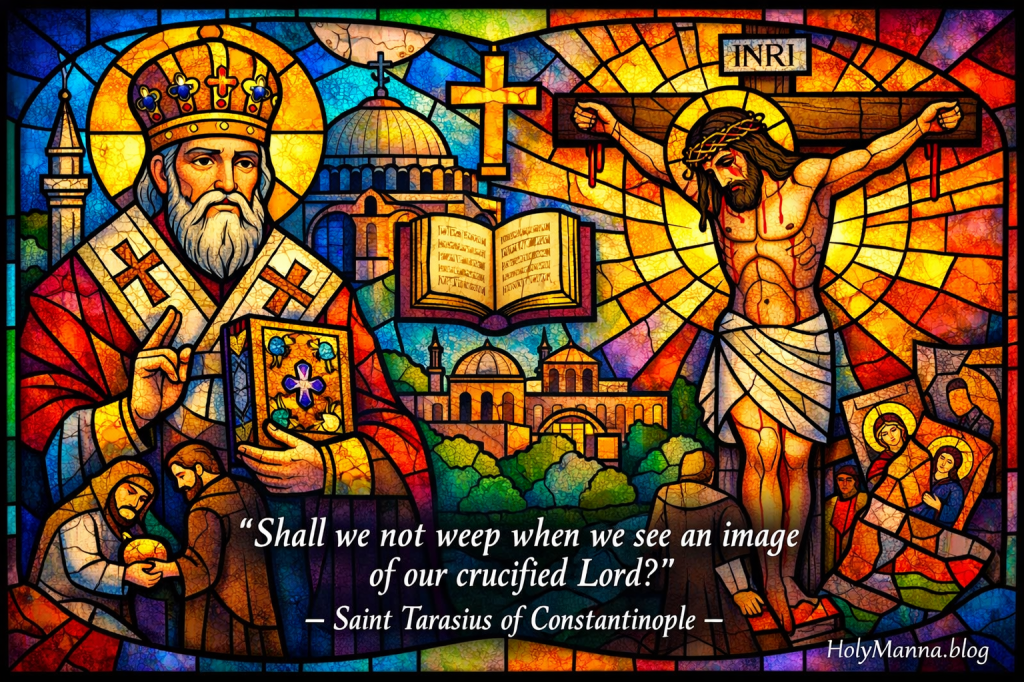
The Patriarch Who Defended the Face of Christ
Saint Tarasius of Constantinople lived when the Church was under pressure from the top down, with emperors trying to control doctrine and force Christians to abandon sacred images. This was the age of iconoclasm, when icons were smashed, churches were stripped, and devotion was treated like a crime. Tarasius is revered because he helped the Church hold the line, not with loud activism, but with steady Catholic conviction. He served as Patriarch of Constantinople from 784 until his death in 806, and he is especially remembered for presiding over the Second Council of Nicaea in 787, the Seventh Ecumenical Council, which defended the rightful veneration of holy images.
His legacy matters because it protects something essential to the Catholic faith: Christianity is not a philosophy floating in the air. The Son of God took flesh. He entered history. He became visible. The Church teaches that sacred images proclaim the mystery of the Incarnation and help announce the same Gospel preached by the Word, and this is taught clearly in The Catechism (CCC 1159–1162). When Catholics kneel before a crucifix, it is not because wood is divine. It is because Christ is Lord, and the image draws the heart toward the living Person it represents, since The Catechism teaches that the honor given to an image passes to the one depicted (CCC 2131).
A Court Official Turned Shepherd
Tarasius was born in Constantinople and came from a respected family. Catholic tradition remembers his father as a man of public responsibility, often described as a judge, and his mother as a woman of sincere piety who formed her son in virtue. Before Tarasius ever stepped into church leadership, he rose in civil service and became a leading imperial official, often described as a chief secretary or senior administrator. This background is surprising because most people imagine saints rising from monasteries or missions, not palace corridors and government meetings.
Catholic biographies consistently portray him as a man who lived with inner discipline even while surrounded by imperial power. He was known for seriousness, restraint, and a conscience that did not bend easily. That inner backbone mattered when the patriarchal seat became vacant and Patriarch Paul resigned after becoming entangled in the iconoclast crisis. Near the end, Paul openly repented and withdrew, and Catholic retellings present this as a moment of conscience that helped open the door to reform.
When Tarasius was chosen to succeed him, the shocking part is that he was still a layman. He did not treat the office like a prize. He resisted, and he accepted only on a condition that sounds unmistakably Catholic: the Church needed a real council to heal division, restore right teaching, and strengthen communion with the wider Church. After his election, Tarasius moved quickly through ordination and was consecrated Patriarch. It was an abrupt change in status, but it was not a sudden change in character. The same man who had carried responsibility in the court now carried responsibility for souls, and the weight of that responsibility shaped everything he did.
The Council That Restored Sacred Vision
The heart of Tarasius’s public mission was the defense of sacred images, and it is important to understand why this was such a serious battle. Iconoclasm was not simply an argument about aesthetics. It was a spiritual attack on the Church’s confession that the Word truly became flesh. If God became man, then God can be depicted in His human nature. A crucifix is not an idol. It is a proclamation. An icon is not a replacement for prayer. It often becomes a doorway into prayer.
Tarasius helped bring about a council to address the crisis. An initial gathering in Constantinople in 786 was disrupted by hostile forces, which showed how intense the conflict had become. The council was then reconvened at Nicaea in 787, where bishops clarified the difference between adoration owed to God alone and the veneration shown to holy images as a reverent honor that passes to the person depicted. This is exactly the distinction later summarized in The Catechism when it teaches that the honor offered to sacred images is ordered to their prototype and is not idolatry (CCC 2131).
Tarasius’s love for Christ shines in an attributed line from the council’s acts that is simple, direct, and deeply Catholic: “Shall we not weep when we see an image of our crucified Lord?” This is not emotional weakness. It is Christian sanity. The crucifix teaches the cost of sin, the depth of mercy, and the kind of love that saves. Another line associated with the council’s spirit is also remembered as part of Tarasius’s account: “Having all taken our places we took Christ as head.” That sentence still cuts through modern noise, because it reminds Catholics that the Church does not invent truth. The Church receives truth from Christ and guards it with reverence.
A Bishop with a Heart for the Poor
Saint Tarasius did not treat doctrine as a hobby for scholars. He understood that what the Church believes shapes how the Church lives. When iconoclasm attacked sacred images, it also attacked Catholic devotion, the prayer life of families, and the sense that Christ is close. Tarasius worked to restore stability so ordinary believers could worship without fear. That kind of leadership rarely looks dramatic in the moment, but it saves souls over time.
Catholic memory also highlights his attention to the poor. In a city marked by wealth and power, he is remembered as a shepherd who did not turn away from need. Charity was not an optional side project. It was part of his identity as a bishop. He is often described as directing church resources toward relief, food, and practical care, and as refusing to live like a prince while others suffered. His reputation also includes a reforming spirit aimed at correcting corruption and restoring seriousness in church life, which makes his charity even more convincing. Mercy and discipline are not enemies in the Catholic life. They belong together when they are rooted in love of Christ.
When Power Demanded Compromise
Tarasius’s hardest trials did not come only from iconoclast mobs or theological enemies. He also faced the pressure that comes when rulers demand the Church’s blessing on public sin. One of the most painful controversies of his patriarchate involved Emperor Constantine VI, who set aside his wife and entered a new union that scandalized the Church. This crisis rippled far beyond the palace because leaders shape culture, and public sin at the top often invites moral collapse below.
Tarasius resisted and refused to treat political desire as a new version of God’s law. At the same time, the crisis forced him into a narrow and difficult path, because severe retaliation could have erupted in an already unstable time. Catholic retellings remember that monastic reformers condemned the emperor’s actions and demanded firm discipline. Tarasius faced criticism from those who believed he should have moved faster or struck harder. Later, when the political situation changed and the emperor fell, Tarasius acted more decisively against the cleric who had performed the unlawful ceremony, and reconciliation followed with those who had opposed him. This episode reveals a saint who was not naive about politics and not casual about sin, because he tried to protect the Church’s moral teaching while also guarding the faithful from greater harm.
A Final Trial and a Living Legacy
Tarasius died in 806, and Catholic tradition preserves a striking account of his final hours. He is remembered as continuing in prayer and sacred duty as long as strength allowed. Near the end, witnesses reported a terrifying spiritual struggle, as if accusers pressed in and he answered them. The tradition does not present this to sensationalize fear. It presents it as a sober reminder that spiritual warfare is real, and that saints are not floating above the battle. Saints fight with humility, repentance, and trust in mercy.
After his death, Catholic tradition holds that miracles were attributed to his intercession. Some accounts speak of signs at his tomb and graces received through prayer for his help. Not every commonly circulated Catholic summary preserves detailed miracle stories by name, but the consistent claim remains that the faithful experienced God’s favor through his intercession after his passing. There is also a long-standing tradition connecting his relics with Venice, especially the Church of San Zaccaria, where devotion associated with his name endured. Even without getting lost in relic maps, the bigger point is clear: Tarasius did not fade into a local memory. His witness spread, and his defense of the faith shaped Christian worship and sacred art for generations.
Learning to See Like Catholics Again
Saint Tarasius offers a clean lesson for a messy world: when the Church loses clarity about Christ, everything else starts to collapse. When the Church holds tight to Christ, even controversy can become a path to purification. His life encourages Catholics to live the faith with both courage and reverence, because truth without charity becomes harsh, and charity without truth becomes sentimentality.
Sacred images are a practical place to start. A crucifix in the home, an icon of Christ, an image of Our Lady, or a depiction of a favorite saint can help keep the soul grounded. These are not magic objects. They are reminders, silent preachers, and visual anchors that point to realities the world tries to make invisible. The Church teaches that Christian sacred images are ordered toward leading believers into the mystery of Christ, not replacing worship but supporting it, and this is expressed clearly in The Catechism (CCC 1159–1162). The same Catechism also explains the key Catholic distinction that protects devotion from superstition, because veneration is not the adoration owed to God alone, and the honor given to an image goes to the one represented (CCC 2131).
How has God used sacred images, such as a crucifix or an icon, to keep faith steady during a hard season?
Where is Jesus calling for more courage right now, especially when it comes to living the faith openly and consistently?
What is one practical way to bring the home back under the gentle reign of Christ this week?
Engage With Us!
Share thoughts and reflections in the comments below. Saints like Tarasius remind the Church that Christ is not an idea, and that fidelity is not optional, even when it costs something.
- What is one crucifix, icon, or sacred image that has helped keep faith steady during a hard season?
- When thinking about Saint Tarasius, what stands out more: his defense of holy images or his willingness to endure criticism for the sake of the Church?
- Where is Jesus calling for more courage right now, especially when it comes to living the faith openly and consistently?
- How can the home become more intentionally Catholic, not with clutter, but with prayerful signs that point to Christ?
Keep walking forward in faith. Hold tight to Jesus. Practice mercy. Speak truth with charity. Do everything with the love and compassion Christ taught, and let every part of life become an offering that leads others to the beauty of the Gospel.
Saint Tarasius of Constantinople, pray for us!
Follow us on YouTube, Instagram and Facebook for more insights and reflections on living a faith-filled life.

 Holy Manna!
Leave a comment