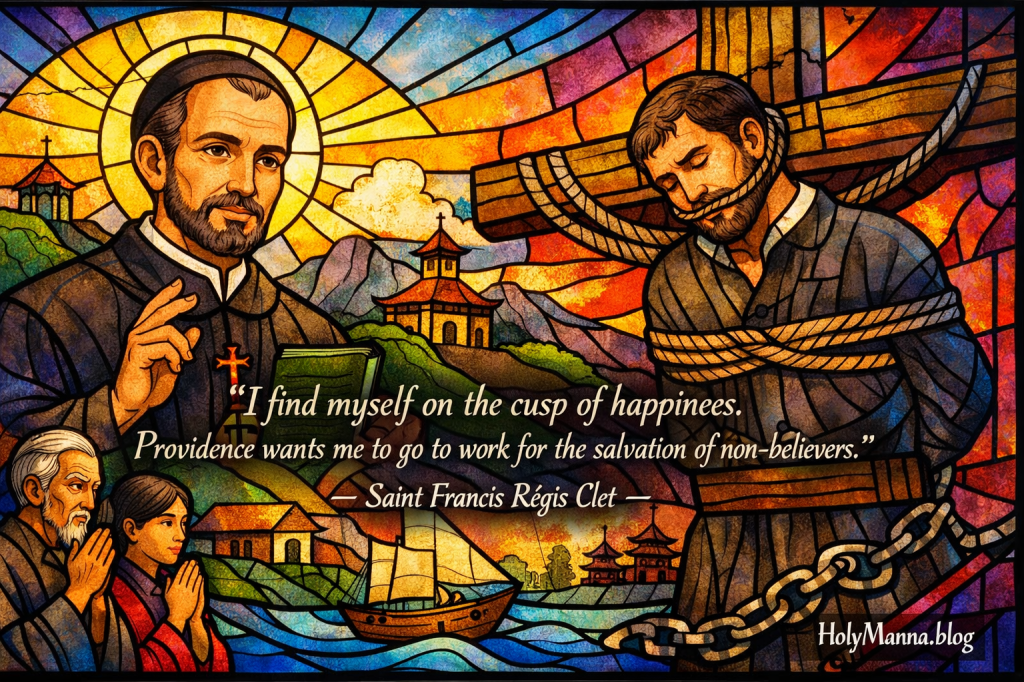
The Priest Who Loved China to the End
Saint Francis Régis Clet was a French priest of the Congregation of the Mission, the Vincentians founded by Saint Vincent de Paul. He spent nearly three decades serving Catholic communities in China at a time when being a priest could cost a man everything. He is revered because his courage was not loud or dramatic. His courage was steady, sacramental, and rooted in love for Jesus Christ and His people.
The Church honors him as a martyr because he chose Christ over safety and refused to abandon his priesthood when the authorities demanded silence. Martyrdom is not about politics or pride. Martyrdom is about love that will not compromise the truth. The Catechism explains it with clarity: “Martyrdom is the supreme witness given to the truth of the faith.” CCC 2473.
A Catholic Boyhood in Grenoble
Francis was born in Grenoble, France, in 1748, into a large and devout Catholic family. He was the tenth of fifteen children, raised in a home where faith was not treated like a hobby. He was educated under the Jesuits and continued his preparation in a seminary influenced by the Oratorians. These were not small details. They shaped his mind to love truth, his heart to love prayer, and his conscience to take holiness seriously.
His conversion story was not a sudden shift from unbelief to belief. It was the quieter, steadier conversion that many Catholics recognize, where God keeps calling a man deeper into surrender. In 1769 he entered the Vincentians, he took vows in 1771, and he was ordained a priest in 1773. For years, he lived a hidden kind of heroism, forming future priests through teaching and spiritual guidance. He served the Church faithfully in ordinary responsibilities, which is often where sanctity is actually forged.
The Mission That Cost Everything
When the French Revolution shook the Church, religious communities faced violence and disruption. In that storm, Francis’s desire grew clearer and stronger. He wanted to go where the Church was most pressed and where souls most needed shepherds. He asked repeatedly to be sent to China, even though it meant leaving the stability of a respected ministry.
When permission finally came, he did not treat it like an adventure. He treated it like a gift and a sacrifice. He helped fund his own journey and left France in 1791. His correspondence reflects the joy and seriousness of his call. One preserved line captures his spirit as he stepped toward the unknown: “I find myself on the cusp of happiness. Providence wants me to go to work for the salvation of non-believers.”
A Quiet Courage
China was not a mission field for tourists. Catholic communities often had to live quietly in order to survive. The faithful were scattered, priests were few, and the danger was constant. Francis learned the language imperfectly, and he never pretended otherwise. That humility becomes part of his witness, because it shows how God uses imperfect instruments. He once wrote with straightforward honesty: “I know only enough for the ordinary dealings of civil life, to hear confessions and to give some instructions.”
That line says a great deal about what he valued. He wanted to hear confessions, teach the faith, and keep people close to the sacraments. He served first in one region, then was assigned to a vast territory where villages were spread out and travel was exhausting. At one point the fellow missionaries near him died, and he was left with years of ministry that required immense endurance. He remained faithful without constant support, and he continued visiting families and communities who depended on a priest for the sacraments and the strength of Catholic teaching.
His letters also show a pastor who cared about real conversion. He did not want shallow Christianity that collapsed under pressure. He urged prudence and depth, resisting the temptation to chase fast results. That patience reflects the Church’s wisdom that discipleship is more than a moment. It is a lifelong surrender.
Miracle stories attached to his name are not usually presented as public, dramatic healings. Instead, Catholic accounts often emphasize providential escapes during persecution, moments when he avoided capture and continued serving the faithful. These are not told like legends meant to impress. They are told like God’s quiet protection, given so the sacraments could keep reaching hungry souls.
A Bounty, a Betrayal and a Prison Cell
Persecution intensified over the years. Churches and mission structures were destroyed, and missionaries had to hide. In later persecutions, a bounty was placed on Francis’s head. He lived with the steady awareness that each journey could be his last, yet he continued his ministry because he believed the priesthood belonged to Jesus, not to his own comfort.
He was captured on June 16, 1819. Catholic tradition remembers that betrayal played a role. Even more painful is the realism that fear can fracture communities. Pressure can lead people to carelessness or compromise. Francis endured harsh treatment and imprisonment, and yet he did not allow suffering to make him bitter. He remained anchored in prayer and fidelity.
One of the most moving details is that in prison he encountered a Chinese Vincentian priest, Father Chen, through whom he could receive the sacraments. This was a powerful sign that the Church was truly taking root in Chinese soil. The missionary who had spent decades giving was now receiving. It was a quiet image of the Church’s catholicity, where grace is never one-directional and the Body of Christ carries its members, even in chains.
Strangled on a Cross for Christ
Francis was sentenced to death and executed on February 18, 1820, at Wuchang. Catholic accounts describe him tied to a wooden frame shaped like a cross and strangled. Tradition also remembers that the rope was tightened, loosened, and tightened again, bringing a threefold agony. His death was not quick, but he endured it as a final act of fidelity.
The Church does not honor martyrdom because suffering is good. The Church honors martyrdom because love is stronger than fear. Francis’s death proclaimed that Jesus is worth more than safety, status, or survival. This is the very heart of the Church’s teaching on martyrdom, expressed in The Catechism with sobering simplicity: “Martyrdom is the supreme witness given to the truth of the faith.” CCC 2473.
The Fruit of Martyrdom
After his death, devotion to Francis Régis Clet spread, especially within the Vincentian family. His relics were preserved, including items associated with his imprisonment and execution, and his remains were eventually transferred to the Vincentian motherhouse in Paris. Catholics do not venerate relics as superstition. The Church reveres the bodies of the saints because the body is destined for resurrection. The saints remind the faithful that grace transforms real human lives, not imaginary ideals.
Common Catholic accounts do not center on a widely known, formally investigated posthumous healing miracle attributed uniquely to him. Instead, the Church points to the spiritual fruit of his witness. His martyrdom strengthened Catholics in China, encouraged the Vincentian family, and inspired later martyrs, including Saint John Gabriel Perboyre. His life demonstrates how one man’s fidelity can become a seed of courage for the next generation.
In 2000, Pope Saint John Paul II canonized him among the Martyrs of China. This placed his witness inside a broader Catholic truth. The Church is not confined to one nation. The Gospel takes root wherever Christ is preached, the sacraments are celebrated, and the faithful endure.
A Three Stranded Rope
Francis Régis Clet is not only a saint for missionaries. He is a saint for anyone trying to live the faith in a world that pressures Christians to keep religion private and harmless. He often repeated a line from Ecclesiastes that became a motto of perseverance: “A three stranded rope is not easily broken.” Eccl 4:12.
That image is practical and deeply Catholic. One strand is the sacraments, especially confession and the Eucharist. Another strand is daily prayer and steady conversion. Another strand is communion with the Church, because isolation is where compromise starts to feel normal.
Where has comfort been quietly shaping choices more than the Gospel has? What would faith look like if it stopped being a weekend accessory and became the center of daily life? How can courage be practiced now in small daily choices, before it is demanded in a crisis?
A simple way to honor this saint is to take Catholic life seriously. Go to confession regularly. Keep Sunday Mass non-negotiable. Pray with consistency. Learn the faith. Speak the truth with charity. Refuse the modern temptation to chase attention and instead choose the hidden strength that comes from being faithful when nobody is watching.
Engage with Us!
Share thoughts and reflections in the comments below, because the witness of the saints is meant to strengthen the whole Body of Christ.
- Where is God asking for steadier fidelity instead of dramatic feelings?
- What fear or attachment would be hardest to surrender if faith became costly tomorrow?
- How can confession and the Eucharist become more central, not occasional, in daily life this month?
- Who is one person who needs patient, consistent love and truth rather than quick fixes?
- What does it mean to be part of a three stranded rope, Christ, the Church, and a faithful community, in everyday life?
May Saint Francis Régis Clet teach hearts to be brave without being loud, faithful without needing applause, and merciful without compromising truth. Live a life of faith, and do everything with the love and mercy Jesus taught us.
Saint Francis Régis Clet, pray for us!
Follow us on YouTube, Instagram and Facebook for more insights and reflections on living a faith-filled life.

 Holy Manna!
Leave a comment