Ash Wednesday – Lectionary: 219
From Ashes to a Whole Heart
There is a certain kind of silence that settles in when ash touches the forehead, because the Church is not playing games today. Ash Wednesday opens Lent with a sober mercy, and all of today’s readings sound like one united call: God does not want a religious performance. God wants a real return, a homecoming of the heart that shows up in prayer, fasting, almsgiving, and reconciliation.
The background matters here. In the Scriptures, ashes and fasting are not trendy symbols or private self-help rituals. They are public signs of repentance, grief for sin, and humble dependence on God, especially when a people have wandered and need to be gathered again. That is why Joel 2:12-18 cries out with the urgency of a trumpet, summoning everyone from elders to infants, even newlyweds, because sin is never only personal and conversion is never only private. The prophet’s message is the heartbeat of the day: “Return to me with your whole heart” and “Rend your hearts, not your garments”. God is calling for interior conversion, not external theater.
That same interior repentance becomes a personal prayer in Psalm 51, the great penitential psalm, where the soul stops defending itself and simply begs for cleansing and renewal. Then 2 Corinthians 5:20-6:2 raises the stakes, because Lent is not merely a season to feel regret. It is an “acceptable time,” a moment of grace when heaven is close and the Church pleads like a mother: “Be reconciled to God”. Finally, The Gospel of Matthew 6:1-6 keeps the heart from turning repentance into a show, warning that even good deeds can be poisoned by the craving to be seen. The Father is not impressed by applause, but He delights in a hidden life that is sincere.
All together, these readings prepare the soul for a simple, demanding theme: Lent begins when pride stops talking and the heart returns. How would life change if repentance stopped being an occasional emotion and became a steady path back to God today?
First Reading – Joel 2:12-18
A trumpet call that invites a real homecoming
The prophet Joel speaks into a moment of national crisis, when the land has been ravaged and the people can feel, in their bones, that something is not right. In the Old Testament, disasters like famine, drought, or plague were not treated as random inconveniences. They became wake up calls that reminded God’s people how fragile life is, and how quickly idols collapse when the ground shifts. Joel does not begin by blaming the weather or flattering the crowd. Joel calls the whole nation to repentance, because sin is never only private, and healing is never only individual.
That is why this reading fits Ash Wednesday so perfectly. Lent begins with ashes and a summons, not to religious theater, but to interior conversion. God is not asking for louder rituals or sharper appearances. God is asking for hearts that stop stalling and start returning. The central theme of today is already beating in this passage: real repentance is not a performance. It is a whole heart turning back to the Lord through fasting, prayer, and humble pleading for mercy.
Joel 2:12-18 – New American Bible (Revised Edition)
Return to the Lord
12 Yet even now—oracle of the Lord—
return to me with your whole heart,
with fasting, weeping, and mourning.
13 Rend your hearts, not your garments,
and return to the Lord, your God,
For he is gracious and merciful,
slow to anger, abounding in steadfast love,
and relenting in punishment.
14 Perhaps he will again relent
and leave behind a blessing,
Grain offering and libation
for the Lord, your God.
15 Blow the horn in Zion!
Proclaim a fast,
call an assembly!
16 Gather the people,
sanctify the congregation;
Assemble the elderly;
gather the children,
even infants nursing at the breast;
Let the bridegroom leave his room,
and the bride her bridal tent.
17 Between the porch and the altar
let the priests weep,
let the ministers of the Lord weep and say:
“Spare your people, Lord!
do not let your heritage become a disgrace,
a byword among the nations!
Why should they say among the peoples,
‘Where is their God?’”The Lord Relents. 18 Then the Lord grew jealous for his land and took pity on his people.
Detailed Exegesis
Verse 12 “Yet even now, oracle of the Lord, return to me with your whole heart, with fasting, weeping, and mourning.”
God’s mercy begins with the words “even now.” That phrase is pure hope. It means the door is not locked, even if the mess is real. The Lord calls for a “whole heart,” not a half apology or a negotiated surrender. Fasting, weeping, and mourning are not meant to be dramatic. They are outward signs of an inward truth: sin is serious, and returning to God is worth everything.
Verse 13 “Rend your hearts, not your garments, and return to the Lord, your God. For he is gracious and merciful, slow to anger, abounding in steadfast love, and relenting in punishment.”
In Joel’s day, tearing one’s garments was a public sign of grief and repentance. God does not reject external signs, but God refuses to let signs replace sincerity. The command is sharp and personal: tear the heart open. The reason is even more powerful: repentance is possible because God’s character is mercy. The Lord is not looking for a reason to destroy. The Lord is looking for a reason to restore.
Verse 14 “Perhaps he will again relent and leave behind a blessing, grain offering and libation for the Lord, your God.”
This “perhaps” is not doubt about God’s goodness. It is humility about timing and outcomes. The people cannot manipulate God with religious acts, but they can beg and return. The mention of grain offering and libation points to worship being restored. Sin disrupts communion with God. Repentance makes space for worship and right order to return.
Verse 15 “Blow the horn in Zion! Proclaim a fast, call an assembly!”
The trumpet is not entertainment. It is an alarm. Zion represents the heart of worship, the place where God’s people gather before the Lord. Repentance here is not a private hobby. It is communal. When the Church begins Lent together, it is living this same biblical instinct: God saves a people, not isolated spiritual freelancers.
Verse 16 “Gather the people, sanctify the congregation; assemble the elderly; gather the children, even infants nursing at the breast; let the bridegroom leave his room, and the bride her bridal tent.”
Nothing gets excluded. The elderly, the children, and even infants are included, because the covenant touches every generation. Even the bride and groom are called out of the most legitimate personal joy to join the common act of repentance. Joel is teaching a hard truth with tenderness: when a people need God, everyone shows up. No one is too important. No one is too small.
Verse 17 “Between the porch and the altar let the priests weep, let the ministers of the Lord weep and say: ‘Spare your people, Lord! do not let your heritage become a disgrace, a byword among the nations! Why should they say among the peoples, “Where is their God?”’”
The priests stand at the threshold of sacrifice and intercession, weeping as leaders who love the flock. Their prayer is not about saving face. It is about God’s name and God’s people belonging together. In the Bible, the honor of God’s name is not vanity. It is the revelation of who God is. When God’s people collapse into disgrace, the nations mock, and the question becomes a taunt: “Where is their God?” The priests plead for mercy, not because the people deserve it, but because God is faithful.
Verse 18 “Then the Lord grew jealous for his land and took pity on his people.”
God’s “jealousy” is not insecurity. It is covenant love that refuses to abandon what belongs to Him. The Lord’s pity is not passive emotion. It is mercy that moves into action. This is the turning point of the reading: when the people return, God responds with compassion. The last word is not disaster. The last word is mercy.
Teachings
Ash Wednesday can tempt the soul to focus on appearances, because ashes are visible and Lent is public. Joel refuses to let conversion become cosmetic. The deepest Catholic instinct in this reading is that repentance is first about communion with God, not about managing an image. True penance is meant to restore a relationship that sin has wounded, and that restoration always involves both the heart and the body.
The Church’s ancient tradition of Lent echoes Joel’s assembly. From the earliest centuries, Christians prepared for Easter through intensified prayer, fasting, and works of mercy, and those preparing for Baptism were accompanied by the whole community. The logic is biblical: the entire people of God returns together. That is why the Church does not simply recommend Lent as a private improvement plan. The Church enters it as a family, because grace is personal, but it is never merely private.
Joel also teaches something that modern ears need to hear. Repentance is not self-therapy. Repentance is worship. The grain offering and libation point to the restoration of right praise, because sin always bends the heart inward. A returned heart bends outward again, toward God, toward the altar, and toward the needs of neighbor. A renewed interior life inevitably reshapes the exterior life, not as a performance, but as fruit.
Finally, Joel places intercession at the center. The priests weep and plead, and their prayer sounds like the heart of the Church in every age: spare your people. This is why Lent fits so naturally with sacramental reconciliation. God does not merely tolerate the repentant. God runs to meet them with mercy.
Reflection
Joel’s message lands cleanly on an ordinary life. There are seasons when the soul feels like a field after a storm, scattered and tired, and quietly aware that habits have become chains. This reading refuses despair. It insists on “even now.” God’s mercy is not trapped in the past. God’s call is present tense, and the path back is not complicated, even if it is demanding.
A practical Lent begins by choosing sincerity over drama. Fasting can be real, but it must be aimed at freedom. When fasting is tied to prayer, hunger becomes a reminder to return, not just a test of willpower. Mourning can be real, but it must be ordered toward hope. Tears for sin are not meant to end in shame. They are meant to end in surrender.
This reading also challenges the temptation to isolate. When repentance becomes only private, it can become fragile. Returning with the Church strengthens the will and steadies the heart. That can look as simple as showing up for Mass with attention, making time for confession, praying for the conversion of family members, and allowing the day’s discipline to reshape the home with patience and humility.
What would change if the hardest thing to surrender this Lent was not a food or a screen, but a divided heart that keeps one foot in the world and one foot in God?
Where has the heart been tearing garments, showing outward signs, while refusing to let God touch the deeper wound underneath?
What concrete act of fasting, prayer, or mercy could become the trumpet blast that finally wakes the soul up to grace, starting today?
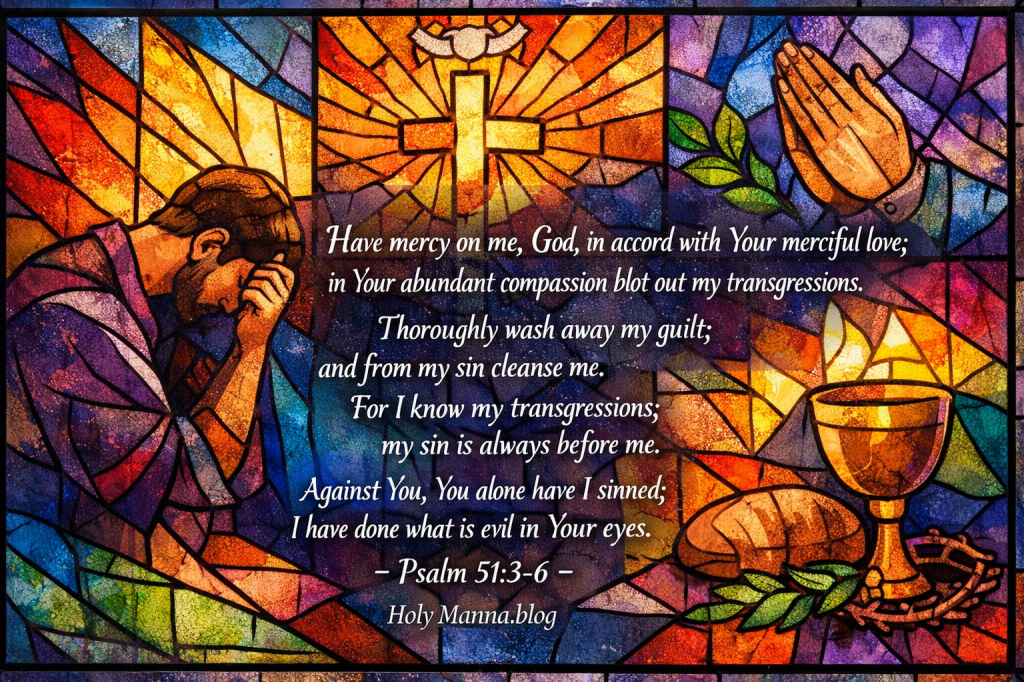
Responsorial Psalm – Psalm 51:3-6, 12-14, 17
The prayer God never ignores
If Joel is the trumpet that wakes the soul up, Psalm 51 is what the soul says when it finally stops arguing. This psalm is traditionally linked to King David after his grave sin, when the prophet Nathan confronted him and the excuses ran out. In Israel’s worship, psalms were not private journaling exercises. They were sung prayers, shaping the conscience of the whole people. That is why the Church places this psalm on Ash Wednesday, because Lent begins with the courage to tell the truth in God’s presence.
This prayer fits today’s theme perfectly. Ashes on the forehead can be real humility, or they can become a religious costume. Psalm 51 refuses the costume. It teaches repentance that is personal, honest, and confident in mercy. It shows what it looks like to “rend the heart,” not the garments, and it asks for the one miracle no human being can accomplish alone: a clean heart.
Psalm 51:3-6, 12-14, 17 – New American Bible (Revised Edition)
3 Have mercy on me, God, in accord with your merciful love;
in your abundant compassion blot out my transgressions.
4 Thoroughly wash away my guilt;
and from my sin cleanse me.
5 For I know my transgressions;
my sin is always before me.
6 Against you, you alone have I sinned;
I have done what is evil in your eyes
So that you are just in your word,
and without reproach in your judgment.12 A clean heart create for me, God;
renew within me a steadfast spirit.
13 Do not drive me from before your face,
nor take from me your holy spirit.
14 Restore to me the gladness of your salvation;
uphold me with a willing spirit.17 Lord, you will open my lips;
and my mouth will proclaim your praise.
Detailed Exegesis
Verse 3 “Have mercy on me, God, in accord with your merciful love; in your abundant compassion blot out my transgressions.”
The prayer begins with God, not with self-analysis. Mercy is not demanded as a right, but begged as a gift rooted in God’s own “merciful love” and “abundant compassion.” David appeals to who God is, because repentance without hope collapses into despair. This verse teaches the Catholic instinct that conversion is possible only because God’s mercy is greater than sin.
Verse 4 “Thoroughly wash away my guilt; and from my sin cleanse me.”
The imagery is not shallow. Sin stains, guilt clings, and the heart cannot scrub itself clean with willpower. The language of washing and cleansing points forward to sacramental grace, especially the cleansing Christ gives through Baptism and renews through Confession. This is not self-improvement. It is purification that comes from God.
Verse 5 “For I know my transgressions; my sin is always before me.”
This is not obsession or self-pity. It is moral clarity. Repentance begins when sin is named without excuses. The psalm refuses denial. That matters on Ash Wednesday, because Lent collapses when it becomes vague, and vague repentance produces no real change.
Verse 6 “Against you, you alone have I sinned; I have done what is evil in your eyes So that you are just in your word, and without reproach in your judgment.”
David does not pretend his sin only affects himself. Sin always harms others, but its deepest wound is against God because it rejects His love and His order. This verse also defends God’s justice. Repentance does not put God on trial. The repentant heart admits that God is right, God is holy, and God’s judgment is true.
Verse 12 “A clean heart create for me, God; renew within me a steadfast spirit.”
This is one of the most important lines in the whole psalm. The verb “create” is not casual. It echoes the kind of creative act only God can do. A clean heart is not a quick polish. It is a new work of creation. The “steadfast spirit” is the stability to remain faithful when feelings fade, temptations rise, and the novelty of Lent wears off.
Verse 13 “Do not drive me from before your face, nor take from me your holy spirit.”
This is the fear of separation, not the fear of embarrassment. The worst consequence of sin is distance from God. David begs not to be cast away, and the mention of the Holy Spirit highlights that holiness is not achieved by grit alone. God’s Spirit is the life of the soul. Without Him, the heart collapses back into the old patterns.
Verse 14 “Restore to me the gladness of your salvation; uphold me with a willing spirit.”
This is not shallow happiness. It is the joy of being rescued. Sin steals joy, not because God is stingy, but because sin bends life toward emptiness. David asks for gladness to be restored, and he asks for a willing spirit because conversion requires cooperation. Grace is a gift, and it also calls the will to say yes.
Verse 17 “Lord, you will open my lips; and my mouth will proclaim your praise.”
The psalm ends with worship. When God restores a sinner, praise becomes the natural overflow. This is the arc of Lent: from repentance to renewed worship, from closed lips to praise, from hiding to communion. It is the same movement Joel points to when he speaks of restored offerings.
Teachings
Psalm 51 is a masterclass in interior penance, and the Church’s teaching lines up perfectly with it. The Catechism describes conversion as first a work of grace that moves the heart, and then a real human response that follows. The language of a “clean heart” belongs to God’s initiative, because only God can create what sin has deformed.
The Catechism also speaks directly about the kind of interior repentance this psalm embodies. CCC 1431 says: “Interior repentance is a radical reorientation of our whole life, a return, a conversion to God with all our heart, an end of sin, a turning away from evil, with repugnance toward the evil actions we have committed.” That is Psalm 51 in one sentence.
The Church also insists that repentance is not only inward emotion but a lived conversion expressed through concrete acts, which is why Ash Wednesday joins this psalm to fasting and prayer. CCC 1434 says: “The interior penance of the Christian can be expressed in many and various ways. Scripture and the Fathers insist above all on three forms, fasting, prayer, and almsgiving, which express conversion in relation to oneself, to God, and to others.” That is exactly what today’s liturgy will keep unfolding, especially in the teaching of Christ in The Gospel of Matthew.
The saints read this psalm as a weapon against despair. Saint Augustine emphasizes that God does not despise the sinner who returns in humility, because true repentance already contains the seed of healing. The psalm’s confidence is not in personal strength but in God’s mercy, which is why it has been prayed for centuries in penitential seasons, at bedsides, and in confession lines, because it teaches the soul how to come home.
Reflection
There is a moment in every conversion story when the heart stops defending itself. That moment is where this psalm lives. It does not sound like a legal argument. It sounds like someone who finally wants God more than excuses. That is why it belongs at the beginning of Lent, because a clean Lent starts with a clean confession, whether that confession is spoken in the confessional or whispered in prayer as a first step back.
A practical way to live this psalm is to pray it slowly, not as poetry, but as truth. The words “wash,” “cleanse,” and “create” can reshape how sin is viewed. Sin is not only breaking a rule. Sin is staining the soul, and the soul needs God to cleanse it. The words “restore to me the gladness of your salvation” can also expose a lie many people carry, which is the idea that holiness is joyless. This psalm says the opposite. Real salvation brings gladness, and sin steals it.
This psalm also teaches how to make Lent sustainable. It asks for a “steadfast spirit” and a “willing spirit,” because people do not drift into holiness. A willing spirit chooses prayer when it is inconvenient, chooses confession when pride resists, and chooses humility when the ego wants applause. When almsgiving and fasting start to feel heavy, this psalm gives the deeper reason. It is not about proving something. It is about being restored.
Where has guilt been carried like a secret weight instead of being brought into the light of mercy through Confession and honest prayer?
What would change if Lent focused less on external goals and more on begging God to create a clean heart and renew a steadfast spirit?
When the Father “sees in secret,” what hidden habit of prayer could become the daily place where the lips are opened again to praise?
Second Reading – 2 Corinthians 5:20-6:2
The time to come home is now
The Second Reading sounds like a man speaking with urgency because he knows the building is on fire. Saint Paul is writing to the Christians in Corinth, a city known for wealth, influence, and moral chaos. Corinth was a crossroads of commerce and culture, and that meant the young Church there faced constant pressure to blend in, compromise, and treat grace like a nice idea instead of a transforming power. Paul writes as an apostle and pastor, not trying to win an argument, but trying to save souls.
This is why the Church proclaims this passage on Ash Wednesday. Lent is not a religious hobby season. It is a moment of decision. Joel calls for a whole-hearted return, Psalm 51 teaches the language of repentance, and now Paul explains what makes repentance even possible. God has already moved first in Christ. God has already opened the door. The only tragedy left is to ignore the invitation. That is why this reading fits today’s theme so tightly: true conversion is not external performance, but reconciliation with God through Jesus Christ, and the time for it is now.
2 Corinthians 5:20-6:2 – New American Bible (Revised Edition)
20 So we are ambassadors for Christ, as if God were appealing through us. We implore you on behalf of Christ, be reconciled to God. 21 For our sake he made him to be sin who did not know sin, so that we might become the righteousness of God in him.
The Experience of the Ministry. 1 Working together, then, we appeal to you not to receive the grace of God in vain. 2 For he says:
“In an acceptable time I heard you,
and on the day of salvation I helped you.”Behold, now is a very acceptable time; behold, now is the day of salvation.
Detailed Exegesis
Verse 5:20 “So we are ambassadors for Christ, as if God were appealing through us. We implore you on behalf of Christ, be reconciled to God.”
Paul describes the apostolic mission with a political image. An ambassador represents a king and speaks with delegated authority, not personal opinion. The shocking part is that God “appeals” through human messengers, which reveals God’s humility and mercy. The word “implore” is strong. Paul is not casually suggesting an improvement plan. He is begging because reconciliation is not optional. To be reconciled means the relationship ruptured by sin is restored. This fits Ash Wednesday perfectly because ashes are not meant to decorate the forehead. They are meant to push the heart toward reconciliation, especially through the sacrament of Confession.
Verse 21 “For our sake he made him to be sin who did not know sin, so that we might become the righteousness of God in him.”
This verse is one of the densest summaries of the Gospel in the New Testament. Christ “did not know sin” because He is sinless, fully obedient, and perfectly united to the Father. Yet, “for our sake,” the Father allowed the Son to enter the deepest consequences of sin and to carry our burden. This does not mean Jesus became a sinner. It means He took upon Himself the weight and penalty of sin, offering Himself as the spotless sacrifice. The purpose is stunning: so that sinners might “become the righteousness of God” in Him. This is not superficial morality. This is a new standing before God, given through grace, making the believer truly righteous by participation in Christ’s life.
Verse 6:1 “Working together, then, we appeal to you not to receive the grace of God in vain.”
Grace is real, but it can be resisted. Paul warns against receiving grace “in vain,” meaning without effect, like rain falling on stone instead of soil. This is a direct challenge to performative religion. It is possible to hear the Word, wear ashes, and keep the same habits untouched. Paul is saying that grace must be welcomed with repentance and cooperation, or it becomes an ignored gift.
Verse 2 “For he says: ‘In an acceptable time I heard you, and on the day of salvation I helped you.’ Behold, now is a very acceptable time; behold, now is the day of salvation.”
Paul quotes Scripture to show this urgency is not his personality. It is God’s own timing. Then he drives it home with a repeated “now.” Salvation is not only a future hope. It is a present moment of grace that demands a response. Lent is the Church placing that “now” in front of the soul. The temptation is always delay. Paul demolishes delay. The door is open today.
Teachings
This passage stands at the heart of Catholic teaching on reconciliation, redemption, and the seriousness of grace. The Church teaches that sin is not merely a mistake. Sin ruptures communion with God, and reconciliation is needed because the relationship has been wounded. The Catechism describes sin as an offense against God and a turning away from Him. CCC 1850 says: “Sin is an offense against God: ‘Against you, you alone, have I sinned, and done that which is evil in your sight.’ Sin sets itself against God’s love for us and turns our hearts away from it.” This connects directly to Paul’s plea: be reconciled to God.
Paul’s claim that Christ was made to be “sin” for us also connects with the Church’s teaching on the saving sacrifice of Christ. The Catechism explains that Jesus freely accepted the Father’s plan to save humanity by His obedience unto death, and that His sacrifice is offered “for many.” CCC 609 says: “By embracing in his human heart the Father’s love for men, Jesus ‘loved them to the end,’ for ‘greater love has no man than this, that a man lay down his life for his friends.’ In suffering and death his humanity became the free and perfect instrument of his divine love which desires the salvation of men.” That is the engine behind reconciliation. God is not asking sinners to climb back by human effort. God has come down in Christ to lift them up.
The Church also teaches that this reconciliation is not only a private feeling. Christ entrusted reconciliation to the Church in a sacrament. CCC 1461 says: “Since Christ entrusted to his apostles the ministry of reconciliation, bishops who are their successors, and priests, the bishops’ collaborators, continue to exercise this ministry.” This makes Ash Wednesday intensely practical. The visible sign of ashes is meant to lead toward the sacramental reality of being reconciled, where grace is not received “in vain,” but received with repentance and healing.
Historically, the early Church treated Lent as a serious season of conversion, especially connected to public penance and the preparation of catechumens for Baptism at Easter. Even when public penance evolved into the more regular sacramental practice Catholics know today, the logic remained the same. The Church does not proclaim “now is the day of salvation” as motivational speech. The Church proclaims it because the Gospel is urgent, and grace is not guaranteed to be welcomed later.
Reflection
This reading exposes one of the most common spiritual tricks: delay. The heart says, “Later, when life calms down. Later, when there is more time. Later, when the habit is easier to break.” Paul answers with a father’s seriousness and a shepherd’s love. The time is now, not because God is impatient, but because the soul is fragile and tomorrow is not promised.
A strong way to live this reading is to treat Lent like an appointment with God that cannot be rescheduled. Reconciliation starts by taking one concrete step toward God’s mercy. That step might be making a Confession with honesty, not a rushed routine. That step might be repairing a relationship that has been allowed to rot through pride. That step might be rejecting the half-hearted version of faith that wants comfort without conversion. Paul is not calling for dramatic gestures. Paul is calling for a real yes.
This passage also offers an identity that changes everything. To be Catholic is not mainly to be part of a cultural tribe or a moral club. It is to belong to Christ and to live as someone who has been reconciled. That identity reshapes how prayer sounds, how fasting works, and how almsgiving becomes love instead of self-congratulation. The ambassador does not represent himself. The ambassador represents the King. Lent becomes lighter when it is understood as returning to the King who is already pleading for the return.
Where has grace been received “in vain,” with good intentions that never became real decisions?
What specific reconciliation has been delayed, whether with God in Confession or with another person through humility and truth?
If today is truly “the day of salvation,” what would change in the next twenty four hours if the heart responded without negotiating?
Holy Gospel – Matthew 6:1-6
Hidden holiness that God alone sees and rewards
Ash Wednesday carries a strange tension. The ashes are visible, but the Gospel warns against doing holy things to be seen. That tension is not a contradiction. It is a test of the heart. In the Sermon on the Mount, Jesus is forming His disciples in the kind of righteousness that actually belongs to the Kingdom of God, not the kind that collects applause. In first-century Jewish life, almsgiving and prayer were genuine acts of devotion, and they were also publicly recognizable. It was easy for sincere religion to be mixed with social status, because public piety could easily become a way to signal virtue.
Jesus does not condemn almsgiving or prayer. Jesus commands them, but He purifies them. He calls His people to do the right things for the right reason, with the Father as the audience. That fits perfectly with today’s theme. Joel demands hearts, not garments. Psalm 51 begs for interior cleansing. Paul pleads for real reconciliation now. Then Jesus cuts to the motive underneath everything. Lent is not a stage. Lent is a return to the Father in secret, where grace reforms the soul without needing validation from anyone else.
Matthew 6:1-6 – New American Bible (Revised Edition)
Teaching About Almsgiving. 1 “[But] take care not to perform righteous deeds in order that people may see them; otherwise, you will have no recompense from your heavenly Father. 2 When you give alms, do not blow a trumpet before you, as the hypocrites do in the synagogues and in the streets to win the praise of others. Amen, I say to you, they have received their reward. 3 But when you give alms, do not let your left hand know what your right is doing, 4 so that your almsgiving may be secret. And your Father who sees in secret will repay you.
Teaching About Prayer. 5 “When you pray, do not be like the hypocrites, who love to stand and pray in the synagogues and on street corners so that others may see them. Amen, I say to you, they have received their reward. 6 But when you pray, go to your inner room, close the door, and pray to your Father in secret. And your Father who sees in secret will repay you.
Detailed Exegesis
Verse 1 “Take care not to perform righteous deeds in order that people may see them; otherwise, you will have no recompense from your heavenly Father.”
Jesus begins with a warning that sounds like a father trying to protect his son from a trap. “Take care” means this danger is subtle. “Righteous deeds” are good works, and Jesus assumes they will be done, but He confronts the motive. If the goal is to be seen, the deed becomes distorted. The consequence is sobering. The Father’s reward is not given to a performance. The Father rewards love, faith, and sincerity.
Verse 2 “When you give alms, do not blow a trumpet before you, as the hypocrites do in the synagogues and in the streets to win the praise of others. Amen, I say to you, they have received their reward.”
Almsgiving was a core religious duty, rooted in justice and mercy, especially for the poor. Jesus targets the “hypocrites,” a word that can mean an actor who wears a mask. The image of blowing a trumpet exposes the hunger for recognition. If praise is the goal, then praise is the only reward, and it dies as soon as the crowd moves on. Jesus is not saying the Father is stingy. Jesus is saying the heart has chosen its payment, and it is too small.
Verse 3 “But when you give alms, do not let your left hand know what your right is doing.”
Jesus uses exaggeration to make a point that sticks. The disciple should give so quietly that even the self is not invited into self-congratulation. This is spiritual warfare against vanity. It is also a strategy for purity. Quiet charity protects the heart from turning the poor into props. It keeps love from being used as a brand.
Verse 4 “So that your almsgiving may be secret. And your Father who sees in secret will repay you.”
The Father is not blind to hidden things. The Father sees what no one else sees, including intention. The phrase “will repay you” does not mean God is a vending machine. It means God is just, faithful, and generous. God’s reward is real, and it includes the deeper reward of becoming the kind of person who loves without needing praise.
Verse 5 “When you pray, do not be like the hypocrites, who love to stand and pray in the synagogues and on street corners so that others may see them. Amen, I say to you, they have received their reward.”
Public prayer was normal, and it could be beautiful. Jesus is not condemning communal prayer, because He Himself prays publicly at times. He is condemning the love of being seen. The “street corners” detail suggests strategic placement, not accidental visibility. The person is not praying to God as Father, but praying to the crowd as judge. Jesus says the reward is already received, because the motive was human praise, not communion.
Verse 6 “But when you pray, go to your inner room, close the door, and pray to your Father in secret. And your Father who sees in secret will repay you.”
The “inner room” is the hidden place, like a storeroom in a home, away from eyes and noise. Jesus is teaching intimacy with the Father. Closing the door is not only physical. It is spiritual. It means shutting out distraction, self-display, and the need to be noticed. The repeated promise returns. The Father sees. The Father rewards. The disciple is never alone in secret prayer, because the Father is there.
Teachings
This Gospel names a real spiritual disease: the need to be admired. The Church has always treated this as dangerous because it can corrupt even good works. A person can fast, pray, and give alms, and still be feeding pride. That is why Ash Wednesday places this reading at the start of Lent, because the enemy of the soul loves a religious Lent that stays on the surface.
The Catechism teaches that prayer is a real relationship, not a performance. It says, CCC 2564: “Christian prayer is a covenant relationship between God and man in Christ. It is the action of God and of man, springing forth from both the Holy Spirit and ourselves, wholly directed to the Father, in union with the human will of the Son of God made man.” That covenant relationship cannot thrive when prayer becomes a public show, because performance turns the heart away from the Father and toward self.
The Church also teaches that almsgiving belongs to conversion. It is not an optional accessory for spiritual people. It is part of justice and mercy flowing from a changed heart. CCC 2447 lists the spiritual and corporal works of mercy and says: “The works of mercy are charitable actions by which we come to the aid of our neighbor in his spiritual and bodily necessities. Instructing, advising, consoling, comforting are spiritual works of mercy, as are forgiving and bearing wrongs patiently. The corporal works of mercy consist especially in feeding the hungry, sheltering the homeless, clothing the naked, visiting the sick and imprisoned, and burying the dead.” This makes Jesus’ teaching practical. Almsgiving is not only money. It is mercy expressed in concrete love, and it must be done for God, not for clout.
Saint John Chrysostom presses this point with force in his preaching. He teaches that Christ did not merely command good deeds, but commanded purity of intention, because the same action can be holy or hollow depending on why it is done. The saints also warn that vanity is especially dangerous in spiritual things, because it can make a person feel righteous while staying unconverted. Jesus cures that disease by moving the Christian life into the hidden place, where God alone sees what is real.
Historically, this Gospel has shaped Catholic Lenten discipline for centuries. Lent is not only about abstaining from pleasures. It is about cleaning motives. The Church’s tradition of fasting, prayer, and almsgiving is meant to be done with humility, because humility makes room for God. Without humility, even penance becomes another way to worship the self.
Reflection
This Gospel is like a flashlight that exposes what the heart does not want to admit. The temptation is to want Lent to be noticed. Some people want to be seen as disciplined. Some want to be seen as serious. Some want to be seen as holy. Jesus does not mock those desires. Jesus replaces them with something better: the Father’s gaze.
A faithful Lent begins by choosing secrecy where possible, not because faith is ashamed, but because love grows deeper in hidden soil. Secret prayer is not glamorous, but it is where the soul is healed. Secret almsgiving is not impressive, but it is where the ego shrinks and charity becomes pure. When fasting is added, it is not meant to make someone look intense. It is meant to make room for God by weakening the tyranny of appetite and strengthening the will to love.
This Gospel also frees the soul from the exhausting treadmill of approval. Human praise is unstable. It rises and falls with trends, moods, and attention spans. The Father’s reward is stable because the Father sees what is true. A person who lives for human praise becomes anxious. A person who lives before the Father becomes peaceful, even while carrying a real cross.
What parts of spiritual life are being done with one eye on God and one eye on other people’s opinions?
If the Father is the audience, what would change about prayer if it became simpler, quieter, and more consistent, even when it feels dry?
What act of mercy could be done in secret this week, not to be admired, but to become more like Christ who loved without needing applause?
The Door Is Open Today
Ash Wednesday brings the soul to a crossroads, not with hype, but with mercy that tells the truth. Joel 2:12-18 sounds the trumpet and refuses shallow religion, insisting that God wants more than torn garments and dramatic gestures. God wants a heart that finally turns back, because the Lord is “gracious and merciful, slow to anger, abounding in steadfast love”. Then Psalm 51 gives the words a repentant heart needs when excuses die and honesty begins, pleading with quiet confidence, “A clean heart create for me, God”. That is the heartbeat of Lent, because a clean heart is not manufactured by willpower. It is created by grace.
2 Corinthians 5:20-6:2 raises the urgency, not to scare, but to wake the soul up. God is not distant. God is appealing through the Church, “Be reconciled to God”, and the time to respond is not later. It is now. Finally, The Gospel of Matthew 6:1-6 protects the whole season from becoming a performance, warning that even good deeds can rot when they are done to be seen. Christ calls for hidden holiness, where the Father is the audience, because “your Father who sees in secret will repay you”.
All of today’s readings converge into one clear invitation: return to the Lord with a whole heart, not with religious theater. Let Lent be real. Let it be quiet. Let it be sacramental. Let it be rooted in prayer that closes the door, fasting that trains desire, and almsgiving that loves without needing applause. The most powerful step does not need to be dramatic. It needs to be honest.
This is the moment to choose one concrete act of conversion and make it visible only to God. This is the moment to plan for Confession instead of postponing it. This is the moment to pray like a son speaking to his Father, not like an actor chasing approval. This is the moment to give mercy in secret, because love becomes pure when nobody claps.
What would change if the ashes were not just a sign on the forehead, but a turning point that finally moved the heart from delay to decision?
Engage with Us!
Readers are invited to share reflections in the comments below, especially any line that struck the heart, any conviction that surfaced, or any grace that felt quietly personal. Lent is lived one day at a time, and hearing how God is working in other lives often gives courage to keep returning with sincerity.
- First Reading, Joel 2:12-18: Where is God inviting a return “with your whole heart,” and what specific attachment or habit needs to be surrendered so that conversion is not just external but truly interior?
- Responsorial Psalm, Psalm 51:3-6, 12-14, 17: What does it look like to pray “A clean heart create for me, God” with real honesty, and what would change if that prayer became the daily foundation of Lent?
- Second Reading, 2 Corinthians 5:20-6:2: Where has grace been received “in vain” through delay or half-measures, and what concrete step toward reconciliation with God should be taken now, not later?
- Holy Gospel, The Gospel of Matthew 6:1-6: Which good deed, prayer habit, or act of sacrifice is most tempted to seek human praise, and how can it be reshaped into something hidden, pure, and offered to the Father alone?
Keep walking forward with faith, because God does not despise a contrite heart, and Jesus never asks for perfection before mercy. Let this Lent be lived with sincerity, humility, and steady courage, doing everything with the love and mercy Jesus taught, so that the world sees not a performance, but a heart truly returning to God.
Sacred Heart of Jesus, we trust in You!
Immaculate Heart of Mary, pray for us!
Saint Michael the Archangel, defend us in battle!
Follow us on YouTube, Instagram and Facebook for more insights and reflections on living a faith-filled life.

 Holy Manna!
Leave a comment