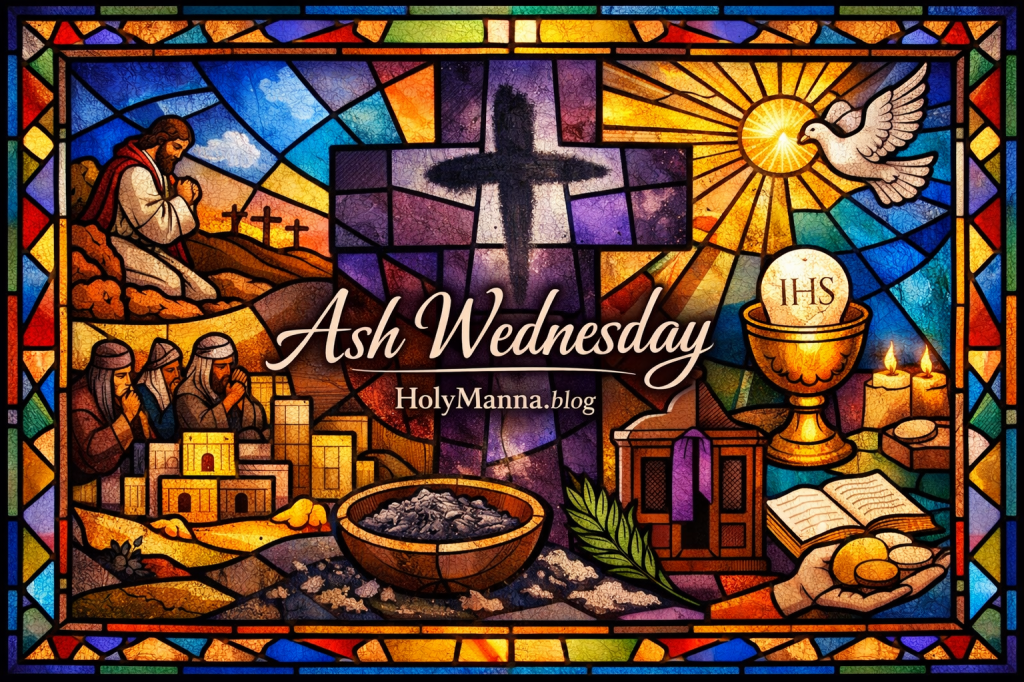
Ashes at the Doorway of Lent
Ash Wednesday opens Lent with a sign that is simple, gritty, and impossible to ignore. The Church marks the faithful with ashes in the shape of the Cross and speaks words that cut through excuses and distractions. “Remember that you are dust, and to dust you shall return.” Or, “Repent, and believe in the Gospel.” Those two lines carry the whole message of the day: human life is fragile, death is real, sin is real, and the mercy of Jesus Christ is more real than all of it.
This day is not about showing how serious someone looks in a church line, and it is not about winning points with God. It is the Church saying, with motherly clarity, that the heart needs to come home. That is why Ash Wednesday is a day of penance that begins the season of conversion. In the Latin Church, it is also a day of fasting and abstinence, because Catholic conversion involves the whole person, including the body. The point is not misery, and it is never pride. The point is to make room for grace and to begin Lent with honesty.
From Ashes to the Altar
Ash Wednesday did not come out of nowhere, and it was never meant to be a vague custom. Ashes are part of the Bible’s own language of repentance and humility. When God’s people recognized sin, mourned what was broken, and begged for mercy, they used tangible signs like sackcloth and ashes. The story of Nineveh in The Book of Jonah makes the meaning easy to grasp, because an entire city hears the call to conversion and responds with fasting and repentance rather than stubbornness.
The early Church carried this biblical instinct into Christian life. Christians knew that baptism was not a cultural label but a real rebirth, and that sin was not a harmless mistake but a wound that needed healing. Over time, penitential discipline developed in the Church, including visible signs for those who sought reconciliation after serious sin. As the centuries passed, the Church’s wisdom deepened, and the sign of ashes became a shared beginning of Lent for the whole faithful, not only for public penitents. This is a deeply Catholic move, because it keeps everyone humble and honest. It refuses the lie that only “those people” need to repent, and it places the whole Church on the same road back to God.
There is also a detail that feels almost poetic when it is understood in a Catholic way. Traditionally, the ashes are made from the palms blessed on the previous year’s Palm Sunday. What was once lifted in praise to Christ the King becomes the sign that calls the sinner back to Christ the Redeemer. That cycle teaches that time is not just passing. Time is being redeemed, and the Church keeps returning the faithful to the same central truth until the heart finally listens.
Dust That Tells the Truth
Ash Wednesday speaks with the kind of realism modern life avoids. The ashes tell the truth about mortality, because the Church does not pretend death is a minor detail. The words “Remember that you are dust” are not meant to terrify anyone. They are meant to shatter pride and wake up the soul. A Catholic does not look at death as a joke or a doom cloud. A Catholic looks at death in the light of Jesus Christ, who entered death and broke its power from the inside.
The Church is also clear that ashes are not magic. They are a sacramental, meaning a blessed sign that disposes the heart to receive grace and cooperate with it. The Catechism teaches that sacramentals prepare the faithful to receive grace and to respond to God with faith, rather than replacing the sacraments themselves. This matters because many people treat Ash Wednesday like a yearly checkpoint, as if ashes are the goal. They are not the goal. They are a call to deeper conversion and a stronger sacramental life, especially a serious return to Confession and the Eucharist during Lent.
That is why the Gospel proclaimed every Ash Wednesday is always from The Gospel of Matthew chapter 6. Jesus warns against praying, fasting, and giving alms in order to be seen. He calls the faithful to do these works in secret, because the Father sees in secret. Ash Wednesday puts a visible sign on the forehead, but the Gospel refuses vanity and demands interior conversion. The Catechism is blunt about this too, teaching that outward practices can become empty if they are not rooted in a real change of heart, and it describes interior penance as a radical reorientation of the whole life back to God. CCC 1430 is the kind of line that keeps Lent from becoming religious performance.
The Roman Road of Prayer and Penance
Ash Wednesday devotion begins with the liturgy because the Church’s worship forms the Catholic imagination and shapes the Catholic heart. The ashes are imposed after the homily because the Word of God explains the sign before the sign is received. That order teaches something important. The Church does not throw symbols at people and hope the meaning sticks. The Church forms the mind and calls the will, and then the sign becomes a personal decision written on the body.
There is also a quiet mercy in the Church’s pastoral practice. Ashes can be distributed within Mass or within a Liturgy of the Word, which allows more people to enter the season of Lent with the Church’s blessing and call to conversion. The same pastoral instinct shows up when ashes are brought to the sick and homebound, because the Church does not forget her children who cannot physically come to church. Lent belongs to them too, and their hidden sacrifices and prayers often carry more weight than anyone realizes.
A traditional Catholic way to live Ash Wednesday is to unite the external sign to real spiritual habits that continue through Lent. Praying with Psalm 51 gives language to contrition, and it keeps repentance from becoming vague or sentimental. A renewed commitment to Confession is especially fitting, because ashes are meant to lead to forgiveness and healing rather than to a feeling of seriousness. Eucharistic adoration also fits naturally, because conversion is not a self powered project. It is a response to the Lord who waits, forgives, and feeds His people.
The Roman tradition also carries a sense of pilgrimage into Lent. The ancient station church custom in Rome, classically connected to Santa Sabina on Ash Wednesday, shows Lent as a road walked together. That image is worth holding onto because the Christian life is not static. A person either walks toward God or drifts away, and Ash Wednesday is the Church choosing, deliberately, to walk.
When the World Sees the Cross
Ash Wednesday has a unique cultural impact because it is both public and personal. In many places, churches are filled from morning to night because people sense that something serious is happening, even if they cannot explain every detail. The ashes quietly evangelize because they raise questions. Someone sees the Cross on a forehead and remembers that Catholics believe sin is real, mercy is real, and life is headed toward eternity.
Different cultures express the day in different ways, but the tone is usually the same. Parishes often shift into a more restrained atmosphere as Lent begins, and the faithful begin to simplify meals and take fasting seriously. This simplicity is not aesthetic. It is spiritual. It is a way of creating space for prayer, for charity, and for repentance that is not performative. The day can be a temptation to vanity, because public signs always carry that risk, but the Church provides the antidote in the Gospel. The Gospel of Matthew insists that true piety is humble, hidden, and directed to the Father rather than to an audience.
Ash Wednesday also reminds the faithful that the Church is not a club for the morally impressive. The Church is a home for sinners who want to become saints. When ashes are received with humility, the day becomes a quiet witness that faith is not about pretending to be fine. Faith is about coming to Christ with the truth and letting Him heal what is broken.
Turning Ashes into a Changed Life
Ash Wednesday gives a choice that is simple but not easy. The day asks whether life will keep running on autopilot or whether the heart will return to God with intention. The ashes are not a decoration. They are a verdict on pride and a promise of mercy. The verdict is that human beings are not self sufficient. The promise is that the Father receives the repentant heart and does not despise a contrite spirit.
A meaningful Lent begins when repentance becomes specific. Repentance is not only regret. Repentance is a turning of the will. The Catechism describes interior penance as a radical reorientation of the whole life back to God, and it explains that true conversion expresses itself through prayer, fasting, and almsgiving. CCC 1434 names these classic forms of penance because the Church has watched them bear fruit for centuries. When prayer becomes steady, the heart learns to listen. When fasting becomes sincere, the body learns freedom. When almsgiving becomes concrete, love becomes more than words.
Ash Wednesday also invites honesty about what needs healing. Some people need to repent of anger that has become normal. Some people need to repent of lust that has become a habit. Some people need to repent of bitterness, gossip, cynicism, or spiritual laziness. The ashes say that time is limited, and excuses do not save anyone. The Gospel says the Father sees the hidden places, and He wants to heal them. How would Lent change if the focus shifted from looking religious to becoming truly free?
The best Lent is not the loudest Lent. It is the Lent that leads to Confession, deeper Eucharistic devotion, and a gentler spirit at home and at work. It is the Lent where repentance becomes mercy, because the person who knows he is dust becomes more patient with other dust. That is how a mark on the forehead becomes a school of charity in the heart.
Engage with Us!
Share thoughts and reflections in the comments below. Ash Wednesday is one of those days that can feel familiar, but it can also become brand new when it is lived with real intention and real trust in God’s mercy.
- When the Church says “Remember that you are dust”, what part of life becomes clearer, and what part becomes harder to face honestly?
- What is one concrete habit that needs repentance right now, not later, so that Lent can be real and not just symbolic?
- How can prayer, fasting, and almsgiving be practiced this Lent in a way that is hidden, humble, and consistent, as taught in The Gospel of Matthew 6?
- What is one step that can be taken toward Confession and Eucharistic devotion during Lent so conversion becomes more than a mood?
- Who is one person God is placing on the heart to love more intentionally through mercy, patience, and concrete sacrifice this season?
Keep walking forward. Keep choosing repentance over excuses and mercy over bitterness. A Catholic life is not about perfection on display. It is about conversion in motion. Live this Lent with faith and do everything with the love and mercy Jesus taught us.
Jesus, our Lord and King, we trust in You!
Follow us on YouTube, Instagram and Facebook for more insights and reflections on living a faith-filled life.

 Holy Manna!
Leave a comment