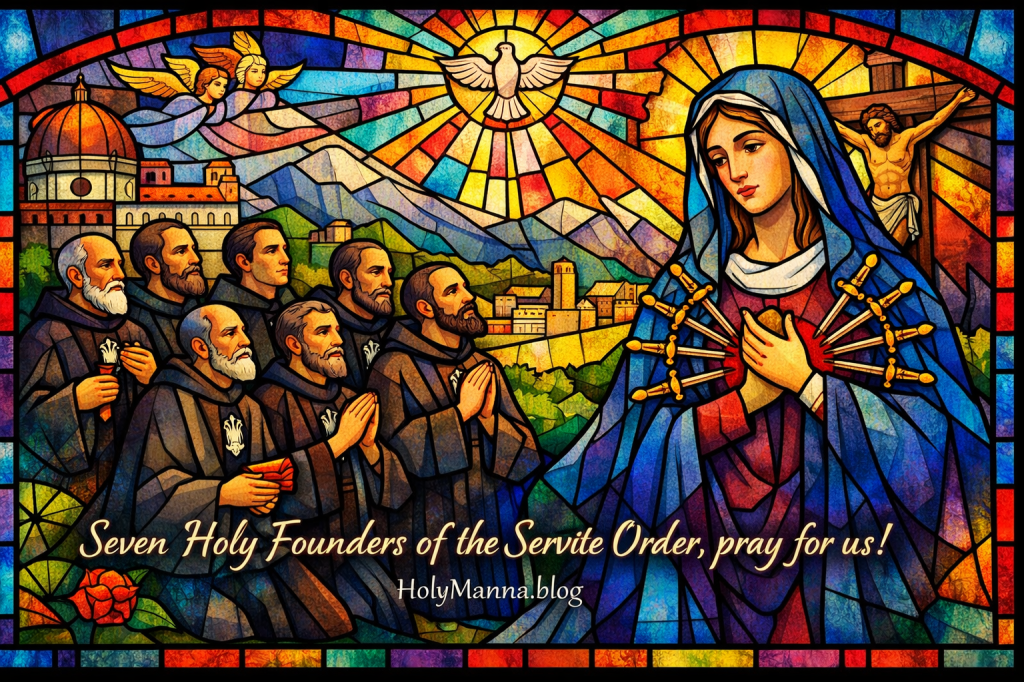
Seven Friends, One Mission
Some saints are remembered for what they accomplished alone. The Seven Holy Founders are remembered because they refused to walk alone, and their unity became a witness the Church still needs. They were seven Florentine laymen who stepped away from status and comfort to become the first “Servants of Mary,” and the Church honors them together because their holiness is a shared story, not a collection of separate legends. Their legacy is the Servite Order, a Marian family in the Church whose spirituality stays close to Jesus through Mary, especially in her Sorrows.
This is the kind of Marian devotion that is never sentimental and never shallow. It is Catholic devotion that leads straight into the mystery of Christ, and the Church teaches that authentic devotion to the Blessed Virgin is “intrinsic to Christian worship” because it draws souls more deeply into the life of Christ, as taught in CCC 971. The Founders teach that Mary is not a distraction from discipleship. Mary is a mother who forms disciples who are willing to carry the Cross.
From Florence’s Noise to a Serious Yes
Thirteenth century Florence was strong, wealthy, and proud, but it was also divided, loud, and politically tense. These seven men were not sheltered monks raised far from temptation and pressure. They were lay Catholics of the city, remembered in Catholic tradition as men of means and influence who belonged to a Marian confraternity that publicly honored the Blessed Virgin. Their faith already had roots, which is often how God works, because grace builds on what is already planted.
Then the call became sharper. Servite tradition remembers a Marian prompting that moved them to renounce their former life and embrace prayer, penance, and fraternity together. This was not an irresponsible escape, and that detail matters. Some were married or widowed, and Catholic sources emphasize that they made arrangements with real prudence before withdrawing, which reflects how the Church understands conversion as a grace that strengthens responsibility rather than removing it.
The Birth of a Marian Family
Their early common life began outside the city, and it soon took them to Monte Senario, where solitude and fraternity formed them into something stable and lasting. On that mountain they prayed, worked, fasted, and learned the slow holiness of obedience and charity. Their life was not designed to attract attention, but holiness tends to draw people in. Others began to seek counsel, vocations began to appear, and what started as a penitential brotherhood became a new religious family in the Church.
Their identity was Marian, but it was Marian in the most serious way. Servite spirituality is shaped by Mary’s fidelity in the Passion, because Mary stands where love is tested. Scripture speaks with quiet power when it says, “Standing by the cross of Jesus were his mother…” (Jn 19:25). The Church teaches that Mary is uniquely united to her Son’s saving work, especially in His suffering and offering, as taught in CCC 964. The Founders built their spiritual home in that mystery, and their order became known for drawing souls into the Passion of Christ through the heart of His Mother.
A Marian Identity That Always Leads to Jesus
Servite tradition also remembers Marian guidance connected to the early shape of their life, including the black habit associated with mourning and Mary’s Sorrows, and their community’s organization under the Rule of Saint Augustine. These traditions are not treated as new doctrine. They are remembered as part of the Servite family’s origins, expressing the same Catholic pattern seen across centuries: when Mary is loved rightly, she leads souls toward deeper obedience to Christ and greater love for the Church.
A short line preserved in the founding tradition captures how the Servites understood their identity from the beginning: “I have chosen you to be my first Servants.” That sentence is not important because it is dramatic. It is important because it describes the fruit that followed. The Founders belonged to Mary so that Mary could lead them more perfectly to her Son, the same Mother who always points away from herself and toward Jesus, just as she says at Cana: “Do whatever he tells you.” (Jn 2:5).
The Deeper Miracle of Conversion
When Catholics hear the word “miracle,” the mind often jumps to public healings or extraordinary signs. With the Seven Holy Founders, the most consistent miracle tradition is tied to their origin story and to the graces surrounding their vocation in Servite memory, especially the Marian guidance connected to their foundation. Yet there is also a deeper miracle that can be missed if the focus stays only on spectacle. Seven men renouncing comfort together, embracing penance, and persevering in unity for decades is not a normal human story. It is the kind of thing that happens when grace is doing the heavy lifting.
Their unity itself became a sign in a city known for conflict. Community life tests a person in ways private devotion never can, because pride, impatience, and selfish habits get exposed quickly when daily life is shared. The Founders kept their brotherhood together, and their fidelity became fertile ground for holiness in later generations of Servites. Catholic tradition remembers that within the early Servite world, sanctity continued to blossom, including miracles and notable works of charity in the wider Servite family, which shows that the Founders did not merely start an institution. They planted a living tree of prayer and penance that kept bearing fruit.
The Long Trial of Perseverance
Not every saint is martyred by execution. Some saints are tested by endurance, by misunderstanding, and by the slow purification that happens when enthusiasm fades and ordinary days remain. Leaving comfort sounds heroic until the routine sets in. Prayer has seasons that feel dry, penance has seasons that feel heavy, and fraternity has seasons where charity must be chosen deliberately. Their holiness includes the quiet courage of staying faithful when no one is applauding.
Their era also included real tension around new religious movements, and mendicant communities could face skepticism or pressure. Servite history remembers periods of uncertainty when the order’s future did not look guaranteed. The Founders endured those pressures without rebellion, holding to fidelity and humility. Saint Alessio Falconieri, the last surviving Founder, becomes especially important here because he carried the founding spirit forward for decades after the others died, embodying the Catholic truth that perseverance is often the most demanding form of courage.
A Devotion That Keeps Converting Hearts
The Founders’ witness did not end at death. Their spiritual home at Monte Senario remained a place of prayer and pilgrimage, and their memory stayed united in the Servite family, even in the way they are honored together. Over the centuries, devotion to the Seven Founders matured in the life of the faithful and was eventually confirmed by the Church through their canonization. This is not a sentimental prize. It is the Church’s public judgment that they lived heroic virtue and now intercede for Christ’s people.
Their posthumous legacy is also visible in the shape of Catholic devotion. Servite spirituality has helped generations meditate on the Passion and on Our Lady of Sorrows in a way that is tender, honest, and Christ-centered. This kind of Marian devotion does not make Catholics gloomy. It makes Catholics faithful, because it teaches the heart to stay near the Cross instead of running from suffering. It also echoes the Church’s teaching that devotion to Mary fosters deeper worship of God when it is lived rightly, as taught in CCC 971.
Living Their Example in Everyday Life
The Seven Holy Founders offer a blueprint for Catholics who want their faith to be more than a label. Their story teaches that holiness grows when prayer becomes steady, when penance is embraced with humility, and when devotion to Mary leads straight to Jesus. Their example also challenges modern habits of isolation and spiritual consumerism. The Christian life is not meant to be lived alone, and it is not meant to be lived only when it feels inspiring.
A practical way to carry their spirit is to spend time with the Passion in The Gospel of John, especially the scenes that place Mary near the Cross, and to ask for the grace to stay faithful in ordinary trials. Another practical way is to embrace small penances as training in love, not as self-punishment, because the point of penance is freedom for charity. Their lives also invite Catholics to build real fraternity, to seek community, and to choose reconciliation over division, which is a deeply Marian way of living because Mary always gathers disciples around her Son.
Engage With Us!
Share your thoughts and reflections in the comments below. The Seven Holy Founders leave behind a beautiful challenge: to stop treating faith like an accessory and start living it like a real discipleship. Their story is not just history, because it still asks for a response today, especially in a world that rewards comfort and discourages sacrifice.
- Where has comfort quietly replaced conversion, and what would it look like to choose penance with love instead of guilt?
- How does devotion to Mary show up in daily life, and does it actually lead closer to Jesus and the Cross?
- What would a healthier Catholic brotherhood or community look like right now, and what is one step that could be taken this week to build it?
- When prayer feels ordinary or dry, what helps perseverance, and how can Mary’s fidelity at Calvary become a model?
Keep walking forward in faith with steadiness and courage. Keep choosing mercy over resentment, purity over compromise, and prayer over distraction. A life lived close to Jesus always makes room for the love He taught, the forgiveness He commanded, and the hope He died to give.
Seven Holy Founders of the Servite Order, pray for us!
Follow us on YouTube, Instagram and Facebook for more insights and reflections on living a faith-filled life.

 Holy Manna!
Leave a comment