Tuesday of the Sixth Week in Ordinary Time – Lectionary: 336
When God Feels Distant
There are days when the heart is doing the math, counting what is missing, rehearsing worst case scenarios, and quietly assuming that God must be the source of the struggle. Today’s readings step into that familiar headspace and correct it with fatherly clarity. The central theme tying everything together is simple and bracing: God does not tempt, God does not abandon, and God does not forget. What changes everything is whether His people will remember His goodness and guard their hearts when pressure rises.
The Letter of James speaks to Christians learning how to live faithfully in a world that still tugs at old desires. In the earliest years of the Church, believers faced ridicule, social pressure, and real hardship, and it was easy to interpret trials as rejection. James refuses that lie and teaches the spiritual mechanics of temptation. Temptation does not come from God, but from disordered desire that tries to lure the soul away from trust. At the same time, the reading insists that every truly good gift comes from above, from the Father who does not change. That matters because a suspicious heart will always interpret God through fear, but a disciplined heart learns to interpret fear through God.
That same lesson is prayed in Psalm 94, which comes from the worship of Israel shaped by exile, injustice, and the long ache for God to set things right. The psalm does not pretend that evil days are imaginary, but it also refuses to believe they are permanent. It blesses the one whom the Lord teaches, because divine instruction is not just information, it is formation. When the foot slips and the mind spirals, the psalm answers with a steadier truth: the Lord will not forsake His people, and His mercy holds them up when their strength runs out.
Then the Gospel lands the lesson in a scene almost too human to ignore. The disciples sit in a boat with Jesus and fixate on the fact that they forgot bread, even after they watched Him feed thousands. In that moment, Christ warns them about the leaven of the Pharisees and Herod, a quiet corruption that spreads through the heart: hardened unbelief, hypocrisy, and worldly calculation that treats God like a problem instead of a Father. Jesus keeps pressing one word because it is the hinge of discipleship: “Do you not remember?” The readings prepare the soul to see what the disciples missed. The real danger is not hunger in the boat, but a heart that forgets who is in the boat.
First Reading – James 1:12-18
Perseverance Turns the Test into a Crown
The Letter of James sounds like a pastor who loves his people enough to speak plainly. This is one of the earliest voices in the Church, written with a strong Jewish Christian flavor, where faith is not treated like a private opinion but like a lived covenant that has to survive real pressure. These believers knew what it felt like to be misunderstood, opposed, and tempted to interpret hardship as a sign that God was distant or displeased. That is why James goes straight for the heart of today’s theme. God does not seduce anyone into evil. God does not play games with His children. God gives good gifts, even when He permits trials that reveal what is really going on inside the human heart. In a world where people often blame God for their darkness, James teaches Christians to name the true enemy within, disordered desire, and to cling to the Father of lights who does not change.
James 1:12-18 – New American Bible (Revised Edition)
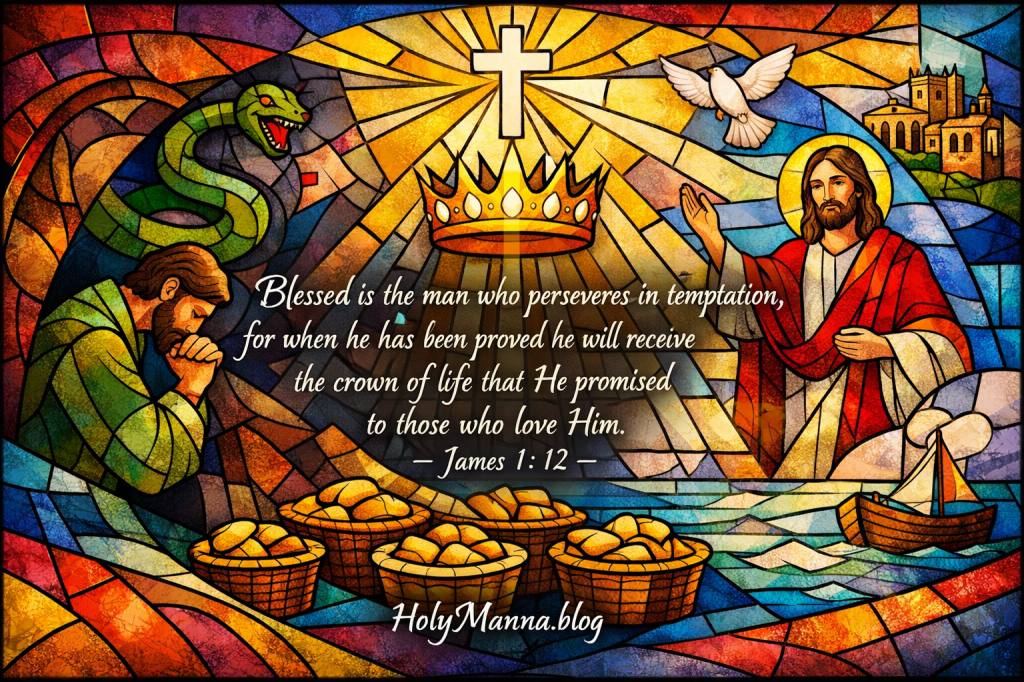
Temptation. 12 Blessed is the man who perseveres in temptation, for when he has been proved he will receive the crown of life that he promised to those who love him. 13 No one experiencing temptation should say, “I am being tempted by God”; for God is not subject to temptation to evil, and he himself tempts no one. 14 Rather, each person is tempted when he is lured and enticed by his own desire. 15 Then desire conceives and brings forth sin, and when sin reaches maturity it gives birth to death.
16 Do not be deceived, my beloved brothers: 17 all good giving and every perfect gift is from above, coming down from the Father of lights, with whom there is no alteration or shadow caused by change. 18 He willed to give us birth by the word of truth that we may be a kind of firstfruits of his creatures.
Detailed Exegesis
Verse 12. “Blessed is the man who perseveres in temptation, for when he has been proved he will receive the crown of life that he promised to those who love him.”
This verse sets the tone with a promise that feels almost too strong for how hard temptation can be. The blessing is not reserved for people who never struggle. The blessing is for the person who stays faithful in the struggle. The word “proved” points to the kind of testing that reveals authenticity, like metal refined by fire. The “crown of life” is not a metaphor for earthly success, but for eternal communion with God, the reward promised to those who love Him. Love is the key word here, because perseverance is not stubbornness. Perseverance is fidelity fueled by love.
Verse 13. “No one experiencing temptation should say, ‘I am being tempted by God’; for God is not subject to temptation to evil, and he himself tempts no one.”
This verse shuts down a common spiritual confusion. God is never the author of sin. God cannot be lured by evil, and He does not lure anyone else. Trials can be permitted by God for purification, humility, and growth, but temptation to sin does not come from the Father. This matters because blaming God becomes an excuse, and excuses keep the heart from repentance and healing.
Verse 14. “Rather, each person is tempted when he is lured and enticed by his own desire.”
Here the spotlight turns inward. Temptation often begins quietly, with a desire that is not governed by reason, faith, and charity. The language “lured and enticed” paints desire like bait on a hook. It promises comfort, control, pleasure, or revenge, but it is hiding a trap. This is not meant to shame anyone. It is meant to bring clarity. A Christian cannot fight an enemy that remains unnamed.
Verse 15. “Then desire conceives and brings forth sin, and when sin reaches maturity it gives birth to death.”
This is a sobering spiritual biology lesson. Desire is pictured as conceiving, sin is born, and death is the final child. The point is not that every desire is evil. The point is that desire unchecked, entertained, and consented to can become action, habit, and bondage. “Death” here includes spiritual death, the withering of friendship with God. It also points to the final tragedy of a life that refuses repentance. James is warning that temptation is never just a moment. It is a doorway.
Verse 16. “Do not be deceived, my beloved brothers”
This sounds like a loving interruption, like someone grabbing a friend by the shoulder before the friend walks into traffic. Deception is one of the most dangerous parts of temptation because it rewrites reality. It makes evil look harmless, it makes sin look reasonable, and it makes God look like a rival. James calls Christians back to sobriety, because a deceived heart cannot see clearly enough to choose freedom.
Verse 17. “All good giving and every perfect gift is from above, coming down from the Father of lights, with whom there is no alteration or shadow caused by change.”
This verse rebuilds trust. God is described as the “Father of lights,” the source of what is true, beautiful, and good. Unlike human moods, politics, and trends, God does not shift. There is no shadow of manipulation in Him. Temptation often whispers that God is withholding, but James insists that goodness is God’s identity. If something is truly good, it comes from Him.
Verse 18. “He willed to give us birth by the word of truth that we may be a kind of firstfruits of his creatures.”
This verse ties temptation and perseverance to a bigger story. Christians are not only forgiven, but they are also reborn. God “willed” it, which means salvation is not an accident and not a reluctant decision. “The word of truth” points to the Gospel proclaimed and received, the living Word that creates new life in the soul. “Firstfruits” is temple language from Israel’s worship, the first and best offered to God in hope of the harvest to come. The baptized are meant to be that sign, a people set apart, living proof that God is making all things new.
Teachings
This reading teaches a clean distinction that modern life often blurs. A trial can be permitted by God to strengthen faith, but temptation to sin is a distortion that tries to separate the soul from God. The Catechism teaches that God is never the cause of moral evil, even though He can permit suffering and draw good from it through His providence. That is the heart of Christian maturity. It stops accusing God and starts asking what grace is being offered in the struggle.
This reading also exposes the truth about the human heart. Temptation is not usually forced from the outside like a mugging. It is often invited from the inside through desires that are allowed to run the house. The Church has long taught that the wounded human condition includes a real interior battle, where passions and impulses can pull against reason and grace. That is why Christians are not called to pretend desire does not exist. Christians are called to have desire healed, ordered, and transformed.
The title “Father of lights” is especially important today because it answers the spiritual cynicism that spreads so easily. The Pharisees and Herod in the Gospel represent hearts that are calculating, hardened, and suspicious toward Jesus. James attacks that same poison at its root by insisting on God’s goodness and stability. If God is truly Father, then the right response to temptation is not despair, but repentance. The right response to trial is not accusation, but endurance. Saints across the centuries have warned that temptation often begins with a lie about God’s character. When God is seen as a rival, sin starts to look like relief. When God is known as Father, sin starts to look like theft.
Finally, this reading teaches Christians to think in terms of spiritual birth. God does not merely offer coping skills. God offers new creation through the word of truth. That is why the Church never treats temptation as a private drama that does not matter. Temptation is a crossroads where the baptized either grow into their identity as firstfruits or drift back toward the old slavery of sin. The grace is real, and the call is real, because God intends His children to live as signs of His light in a dark world.
Reflection
This passage lands right where real people live. Temptation often shows up when someone is tired, overstimulated, lonely, irritated, or quietly resentful. It whispers that a small compromise will bring peace, or that a secret indulgence will take the edge off, or that bitterness is justified because life feels unfair. James does not treat that battle as mysterious. He calls it what it is and then points the heart back to the Father who gives good gifts.
A practical way to begin is to slow down long enough to identify the desire before it grows legs. If desire is the bait, then naming it breaks the spell. A person can say, “This is the temptation for control,” or “This is the temptation to be admired,” or “This is the temptation to escape discomfort,” and that honest naming makes room for grace. It also helps to replace the lie with truth. God is not tempting anyone. God is providing a path to life, even if it feels like a narrow road in the moment.
Perseverance becomes more realistic when the heart remembers the promise attached to it. The crown of life is not earned by perfect performance. It is received by those who love God and keep returning to Him when they fall. That is why the Christian response to failure is never hiding. The Christian response is repentance, sacramental mercy, and a fresh beginning, because the Father of lights does not change.
Where has temptation tried to convince the heart that God is the problem instead of the healer?
What desire has been luring the soul lately, and what practical boundary would protect freedom today?
If every good gift comes from the Father, what good gift has been overlooked out of fear, distraction, or cynicism?
A week shaped by this reading looks quietly different. It looks like examining the heart honestly, asking for wisdom before reacting, cutting off the path to predictable falls, and choosing trust when emotions want to accuse God. It looks like remembering that the same Father who permits a test also promises a crown, and He does not break promises.
Responsorial Psalm – Psalm 94:12-15, 18-19
When the Foot Slips, Mercy Holds the Whole Person Up
Psalm 94 is the kind of prayer that sounds like it was written with real bruises, not theories. It comes from the worshiping life of Israel, where faith was lived under pressure from unjust leaders, hostile neighbors, and long seasons when God’s timing felt slow. In that world, it was tempting to assume the Lord had stepped away or that evil was winning. Today’s psalm answers that temptation with a steady rhythm of truth: the Lord teaches His people, disciplines them like a father, and refuses to abandon His inheritance. This fits perfectly with today’s theme because it trains the heart to interpret hardship the right way. God is not the one luring the soul into sin. God is the one holding the soul upright when strength fails. The psalm places trust where it belongs, not in perfect circumstances, but in the mercy and instruction of the Lord.
Psalm 94:12-15, 18-19 – New American Bible (Revised Edition)
12 Blessed the one whom you guide, Lord,
whom you teach by your instruction,
13 To give rest from evil days,
while a pit is being dug for the wicked.
14 For the Lord will not forsake his people,
nor abandon his inheritance.
15 Judgment shall again be just,
and all the upright of heart will follow it.18 When I say, “My foot is slipping,”
your mercy, Lord, holds me up.
19 When cares increase within me,
your comfort gives me joy.
Detailed Exegesis
Verse 12. “Blessed the one whom you guide, Lord, whom you teach by your instruction,”
This blessing does not belong to the person who never struggles. It belongs to the person who allows the Lord to guide and teach. In the biblical world, instruction is not merely information. It is formation, like a father training a child to walk straight. This verse frames divine guidance as a gift, not a restriction. It also shows that God’s love often arrives as teaching that corrects, strengthens, and steadies the heart.
Verse 13. “To give rest from evil days, while a pit is being dug for the wicked.”
The psalm is honest that there are “evil days,” seasons marked by injustice, hardship, and confusion. The “rest” God gives is not always immediate comfort, but interior stability that keeps the soul from panic and revenge. The image of a pit being dug for the wicked is a reminder that evil is not ultimately in control. Even when the wicked look untouchable, their path is already collapsing under the weight of divine justice.
Verse 14. “For the Lord will not forsake his people, nor abandon his inheritance.”
This is covenant language. Israel is not simply a crowd. Israel is God’s people, His inheritance, His chosen possession. The Lord’s faithfulness is not based on human perfection but on His own promise. This verse pushes back against the fear that suffering means abandonment. It insists that the Lord’s commitment is stronger than the moment.
Verse 15. “Judgment shall again be just, and all the upright of heart will follow it.”
This verse acknowledges that justice can seem delayed, but it will not be denied. When judgment is just, the upright recognize it and follow it, because the upright do not crave chaos. They crave truth. This is also a quiet warning against becoming cynical. The temptation in evil days is to believe justice will never return, and then to justify compromise. The psalm calls the heart to remain upright and to wait with integrity.
Verse 18. “When I say, ‘My foot is slipping,’ your mercy, Lord, holds me up.”
This is one of the most personal lines in the psalter. The foot slipping is the moment of instability, when anxiety rises, when temptation feels persuasive, when patience wears thin, and when a person senses the edge of a fall. The answer is not self-confidence. The answer is mercy. The Lord does not merely give advice from afar. He holds His child up. Mercy here is not sentimental. Mercy is strength that intervenes.
Verse 19. “When cares increase within me, your comfort gives me joy.”
The psalm does not treat worry like a small problem. It describes cares multiplying inside, like a crowded room that gets louder by the minute. Yet the Lord’s comfort does not merely reduce stress. It gives joy, which is deeper than mood. This kind of joy is the quiet assurance that God remains Father, that the story is not over, and that faithfulness is possible even in the middle of pressure.
Teachings
This psalm teaches a thoroughly Catholic way of suffering that refuses two extremes. It refuses despair, which assumes God has abandoned His people. It also refuses the illusion that the Christian life is meant to be painless. Instead, it presents the biblical pattern of divine pedagogy, where God teaches, corrects, and guides His children through real trials toward stability and holiness.
The Catechism describes this relationship using language of filial trust and the realism of spiritual combat. It teaches that prayer is inseparable from the battle of faith, and that perseverance is shaped precisely in moments when the heart feels weak. The psalm’s line about slipping feet is what that looks like in lived prayer. The heart admits weakness, then leans on mercy. The Church also teaches that God’s providence is at work even when evil seems loud, and that divine justice will not fail, even if it is delayed in time.
The Fathers of the Church often read Psalm 94 as a school of patience. St. Augustine, preaching on this psalm, frames its message as endurance in the sufferings of the righteous, not a shortcut around them. He warns against interpreting God’s patience as God’s absence, and he encourages believers to remain steady, trusting that the Lord is shaping the heart and will set things right. This connects directly with the temptation described in James. A deceived heart blames God and compromises. A trained heart prays, waits, and remains upright.
Historically, Israel sang psalms like this in seasons of national humiliation and moral confusion, when foreign powers dominated and corrupt leaders exploited the weak. That background matters because it shows how realistic this prayer is. The psalm was not created in a calm living room. It was forged in hardship. That is why it has the weight to train Christian hearts today, especially in a culture where people are constantly told that peace comes from control, comfort, and winning arguments. The psalm teaches that peace comes from belonging to the Lord who does not abandon His inheritance.
Reflection
This psalm is for the person who feels the inner wobble, the moment when the foot starts slipping toward old habits, harsh words, secret bitterness, or numb escapism. It gives permission to say out loud what pride hates to admit: the heart is not always steady. Then it offers the better confession: mercy holds the soul up.
A practical way to live this psalm is to treat God’s instruction as a shelter rather than a constraint. The Lord guides through Scripture, through the Church’s teaching, through conscience properly formed, and through the steady discipline of prayer. When cares increase, the temptation is to scroll, snack, distract, or lash out. The psalm invites a different move. It invites a pause that turns into prayer, even if the prayer is simple and honest. The psalm also calls for patience with God’s timing. Evil days do not mean God is absent. Evil days are often the classroom where trust becomes real.
Where has the foot been slipping lately, and what situation tends to trigger that loss of balance?
When cares increase within, where does the heart instinctively run for comfort, and is that comfort actually leading toward joy?
What would change this week if God’s instruction were received as loving guidance instead of criticism?
This psalm does not promise that the week will be easy. It promises something better. It promises that the Lord will not forsake His people, and that when weakness is admitted, mercy can hold the whole person upright.
Holy Gospel – Mark 8:14-21
The Real Hunger Is Forgetting Who Is in the Boat
This scene unfolds in the gritty, ordinary setting of a boat crossing, the kind of daily moment where discipleship gets tested not by dramatic persecution but by simple stress. In first century Galilee, bread was not a side detail. Bread was survival. A forgotten loaf could feel like a real problem, especially on water, away from villages and markets. That is why this passage is so revealing. The disciples are sitting with Jesus after witnessing overwhelming miracles, and yet their minds collapse into scarcity thinking. They start whispering about what they do not have. Jesus, seeing deeper, warns them about “leaven,” a quiet influence that spreads through the whole heart. The Pharisees represent a religious posture that can look faithful on the outside while resisting God on the inside. Herod represents worldly calculation, fear, and compromise with power. Together they form a spiritual toxin: a hardened heart that forgets God’s works and replaces trust with suspicion. This is the perfect capstone to today’s theme. Temptation often begins with a lie about God’s goodness, and anxiety often grows when memory of God’s providence goes dim. Jesus calls His disciples back to remembrance so their hearts can stay soft and alert.
Mark 8:14-21 – New American Bible (Revised Edition)
The Leaven of the Pharisees. 14 They had forgotten to bring bread, and they had only one loaf with them in the boat. 15 He enjoined them, “Watch out, guard against the leaven of the Pharisees and the leaven of Herod.” 16 They concluded among themselves that it was because they had no bread. 17 When he became aware of this he said to them, “Why do you conclude that it is because you have no bread? Do you not yet understand or comprehend? Are your hearts hardened? 18 Do you have eyes and not see, ears and not hear? And do you not remember, 19 when I broke the five loaves for the five thousand, how many wicker baskets full of fragments you picked up?” They answered him, “Twelve.” 20 “When I broke the seven loaves for the four thousand, how many full baskets of fragments did you pick up?” They answered [him], “Seven.” 21 He said to them, “Do you still not understand?”
Detailed Exegesis
Verse 14. “They had forgotten to bring bread, and they had only one loaf with them in the boat.”
This verse sets the human tension. The disciples are not plotting evil. They are distracted and anxious. The detail of “one loaf” matters because it highlights their narrow focus on scarcity, even with Jesus present. It also quietly foreshadows the deeper truth that they do not recognize: the true Bread is with them, and they are acting as if God is absent.
Verse 15. “He enjoined them, ‘Watch out, guard against the leaven of the Pharisees and the leaven of Herod.’”
Jesus issues a warning with urgency. Leaven works invisibly, and that is the danger. A small interior attitude can spread until it shapes perception, decisions, and character. The leaven of the Pharisees is not simply a different opinion. It is a resistant posture that can hide behind religious language while refusing conversion. The leaven of Herod is the mindset that reduces truth to strategy and morality to convenience. Jesus is teaching vigilance because the heart can be influenced without noticing.
Verse 16. “They concluded among themselves that it was because they had no bread.”
The disciples misunderstand Jesus in a very relatable way. They interpret a spiritual warning as a practical scolding. This is what anxiety does. It shrinks the horizon of the mind until everything sounds like a threat. It also shows how easily the heart can become self-focused, even after grace filled experiences.
Verse 17. “When he became aware of this he said to them, ‘Why do you conclude that it is because you have no bread? Do you not yet understand or comprehend? Are your hearts hardened?’”
Jesus responds with questions that expose the real issue. The problem is not the missing bread. The problem is the hardened heart, a heart that has seen miracles and still interprets life as if God cannot be trusted. In Scripture, hardness of heart is a spiritual condition where the person resists grace, forgets God’s deeds, and becomes slow to believe. Jesus is not insulting them. He is diagnosing them, like a divine physician who refuses to let the disease spread.
Verse 18. “Do you have eyes and not see, ears and not hear? And do you not remember,”
Jesus echoes the language used by the prophets when Israel drifted into spiritual dullness. The issue is not physical eyesight or hearing. The issue is perception. A heart affected by leaven sees reality through suspicion, pride, or fear. The final phrase is the hinge: “Do you not remember.” Memory of God’s works is not nostalgia. It is spiritual sanity.
Verse 19. “When I broke the five loaves for the five thousand, how many wicker baskets full of fragments you picked up?’ They answered him, ‘Twelve.’”
Jesus points to a concrete event they personally experienced. The twelve baskets are not trivia. Twelve evokes the twelve tribes of Israel, suggesting fullness and God’s covenant provision. Jesus is reminding them that God does not merely provide enough. God provides with abundance. Their worry is incompatible with what they saw and touched.
Verse 20. “When I broke the seven loaves for the four thousand, how many full baskets of fragments did you pick up?’ They answered him, ‘Seven.’”
Again Jesus forces remembrance, this time of the second multiplication. Seven in biblical symbolism often points to completeness. The point is not numerology for its own sake. The point is that Jesus has already demonstrated that scarcity is never the final word when the Lord is present. Their anxiety is a spiritual amnesia that needs healing.
Verse 21. “He said to them, ‘Do you still not understand?’”
This final question lands with weight. Understanding here is not mere intelligence. It is faith, perception, and trust. Jesus is calling them to move from superficial thinking to deeper discipleship, where the heart remains alert to corruption, remembers God’s works, and trusts the Lord’s providence even when circumstances feel tight.
Teachings
This Gospel teaches that the biggest danger in the Christian life is not always open rebellion. Often the greater danger is quiet interior corruption that changes how a person interprets God. That is what leaven does. It spreads slowly until it shapes the whole loaf. Jesus names two kinds of leaven because they are still common today. One kind hides behind religious appearance while resisting conversion. The other kind is worldly calculation that fears man more than God.
The Church teaches that faith is a real act of the intellect and will, but it is also vulnerable to spiritual dullness. The heart can become hardened through repeated compromise, pride, or fear. That is why vigilance is part of discipleship. A Catholic cannot coast into holiness. Holiness requires guarding the heart, forming the conscience, and staying close to the sacramental life where grace strengthens what is weak and heals what is wounded.
This passage also teaches the importance of remembrance. In the Bible, remembering is not simply recalling facts. Remembering is bringing God’s deeds into the present so the heart can interpret today correctly. Israel repeatedly fell into sin by forgetting the Exodus and God’s providence. The disciples are repeating the same pattern in miniature. Jesus is rebuilding their faith by forcing them to name what they saw. The baskets of fragments are like receipts of divine generosity. The Lord is teaching them to live from evidence of His faithfulness rather than from the panic of the moment.
The Catechism speaks about temptation and spiritual combat in a way that fits this passage closely. It teaches that discernment is needed to distinguish between trials that strengthen and temptations that lead to sin and death, and it teaches that the petition “lead us not into temptation” asks for grace not to enter the path that leads to sin. Here is the Church’s language in full: CCC 2847 says, “The Holy Spirit makes us discern between trials, which are necessary for the growth of the inner man, and temptation, which leads to sin and death. We must also discern between being tempted and consenting to temptation.” This is exactly what Jesus is doing in the boat. He is helping them discern the interior leaven before it turns into consented unbelief.
The saints often describe this same battle as a fight for attention and trust. When fear takes over, the mind starts to interpret God as absent and the heart starts to treat prayer like a last resort. Jesus refuses that pattern. He corrects His disciples not to shame them, but to save them from becoming the kind of religious men who saw the Light and still chose darkness.
Reflection
This Gospel is painfully current because it describes what happens when the mind runs on scarcity and the heart forgets what God has already done. It is easy to laugh at the disciples until the same pattern shows up in daily life. A person can have a history of answered prayers and still panic when money gets tight, when health feels uncertain, when a relationship is strained, or when temptation feels relentless. The boat becomes any situation where control feels limited, and the missing bread becomes the thing that seems too urgent to ignore.
Jesus’ warning about leaven invites an honest examination of what has been quietly shaping the heart. It is possible to be around holy things and still carry a Pharisee like resistance to repentance. It is also possible to be practical and responsible while still carrying a Herod like fear of losing comfort or status. The Gospel invites a cleaner, calmer way of living. It begins with vigilance, refusing the small compromises that spread. It continues with remembrance, deliberately recalling concrete moments of God’s provision. It ends with trust that is not naive, but trained.
A strong practical step is to build a habit of spiritual memory. It helps to recall specific times when God provided, protected, or guided, and to bring those memories into prayer when anxiety starts narrating the day. It also helps to guard speech, because anxious murmuring spreads like leaven through a household, a workplace, or a friend group. Jesus calls His disciples to a different kind of conversation, one rooted in faith and truth.
Where has the heart been acting as if the Lord is not in the boat, even though the Lord has been faithful again and again?
What leaven has been quietly influencing the way God is perceived, religious pride that refuses repentance, or worldly fear that refuses trust?
What would change this week if the mind remembered God’s past provision before reacting to today’s pressure?
This Gospel leaves the soul with a firm but hopeful question: “Do you still not understand?” It is not a question meant to crush. It is a question meant to awaken. The Bread of Life is not far away. He is present, and He is teaching His people to see clearly, remember deeply, and trust fully.
Keep the Heart Soft and the Memory Sharp
Today’s readings land like a single conversation from a good Father who knows how easily His children get distracted. James 1:12-18 makes the first correction with clarity: God does not tempt anyone into evil, and the lie that blames God only deepens the trap. Temptation grows when disordered desire is entertained, but perseverance in the test leads to life, not defeat. The reading also restores trust by naming God’s true identity as the giver of every good gift, the Father of lights who does not change.
Psalm 94 then becomes the prayer a believer needs in the middle of the struggle. It blesses the one whom the Lord teaches, because divine instruction is not punishment, but guidance that steadies the soul. When the foot slips and cares multiply within, the psalm refuses to pretend everything is fine, yet it refuses despair even more. It insists that the Lord will not forsake His people, and it dares to say out loud that mercy holds the whole person up.
Finally, The Gospel of Mark 8:14-21 shows what happens when spiritual memory fades. The disciples panic about bread while sitting in the boat with the One who fed thousands. Jesus warns them about the leaven of the Pharisees and Herod, the quiet interior corruption that turns faith into suspicion and discipleship into calculation. Then He presses the question that ties the whole day together: “Do you not remember?” A hardened heart forgets. A faithful heart remembers. A guarded heart refuses the leaven that spreads cynicism, pride, and fear.
This is the invitation for today. Do not let anxiety rewrite the story. Do not let temptation convince the soul that God is the enemy. Instead, guard the heart, name the desire before it becomes sin, and practice remembrance of God’s real provision. Bring the slipping foot to mercy. Bring the crowded mind to the Lord’s comfort. Bring the fearful calculations to the Bread of Life who is already in the boat.
Let this day become a turning point in small, concrete ways. Choose prayer before panic, honesty before excuses, and repentance before compromise. Ask God for a heart that stays teachable, because a teachable heart stays free. Walk into the next temptation with humility and vigilance, trusting that perseverance is not wasted, and that the Father who gives good gifts will never abandon His inheritance.
Engage with Us!
Share your reflections in the comments below, because the Word of God comes alive when believers listen together, wrestle honestly, and encourage one another toward holiness.
- First Reading, James 1:12-18: Where has temptation tried to convince the heart that God is withholding or distant, and what specific disordered desire tends to lure the soul off course in those moments?
- Responsorial Psalm, Psalm 94:12-15, 18-19: When the foot feels like it is slipping, what practical habit helps the soul receive the Lord’s instruction and experience His mercy holding it up instead of giving in to panic or resentment?
- Holy Gospel, The Gospel of Mark 8:14-21: What “leaven” has been quietly influencing the heart lately, and what concrete memory of God’s past provision could be brought to mind today to replace fear with trust?
Keep walking forward with confidence, because God does not abandon His people and Jesus does not stop teaching His disciples. Live this week with a guarded heart and a grateful memory, and do every ordinary task with the faith, love, and mercy that Jesus taught, so that daily life itself becomes a witness to the Gospel.
Sacred Heart of Jesus, we trust in You!
Immaculate Heart of Mary, pray for us!
Saint Michael the Archangel, defend us in battle!
Follow us on YouTube, Instagram and Facebook for more insights and reflections on living a faith-filled life.

 Holy Manna!
Leave a comment