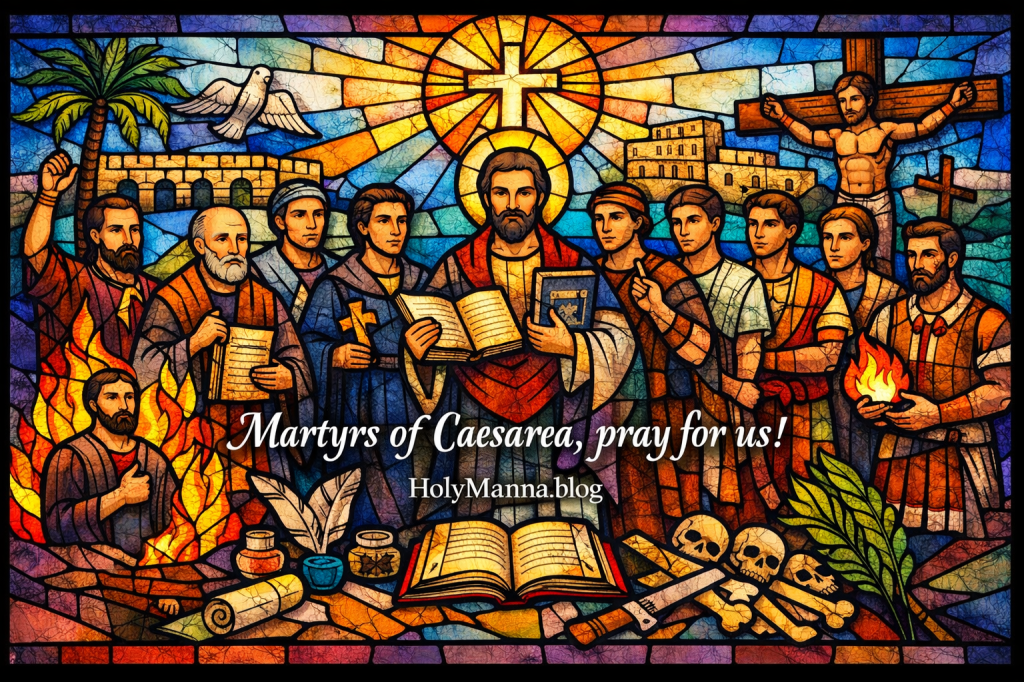
The Library of the Brave
Saint Pamphilus and his companions shine in the Church’s memory because their witness shows how Catholic the early Church already was. It was not a private club of intellectuals, and it was not a political faction hiding in the shadows. It was a family made of different kinds of people, united by one Lord, one faith, and one baptism. In Caesarea, that family was tested under persecution, and instead of breaking apart, it became more radiant.
Saint Pamphilus was a priest, a teacher, and a guardian of Christian truth. His companions included Valens the deacon, Paul a confessor who had already suffered for Christ, Seleucus a former soldier known for serving Christians in danger, Theodulus connected to the governor’s household, Julian a traveler who could not stay silent, Porphyry the young disciple who honored the dead, and five young Egyptians whose courage still sounds fresh today. Their story matters because it makes one thing plain. Christianity is meant to be lived, even when it costs something.
The Church reveres them because martyrdom is not just a tragic ending. It is a supreme witness to the truth of the faith. The Catechism teaches that martyrdom is the highest testimony given to the truth of the faith, and it means bearing witness even unto death for Christ (CCC 2473 to 2474). These martyrs prove that Jesus is not an idea. Jesus is worth everything.
Pamphilus Chooses the Gospel
Saint Pamphilus was formed in a world where education mattered and status opened doors. Catholic tradition places his beginnings in the region of Beirut, and he is remembered as a man of means who did something that still feels shocking. He gave away his wealth to serve the poor, and he dedicated his mind to the service of the Word of God. This was not a dramatic social statement. It was obedience to Christ, who calls His disciples to love the least with real sacrifice and to store up treasure in Heaven.
Pamphilus pursued serious Christian formation, including strong ties to the learning associated with Alexandria. In that era, Alexandria was a major center of Christian study, and Pamphilus absorbed that disciplined love for truth. When he later came to Caesarea and was ordained a priest, he did not treat learning as something separate from holiness. He treated learning as service. He wanted Christians to be fed by Scripture and strengthened by sound teaching, especially when fear and confusion were pressing in from every side.
This was also a time when owning Christian writings could put a target on a believer’s back. Pamphilus became the kind of man who protected truth without turning cold or bitter. He learned the heart of the Church early. Charity without truth becomes sentimentality. Truth without charity becomes cruelty. Pamphilus held both together with the steady patience of a shepherd.
Scripture as Bread for the Hungry
If Saint Pamphilus were alive today, people might assume he was simply an academic. That would miss the point. His scholarship was deeply pastoral. He is remembered for building and expanding the famed library and scriptorium of Caesarea, gathering manuscripts, preserving Christian writings, and making careful copies of Scripture. This was not merely organizing books. It was guarding the Church’s memory so future believers could hear the voice of God clearly.
What makes Pamphilus especially compelling is how his love for Scripture became generosity. He did not cling to texts as rare collectibles. He was known for providing copies to those who could not afford them, treating the Word of God like bread that must be shared. In an age when copies were made by hand, that kind of generosity required time, expense, and patience. It also required conviction that God’s Word is worth laboring for, and worth passing on.
Pamphilus was also connected to the complicated story of Origen, a brilliant early Christian thinker whose legacy later became controversial. Pamphilus worked on a defense of Origen, not as a way of blessing every speculation, but as a way of defending what he believed was faithful teaching and good intent. That detail reveals a saint who loved truth enough to work carefully, and loved the Church enough to avoid turning theological disputes into hatred. It takes maturity to defend what is good without pretending there are no problems. Pamphilus lived that maturity.
Ordinary Men with Uncommon Courage
The companions of Pamphilus are the kind of people modern Catholics should think about when the world says faith is just a private hobby. These were real men with real social pressures who chose Christ anyway. Their group is often remembered as twelve, a number that echoes the apostles and suggests the Church standing firm like a living icon of God’s people. It is as if Providence placed a complete picture of Christian life in Caesarea so the faithful could see what endurance looks like.
Valens, a deacon tied to the Church of Jerusalem, was remembered for his deep familiarity with Scripture, even carrying it in memory. That kind of devotion was not sentimental. It was dangerous, because the Scriptures formed believers into confessors. Paul is remembered as someone who had already suffered for Christ before the final trial, and his earlier wounds became part of his final witness. Seleucus, once a soldier, is remembered for compassionate service to Christians under persecution. He did not use strength to dominate. He used strength to protect and to help.
Theodulus is one of the most striking figures because he was connected to the governor’s household, which is where compromise often begins. Yet he confessed Christ anyway. Julian arrived as a traveler, but when he saw the martyrs, he could not pretend nothing was happening. He honored them publicly and paid the price. Porphyry, the young disciple close to Pamphilus, showed courage that still challenges comfortable believers. He pleaded for the bodies to be released for burial, and that simple act of mercy exposed him to brutal punishment. These men remind the Church that holiness is not built on perfect circumstances. Holiness is built on fidelity.
Prison and Trial
Persecution did not come like one quick blow. It came as a grinding pressure that tested endurance. Pamphilus and others suffered a long imprisonment, often described as around two years, where deprivation and fear were meant to break their resolve. This is where the story becomes painfully relevant. Many people can be brave for a moment. Few can be faithful for a long season. Pamphilus and his companions show the strength that grows when prayer becomes stubborn and hope becomes disciplined.
As the persecution tightened, five young Egyptians entered the story and changed everything. They had accompanied Christians condemned to harsh labor in the mines, and they were arrested near Caesarea for openly confessing Christ. When they were questioned and pressured to name their city, one of them answered with a truth that sounded like madness to pagan ears. He claimed Jerusalem, not as a political address, but as a heavenly identity, echoing Saint Paul’s teaching that the Jerusalem above is our mother in Galatians 4:26. The world demanded a name on a map. These Christians offered citizenship in the Kingdom.
The governor treated this confession as rebellion or deception and responded with cruelty. The message was clear. If Christians insisted they belonged to another Kingdom, Rome would punish them as a threat. The martyrs answered with the only response that makes sense for disciples of Christ. They stayed faithful, and their fidelity became a kind of preaching that no courtroom could silence.
Fire and Steel
The deaths of Pamphilus and his companions were intended to shame them and frighten the Church. Instead, their deaths became a sermon that outlived the empire. Pamphilus, Valens, Paul, and others were condemned to be beheaded. The sword was meant to silence the Word, yet the Word only spread further. Porphyry was burned after asking for the bodies to be buried. Julian was also burned after honoring the martyrs. Theodulus was crucified, which carries a chilling symbolism for Christians because it echoes the Cross of the Lord. The persecutors tried to make examples of them. God made them witnesses.
Eusebius, the Church historian who lived in Caesarea and knew Pamphilus, spoke of him with deep reverence, calling him “my lord Pamphilus.” That phrase is not exaggerated devotion. It is the voice of a Christian who saw holiness up close and never forgot it. In a Catholic understanding, the meaning of their martyrdom is not merely historical. The Church teaches that martyrdom is the supreme witness to the truth of the faith, because it unites a person to Christ who died and rose (CCC 2473 to 2474). The martyrs do not worship death. They worship the living God, and they would rather die than deny the One who saved them.
A Legacy That Still Feeds the Church
One of the striking details preserved in the ancient account is what happened after the executions. Their bodies were left exposed as a final insult, yet they were reported to remain untouched for days, even though animals were present. To the early Christians, this was a sign of God’s care, a way of showing that the martyrs were not abandoned. Eventually the faithful were able to recover the bodies and bury them with honor, and even that burial became a confession that the martyrs belonged to Christ.
The longer legacy of Saint Pamphilus is also deeply practical. His work with texts and manuscripts helped preserve the Church’s resources for biblical study and theological reflection. Later saints and scholars benefited from what was gathered at Caesarea. In a sense, Pamphilus continued feeding the Church long after he died, because careful scholarship can become an act of love when it serves the faith of ordinary believers.
The Church’s devotion to him and his companions is not based on nostalgia. It is family loyalty in Christ. The Catechism teaches that the saints remain united to us and do not stop interceding for the faithful, because the Communion of Saints is real (CCC 956). These martyrs are not distant figures. They are living members of the Church in glory, and their witness still strengthens those who are trying to remain faithful today.
Living as Citizens of the Heavenly Jerusalem
Saint Pamphilus and companions challenge modern believers in a direct way. Their story asks whether faith is only a comforting label or a real allegiance. The five Egyptians who confessed Jerusalem were not trying to be clever. They were telling the truth about where they belonged. That same truth still applies. A Catholic belongs to the Church, and the Church is not a club. The Church is the Body of Christ, built for Heaven, sent into the world, and tested by the world.
A practical way to imitate Saint Pamphilus begins with a renewed love for Scripture and sound teaching. It is easy to drift into a shallow faith that lives on slogans. Pamphilus shows that the Word of God deserves attention, patience, and reverence. Even a few minutes a day with the Gospels can reshape a person’s conscience. This also means guarding the mind, because not every loud voice deserves a place in the heart. The saints show that truth is not invented. Truth is received.
The companions teach courage in public life. They were not reckless, but they were not ashamed. Their witness encourages Catholics to practice the faith with consistency at home, at work, and in community. That might look like refusing dishonest shortcuts, choosing purity, keeping Sunday holy, or speaking calmly about Christ when it would be easier to stay silent. Saint Pamphilus also teaches charity that is concrete. He gave away wealth, served the poor, and shared spiritual nourishment. A modern Catholic can imitate that by giving time, money, and attention to people who are easy to overlook.
How does this story speak to your heart today? The martyrs invite a serious answer, because their courage shows that love is strongest when it costs something, and faith becomes real when it is lived.
Engage with Us!
Share your thoughts and reflections in the comments below. What part of this story stayed with you the most?
- What would change in daily life if it was truly believed that citizenship is in Heaven before it is anywhere else?
- Where is the easiest place to “soften” the faith to avoid discomfort, and what would courage look like there?
- How can devotion to Scripture become more real and less rushed in everyday life?
- Saint Pamphilus served truth and served the poor. Which one is most neglected right now, and why?
- Who in life needs mercy and patience this week, and how can that be offered without needing recognition?
- What is one fear that needs to be placed under the Lordship of Jesus today?
Keep walking forward with faith. Keep speaking truth with charity. Keep choosing mercy over bitterness. Do everything with the love and mercy Jesus taught us, and trust that no act of fidelity is ever wasted in the Kingdom of God.
Martyrs of Caesarea, pray for us!
Follow us on YouTube, Instagram and Facebook for more insights and reflections on living a faith-filled life.

 Holy Manna!
Leave a comment