Chains of Courage
Saint Juliana is one of those early Christian witnesses whose name never stopped echoing in the Church, even when the paperwork of history got thin. She is honored as a virgin and martyr, remembered for a steadfast love for Jesus Christ that did not bend under pressure, fear, or pain. The Church’s memory of her is not built on hype, but on the quiet fact that Christians kept calling on her, building churches, reverencing relics, and passing down her feast day from generation to generation.
Catholic sources also admit something important, and it is worth saying plainly because truth matters. The later written “Acts” about Juliana contain legendary development, so not every dramatic scene can be treated like a modern biography. Still, her ancient veneration and the Church’s steady commemoration show that she was honored as a real martyr whose witness strengthened the faithful. The Catechism explains why the Church treasures martyrs so deeply: “Martyrdom is the supreme witness given to the truth of the faith.” (CCC 2473). Saint Juliana’s life is remembered because it is a real example of that supreme witness, even when some details are preserved mainly through devotional tradition.
A Hidden Childhood
Very little is securely known about Juliana’s childhood and family in the way people might want today. Some traditions associate her with Nicomedia, while other ancient notes and later Catholic memory connect her with southern Italy near Cumae and Naples. That mix can feel confusing, but it actually teaches a helpful lesson. The Church’s devotion is not a trivia game. The Church remembers saints because their holiness was real, their witness bore fruit, and their intercession strengthened the faithful across time.
In the traditional account, Juliana appears as a young woman raised in a pagan environment, often portrayed as the daughter of a pagan father and promised in marriage to a powerful pagan official. Those names and scenes belong to later devotional tradition, but the spiritual conflict behind them is timeless. A young Christian is pressured to compromise, and Juliana chooses Christ with a steady, undivided heart. This is where her life becomes personal for modern readers, because many people face the same pressure today, even if it looks more polite and less violent.
Her “conversion” is best understood as a deepening of faith rather than a dramatic change from atheism to belief. Juliana’s story, as the Church receives it, is about a woman who refused to split her life in half. She would not treat Jesus as a Sunday habit while living like everyone else the rest of the week. She belonged to Christ, and she understood that belonging to Christ touches everything, including the body, relationships, and the future.
The Bride of Christ
Juliana is most remembered for refusing a marriage that would require betrayal of her faith. In the traditional story, her suitor is not just a man asking for her hand. He represents the world’s demand that she sacrifice truth for comfort, popularity, and security. Juliana’s refusal is not stubbornness or pride. It is spiritual sanity. She will not pretend that idols are harmless, and she will not build her life on a lie.
This is also why Juliana is often honored as a model of chastity. Chastity is not merely avoidance of sin, and it is not a gloomy fear of the body. Chastity is the virtue that makes love truthful and free. The Catechism teaches that chastity is a moral virtue and a gift from God that integrates sexuality within the person and trains the heart for real love. (CCC 2337). Juliana’s witness is a reminder that purity is not weakness. Purity is strength that protects the soul, guards love, and refuses to be owned by the world’s appetites.
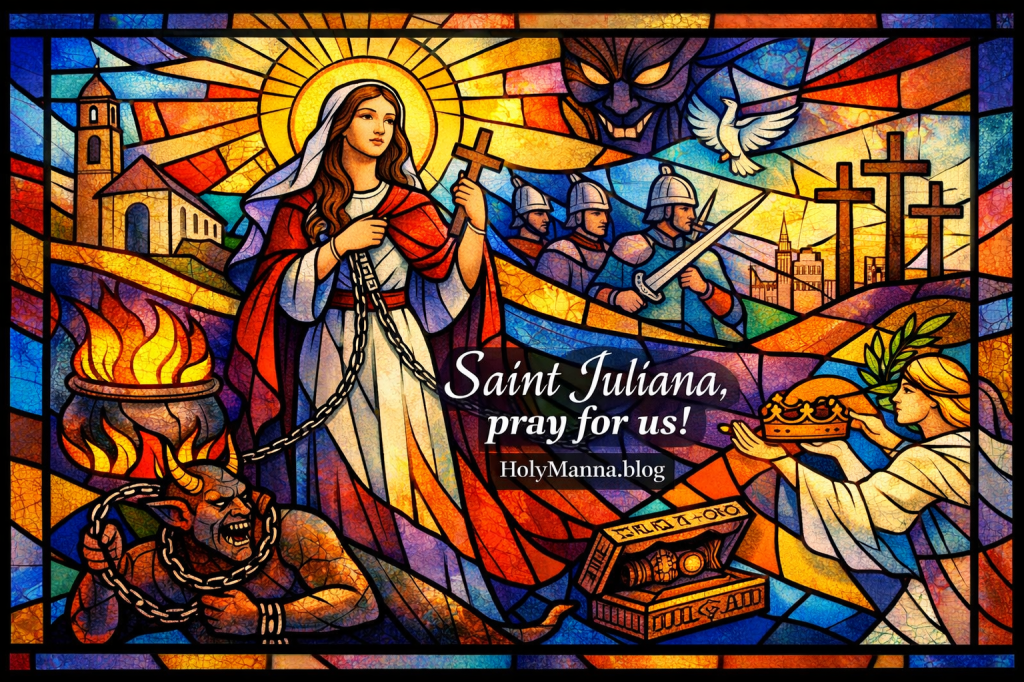
The tradition also keeps a vivid image tied to her witness. Juliana is sometimes shown in art with a demon chained or subdued, reflecting a famous prison episode in which she confronts deception and refuses to be intimidated. Even when that scene is read as symbolic or dramatized, the Catholic truth behind it is firm. Christians are not only fighting habits and moods. Christians are resisting real spiritual evil and must lean on grace. The Church prays constantly for deliverance from evil, and The Catechism explains that this petition of the Lord’s Prayer is serious and real. (CCC 2850–2854).
Signs of God’s Strength
Catholic devotional tradition describes Juliana enduring brutal torture intended to break her will. Some tellings speak of fire and other punishments meant to terrify her into submission, and the central theme is always the same. She remains faithful, and God’s strength is shown through her endurance. It is important to speak carefully here, because these scenes come mainly from later hagiography, not from early historical records. Still, they were preserved because they teach the Church something true about grace. God can strengthen the weak to stand firm when the world expects collapse.
Martyr stories also teach that faith is not merely a private feeling. Faith becomes visible when it is tested. Juliana’s suffering, as the Church remembers it, is a witness that love for Christ is not shallow. It holds steady under pressure. It is also a reminder that holiness is rarely built in one dramatic moment. It is built by many smaller decisions, repeated until the soul becomes stable. This is why the martyrs still feel so modern. They show what happens when a person trains the heart to say yes to Jesus long before the crisis arrives.
The Triumph of Faith
Saint Juliana is honored as a martyr because she suffered for Christ and did not deny Him. Catholic sources connect her martyrdom to the era of the great persecutions, when state power demanded public acts of pagan worship and punished Christians who refused. The traditional accounts vary in details about interrogations and punishments, but they agree on the heart of the story. Juliana refused idolatry, rejected compromise, and accepted death rather than betray the Lord.
Her martyrdom is not remembered because Christians love tragedy. It is remembered because it reveals what a human being is truly made for. A martyr shows that truth matters more than comfort and that Christ is worth more than life. This is also where Juliana becomes a living lesson in fortitude. The Catechism teaches that fortitude ensures firmness in difficulties and constancy in the pursuit of the good, even when sacrifice is required. (CCC 1808). Juliana’s fortitude was not merely temperament. It was grace, and grace is still available to every Christian who asks for it.
A Living Catholic Memory
Juliana’s legacy after death is marked by enduring devotion and the veneration of relics. Catholic memory ties her strongly to southern Italy, and devotion to her also spread widely through parts of Europe in the Middle Ages. In some regions she became especially invoked for the sick, and that kind of patronage does not usually develop without generations of believers turning to a saint in trust, receiving spiritual comfort, and attributing favors to the saint’s intercession.
This legacy fits perfectly within Catholic teaching about the communion of saints. The saints are not distant celebrities. They are members of the same family, alive in Christ, and united with the faithful on earth through love and prayer. Relics and feast days are not superstition when they are properly understood. They are reminders that the Christian faith is incarnational, meaning God works through real bodies and real history. The Catechism speaks about popular piety as something that can extend the Church’s liturgical life and help the faithful live the Gospel in concrete ways when it remains rightly ordered. (CCC 1674). Juliana’s shrines, relic devotion, and remembrance are meant to draw hearts to Christ, not distract from Him.
Not every saint has a neatly recorded list of posthumous miracles in the way later canonized saints sometimes do, but Juliana’s long-standing reputation as an intercessor, especially in sickness, shows the kind of living devotion that sustained Christian communities for centuries. The Church does not ask the faithful to pretend certainty about details that are not documented. The Church does ask the faithful to honor the martyr’s witness and to learn from the virtues that the martyr clearly embodies.
A Saint for Modern Battles
Saint Juliana speaks directly to a culture that always wants to negotiate with truth. Many people are pressured to compromise, not through threats of prison, but through the fear of being disliked, excluded, or labeled extreme. Juliana’s witness exposes that kind of pressure for what it is. It is still a demand to worship something other than God, whether that idol is approval, pleasure, career, or comfort.
Her life also speaks to struggles with purity. Juliana’s strength challenges the modern lie that chastity is impossible. Chastity is difficult, but it is not impossible, because it is not lived by willpower alone. It is lived through grace, prayer, sacraments, and practical boundaries. Her traditional image of chaining the devil offers a simple spiritual strategy. Do not entertain the lie. Bring temptation into the light. Confess it. Reject it. Replace it with something holy and concrete. It is not glamorous, but it is effective, and it is exactly how Christians grow.
Juliana’s story ends with the kind of encouragement every believer needs. Jesus Christ is worth the cost. He is worth the awkwardness. He is worth the sacrifice. A faithful life is never wasted, and the saints prove that love becomes strongest when it is tested.
Engage with Us!
Share your thoughts and reflections in the comments below. Saint Juliana’s witness is intense, but it is also incredibly practical for real life, especially in a culture that pressures people to compromise.
- Where does modern life most pressure the heart to compromise the faith, even in small ways?
- What does true chastity look like in daily choices, not just in big public decisions?
- When temptation feels relentless, what concrete habits of prayer and accountability help the soul stay steady?
- How does remembering the martyrs change the way faith is lived at work, online, and in relationships?
- What is one specific area where greater courage is needed to follow Jesus without fear?
Keep going. Keep choosing holiness. Keep asking for grace. A life of faith is built through steady love that refuses to belong to the world. Do everything with the love and mercy Jesus taught us, and trust that the saints are not distant stories. They are family, cheering the faithful on toward heaven.
Saint Juliana, pray for us!
Follow us on YouTube, Instagram and Facebook for more insights and reflections on living a faith-filled life.

 Holy Manna!
Leave a comment