Monday of the Sixth Week in Ordinary Time – Lectionary: 335
When Faith Gets Tested, God Builds Something Stronger
There is a certain moment in the spiritual life when everything stops feeling easy, and that is often the moment God is doing His deepest work. Today’s readings speak to anyone who has ever asked, in the middle of pressure or confusion, whether God is still close. They tell a single story with three voices. James 1:1-11 speaks like a wise pastor writing to believers scattered and strained, reminding them that trials do not have to destroy faith. They can strengthen it. Psalm 119:67-68, 71-72, 75-77 answers like a humbled disciple who finally admits that affliction can correct the heart and teach it to treasure God’s Word above comfort and wealth. Then Mark 8:11-13 gives a sharp warning through a brief scene where the Pharisees demand a sign, and Jesus responds with a sigh that sounds like grief from the depths, because a hardened heart can stare straight at grace and still refuse to trust.
The central theme tying all of this together is simple, but it cuts deep: God forms mature faith through trials, and that faith does not need to bully heaven for proof. The early Church knew what it meant to live under pressure. Many believers were dispersed across the Roman world, facing uncertainty, temptation, and social hostility. That is why James 1:1-11 addresses “the twelve tribes in the dispersion.” It is not a geography lesson. It is a spiritual diagnosis of a people learning to live as pilgrims, with loyalties split between the world’s security and God’s promises. James insists that suffering becomes meaningful when it produces perseverance, and perseverance becomes holy when it is allowed to finish its work. The goal is not toughness for its own sake. The goal is wholeness, a life no longer divided by fear, pride, or double mindedness.
This is where the Psalm becomes the prayer that makes the whole day click into place. The psalmist confesses, “Before I was afflicted I went astray, but now I hold to your promise.” The suffering did not automatically sanctify him. It woke him up. It pushed him back into God’s hands, where mercy and truth can reshape a wandering heart. Meanwhile, the Gospel shows the opposite posture, a refusal to be taught. The Pharisees do not come seeking salvation. They come seeking leverage. They want a sign “from heaven” on their terms, as if God must submit to their courtroom. Jesus will not play that game, because faith is not born from bargaining. Faith is born from surrender.
What happens when the heart stops demanding control and starts asking for wisdom instead? That question sits underneath every line today. These readings prepare the soul for a better kind of prayer, the kind that stops saying, “Prove it,” and starts saying, “Teach me.” When that shift happens, trials stop being pointless pain and start becoming a workshop where God builds steadiness, humility, and real joy that does not collapse when life gets hot.
First Reading – James 1:1-11
A Faith That Grows Up Under Pressure
The letter of James opens like a message sent to believers who are tired, scattered, and trying to stay faithful in a world that does not make it easy. When James writes to the “twelve tribes in the dispersion,” he is speaking in the language of Israel, but he is addressing the Church living far from home, surrounded by pressure, and tempted to compromise. This is the early Christian experience in a nutshell. Many disciples were not living in comfort or cultural power. They were learning how to follow Christ when life felt unstable, when money was uncertain, and when suffering made people question whether God was still close.
James does not treat trials like meaningless accidents. He treats them like a furnace where faith gets refined, the way gold is purified by heat. That fits perfectly with today’s theme: God forms mature faith through trials, and that faith does not demand God prove Himself on human terms. James teaches believers to ask God for wisdom with a steady heart, not a divided one. He also turns the world’s scoreboard upside down by warning the rich and encouraging the lowly, because both are being tested. Poverty tests trust. Wealth tests humility. Either way, the soul is being asked to choose what it really worships.
James 1:1-11 – New American Bible (Revised Edition)
1 James, a slave of God and of the Lord Jesus Christ, to the twelve tribes in the dispersion, greetings.
Perseverance in Trial. 2 Consider it all joy, my brothers, when you encounter various trials, 3 for you know that the testing of your faith produces perseverance. 4 And let perseverance be perfect, so that you may be perfect and complete, lacking in nothing. 5 But if any of you lacks wisdom, he should ask God who gives to all generously and ungrudgingly, and he will be given it. 6 But he should ask in faith, not doubting, for the one who doubts is like a wave of the sea that is driven and tossed about by the wind. 7 For that person must not suppose that he will receive anything from the Lord, 8 since he is a man of two minds, unstable in all his ways.
9 The brother in lowly circumstances should take pride in his high standing, 10 and the rich one in his lowliness, for he will pass away “like the flower of the field.” 11 For the sun comes up with its scorching heat and dries up the grass, its flower droops, and the beauty of its appearance vanishes. So will the rich person fade away in the midst of his pursuits.
Detailed Exegesis
Verse 1 “James, a slave of God and of the Lord Jesus Christ, to the twelve tribes in the dispersion, greetings.”
James introduces himself as a “slave,” not as a celebrity or spiritual VIP. That word is not meant to degrade him. It is meant to clarify loyalty. A slave belongs completely to his master, and James is saying his life belongs to God and to Jesus Christ. The greeting to the “twelve tribes” draws on Israel’s story, but the “dispersion” signals a people living scattered and vulnerable. In the Church’s life, this becomes a picture of Christians as pilgrims, not fully at home in any earthly system. The disciple belongs to Christ first, even when that costs something.
Verse 2 “Consider it all joy, my brothers, when you encounter various trials.”
James is not calling pain pleasant. He is calling trials purposeful. The “joy” here is not a mood. It is the deep confidence that God can work through suffering without being defeated by it. Christian joy is not denial. It is hope that refuses to surrender. This verse begins the hard but healing truth that faith matures through endurance, not through comfort.
Verse 3 “For you know that the testing of your faith produces perseverance.”
Faith that is never tested stays fragile. James assumes believers already “know” this because it is part of the biblical pattern. God permits testing not to learn something about the believer, because God already knows the heart. He permits it so the believer can learn the truth about the heart, and so perseverance can be formed. This is spiritual strength with a purpose, not stubbornness.
Verse 4 “And let perseverance be perfect, so that you may be perfect and complete, lacking in nothing.”
James describes perseverance as a work that must be allowed to finish. The word “perfect” here points to maturity and completion, not to flawless performance. The Christian life is meant to become whole. Trials expose the cracks, and perseverance lets God repair them. This is not self improvement. This is sanctification. The believer becomes “complete” as the heart becomes undivided, choosing God even when circumstances are hard.
Verse 5 “But if any of you lacks wisdom, he should ask God who gives to all generously and ungrudgingly, and he will be given it.”
James knows the first thing people ask in suffering is, “What is going on?” Wisdom is not just information. Wisdom is the ability to see life with God’s eyes, to know what to do, and to endure with trust. James promises that God gives generously, which corrects a common fear that God is stingy with help. This verse invites honest prayer that says, “Lord, teach me how to live this well.”
Verse 6 “But he should ask in faith, not doubting, for the one who doubts is like a wave of the sea that is driven and tossed about by the wind.”
James does not mean that every question is sinful. He means a divided heart that refuses trust cannot receive what it asks for. A wave is moved by whatever force hits it. That is what happens when faith is ruled by moods, fear, or the need for control. The image is vivid because it is familiar. When the heart is unstable, every new hardship becomes a new crisis.
Verse 7 “For that person must not suppose that he will receive anything from the Lord.”
This is not God refusing a sincere seeker. This is a warning about trying to pray while holding God at arm’s length. Faith is relational. It involves surrender. When someone prays while also insisting on being the judge, the prayer becomes a performance. James is pressing the believer toward a real act of trust.
Verse 8 “Since he is a man of two minds, unstable in all his ways.”
A “two minded” person is divided between God and something else. The instability is not just emotional. It becomes practical. Choices become inconsistent because the heart has competing masters. This is why James links faith to steadiness. A single heart produces a steady life.
Verse 9 “The brother in lowly circumstances should take pride in his high standing.”
James speaks directly to believers who are poor, overlooked, or socially powerless. Their “high standing” is not worldly status. It is dignity in Christ. In the Church, the poor are never meant to be treated as spiritual leftovers. They are heirs of the Kingdom. James teaches them to see themselves as God sees them.
Verse 10 “And the rich one in his lowliness, for he will pass away like the flower of the field.”
The rich person is called to a different kind of “pride,” which is really humility. Wealth can trick the soul into thinking it is secure and superior. James reminds the rich that earthly glory is fragile. The image of the flower is biblical realism. Beauty fades. Money cannot stop time.
Verse 11 “For the sun comes up with its scorching heat and dries up the grass, its flower droops, and the beauty of its appearance vanishes. So will the rich person fade away in the midst of his pursuits.”
James finishes with a picture anyone can understand. Heat comes. The field changes. The flower collapses. In the same way, worldly pursuits cannot guarantee permanence. The warning is not that having money is automatically sinful. The warning is that pursuing life as if money is salvation will end in disappointment. The soul must belong to God, not to possessions.
Teachings
This reading teaches that God uses trials to mature faith, and that spiritual maturity requires an undivided heart. It also teaches that wisdom is not earned by strength but received through humble prayer, and that wealth and poverty both test the soul in different ways.
The Church teaches that trials can become a path of purification and growth when they are lived with faith and united to Christ. The Catechism speaks plainly about what perseverance does in the Christian life, especially in prayer, because prayer is often where people quit first when suffering hits. CCC 2725 teaches, “Prayer is both a gift of grace and a determined response on our part. It always presupposes effort. The great figures of prayer of the Old Covenant before Christ, as well as the Mother of God, the saints, and he himself, teach us this: prayer is a battle.” This connects directly to James’s warning about instability and double mindedness. A divided heart prays and quits, prays and quits, until it finally stops praying altogether. A persevering heart keeps asking God for wisdom with trust.
James also challenges the world’s obsession with status by lifting up the poor and humbling the rich. The Church echoes this moral clarity about wealth’s dangers and the spiritual freedom that comes from detachment. CCC 2544 teaches, “Jesus enjoins his disciples to prefer him to everything and everyone, and bids them ‘renounce all that [they have]’ for his sake and that of the Gospel. Shortly before his passion he gave them the example of the poor widow of Jerusalem who, out of her poverty, gave all that she had to live on. The precept of detachment from riches is obligatory for entrance into the Kingdom of heaven.” James’s flower of the field is the same lesson in a different image. Everything fades except holiness.
Saints and pastors across the centuries have returned to James for a reason. This letter refuses to let faith become sentimental. It insists faith must become sturdy. Saint Augustine often describes God’s fatherly discipline as medicinal, not cruel. The soul that wanders is often brought back through affliction, not because God enjoys suffering, but because God loves the person too much to leave the heart asleep. That is the logic behind James and the Psalm that follows, because both show that pain can become instruction when it leads the soul back to God.
Reflection
This reading speaks directly to daily life because daily life is full of pressure. Some trials arrive like storms that change everything at once. Other trials arrive like a slow grind that wears down patience, marriage, parenting, finances, or emotional peace. James offers a map for living through it without losing the soul.
The first step is to stop treating trials like proof that God has abandoned the believer. James invites a different lens. Trials can become training. Perseverance can become maturity. The second step is to ask God for wisdom instead of demanding escape. Wisdom is the grace to respond well, to speak with charity under stress, to choose prayer instead of bitterness, and to make decisions that are faithful rather than impulsive. The third step is to reject the divided heart. A person cannot move toward holiness while constantly negotiating with God, obeying only when life feels comfortable. James is calling for a whole heart that belongs to Christ in every season.
The last part of the reading adds a serious examination of conscience. If life is lowly, the temptation is despair and resentment. If life is comfortable, the temptation is pride and self reliance. Both conditions are tests, and both require humility.
Where is the heart tempted to become double minded, trusting God in words but clinging to control in practice?
When a trial hits, does the soul ask God for wisdom, or does it only ask for relief?
If money and comfort disappeared tomorrow, what would remain as the foundation of identity and peace?
James is not offering a motivational speech. He is offering the tough love of a pastor who wants the believer to become steady. The reading calls for a faith that grows up, a faith that prays with trust, and a heart that refuses to worship what fades like a flower in the heat.
Responsorial Psalm – Psalm 119:67-68, 71-72, 75-77
When Pain Becomes a Teacher Instead of a Prison
Psalm 119 is the longest psalm in Scripture, and it reads like a slow, steady love letter to the Word of God. It comes from Israel’s worship life, where God’s law was not seen as a cold list of rules, but as a living path that protects freedom and forms holiness. In a culture where memory mattered, faithful Jews prayed the Scriptures out loud, sang them, and passed them on like family treasure. That is the spirit behind this psalm. It is not academic. It is personal, like someone looking back on hard seasons and realizing, almost with surprise, that God was teaching the heart through the very things that once felt unbearable.
Today’s selection fits perfectly with the theme running through the whole day: God forms mature faith through trials, and that faith learns to trust without demanding signs. While James 1:1-11 explains that testing produces perseverance, Psalm 119 shows what that looks like from the inside. The psalmist admits that affliction exposed the soul’s tendency to wander, then he confesses that suffering became the classroom where God’s statutes finally started to sink in. The Psalm also answers the Gospel’s warning. The Pharisees demand proof. The psalmist chooses docility. He does not demand a sign. He asks to be taught.
Psalm 119:67-68, 71-72, 75-77 – New American Bible (Revised Edition)
67 Before I was afflicted I went astray,
but now I hold to your promise.
68 You are good and do what is good;
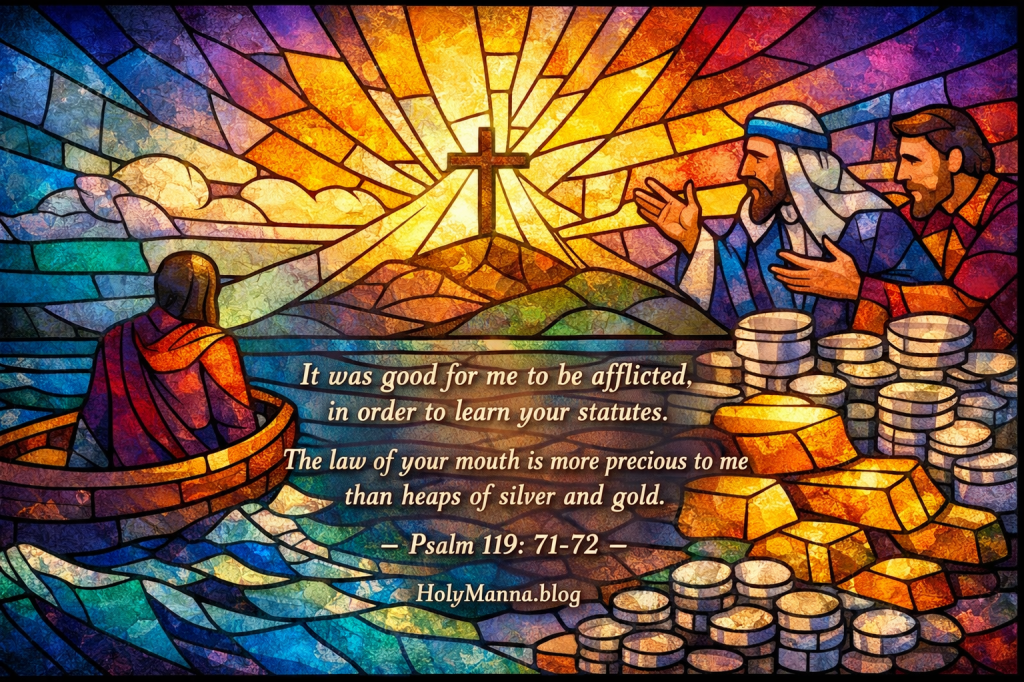
teach me your statutes.71 It was good for me to be afflicted,
in order to learn your statutes.
72 The law of your mouth is more precious to me
than heaps of silver and gold.75 I know, Lord, that your judgments are righteous;
though you afflict me, you are faithful.
76 May your mercy comfort me
in accord with your promise to your servant.
77 Show me compassion that I may live,
for your law is my delight.
Detailed Exegesis
Verse 67 “Before I was afflicted I went astray, but now I hold to your promise.”
This verse sounds like someone telling the truth after the fact. It acknowledges that comfort can create spiritual laziness, while hardship can wake the soul up. The psalmist does not blame God for wandering, and he does not pretend that affliction is fun. He simply recognizes that the trial became a turning point. “Promise” here is not a vague encouragement. It is God’s faithful word, the kind that anchors a person when emotions are unstable. This is the posture James calls perseverance, because perseverance is not just endurance. Perseverance is staying loyal to God’s promise when the heart wants to drift.
Verse 68 “You are good and do what is good; teach me your statutes.”
The psalmist begins with theology before asking for help. He declares God’s goodness, then asks to be taught. That order matters. When suffering hits, the temptation is to question God’s character. The psalmist does the opposite. He insists God is good even when life is hard. Then he asks for instruction, which is the language of a disciple. The Church teaches that God’s commandments are not obstacles to freedom. They are the path to it. CCC 1950 says, “The moral law is the work of divine Wisdom. Its biblical meaning can be defined as fatherly instruction, God’s pedagogy. It prescribes for man the ways, the rules of conduct that lead to the promised beatitude; it proscribes the ways of evil which turn him away from God and from his love.” The psalmist is living that truth by asking for God’s statutes as fatherly instruction.
Verse 71 “It was good for me to be afflicted, in order to learn your statutes.”
This is one of those lines that only makes sense after the storm. The psalmist calls affliction “good” not because suffering is holy in itself, but because God used it to teach obedience and restore the heart. The spiritual life often works like this. Pride, distraction, and divided loves do not usually get defeated by comfort. They get exposed under pressure. The psalmist is not worshiping pain. He is praising God’s ability to transform pain into wisdom.
Verse 72 “The law of your mouth is more precious to me than heaps of silver and gold.”
Now the psalmist gets to the root. Affliction clarified priorities. God’s Word became more valuable than wealth. This is where the Psalm lines up with James 1:9-11, which warns that riches fade like a field flower. The psalmist is saying the same thing with a different image. Silver and gold cannot heal the soul, and they cannot buy eternity. Only God can. Detachment becomes possible when the heart finally believes that.
Verse 75 “I know, Lord, that your judgments are righteous; though you afflict me, you are faithful.”
This verse is a mature confession of trust. The psalmist does not deny the affliction. He names it. But he also names God’s faithfulness. The word “judgments” points to God’s right ordering of things, His truth, and His justice. The psalmist believes God’s governance is righteous even when it hurts. This is not fatalism. This is faith. It is the steady heart James describes, the opposite of being tossed like a wave. The Church teaches that God’s providence is real, and that trust in the Father belongs at the center of Christian prayer. CCC 305 says, “Jesus asks for childlike abandonment to the providence of our heavenly Father who takes care of his children’s smallest needs.” That “abandonment” is exactly what the psalmist is practicing.
Verse 76 “May your mercy comfort me in accord with your promise to your servant.”
The psalmist does not pretend to be above comfort. He asks for it, but he asks for it in the right place. He does not demand a sign from heaven. He asks for mercy according to God’s promise. Comfort here is not indulgence. It is the strengthening mercy that keeps a believer from collapsing. This is a deeply Catholic view of consolation. It is not about escaping suffering at any cost. It is about receiving the grace to endure it faithfully.
Verse 77 “Show me compassion that I may live, for your law is my delight.”
The psalmist ends with a plea that feels humble and honest. Compassion is not presented as a luxury. It is presented as life itself. This is what happens when the heart has been purified. Instead of delighting in control, attention, or wealth, the psalmist delights in God’s law. That delight is a sign of conversion. When a person actually delights in God’s will, the heart is no longer living as an enemy of God’s commandments. It is living as a son.
Teachings
This Psalm teaches that affliction can become a place of conversion, and that God’s Word is not merely information but formation. It teaches that the faithful response to suffering is not cynicism, not bargaining, and not sign demanding, but docility and trust. The psalmist does not come to God as a prosecutor asking for evidence. He comes as a servant asking to be taught and comforted.
The Catechism repeatedly frames God’s law as a gift that leads to freedom and beatitude, which matches the Psalm’s love for God’s statutes. CCC 1950 teaches, “The moral law is the work of divine Wisdom. Its biblical meaning can be defined as fatherly instruction, God’s pedagogy. It prescribes for man the ways, the rules of conduct that lead to the promised beatitude; it proscribes the ways of evil which turn him away from God and from his love.” This is why the psalmist can call the law “more precious” than riches. The law is not a burden when it is understood as the Father’s way of leading His children to life.
The Psalm also teaches trust in God’s providence, especially when life is painful. The Church names this childlike trust as a hallmark of Christian prayer. CCC 305 teaches, “Jesus asks for childlike abandonment to the providence of our heavenly Father who takes care of his children’s smallest needs.” The psalmist’s confidence that God is faithful even in affliction is this abandonment in action.
Many saints echo this biblical wisdom with the realism of experience. Saint Augustine often speaks of God using hardship as medicine for the soul, not because God delights in pain, but because God loves the person too much to leave the heart wandering. The Psalm sounds like a man who finally stopped fighting the lesson and started receiving it. Affliction did not create holiness automatically. It created a moment of clarity where pride could be humbled and the Word of God could become precious again.
Reflection
This Psalm is for anyone who has looked back on a hard season and realized it changed everything. The trouble may have been unwanted, but it exposed what was drifting. It revealed where promises were being forgotten and where habits were quietly reshaping the heart. The psalmist’s honesty is refreshing because it refuses two extremes. It refuses to romanticize suffering, and it refuses to waste suffering.
A practical way to live this Psalm is to stop treating affliction as only an interruption. Affliction can also be an invitation. It invites the believer to return to God’s promise, to ask for wisdom, and to learn obedience again. The Psalm also teaches a clean form of prayer. Instead of demanding God prove Himself, the soul can pray for three things the psalmist prays for: teaching, mercy, and compassion. Teaching brings clarity. Mercy brings strength. Compassion brings life.
Where did life become easier, but the heart became more careless?
What affliction has recently exposed a spiritual drift that needs correction?
If God’s Word is truly more precious than silver and gold, what daily habit would prove that is real and not just a nice idea?
The psalmist’s story is not complicated, but it is powerful. Affliction came, wandering was exposed, and the heart learned to cling to God’s promise. That is the kind of faith that grows up, the kind of faith that does not need a sign from heaven to keep trusting.
Holy Gospel Mark 8:11-13
Mercy Is Still at Work
This Gospel scene is short, but it hits like a cold gust of wind. It takes place after Jesus has already fed the crowd, healed the sick, and shown clear authority over demons and disorder. In other words, the Pharisees are not meeting a mysterious stranger with no track record. They are confronting a man whose works are already speaking loudly. Yet they come forward “to argue,” not to learn. That detail matters because it reveals motive. In the religious culture of first century Judaism, debates between teachers were common, and asking for a sign could sound spiritual on the surface. Israel’s Scriptures are full of signs from God, from Moses before Pharaoh to Elijah on Mount Carmel. But those signs were given to call people to repentance and faith, not to satisfy pride or provide a loophole for disbelief.
That is why the Pharisees’ demand is so serious. They ask for “a sign from heaven” to test Him, which means they are trying to put Jesus on trial. This fits today’s theme perfectly. James 1:1-11 warns about the double minded heart that wants God but also wants control. Psalm 119 shows the obedient heart that asks to be taught in affliction. This Gospel shows the opposite posture. It is the heart that keeps God at arm’s length by demanding proof on its own terms. Jesus refuses, not because He lacks power, but because a sign will not heal a heart that does not want to surrender.
Mark 8:11-13 – New American Bible (Revised Edition)
The Demand for a Sign. 11 The Pharisees came forward and began to argue with him, seeking from him a sign from heaven to test him. 12 He sighed from the depth of his spirit and said, “Why does this generation seek a sign? Amen, I say to you, no sign will be given to this generation.” 13 Then he left them, got into the boat again, and went off to the other shore.
Detailed Exegesis
Verse 11 “The Pharisees came forward and began to argue with him, seeking from him a sign from heaven to test him.”
The Pharisees come “forward,” which suggests a confrontational approach, and they begin to argue, not to ask sincerely. The phrase “to test him” reveals the real intent. This is not a humble request for guidance. It is a challenge meant to trap Him, discredit Him, or force Him into their framework. The “sign from heaven” language implies something cosmic and undeniable, like fire from the sky, because ordinary miracles were not enough for hearts determined to resist. The problem is not evidence. The problem is pride. A person can demand an even bigger miracle simply to avoid admitting the truth already present.
This is why the Church treats “testing God” as a serious spiritual disorder. It is a form of rebellion disguised as religious concern. The Catechism states this clearly in CCC 2119: “Tempting God consists in putting his goodness and almighty power to the test by word or deed. Thus Satan attempted to draw Jesus away from God’s mission and to induce him to act against God. It is forbidden to put God to the test. The challenge contained in such tempting of God always harbors doubt about his love, his providence, and his power.” The Pharisees are doing something close to what the devil tried to do in the desert. They want God to serve their terms.
Verse 12 “He sighed from the depth of his spirit and said, ‘Why does this generation seek a sign? Amen, I say to you, no sign will be given to this generation.’”
The sigh is one of the most human moments in the Gospel. It sounds like grief, not fear. It is the sorrow of a heart that sees what is going on underneath the religious language. Jesus is not being stubborn. He is being truthful. A heart committed to testing God will never be satisfied. Even if a sign is given, it will be explained away, ignored, or turned into a new argument. The phrase “this generation” echoes the prophetic language of the Old Testament, where Israel sometimes resisted God’s works in the wilderness even after seeing miracles. Jesus is identifying a spiritual pattern, not insulting people randomly. The refusal to give a sign is a judgment, but it is also mercy. It blocks them from turning miracles into entertainment, and it exposes the need for conversion.
The “Amen, I say to you” is a solemn marker. Jesus is speaking with authority. He is not negotiating. He is calling out the spiritual sickness underneath the demand. The real sign will not be fireworks on command. The real sign will be the Cross and the Resurrection, which must be received in faith, not demanded as a performance.
Verse 13 “Then he left them, got into the boat again, and went off to the other shore.”
This ending is quiet and heavy. Jesus leaves. That is not a tantrum. It is a boundary. Some conversations cannot bear fruit because the heart is not open. The boat imagery in Mark often signals movement toward mission, teaching, and the next encounter where someone is actually ready to receive. There is also a warning here. When a person keeps treating God like a defendant, the soul can end up with distance instead of intimacy. Jesus does not chase manipulation. He offers grace, and He moves on when grace is being used as fuel for arguments.
Teachings
This Gospel teaches that not every religious question is a faithful question. Some questions are actually resistance wearing church clothes. It teaches that faith is not built on controlling God, and that demanding proof on personal terms can become a way of refusing conversion. It also reveals something important about Jesus. He is patient with the weak, but He is not impressed by performative religion. He heals the blind who cry out for mercy, but He does not entertain the proud who come to argue.
The Catechism’s teaching on “tempting God” fits this Gospel perfectly. CCC 2119 says, “Tempting God consists in putting his goodness and almighty power to the test by word or deed. Thus Satan attempted to draw Jesus away from God’s mission and to induce him to act against God. It is forbidden to put God to the test. The challenge contained in such tempting of God always harbors doubt about his love, his providence, and his power.” This is not just about dramatic dares. It includes subtle bargaining prayers that say God must prove Himself before obedience happens. The Pharisees are living that mindset openly.
The Church also teaches that miracles have a purpose. They are not magic tricks. They are signs meant to awaken faith and confirm the truth of God’s revelation. When the heart is unwilling, miracles do not force belief. They can even harden resistance. That is why the Gospels show different reactions to the same Jesus. Some people repent. Some people plot. The difference is not what they saw. The difference is what they wanted.
Saints and Doctors of the Church often warn that pride can hide behind religious language. Saint Augustine speaks about the danger of seeking God for gifts rather than seeking God as God. A person can pursue spiritual experiences and still refuse the Lord Himself. The Pharisees are a cautionary tale of that temptation. They want a sign “from heaven,” but they do not want the One who came from heaven standing in front of them.
Historically, the Pharisees were not cartoon villains. They were influential religious leaders committed to strict observance and concerned about fidelity to the law. That background matters because it shows how serious the warning is. A person can be knowledgeable, disciplined, and publicly religious, and still be spiritually closed. This Gospel exposes the difference between genuine reverence and spiritual control.
Reflection
This Gospel is a mirror for modern life because the temptation to demand signs did not die in the first century. It just changed outfits. Many people do not say “sign from heaven,” but they think it. They want God to prove His love through outcomes, through comfort, through immediate clarity, through a life that feels smooth. When life gets hard, the heart can start bargaining. It can say that obedience will come later, once God provides enough certainty. That is exactly the double minded instability James 1:6-8 warns against, and it is the opposite of the Psalm’s humble prayer, “teach me your statutes.”
A practical way to apply this Gospel is to examine what kind of questions are being brought to God. Honest questions are not the problem. Honest questions can be holy. The problem is the testing question, the kind that comes with conditions. The testing question says faith will only happen if God performs. The faithful question says obedience will happen because God is trustworthy, and wisdom is needed to live it well.
This passage also encourages a sober humility. A person can be close to Jesus, hearing the same words, seeing the same works, and still miss Him if pride is steering the wheel. The Pharisees were not ignorant. They were resistant. That should wake up anyone who thinks knowledge alone guarantees holiness.
Where has prayer started to sound like bargaining instead of trust?
What sign is secretly being demanded before offering full obedience in a specific area of life?
If Jesus refuses to perform on command, is the heart still willing to follow Him simply because He is Lord?
This Gospel ends with Jesus getting back in the boat, which is a quiet invitation to move with Him. The heart that wants control stays on the shore arguing. The heart that wants salvation steps into the boat, even when it does not get all the proofs it demanded, because it finally trusts the One who is already present.
Step Into the Boat with Trust
Today’s readings tell one clear story with three steady beats. James 1:1-11 teaches that trials are not random interruptions when faith is real. Trials become the testing ground where perseverance is formed, where the divided heart is exposed, and where wisdom is learned by asking God with trust instead of suspicion. Psalm 119:67-68, 71-72, 75-77 puts a human voice to that lesson, admitting that affliction can correct what comfort often hides, and confessing that God’s Word is worth more than anything money can buy. Then Mark 8:11-13 delivers the warning that ties the whole day together. A heart that demands a sign is often a heart that does not want to surrender. Jesus will not perform on command, because salvation is not a negotiation. Faith is not built by forcing God to meet human terms. Faith is built by choosing trust, especially when life feels uncertain.
The key message is simple and it can change everything. God uses difficulty to mature the soul, but the soul must respond like a disciple, not like a critic. James calls believers to let perseverance finish its work. The Psalm shows what that looks like when someone finally stops drifting and starts clinging to God’s promise. The Gospel exposes the temptation to treat God like a defendant, as if obedience depends on getting the perfect proof. The path forward is not complicated, but it is demanding in a holy way. Ask for wisdom. Stay steady. Refuse double mindedness. Choose humility whether life is lowly or comfortable. Stop testing God, and start trusting Him.
This is the invitation for today. Let trials become training instead of bitterness. Let God’s Word become more precious than the security of silver and gold. Let prayer become a real conversation with the Father instead of a demand for control. Then take one concrete step that proves faith is alive. Choose a small act of obedience that has been delayed. Choose a moment of patience where anger usually wins. Choose a sincere prayer for wisdom that is not followed by panic. Choose to delight in God’s law, not because it is easy, but because it is the path that leads to life.
What would change this week if God’s promises were trusted more than feelings and circumstances?
Where is the heart still trying to control God instead of following Him?
What simple act of perseverance would show that faith is no longer being tossed around like a wave?
The day ends with a quiet image that stays in the mind. Jesus gets into the boat and goes to the other shore. The ones who argue stay behind. The ones who follow move with Him. The invitation is to step into that boat with trust and let God finish His work.
Engage with Us!
Readers are invited to share reflections in the comments below, especially any line that stirred the heart or challenged the conscience today. Honest thoughts, real struggles, and small wins all matter here, because God uses real life to form real faith.
- First Reading, James 1:1-11: Where is a current trial revealing a divided heart, and what would it look like to ask God for wisdom with steady trust instead of anxiety?
- Responsorial Psalm, Psalm 119:67-68, 71-72, 75-77: What affliction has actually taught something important about God, and how can God’s Word become more precious than comfort, money, or control in daily decisions?
- Holy Gospel, Mark 8:11-13: Where is the soul tempted to demand a sign before obeying, and how can trust be chosen today even if God refuses to perform on human terms?
Keep walking forward with courage, because faith grows when perseverance is allowed to finish its work. Let every choice today be shaped by the love and mercy Jesus taught, so that even trials become places where holiness takes root and bears fruit.
Sacred Heart of Jesus, we trust in You!
Immaculate Heart of Mary, pray for us!
Saint Michael the Archangel, defend us in battle!
Follow us on YouTube, Instagram and Facebook for more insights and reflections on living a faith-filled life.

 Holy Manna!
Leave a comment