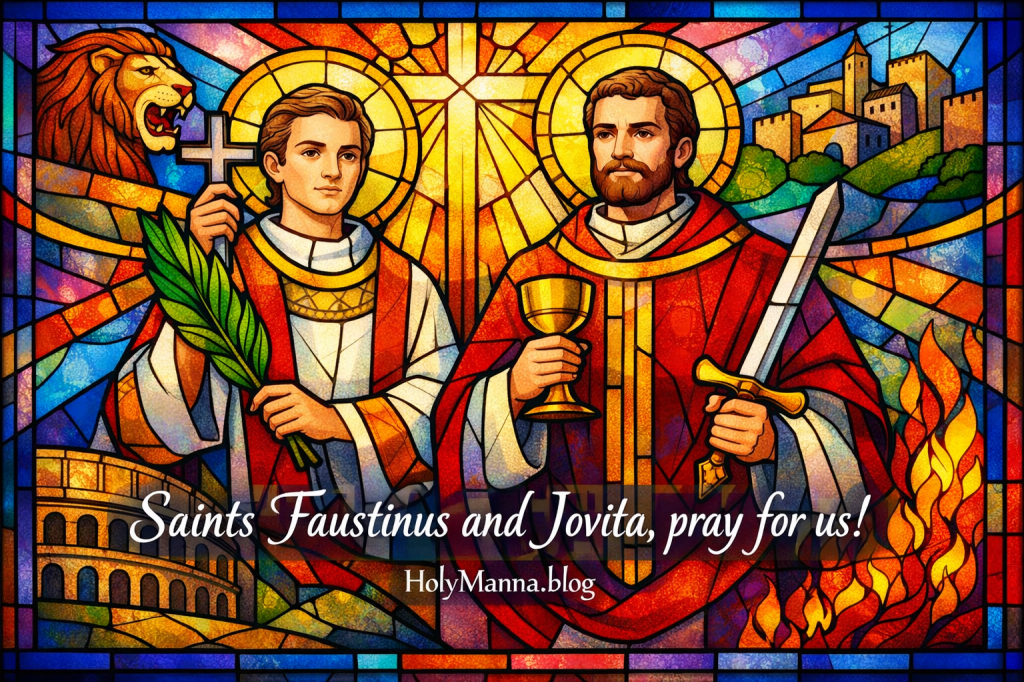
Brescia’s Unbreakable Brothers
Saints Faustinus and Jovita are remembered because they loved Jesus Christ more than comfort, reputation, or even life itself. Their names have been spoken for centuries in Brescia like the names of family, because the Church there never forgot what these martyrs proved with their blood. Christianity is not a private hobby and it is not a cultural accessory. It is belonging to the living Lord, even when that loyalty becomes costly.
There is also something refreshingly honest about how the Church holds their story. A solid ancient core is clearly preserved, and later devotional traditions grew around that core to preach courage and fidelity. That balance does not weaken their witness. It sharpens it, because it keeps the focus on what matters most. These men stood with Christ when standing with Christ could ruin them. In the words of The Gospel of John, “No one has greater love than this: to lay down one’s life for one’s friends.” Jn 15:13.
Blood, Relics, and Early Devotion
When people ask for a neat biography of Faustinus and Jovita, it helps to know where Brescia’s Catholic memory actually starts. It starts with a people who already honored them as martyrs and with places of prayer that carried their names. One ancient shrine is remembered with a striking title: San Faustino ad sanguinem, meaning Saint Faustinus at the blood. That title captures the early Christian instinct to tell the truth about martyrdom without turning it into spectacle. The blood was not a curiosity. It was a confession that Christ is worth everything.
Brescia also preserved devotion around relics tied to these martyrs, and the growth of their cult belongs to the Church’s earliest centuries, when local communities gathered at holy sites and celebrated the victory of faith under persecution. It is important to say this clearly and respectfully. Not every early historical detail about their origins can be recovered with modern certainty, and even local Catholic memory admits that the provenance of the relics is not fully known. Over time, devotion became deeply localized and the martyrs were cherished as patrons and protectors of the city in a spiritual sense. This is still very Catholic, because the Church recognizes holiness not through perfect paperwork but through enduring veneration, liturgy, and the fruit of faith across generations.
From Noble Blood to Baptized Courage
Later tradition fills in a portrait that fits the pattern of many early martyrs. Faustinus and Jovita are often described as coming from a noble family in Brescia and serving as clerics, with Faustinus remembered as a priest and Jovita as a deacon. That detail matters because it frames them as men formed inside the Church’s sacramental life, not as vague spiritual heroes. They belonged to the Christian community, they served the faithful, and they refused to let pagan worship coexist with the worship owed to God.
Tradition also presents them as bold evangelizers, men who would not keep faith hidden when the world insisted religion stay controlled and convenient. In the ancient world, public worship was tied to civic identity, social order, and political loyalty. A Christian refusal to sacrifice to the gods could be seen as rebellion. That pressure is what makes early martyrdom so relevant now. The tools of pressure change, but the demand is the same. The world wants outward compliance. The saints insist that worship belongs to God alone.
Trials That Became a Sermon
Devotional tradition surrounding Faustinus and Jovita includes accounts of dramatic trials, severe punishments, and moments of divine deliverance. Some stories use familiar early martyr motifs, like public spectacles meant to terrify believers and miraculous reversals meant to proclaim God’s power. These accounts should be told with care, because not every detail can be verified historically. Still, they express a Catholic conviction that remains true in every age. God does not abandon His servants, and He gives strength that is beyond mere personality.
This is exactly how the Church teaches believers to understand martyrdom. The Catechism says, “Martyrdom is the supreme witness given to the truth of the faith.” CCC 2473. The miracle is not always an escape from suffering. The miracle is grace holding a person steady when every natural instinct begs for compromise. These saints preach that fidelity is possible because Christ is faithful first, and because the Holy Spirit gives what He commands.
The Cost of Refusing to Bow
The traditional telling presents their hardships as a long campaign of pressure meant to break their resolve. They are arrested, interrogated, threatened, punished, and pushed toward a simple bargain. Offer a small act of sacrifice, say the right words, blend in, and live. Their refusal was not stubborn pride. It was truthfulness. They could not pretend that Caesar and the idols deserved what belongs to God.
Their martyrdom is commonly described as the final outcome after many trials. The Church honors this not because pain is good, but because love is good. Martyrdom is not death worship. It is love proven. It is fidelity purified until fear no longer rules the heart. Their witness stands as a warning to every age that tries to make faith polite, private, and harmless. The Gospel refuses to be domesticated.
The Saints Who Stayed Close to Their People
The legacy of Faustinus and Jovita after death is concrete and deeply Catholic. Their relics were honored with solemnity, and in the ninth century their bodies were translated to the church known as San Faustino Maggiore, which became a major center of devotion. This kind of translation was never meant to be superstition. It was the Church proclaiming that holiness is real and that the communion of saints is not a metaphor. The saints are alive in Christ and they remain united to the Church they served.
Local devotion also preserves posthumous stories that express their protection of Brescia, especially in times of danger. Traditions speak of remarkable signs connected with processions involving their relics and of heavenly help remembered during moments of threat. These accounts are best received as cherished local memory, told to strengthen faith and express the conviction that patron saints remain close to their people. This conviction fits Catholic doctrine. The Catechism teaches that the saints do not stop caring once they enter glory, and that their intercession strengthens the Church. CCC 956.
A Feast That Formed a City
The celebration of Saints Faustinus and Jovita on February 15 became part of the public heartbeat of Brescia, not just a private devotion tucked into the corners of church life. In Brescia the feast has long been honored with special solemnity, because these martyrs represent what the Church wants to form in every believer. The city learned to remember that faith is not only personal, but communal. A people needs patrons, holy examples, and shared stories that call them back to courage.
Over the centuries, the feast developed religious ceremonies and communal customs that kept the saints in the imagination of the city. That blend of liturgy and local culture is not an accident. Catholic life is meant to spill into daily life. The saints are honored at Mass, and the joy of that honor flows outward into family life, neighborhoods, and public memory. It is a reminder that real Christianity is never only private. It shapes what a people loves and what a people is willing to defend.
What Their Witness Looks Like Today
Saints Faustinus and Jovita do not challenge believers to chase drama. They challenge believers to choose fidelity. Their witness teaches that courage is built long before a crisis arrives, and that the daily Catholic life is the training ground for heroic faith. Daily prayer builds attention to God. Regular Confession builds humility and honesty. The Eucharist builds communion with Christ, which is the only real source of strength when pressure rises.
Their story also exposes the small compromises that slowly weaken the soul. A quiet lie, a hidden habit, a convenient silence, a decision to blend in rather than stand for the truth. Martyrs reveal that these small choices matter, because they form the kind of person someone becomes when a bigger test arrives. Their witness is also a comfort. God does not demand a superhuman personality. God gives grace, and grace is stronger than fear.
How might life change if the biggest fear stopped being what people think and became what God thinks? How would choices shift if loyalty to Jesus mattered more than comfort? These are not abstract questions. They are the questions that shape a soul into a saint.
Engage with Us!
Share your thoughts and reflections in the comments below. These patron martyrs of Brescia still challenge the Church today, because their story presses on the parts of the heart that want an easy faith.
- Where is the world pressuring faith to stay private, silent, or “polite,” and what would a humble public witness look like in that situation?
- What is one small compromise that has been treated as harmless, even though it weakens fidelity to Christ?
- How can prayer, the sacraments, and daily discipline build courage now, before a bigger test arrives?
- Who needs encouragement to stay faithful, and how can that encouragement be offered this week with charity and clarity?
May Saints Faustinus and Jovita pray for a faith that does not bend, a hope that does not quit, and a love that looks like Jesus. Go live with courage, stay close to the sacraments, forgive quickly, repent honestly, and do everything with the love and mercy Jesus taught us.
Saints Faustinus and Jovita, pray for us!
Follow us on YouTube, Instagram and Facebook for more insights and reflections on living a faith-filled life.

 Holy Manna!
Leave a comment