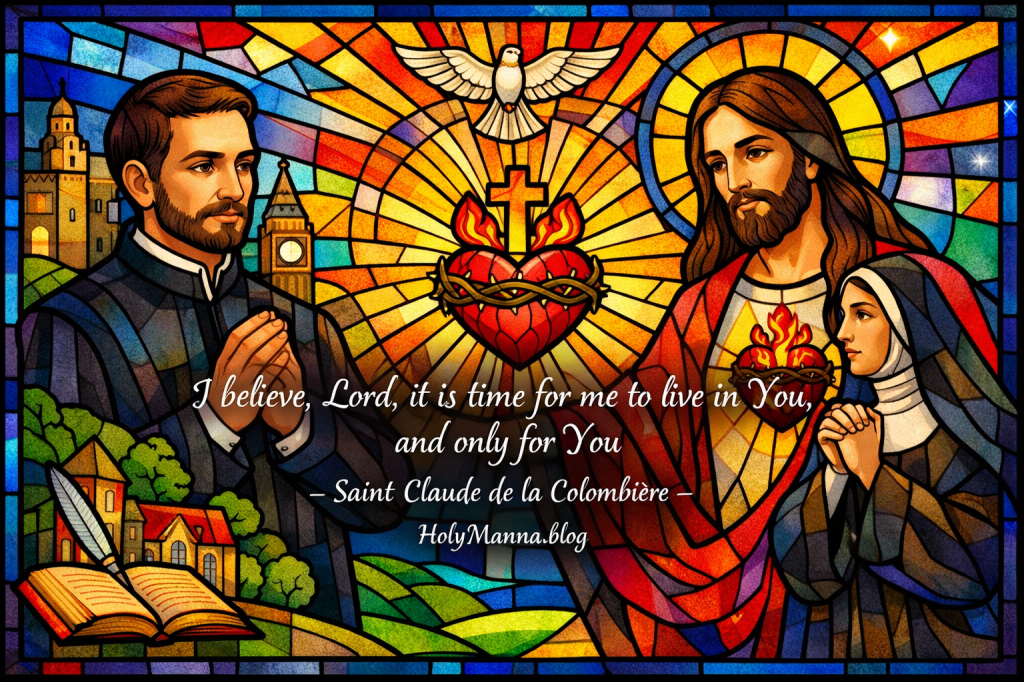
A Saint for Anxious Hearts
Saint Claude de la Colombière is the kind of saint who makes Catholicism feel concrete and close to home, because his holiness was forged in ordinary duties, careful discernment, and real suffering. He is especially loved because he became a key witness for devotion to the Sacred Heart of Jesus at a time when many Christians were tempted to picture God as harsh and distant. Claude helped the Church receive this devotion in a sober and obedient way, and he taught people how to trust Jesus without turning faith into a mood.
The Church explains that private revelations do not add to the deposit of faith, but can help believers live the Gospel more fully when they are discerned and received with humility, which is why this fits so well with CCC 67. Devotion to the Sacred Heart is not sentimental decoration. It is rooted in the mystery of the Incarnation itself, because the Son of God truly loves with a human heart, as the Church teaches in CCC 478. Claude’s life shows what happens when that divine love meets a human heart that is being purified by obedience, prayer, and the Cross.
From Comfort to Calling
Claude was born on February 2, 1641, in Saint Symphorien d’Ozon in France. He was intelligent, cultured, and the kind of young man who could have built a comfortable life without much struggle. He loved literature, friendships, and the good gifts of ordinary life, and that detail matters because it makes his vocation more believable. Claude later admitted that he felt strong resistance to becoming a Jesuit, not because he rejected God, but because he enjoyed the world he knew and did not want to surrender control. That honesty is part of why his story lands with so many people today.
He entered the Society of Jesus as a teenager and embraced the long Jesuit formation of study, prayer, discipline, and apostolic work. Over the years he became a teacher, preacher, and spiritual guide, and his superiors trusted him with serious responsibilities. He studied theology in Paris and even tutored the children of an influential royal minister, which shows he was not sheltered or naïve. He could move in powerful circles without losing the humility that keeps a priest grounded.
His conversion deepened as he matured, and it became especially clear during his final stage of Jesuit formation, when he committed himself to faithful obedience and serious holiness in daily duties. This did not make him rigid. It made him free. One line preserved from his spiritual writings reveals the kind of surrender that formed his heart: “I believe, Lord, it is time for me to live in You, and only for You… at my age You died for me in particular.” He was not trying to sound impressive. He was trying to stop delaying holiness.
The Sacred Heart of Jesus
Claude’s life became historically important when he was appointed to leadership at Paray le Monial. It looked like a quiet assignment, but it placed him near Saint Margaret Mary Alacoque, a Visitation nun who was receiving messages about the Sacred Heart of Jesus. She was also carrying heavy burdens, because she faced misunderstanding, suspicion, and the kind of pressure that can break a sensitive soul. Claude did not treat her claims with shallow enthusiasm, and he did not dismiss her like a cynical critic. He listened as a priest trained to think with the Church.
He prayed, tested the fruits, and examined whether her experiences produced humility, obedience, and deeper love of Christ. Then he guided her with steady clarity. He encouraged her to write down what she had received and to remain obedient to her superiors. He supported her mission in a way that protected both her soul and the Church’s prudence. That is the Catholic approach to private revelation, and it is exactly the kind of discernment the Church calls for in CCC 67. Claude’s role was not to create a new doctrine, but to help the Church receive a devotion that points directly to the Gospel, because it centers on the love of Christ crucified and risen.
Devotion to the Sacred Heart becomes dangerous only when people turn it into a soft slogan. Claude lived it as a call to repentance, reparation, and confidence in mercy. He preached that God’s presence within the soul is meant to inspire reverence and trust, not fear and panic. He helped people breathe again spiritually, especially those burdened by guilt or scrupulosity.
A Priest Who Watched Mercy Win
After Paray le Monial, Claude was sent to London, where he served Catholics in a tense environment. He preached, heard confessions, and offered spiritual direction, and he labored for conversions and reconciliations in a place where Catholic life carried real social and political risk. His work was not glamorous, but it was fruitful. He watched hearts return to God, and he saw hardened consciences soften through grace.
Claude left a line from this mission that still captures the tone of his priesthood and the joy of seeing sinners come home. He said, “I could write a book about the mercy of God I’ve seen Him exercise since I arrived here!” This was not naïve optimism. It was the testimony of a priest who saw that Jesus does not give up on people. His greatest miracles during life were not flashy wonders that attracted crowds. His greatest miracles were conversions, reconciliations, and the healing of souls through the sacramental life of the Church. These are the kinds of miracles that last, because they reach into eternity.
Claude’s teaching was consistent. God is near. God is trustworthy. God’s mercy is stronger than shame. When this is lived in the sacraments, it does not produce laziness. It produces repentance, gratitude, and courage.
The Cross of Injustice
Claude’s London mission eventually placed him in the path of intense anti Catholic hysteria during the so called Popish Plot. He was falsely accused, arrested, and imprisoned in harsh conditions that damaged his health and pushed him toward an early death. This suffering was not a short dramatic moment. It was slow, humiliating, and exhausting. He endured it without bitterness, and he remained faithful even when his life felt like it was being dismantled by lies.
Claude did not die as a martyr executed for the faith, but he belongs to that ancient category of confessors, those who suffered for Christ and bore witness by endurance. His suffering also reveals the truth about devotion to the Sacred Heart. It is not an escape from the Cross. It is a deeper entry into it. The Heart of Jesus is pierced love, not soft comfort. Claude’s spirituality was proven in prison air and sickness, and it remained steady because it was rooted in Christ rather than in circumstances.
He was eventually expelled from England and returned to France deeply weakened. He continued to serve as health allowed, including supporting and forming others. In 1681 he returned to Paray le Monial in frailty, and he died on February 15, 1682, after a severe hemorrhage. His death was quiet, but his life had already preached its final sermon.
Miracles After Death
After Claude’s death, devotion to his intercession grew, especially among those devoted to the Sacred Heart. Over time, the Church examined miracles attributed to his intercession as part of the careful process that led to his beatification and canonization. The Church does not rush these investigations, because miracles must be tested with real scrutiny. Several healings were examined and accepted in connection with his cause, including cures from serious illnesses.
One widely discussed modern case involved the healing of a Jesuit priest, Father John Houle, who suffered from a serious and reportedly terminal lung disease. After prayers for Claude’s intercession and the veneration of a relic, his recovery was judged medically inexplicable in the canonical investigation connected to his canonization. For Catholics, this is not about treating God like a vending machine. It is about God offering signs that point souls back to Christ, and it is about the communion of saints in action, which the Church explains in CCC 956.
Claude’s memory is strongly tied to Paray le Monial, a place that continues to draw pilgrims who want deeper conversion and deeper trust. His writings also continued to nourish souls long after his death. His sermons, retreats, meditations, and letters carried a spiritual clarity that remains surprisingly fresh because it is rooted in Christ rather than trends.
Living Sacred Heart Confidence Today
Saint Claude’s story is a challenge for modern Catholics who struggle with anxiety, fear, and spiritual exhaustion. He shows that confidence in God is not denial of suffering. He suffered real injustice, real illness, and real weakness. Yet he refused to let fear have the final word. This kind of trust is not personality. It is the theological virtue of hope, and the Church describes it as essential to Christian life in CCC 1817.
Claude also offers a practical remedy for scrupulosity and despair. He preached that God’s presence is meant to create reverence and confidence, not panic. He knew mercy is not permission to sin. Mercy is power to break sin’s chains. That is why devotion to the Sacred Heart belongs at the center of Catholic life when it is lived correctly. It leads people back to Confession, back to the Eucharist, and back to daily prayer that does not depend on feelings.
Pope Saint John Paul II highlighted Claude’s teaching by pointing to the Heart of Jesus as “always burning with love for men.” This is not sentimental language. It is a hard truth meant to break despair. It means there is no prison, no humiliation, no weakness, and no sin that outlasts the mercy of Christ when a soul returns and trusts.
Where has fear replaced trust in God’s mercy?
What would change if the Heart of Jesus was treated as near and personal instead of distant and theoretical?
What concrete act of trust can be offered today even if feelings do not cooperate?
Engage With Us!
Share your thoughts and reflections in the comments below, because the saints are not museum pieces. They are family, and their stories are meant to provoke real conversion and real hope.
- What part of Saint Claude’s story feels most relatable right now, his resistance at the beginning, his hidden faithfulness, or his suffering in prison?
- How can devotion to the Sacred Heart become more than a nice image and turn into a daily way of living?
- What is one concrete way to practice trust this week, especially when prayer feels dry or circumstances feel heavy?
- Who in daily life needs to experience the mercy of Jesus through patience, forgiveness, or a humble conversation?
Go forward with courage. Live a life of faith. Choose fidelity over mood, obedience over ego, and prayer over panic. Do everything with the love and mercy Jesus taught us, because the Heart of Christ is not a symbol of weakness. It is the furnace where saints are made.
Saint Claude de la Colombière, pray for us!
Follow us on YouTube, Instagram and Facebook for more insights and reflections on living a faith-filled life.

 Holy Manna!
Leave a comment