Sixth Sunday in Ordinary Time – Lectionary: 76
Choosing God from the Heart
There are days when faith feels complicated, and then there are days like today, when Scripture speaks with a clean, bright honesty that cuts through the noise. God places a real choice in front of every soul, not as a trap, but as a gift. The readings sound like a single message told from four angles: life with God is not an accident, and holiness is not a performance. It is a decision that begins in the heart and shows itself in the way a person lives.
The central theme tying today together is this: God offers life through His commandments, and Christ fulfills that law by bringing it into the inner life, where love, truth, and purity either take root or wither. In Sirach 15:15-20, wisdom teaches that God sets before each person fire and water, life and death, and the human will truly reaches for one or the other. The Responsorial Psalm, Psalm 119, answers like a grateful disciple who has discovered that the law is not a burden but a path of blessing, because God’s instructions shape a life that is whole. Then 1 Corinthians 2:6-10 lifts the curtain even higher, revealing that God’s plan is not merely moral improvement but a hidden wisdom unveiled through the Holy Spirit, a wisdom the world did not recognize when it crucified the Lord of glory. Finally, in The Gospel of Matthew 5:17-37, Jesus speaks as the true fulfillment of the Law and the Prophets, pushing beyond external obedience into the deeper battlefield of anger, lust, fidelity, and truthfulness, where the real drama of conversion unfolds.
This is important to understand in the world Jesus lived in. First century Jewish life was shaped by the Torah, not simply as a list of rules but as the covenant story of a people called to be holy in the middle of a pagan world. The law marked Israel as different, a nation set apart to worship the one true God, to reject idols, and to live in a way that reflected His justice and mercy. By the time of Jesus, many devout teachers worked hard to protect that covenant identity, but the temptation was always there to reduce holiness to visible compliance, to measure righteousness by what could be seen and counted. Jesus does not reject the law, because the law was never the enemy. He reveals its true purpose. God’s commandments were always meant to form a heart that loves, and Christ comes to complete that work by calling His disciples to a righteousness that is not louder, but deeper.
Today’s readings prepare the soul for a serious but hopeful question. Where is the hand reaching right now, toward fire or water, toward life or death, toward self or toward God? The good news is that God does not merely command what is good. He provides what is needed to live it, because His wisdom is not just spoken, it is poured into the heart by the Spirit, and it leads straight into the freedom of a life that finally makes sense.
First Reading – Sirach 15:15-20
A God Who Respects Freedom and Refuses to Lie About Sin
The Book of Sirach comes from the wisdom tradition of Israel, written in a world where God’s people were surrounded by tempting compromises. Many voices in the ancient Near East treated religion like a tool for winning favors from the gods, or excusing bad behavior with fate and fortune. Sirach pushes back hard against that darkness. It teaches that the Lord is not a negotiable concept and His commandments are not suggestions. They are life. Even more striking, this reading insists on something modern people still try to dodge: choices are real, and responsibility is personal.
This fits perfectly with today’s theme. God offers life through His law, and Christ fulfills that law by bringing it into the heart where the real decisions are made. Before Jesus speaks about anger, lust, fidelity, and truthfulness in The Gospel of Matthew, Sirach clears the ground by saying the quiet part out loud. God does not command sin. God does not excuse deception. God sets the path of life in front of every person, and He honors the dignity of human freedom enough to allow a person to choose.
Sirach 15:15-20 – New American Bible (Revised Edition)
15 If you choose, you can keep the commandments;
loyalty is doing the will of God.
16 Set before you are fire and water;
to whatever you choose, stretch out your hand.
17 Before everyone are life and death,
whichever they choose will be given them.18 Immense is the wisdom of the Lord;
mighty in power, he sees all things.
19 The eyes of God behold his works,
and he understands every human deed.
20 He never commands anyone to sin,
nor shows leniency toward deceivers.
Detailed Exegesis
Verse 15. “If you choose, you can keep the commandments; loyalty is doing the will of God.”
This verse begins with a straightforward claim: obedience is possible. It does not say obedience is easy, or automatic, or merely a matter of willpower. It says the human person can truly respond to God. The word “loyalty” points to covenant love, the kind of faithful relationship Israel was called to live with the Lord. This is not cold rule keeping. It is devotion expressed through concrete choices.
Verse 16. “Set before you are fire and water; to whatever you choose, stretch out your hand.”
Fire and water are vivid images for outcomes that are not the same. Water sustains. Fire can purify, but it can also destroy. The point is not that life is morally confusing. The point is that life is morally serious. The hand stretches toward something every day through habits, entertainment, speech, and hidden thoughts. In a culture that loves to blame everything except the will, this verse insists that the hand still reaches.
Verse 17. “Before everyone are life and death, whichever they choose will be given them.”
This is not fatalism. It is the opposite. It is a moral universe where actions carry weight. Scripture repeatedly connects obedience to life, because God is the source of life. When a person chooses what opposes God, the person chooses what opposes life. That is why the Church speaks of sin as deadly in its most serious forms, not because God is petty, but because sin cuts the soul off from the One who gives life.
Verse 18. “Immense is the wisdom of the Lord; mighty in power, he sees all things.”
After speaking about human choice, the reading immediately speaks about divine knowledge. God is never confused about what is happening in the human heart. His wisdom is not limited like human wisdom. His power is not threatened by human freedom. This is comforting for anyone who feels unseen and sobering for anyone who tries to live a double life.
Verse 19. “The eyes of God behold his works, and he understands every human deed.”
God sees more than outward performance. He understands deeds in their fullness, including motives, pressures, and intentions. This does not erase accountability. It deepens it, because the truth about a deed includes the truth about why it was done. This prepares the soul for Jesus’ teaching that righteousness cannot stay on the surface.
Verse 20. “He never commands anyone to sin, nor shows leniency toward deceivers.”
This verse dismantles two common lies. The first lie says God is somehow behind the sin, as if temptation were a divine instruction. The second lie says deception is a small problem, a personality quirk, or a clever survival skill. Scripture says no. God is not the author of sin, and God does not make peace with deceit. The Lord is merciful, but His mercy is never permission to lie. Mercy heals what is sick, and it does not flatter what is evil.
Teachings
This reading stands shoulder to shoulder with the Church’s teaching on freedom, responsibility, and the truth about moral evil. The Church rejects every attempt to blame God for sin, whether through superstition, fatalism, or the modern habit of calling everything “just how it is.” The Lord permits human freedom because love without freedom is not love.
The Catechism speaks plainly about God and moral evil: CCC 311 says “God is in no way, directly or indirectly, the cause of moral evil. He permits it, however, because he respects the freedom of his creatures and, mysteriously, knows how to derive good from it.” This matches the force of Sirach 15:20, because Scripture refuses to let anyone claim that God commands sin.
The Church also teaches that freedom is real and meaningful, not pretend. CCC 1731 says “Freedom is the power, rooted in reason and will, to act or not to act, to do this or that, and so to perform deliberate actions on one’s own responsibility. By free will one shapes one’s own life. Human freedom is a force for growth and maturity in truth and goodness; it attains its perfection when directed toward God, our beatitude.” That is the Catholic heart of Sirach 15:16-17. The hand stretches, the will chooses, and a life takes shape.
Because freedom is real, responsibility is real. CCC 1734 says “Freedom makes man responsible for his acts to the extent that they are voluntary.” This is exactly why Sirach refuses to treat sin as an accident without an owner. The reading is not trying to frighten anyone into obedience. It is trying to awaken the soul to dignity. A person is not a helpless passenger. A person is a moral agent called to choose the good.
At the same time, the Church refuses the opposite error, which is the fantasy that a person can save himself by sheer effort. God’s grace is not optional. The Catholic tradition holds both truths together: God’s grace is primary, and human cooperation is real. CCC 1847 captures this with a famous line from Saint Augustine: “God created us without us: but he did not will to save us without us.” This belongs to today’s reading because Sirach insists on a genuine choice, and the Church insists that this choice is made possible and fruitful by grace.
Reflection
This reading is a wake up call for ordinary daily life, because most people do not wake up and choose death in a dramatic way. Death is usually chosen by a slow drift, a thousand small reaches of the hand toward what hardens the heart. A person reaches for resentment and calls it honesty. A person reaches for lust and calls it stress relief. A person reaches for deception and calls it strategy. Then a person wonders why prayer feels dry and peace feels far away.
Sirach offers a better story. God puts life within reach, and the first step is to stop blaming anyone else for the choices that are still being made. This is where spiritual maturity begins. It begins when a person admits, without excuses, that the hand has been reaching, and it can reach somewhere else.
A practical way to live this reading is to slow down one decision each day and name it honestly before God. A choice about words. A choice about what enters the eyes. A choice about whether to forgive or rehearse the same anger again. Then the soul can ask for grace with clarity, because grace is not vague encouragement. Grace is strength for a real decision.
Where has the hand been reaching lately, toward fire or toward water, toward life or toward death?
What is the most common excuse used to avoid responsibility, and what would change if that excuse died today?
If God “understands every human deed,” what hidden pattern needs to be brought into the light through confession, accountability, and prayer?
The good news is that this reading does not end in anxiety. It ends in truth. God sees, God knows, and God does not command sin. That means no one is trapped in confusion. The path of life is real, and by grace, the hand can reach for it.
Responsorial Psalm – Psalm 119:1-2, 4-5, 17-18, 33-34
The Happy Life Is the Obedient Life.
If the First Reading sounds like a fork in the road, this psalm sounds like a traveler who has already walked the right path and wants others to know what it feels like. Psalm 119 is the longest psalm in Scripture, and it is not long because it is rambling. It is long because it is in love. It is a sustained meditation on God’s law, not as a cold legal code, but as the wise and fatherly instruction that protects a person from self destruction and teaches the soul how to live.
In ancient Israel, the law was never meant to be separated from relationship. The commandments were given in the context of covenant, meaning God did not simply issue rules from a distance. He rescued His people, made them His own, and then taught them how to live as free men and women. That is why this psalm speaks in the language of blessing, desire, and prayer. It fits today’s theme perfectly. God sets life and death before the human person in Sirach, and Jesus fulfills the law by bringing it into the heart in The Gospel of Matthew. This psalm becomes the voice in between, reminding the Church that the law is not merely something to obey, but something to love, because it leads to life.
Psalm 119:1-2, 4-5, 17-18, 33-34 – New American Bible (Revised Edition)
A Prayer to God, the Lawgiver
1 Blessed those whose way is blameless,
who walk by the law of the Lord.
2 Blessed those who keep his testimonies,
who seek him with all their heart.4 You have given them the command
to observe your precepts with care.
5 May my ways be firm
in the observance of your statutes!17 Be kind to your servant that I may live,
that I may keep your word.
18 Open my eyes to see clearly
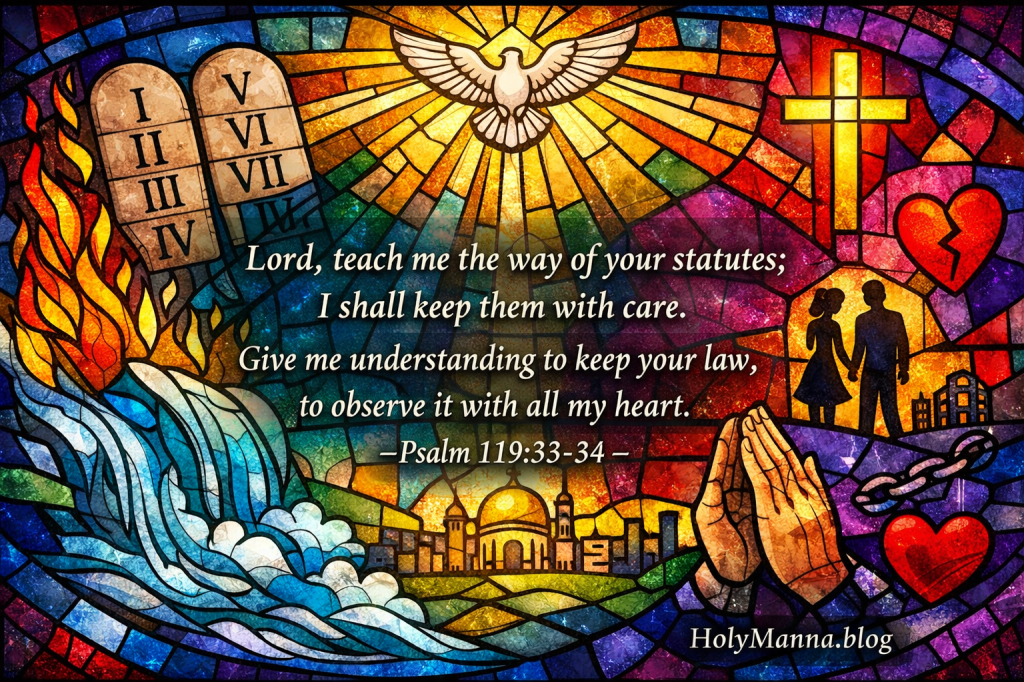
the wonders of your law.33 Lord, teach me the way of your statutes;
I shall keep them with care.
34 Give me understanding to keep your law,
to observe it with all my heart.
Detailed Exegesis
Verse 1. “Blessed those whose way is blameless, who walk by the law of the Lord.”
“Blessed” here means more than a pleasant mood. It means the deep happiness of a life ordered toward God. A “blameless way” does not describe a person who has never sinned. It describes a person who is sincere, striving, and willing to be corrected. To “walk” by the law of the Lord is to treat God’s commandments as a path, not as a debate topic. This echoes the Catholic understanding that the moral life is a journey of discipleship, shaped by grace and guided by truth.
Verse 2. “Blessed those who keep his testimonies, who seek him with all their heart.”
The psalm refuses to separate obedience from love. “Keep” is not mere compliance. It is guarding something precious. The heart is central because God is not satisfied with outward behavior that hides inward rebellion. This pairs beautifully with Jesus’ insistence that righteousness must surpass surface level religion. The line “seek him with all their heart” points to a whole person religion, where God is not one interest among many, but the center.
Verse 4. “You have given them the command to observe your precepts with care.”
The psalmist speaks like someone grateful that God has spoken clearly. God has “given” commands, meaning the law is gift, not burden. “With care” suggests attention, seriousness, and reverence. This verse counters a casual spirituality that treats commandments as optional suggestions. It also corrects the modern idea that real freedom means never being told what to do. Scripture presents a better freedom, the freedom to become good.
Verse 5. “May my ways be firm in the observance of your statutes!”
This is the honest cry of a believer who knows weakness. The psalmist does not boast. The psalmist prays for steadiness. This fits Catholic life perfectly, because the Church teaches that grace heals and strengthens human nature rather than bypassing it. This verse is a prayer for perseverance, not perfectionism. It is the kind of line that belongs on the lips before temptation and after failure.
Verse 17. “Be kind to your servant that I may live, that I may keep your word.”
Here the psalm ties obedience to life and life to mercy. “Be kind” is not sentimental. It is a plea for God’s gracious help. The psalmist wants to live, not merely survive, and understands that true life includes keeping God’s word. This sounds like Sirach again, where life and death are set before the human person, and it sounds like the New Covenant, where grace empowers what God commands.
Verse 18. “Open my eyes to see clearly the wonders of your law.”
This is a prayer for vision. A person can know the rules and still miss the beauty. This verse asks God to reveal the “wonders” in His law, meaning the goodness, wisdom, and protective love underneath every commandment. In a world that treats moral teaching as oppressive, this verse asks for the grace to see the commandments as light. This is also a quiet preparation for 1 Corinthians, where God’s wisdom is revealed through the Spirit.
Verse 33. “Lord, teach me the way of your statutes; I shall keep them with care.”
The psalmist speaks as a student, not as a critic. “Teach me” acknowledges that a person does not automatically understand how to live. God must instruct. This verse also shows that obedience grows through formation. It is not instant. It is learned. The promise to “keep them with care” is not pride. It is commitment, a decision to treat God’s will as weighty and worth protecting.
Verse 34. “Give me understanding to keep your law, to observe it with all my heart.”
This verse brings the theme to its climax. The psalmist asks for understanding, not merely willpower. That matters because many sins are fueled by spiritual stupidity, meaning the inability to see where certain roads lead. Understanding is a gift God gives, and it leads to wholehearted obedience. “With all my heart” returns again, because God is always after the inner person, which is exactly where Jesus goes in the Gospel.
Teachings
This psalm is a strong biblical foundation for the Catholic belief that God’s commandments are ordered to human flourishing and genuine happiness. The Church does not see the moral law as an enemy of freedom. The Church sees it as a guide to freedom, because it trains the soul to choose the good.
The Catechism describes the moral law as a work of divine wisdom. CCC 1950 says “The moral law is the work of divine Wisdom. Its biblical meaning can be defined as fatherly instruction, God’s pedagogy. It prescribes for man the ways that lead to the promised blessedness and forbids the ways that turn away from God and from his love.” This is basically Psalm 119 turned into doctrine. The psalm keeps repeating that God’s law leads to blessing, and it begs God to teach the heart how to walk that path.
The Church also teaches that the law is not merely an Old Testament memory. It is fulfilled in Christ and lived in grace. CCC 1968 says “The Law of the Gospel fulfills the commandments of the Law. The Lord’s Sermon on the Mount, far from abolishing or devaluing the moral prescriptions of the Old Law, releases their hidden potential and has new demands arise from them. It reveals their entire divine and human truth.” That is the exact movement happening today. Psalm 119 praises the law as a path, and The Gospel of Matthew shows that path reaching into anger, lust, fidelity, and truth, not to crush the soul, but to free it.
Saint Augustine also helps here because he understood that the law, by itself, can show what is right without giving the power to do it. The psalm’s repeated pleas, “teach me” and “give me understanding,” sound like a heart that knows it needs God’s help. CCC 1996 captures the Catholic balance between command and grace: “Our justification comes from the grace of God. Grace is favor, the free and undeserved help that God gives us to respond to his call to become children of God, adoptive sons, partakers of the divine nature and of eternal life.” The psalm asks for kindness and understanding because the believer knows obedience is lived as a response to God’s help, not as a self made achievement.
Reflection
This psalm challenges a common spiritual lie. Many people assume happiness comes from having fewer boundaries and more options. The psalm says the opposite. The blessed life belongs to the one whose way is shaped by God’s wisdom. That does not mean life becomes painless. It means life becomes ordered, and an ordered life is harder to manipulate, harder to destroy, and far more peaceful.
A practical way to live this psalm is to stop treating commandments like emergency rules that only matter in crises. A better approach is to treat God’s law like a daily compass. When choices show up, and they always do, the question is not simply what feels right in the moment. The question is whether the choice walks by the law of the Lord. That question protects marriages, friendships, finances, and the hidden interior world where sins begin.
This psalm also teaches how to pray when faith feels dry. It gives simple but powerful prayers that can be spoken before a workday, before a difficult conversation, or before logging into the internet. “Open my eyes to see clearly the wonders of your law.” That line is a request for renewed vision when temptation makes sin look exciting and holiness look boring. “May my ways be firm in the observance of your statutes!” That line is a request for steadiness when habits are pulling the soul in the wrong direction.
Do God’s commandments feel like protection or like restriction right now, and what does that reaction reveal about the heart’s current attachments?
What would change in daily life if the prayer became simple and steady, asking God each morning for understanding and firmness rather than waiting until a crisis hits?
Where does the heart most need God to “open the eyes,” so the soul can see the real consequences of sin and the real beauty of obedience?
This psalm is not naïve. It knows weakness, which is why it asks for kindness, understanding, and teaching. It is the voice of a believer who has learned that God’s law is not the enemy of joy. It is the road that leads to it.
Second Reading – 1 Corinthians 2:6-10
God’s Wisdom Is a Mystery Revealed by the Spirit.
Corinth was the kind of city that knew how to look impressive. It was wealthy, strategic, and loud with competing ideas. People chased status, eloquence, and the kind of “wisdom” that made a person sound superior at dinner parties. Into that world, St. Paul preached Christ crucified, which sounded like the opposite of wisdom to the cultural elites. That tension is sitting right underneath today’s passage. Paul is speaking to believers who are tempted to measure God by the standards of the age, and he refuses to let them do it.
This reading fits today’s theme by answering a crucial question. If God’s law leads to life, and if Jesus fulfills the law by demanding a deeper righteousness of the heart, then where does the strength and clarity come from to live that way? Paul’s answer is that Christian life is not powered by human cleverness. It is powered by divine revelation and the Holy Spirit. The commandments are not simply rules that pressure the soul. They are invitations into God’s own wisdom, a wisdom the world could not recognize because it was hidden in the humility of the Cross.
1 Corinthians 2:6-10 – New American Bible (Revised Edition)
6 Yet we do speak a wisdom to those who are mature, but not a wisdom of this age, nor of the rulers of this age who are passing away. 7 Rather, we speak God’s wisdom, mysterious, hidden, which God predetermined before the ages for our glory, 8 and which none of the rulers of this age knew; for, if they had known it, they would not have crucified the Lord of glory. 9 But as it is written:
“What eye has not seen, and ear has not heard,
and what has not entered the human heart,
what God has prepared for those who love him,”10 this God has revealed to us through the Spirit.
For the Spirit scrutinizes everything, even the depths of God.
Detailed Exegesis
Verse 6. “Yet we do speak a wisdom to those who are mature, but not a wisdom of this age, nor of the rulers of this age who are passing away.”
Paul does not reject wisdom itself. He rejects counterfeit wisdom. The world’s wisdom is often obsessed with winning, controlling, and looking right, and it fades because every empire, every trend, and every celebrity eventually passes away. Paul speaks to “those who are mature,” meaning those willing to be formed by God, not merely entertained by ideas. Christian maturity is not arrogance. It is the ability to receive truth even when it contradicts pride.
Verse 7. “Rather, we speak God’s wisdom, mysterious, hidden, which God predetermined before the ages for our glory.”
This “mysterious, hidden” wisdom is not a puzzle that humans solve with effort. In Catholic language, a mystery is a divine reality that can be truly known because God reveals it, but it can never be exhausted by the human mind. The stunning claim is that God planned this wisdom “before the ages,” meaning the Cross is not plan B. It is part of God’s eternal design to draw humanity into glory, which is communion with Him.
Verse 8. “And which none of the rulers of this age knew; for, if they had known it, they would not have crucified the Lord of glory.”
The Cross exposes how blind worldly power can be. Those who considered themselves most realistic and most informed did not recognize God standing in front of them. They crucified “the Lord of glory,” a title that holds together humility and divinity in one breath. This verse also shows that sin is not only personal, it can become cultural and institutional, where whole systems get organized against the truth.
Verse 9. “But as it is written: ‘What eye has not seen, and ear has not heard, and what has not entered the human heart, what God has prepared for those who love him,’”
Paul reaches for Scripture to describe the future God is preparing. Human imagination does not naturally rise to the level of God’s promises. The line is meant to expand hope, not to create vague spiritual optimism. The promise is concrete, because it is tied to love. God prepares glory for “those who love him,” meaning those who cling to Him in faith and obedience even when the world calls that foolish.
Verse 10. “This God has revealed to us through the Spirit. For the Spirit scrutinizes everything, even the depths of God.”
Here is the hinge of the whole passage. Christianity is not primarily about human discovery. It is about divine disclosure. God reveals His wisdom through the Holy Spirit, who is not a force or a mood, but a divine Person who knows God from within, because the Spirit is God. The Spirit “scrutinizes” even the depths of God, meaning the Spirit is able to bring the believer into real knowledge of God’s plan, not merely opinions about God.
Teachings
This reading supports several foundational Catholic teachings: the reality of divine revelation, the nature of mystery, and the indispensable role of the Holy Spirit in understanding and living the faith.
The Church teaches that revelation is God’s personal self disclosure, not humanity’s best guess. CCC 51 says “It pleased God, in his goodness and wisdom, to reveal himself and to make known the mystery of his will.” This matches Paul’s insistence that God’s wisdom is “mysterious, hidden,” and then revealed. The faith is not built on spiritual speculation. It is built on God speaking and acting in history, culminating in Jesus Christ.
Paul’s language about “mysterious, hidden” wisdom also connects with the Church’s understanding of the “mystery” as something real and saving, not something vague. CCC 234 says “The mystery of the Most Holy Trinity is the central mystery of Christian faith and life.” A mystery is not a fog. It is a blazing light that the human mind cannot stare at without being overwhelmed. The Spirit does not remove mystery. The Spirit leads the believer into it.
Since Paul says the Spirit reveals what the eye cannot see and the ear cannot hear, it is important to hear what the Church says about the Holy Spirit’s mission. CCC 683 says “No one can say ‘Jesus is Lord’ except by the Holy Spirit.” This matters because the moral demands of Jesus in The Gospel of Matthew cannot be lived as a self improvement program. They are lived as a supernatural life, empowered by the Spirit who makes Christ known and gives strength to follow Him.
The Church also teaches that the Spirit forms the inner life through grace, which elevates human nature and heals it. CCC 1996 says “Our justification comes from the grace of God. Grace is favor, the free and undeserved help that God gives us to respond to his call to become children of God, adoptive sons, partakers of the divine nature and of eternal life.” That line belongs here because Paul is describing a wisdom “predetermined before the ages for our glory.” The goal is not merely improved behavior. The goal is participation in God’s life, which the Church calls the divine nature.
Historically, Corinth also helps the message land. The early Church was living in the middle of a Greco Roman world where philosophers competed for disciples and patrons. Rhetoric could become a performance, and “wisdom” could become a status symbol. Paul refuses to let the Gospel become another brand on the shelf. He insists that the Cross is God’s wisdom, and that wisdom is revealed by the Spirit, not earned by ego.
Reflection
This reading is a reality check for anyone tempted to treat the faith like a tool for feeling better or looking better. God’s wisdom is not designed to impress the world. It is designed to save the world. That is why it centers on the Cross. The world wants a wisdom that flatters pride, excuses sin, and promises control. God offers a wisdom that humbles pride, forgives sin, and teaches surrender. The world calls that weakness. Heaven calls it glory.
A practical way to live this reading is to stop asking whether the Gospel feels useful and start asking whether it is true. Then ask for the Holy Spirit’s help to see what God is doing beneath the surface. When a person keeps falling into the same patterns, anger, lust, dishonesty, resentment, the issue is often not just lack of effort. It is lack of spiritual vision. The heart is trying to interpret life with the “wisdom of this age,” which always fades and always disappoints. Paul invites believers to ask for the Spirit’s light, because the Spirit reveals the deeper meaning and gives strength to choose what leads to glory.
This also speaks to the discouragement people feel when Jesus’ commands go straight to the heart. It can sound impossible until Paul’s message is heard. God reveals His wisdom and provides His Spirit, which means holiness is not a solo project. It is a response to grace.
Where has the heart been chasing the “wisdom of this age,” meaning approval, comfort, control, or status, instead of chasing what lasts?
When the Cross appears in daily life through sacrifice, restraint, or the decision to forgive, is it treated as failure or received as God’s wisdom?
What would change if the day began with a serious prayer for the Holy Spirit to “open the eyes,” so God’s hidden work could be seen and trusted?
Paul’s message is steady and hopeful. God has prepared more than human imagination can invent, and He has not kept it locked away. He has revealed it through the Spirit, so the believer can live with a deeper mind, a stronger heart, and a hope that does not pass away.
Holy Gospel – Matthew 5:17-37
Jesus Heals the Heart that Keeps Breaking It.
This passage lands in the Sermon on the Mount, where Jesus teaches like the new Moses, not from a palace, but from a hillside, gathering ordinary people who are hungry for God and tired of empty religion. In the Jewish world of the first century, the Law was holy. It came from God. It formed Israel as a covenant people in the middle of a pagan world. Yet many had learned to treat righteousness as something measurable, something that could be managed by external compliance, public reputation, and clever interpretation. Jesus steps into that atmosphere and does something that still surprises people. He refuses to abolish the Law, and He refuses to let anyone hide behind it.
This fits perfectly with the theme running through all the readings. Sirach insists that life and death are set before the human person. Psalm 119 teaches that blessedness belongs to those who love God’s commandments. 1 Corinthians reveals that God’s wisdom is hidden and only understood by the Spirit. Now Jesus brings it all together. He fulfills the Law, not by relaxing it, but by bringing it to completion. He reveals what the Law always aimed at: a heart that loves, a life that tells the truth, and a holiness that begins on the inside and reshapes everything on the outside.
Matthew 5:17-37 – New American Bible (Revised Edition)
Teaching About the Law. 17 “Do not think that I have come to abolish the law or the prophets. I have come not to abolish but to fulfill. 18 Amen, I say to you, until heaven and earth pass away, not the smallest letter or the smallest part of a letter will pass from the law, until all things have taken place. 19 Therefore, whoever breaks one of the least of these commandments and teaches others to do so will be called least in the kingdom of heaven. But whoever obeys and teaches these commandments will be called greatest in the kingdom of heaven. 20 I tell you, unless your righteousness surpasses that of the scribes and Pharisees, you will not enter into the kingdom of heaven.
Teaching About Anger. 21 “You have heard that it was said to your ancestors, ‘You shall not kill; and whoever kills will be liable to judgment.’ 22 But I say to you, whoever is angry with his brother will be liable to judgment, and whoever says to his brother, ‘Raqa,’ will be answerable to the Sanhedrin, and whoever says, ‘You fool,’ will be liable to fiery Gehenna. 23 Therefore, if you bring your gift to the altar, and there recall that your brother has anything against you, 24 leave your gift there at the altar, go first and be reconciled with your brother, and then come and offer your gift. 25 Settle with your opponent quickly while on the way to court with him. Otherwise your opponent will hand you over to the judge, and the judge will hand you over to the guard, and you will be thrown into prison. 26 Amen, I say to you, you will not be released until you have paid the last penny.
Teaching About Adultery. 27 “You have heard that it was said, ‘You shall not commit adultery.’ 28 But I say to you, everyone who looks at a woman with lust has already committed adultery with her in his heart. 29 If your right eye causes you to sin, tear it out and throw it away. It is better for you to lose one of your members than to have your whole body thrown into Gehenna. 30 And if your right hand causes you to sin, cut it off and throw it away. It is better for you to lose one of your members than to have your whole body go into Gehenna.
Teaching About Divorce. 31 “It was also said, ‘Whoever divorces his wife must give her a bill of divorce.’ 32 But I say to you, whoever divorces his wife (unless the marriage is unlawful) causes her to commit adultery, and whoever marries a divorced woman commits adultery.
Teaching About Oaths. 33 “Again you have heard that it was said to your ancestors, ‘Do not take a false oath, but make good to the Lord all that you vow.’ 34 But I say to you, do not swear at all; not by heaven, for it is God’s throne; 35 nor by the earth, for it is his footstool; nor by Jerusalem, for it is the city of the great King. 36 Do not swear by your head, for you cannot make a single hair white or black. 37 Let your ‘Yes’ mean ‘Yes,’ and your ‘No’ mean ‘No.’ Anything more is from the evil one.
Detailed Exegesis
Verse 17. “Do not think that I have come to abolish the law or the prophets. I have come not to abolish but to fulfill.”
Jesus begins by shutting down a common misunderstanding. He is not an enemy of Israel’s Scriptures. He is their fulfillment. To fulfill means to bring to completion, to fill up what was promised, and to reveal the full meaning. The Law and the Prophets point toward Him, and in Him they reach their goal.
Verse 18. “Amen, I say to you, until heaven and earth pass away, not the smallest letter or the smallest part of a letter will pass from the law, until all things have taken place.”
Jesus speaks with divine authority, using “Amen” in a way that signals certainty. He emphasizes the enduring seriousness of God’s will. This is not about obsessing over technicalities. It is about honoring the holiness of what God has spoken. The moral truth does not expire because culture shifts.
Verse 19. “Therefore, whoever breaks one of the least of these commandments and teaches others to do so will be called least in the kingdom of heaven. But whoever obeys and teaches these commandments will be called greatest in the kingdom of heaven.”
Jesus ties personal obedience to responsibility for others. A life does not exist in isolation. People teach constantly by example. The warning is not against honest weakness. The warning is against using influence to normalize sin.
Verse 20. “I tell you, unless your righteousness surpasses that of the scribes and Pharisees, you will not enter into the kingdom of heaven.”
This is the shock line. The scribes and Pharisees were known for religious seriousness. Jesus demands a righteousness beyond visible performance. He calls for integrity, purity of intention, and a heart aligned with God. The kingdom is not entered by appearances.
Verse 21. “You have heard that it was said to your ancestors, ‘You shall not kill; and whoever kills will be liable to judgment.’”
Jesus quotes the commandment and its legal consequence. The people knew the external rule. Jesus is about to reveal the internal root.
Verse 22. “But I say to you, whoever is angry with his brother will be liable to judgment, and whoever says to his brother, ‘Raqa,’ will be answerable to the Sanhedrin, and whoever says, ‘You fool,’ will be liable to fiery Gehenna.”
Jesus moves from murder to anger, contempt, and verbal violence. “Raqa” is a slur of dismissal, treating another person as worthless. Jesus shows that hatred and contempt are spiritual seeds of murder. “Gehenna” evokes the image of final ruin, and it underlines that interior sin is not harmless.
Verse 23. “Therefore, if you bring your gift to the altar, and there recall that your brother has anything against you,”
Jesus connects worship to reconciliation. The “altar” language evokes sacrifice. God does not accept a life that performs worship while clinging to hostility.
Verse 24. “Leave your gift there at the altar, go first and be reconciled with your brother, and then come and offer your gift.”
Reconciliation is treated as urgent. This is not permission to skip worship casually. It is a demand to remove what blocks true worship. A divided heart cannot offer a whole offering.
Verse 25. “Settle with your opponent quickly while on the way to court with him. Otherwise your opponent will hand you over to the judge, and the judge will hand you over to the guard, and you will be thrown into prison.”
Jesus uses a legal image to describe spiritual urgency. Do not delay repentance. Do not postpone peace. Pride loves delay because delay keeps control. Jesus urges humility now.
Verse 26. “Amen, I say to you, you will not be released until you have paid the last penny.”
This intensifies the warning. Actions have consequences. Sin creates debts that must be faced. The line teaches that postponing reconciliation and repentance only hardens the cost.
Verse 27. “You have heard that it was said, ‘You shall not commit adultery.’”
Again Jesus quotes the external commandment. The crowd knows it. Jesus is about to go deeper.
Verse 28. “But I say to you, everyone who looks at a woman with lust has already committed adultery with her in his heart.”
Jesus reveals the interior battlefield of purity. Lust is not the same as noticing beauty. Lust is the willful gaze that turns a person into an object. It trains the heart to consume rather than to love. Jesus is defending the dignity of women and the integrity of men by attacking the sin at its root.
Verse 29. “If your right eye causes you to sin, tear it out and throw it away. It is better for you to lose one of your members than to have your whole body thrown into Gehenna.”
This is intense, hyperbolic language meant to shock the listener into seriousness. Jesus is not endorsing self-harm. He is commanding spiritual surgery. Anything that leads to grave sin must be cut off decisively. The eternal stakes are real.
Verse 30. “And if your right hand causes you to sin, cut it off and throw it away. It is better for you to lose one of your members than to have your whole body go into Gehenna.”
The hand represents actions, habits, and choices. If the eye is the entry point of temptation, the hand is the follow through. Jesus is teaching that holiness requires concrete changes, not vague intentions.
Verse 31. “It was also said, ‘Whoever divorces his wife must give her a bill of divorce.’”
Jesus references a legal provision that existed in Israel, often used to justify dismissing a spouse. In the ancient world, women could be left economically and socially vulnerable. Jesus is about to defend the covenant meaning of marriage.
Verse 32. “But I say to you, whoever divorces his wife, unless the marriage is unlawful, causes her to commit adultery, and whoever marries a divorced woman commits adultery.”
Jesus restores marriage to its covenant dignity. He teaches that marriage is not a contract that can be discarded when feelings change. The “unless” clause points to situations where a union is not a true marriage in the first place. The emphasis is that a valid marriage is not meant to be broken, because it reflects God’s faithful love.
Verse 33. “Again you have heard that it was said to your ancestors, ‘Do not take a false oath, but make good to the Lord all that you vow.’”
Jesus turns to truthfulness and reverence. Oaths were common, sometimes abused, and often used as loopholes. People could hide dishonesty behind technical wording. Jesus exposes that gamesmanship.
Verse 34. “But I say to you, do not swear at all; not by heaven, for it is God’s throne;”
Jesus calls His disciples to truth so solid that it does not require dramatic swearing. Heaven is not a tool for manipulating trust. It belongs to God.
Verse 35. “Nor by the earth, for it is his footstool; nor by Jerusalem, for it is the city of the great King.”
Jesus names sacred realities and refuses to let them be used as props. Earth and Jerusalem are not bargaining chips. They are part of God’s order, and truth cannot be built on exploiting holy things.
Verse 36. “Do not swear by your head, for you cannot make a single hair white or black.”
This exposes human limitation. People swear by themselves as if they control the future. Jesus reminds the listener that life is fragile and limited. Humility belongs in speech.
Verse 37. “Let your ‘Yes’ mean ‘Yes,’ and your ‘No’ mean ‘No.’ Anything more is from the evil one.”
Jesus calls for clean, honest speech. A Christian should be so truthful that ordinary words carry weight. The warning about “the evil one” highlights how deception is never neutral. It aligns the heart with darkness.
Teachings
This Gospel is a central text for Catholic moral teaching because it reveals the New Law of Christ as an interior law. It does not replace commandments with feelings. It transforms the commandments into a path of love rooted in grace.
The Catechism teaches that the moral law is fulfilled and brought to completion in Christ. CCC 1968 says “The Law of the Gospel fulfills the commandments of the Law. The Lord’s Sermon on the Mount, far from abolishing or devaluing the moral prescriptions of the Old Law, releases their hidden potential and has new demands arise from them. It reveals their entire divine and human truth.” This explains why Jesus repeatedly says, “You have heard it said,” and then, “But I say to you.” He is not contradicting God. He is revealing God’s full intent.
On anger and hatred, the Church is direct. CCC 2302 says “By recalling the commandment, ‘You shall not kill,’ our Lord asked for peace of heart and denounced murderous anger and hatred as immoral.” Jesus is not being dramatic for effect. He is teaching that the heart can become a weapon before the hand ever becomes one.
On lust and purity, the Church again speaks in harmony with Jesus. CCC 2336 says “Jesus came to restore creation to the purity of its origins. In the Sermon on the Mount, he gives an authoritative interpretation of the ‘divine plan’: ‘You have heard that it was said, “You shall not commit adultery.” But I say to you that everyone who looks at a woman lustfully has already committed adultery with her in his heart.’” This shows that the Gospel is not prudish. It is protective. It protects persons from being reduced to objects, and it protects the human heart from being trained in slavery.
On divorce, the Church teaches that Christ restored marriage to God’s original plan of indissolubility. CCC 2382 says “The Lord Jesus insisted on the original intention of the Creator who willed that marriage be indissoluble.” This teaching is not a harsh rule meant to trap people. It is a proclamation that love is meant to be faithful, that spouses are not disposable, and that covenant reflects God.
On truthfulness and oaths, the Church clarifies Jesus’ meaning. CCC 2154 says “The tradition of the Church has understood Jesus’ words as not excluding oaths made for grave and right reasons, for example in court. ‘Swearing does not contradict the prohibition against taking the Lord’s name in vain when it is done with truth, discernment, and justice.’” Jesus is condemning manipulative speech and casual misuse of holy things, while calling His disciples to honesty rooted in reverence.
The saints consistently read this Gospel as a call to interior conversion rather than mere external reform. Saint John Chrysostom emphasized that Christ leads His disciples beyond the surface, demanding not just avoidance of overt sin, but purification of the causes within. This is why the Church calls the Sermon on the Mount a cornerstone of Christian morality. It shows what grace aims to produce.
Reflection
This Gospel confronts a comfortable illusion. Many people want a faith that keeps religion on the weekends and leaves the heart untouched during the week. Jesus refuses that arrangement. He goes after the interior life because that is where the real war is fought. The anger that turns relationships cold. The lust that trains the eyes to take instead of love. The casual dishonesty that makes words meaningless. The unwillingness to reconcile that makes worship hollow.
A practical way to respond is to pick one area Jesus names and treat it like the primary battlefield for the week. If anger is the struggle, then reconciliation must become a priority, not when it feels convenient, but because Jesus says worship and peace belong together. If lust is the struggle, then serious spiritual surgery is required, meaning removing triggers, changing habits, and seeking the sacraments with humility. If truthfulness is the struggle, then speech must be cleaned up, exaggeration must die, and the habit of saying what is convenient must be replaced with the courage to say what is true.
This Gospel also offers hope, because Jesus is not merely exposing sin. He is revealing the path of freedom. He is teaching what a healed heart looks like. He is inviting His disciples into a righteousness deeper than reputation. That kind of righteousness is impossible without grace, which is why the rest of today’s readings matter. Sirach insists the choice is real. Psalm 119 teaches that God’s law is a blessing. 1 Corinthians says the Spirit reveals God’s wisdom and makes it livable. Jesus then names the inner sins not to shame, but to heal.
Where does the heart secretly excuse what Jesus confronts directly, whether anger, lust, broken promises, or dishonest speech?
What relationship needs reconciliation, not in theory, but in a concrete act of humility that can be done soon?
What “eye” and what “hand” need spiritual surgery, meaning a practical change that removes access to temptation rather than pretending willpower will solve everything?
If the words “yes” and “no” were audited this week, would they reveal reliability and integrity, or would they reveal a habit of protecting comfort at the cost of truth?
Jesus calls for a righteousness that surpasses the scribes and Pharisees, not because God wants impossible demands, but because God wants a real disciple. The disciple is not someone who looks religious. The disciple is someone whose heart is being remade, one honest choice at a time, by the wisdom of God and the grace of the Holy Spirit.
The Freedom to Love for Real
Today’s readings tell one clear story, and it is a story that respects the dignity of every human soul. God does not treat people like machines. He places a real choice in front of them. Sirach 15:15-20 says it plainly with images that are impossible to forget. “Set before you are fire and water” and “Before everyone are life and death.” This is not meant to create anxiety. It is meant to awaken courage. God does not command anyone to sin, and He does not excuse deception, because He loves too much to lie about what destroys a person.
Then the Church answers with the voice of prayer in Psalm 119. The psalm does not speak like someone trapped under rules. It speaks like someone who has tasted the peace of obedience and does not want to go back. “Blessed those whose way is blameless” becomes the refrain of a life that is no longer ruled by impulse. The psalm teaches that God’s commandments are not there to shrink a person. They are there to steady a person, to open the eyes, and to form a heart that can actually love.
St. Paul then explains why this path cannot be lived by human effort alone. 1 Corinthians 2:6-10 reminds believers that God’s wisdom is not the wisdom of the age. It is hidden, it is deep, and it centers on the Cross. What the world calls foolish, God calls glory. What the world tries to control, God teaches the soul to surrender. And this wisdom is not guessed at. It is revealed, because “this God has revealed to us through the Spirit.” That is the quiet source of hope running under the whole day. The Christian life is not a life of mere willpower. It is a life of grace.
Finally, Jesus speaks in The Gospel of Matthew 5:17-37 and brings everything to its sharp, saving point. He does not abolish the law. He fulfills it. Then He refuses to let anyone hide behind surface level righteousness. He goes straight for the heart, where anger becomes contempt, lust becomes interior adultery, vows become disposable, and words become slippery. Jesus is not humiliating anyone here. He is naming the real problem so it can finally be healed. He is teaching what freedom looks like when it is rooted in truth, and what love looks like when it is not divided.
The call to action is simple, but it is not shallow. Choose life today in a concrete way. Pick one place where the heart has been reaching toward fire, and reach toward water instead. Choose reconciliation instead of replaying the argument. Choose purity instead of feeding the imagination with poison. Choose honesty instead of using half truths to protect comfort. Choose fidelity instead of daydreaming about escape. Then bring that choice to God with humility and confidence, because the Lord who commands also gives grace. The believer is not asked to become holy by pretending. The believer is invited to become holy by surrendering, repenting, and walking step by step in the wisdom of Christ.
What would change this week if the soul stopped negotiating with sin and started treating God’s commandments as a path to real peace?
What relationship, habit, or hidden pattern needs to be brought into the light so grace can actually heal it?
If Jesus is fulfilling the law in the heart, what does it look like to give Him access to the places that have been kept private?
This is the kind of Sunday that can reset a life. God places life in front of His people, teaches them the way, reveals the wisdom of the Cross, and then sends them out to live with a heart that is whole. The next step is not to be impressive. The next step is to be honest, to be obedient, and to trust that the Spirit is strong enough to make a real disciple out of an ordinary person.
Engage with Us!
Share reflections in the comments below. It is always powerful to hear how God is speaking through the Scriptures in real daily life, especially when these readings challenge the heart and call for a clearer choice.
- First Reading, Sirach 15:15-20: Where is life presenting “fire and water” right now, and what concrete choice would show a real decision for God instead of drifting?
- Responsorial Psalm, Psalm 119:1-2, 4-5, 17-18, 33-34: Which line of this psalm feels most needed today, and how could that verse become a daily prayer that reshapes habits and priorities?
- Second Reading, 1 Corinthians 2:6-10: Where has the heart been tempted to chase the wisdom of this age, and what would it look like to trust the hidden wisdom of the Cross in that exact situation?
- Holy Gospel, Matthew 5:17-37: Which area Jesus names hits closest to home right now, anger, lust, reconciliation, fidelity, or truthfulness, and what specific “spiritual surgery” would help cut off what leads to sin?
Keep walking in faith with a steady heart, even when the path feels demanding, because God never calls anyone to holiness without also offering grace. Live this week with courage, choose life in the small decisions, and do everything with the love and mercy Jesus taught us.
Sacred Heart of Jesus, we trust in You!
Immaculate Heart of Mary, pray for us!
Saint Michael the Archangel, defend us in battle!
Follow us on YouTube, Instagram and Facebook for more insights and reflections on living a faith-filled life.

 Holy Manna!
Leave a comment