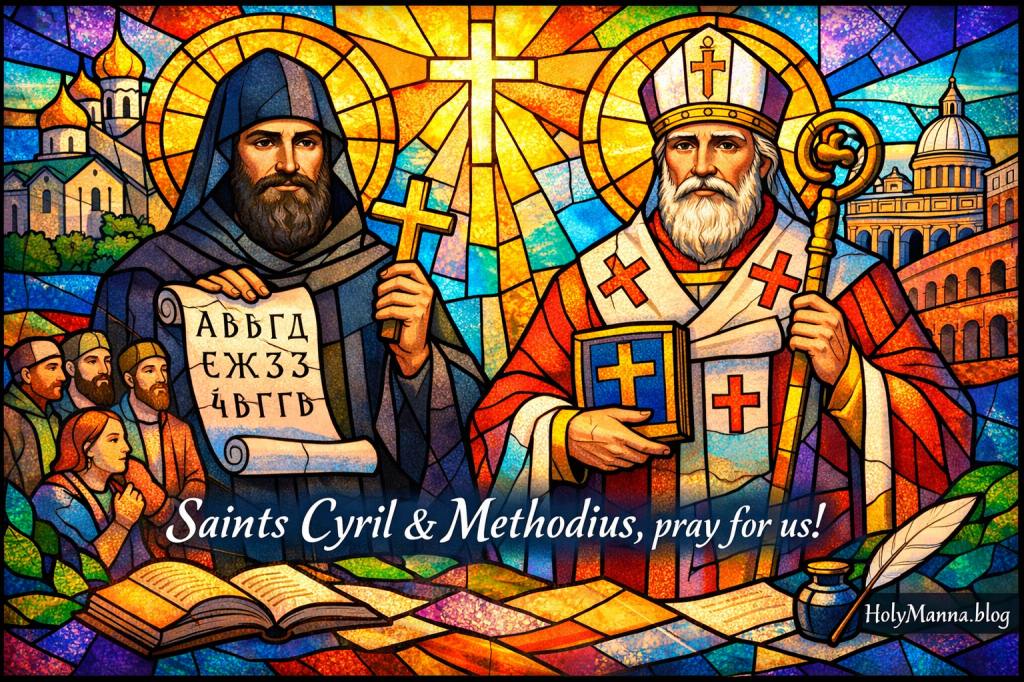
Two Brothers Who Changed Europe
Saints Cyril and Methodius are remembered the way great missionaries should be remembered. They did not treat conversion like a change of costume, and they did not treat culture like an enemy. They treated the Catholic faith like a treasure meant for every nation, every language, and every heart willing to receive Jesus Christ. These two brothers from Thessalonica carried the Gospel into Slavic lands and helped whole peoples learn how to pray, worship, and think with the mind of the Church.
They are often called the Apostles to the Slavs because their work was not a small local effort. It reshaped Christian life across a wide region for generations. They are also honored as co-patrons of Europe because their witness reminds the world that Europe’s deepest unity is not politics or economics. Its deepest unity is Jesus Christ, confessed in the one faith, lived in holiness, and safeguarded in communion. Their story also matches what The Catechism teaches about the Church’s missionary identity, because the Church exists to evangelize and bring all peoples into the life of Christ, CCC 849-856.
Two Brothers, One Providence
Cyril was born with the name Constantine, and Methodius was his older brother. They grew up in Thessalonica, a city where languages and cultures mixed every day. That background mattered because it prepared them to understand a basic missionary truth. If the Church truly loves a people, the Church speaks so that the people can truly hear.
Cyril became known for intellectual brilliance and deep study, yet his gifts did not turn into pride. They became service. He was trained in theology and philosophy, and the Christian East remembered him with a title that hints at his reputation, calling him “the Philosopher.” Methodius followed a more administrative path at first, learning leadership, discipline, and responsibility. That early experience later became a hidden preparation for his work as a bishop, because shepherding souls requires steadiness, patience, and courage when the pressure rises.
Their conversion story is not a single dramatic scene. It is the slow, faithful kind of conversion that builds a saint through daily obedience. They kept choosing prayer, discipline, and the Church’s mission again and again, until their whole lives were shaped by that yes. This is the kind of holiness that looks ordinary until the day it becomes heroic.
An Alphabet for the Gospel
Before the mission that made them famous, the brothers were already trusted with difficult and delicate work. They were sent to places where language barriers were real, where politics could shift overnight, and where religious debates were intense. Their experience sharpened them for the moment when a major request arrived from Slavic lands. The people needed missionaries who could teach the faith clearly and lead them into worship that formed the heart, not just the mind.
Cyril and Methodius understood that the Gospel is not meant to stay locked inside one cultural bubble. Cyril devised an alphabet suited to Slavonic speech, and together they translated Scripture and essential liturgical texts. This was not a gimmick and it was not a protest. It was missionary love expressed through disciplined work. It helped people hear the Word of God, confess the faith, and pray as Catholics with real understanding.
That decision stirred controversy. Some insisted worship should be restricted to a small set of languages, as if God only listened to a holy few. Cyril’s response was not bitterness or mockery. It was prayer and pastoral concern, because he knew that cutting people off from understanding could cut people off from deep discipleship. His spiritual battle shows up in a line attributed to him that captures the heart of the conflict, “Free them from the heresy of the three languages.” This was never about attacking legitimate tradition. It was about defending the right of ordinary people to receive the faith with clarity and reverence.
Signs of Grace and Works of Mercy
When people ask about miracles, it is wise to speak with reverence and honesty. The ancient Christian world often recorded wonders in the language of devotion, not in modern medical style reports. Still, Catholic tradition preserves striking moments that point to God’s providence around these saints and their mission.
One major episode involves the relics of Pope Saint Clement I. Catholic memory connects Cyril with discovering those relics and bringing them to Rome. That translation was remembered with language suggesting extraordinary signs, and it became a powerful symbol that their mission was not a private project. It belonged to the universal Church, rooted in apostolic communion. Relics are not magic, and the saints are not mascots. Relics point to the truth that God works through real bodies, real history, and real holiness, and that the Church remains one across nations and languages.
Their story also includes a kind of miracle that modern people often overlook, the miracle of mercy lived courageously. Cyril resisted worldly rewards and treated human dignity as part of evangelization. Catholic tradition remembers that he accepted slaves as gifts and freed them when they embraced the faith. That act of charity preaches loudly. It says the Gospel does not only change opinions. It changes lives. It breaks chains, both spiritual and human, and it teaches Christians to see every person as someone made for freedom in Christ.
The work of translation itself also deserves to be seen as a providential gift. These brothers did not only preach sermons. They built a foundation for Christian life. They made it possible for families to hear Scripture proclaimed in words they understood. They made it possible for worship to form hearts from the inside out. This is exactly what the Church means when she teaches that the liturgy can be expressed in different cultures and languages without changing the faith itself, CCC 1204-1206.
The Cost of Unity
If their story were only victories, it would not be as helpful. God allowed their mission to be tested, and the testing was painful. Opposition became personal. Their motives were questioned. Their orthodoxy was attacked. Their use of Slavonic in worship was treated as suspicious, even though it was ordered toward evangelization and catechesis.
Here is the detail many people miss. When controversy erupted, Cyril and Methodius did not act like independent rebels who treated unity as optional. They went to Rome and placed their work under the judgment of the Church. That mattered because their method was examined, and they received papal support and approval. Their story shows the Catholic principle that unity is not maintained by pride, and it is not maintained by force. Unity is safeguarded through communion, and communion is protected through legitimate authority, as The Catechism teaches about the role of Peter and the unity of the Church, CCC 881-882.
Cyril’s final years reveal humility and peace. Near the end of his life he embraced monastic life and took the name Cyril. He died in Rome, leaving behind more than texts and translations. He left behind a model of obedience, prayer, and missionary courage. Methodius carried the mission forward as a bishop, and his cross was heavy. He was deposed by hostile forces and imprisoned for a long period. His suffering was not a side note. It was part of his sanctity.
Methodius returned to ministry without quitting, without turning bitter, and without abandoning the Church. He continued translating, teaching, and forming disciples even as political winds shifted and enemies waited for him to weaken. Catholic memory preserves Cyril’s encouragement to his brother at the end, and it sounds like the kind of command a weary Christian needs to hear, “Do not give up your work of teaching.” In a world that tells people to quit when things get hard, these saints teach endurance rooted in love.
Seeds That Refused to Die
When saints die, the world often tries to bury their influence with them. God does not allow that. After Cyril and Methodius, the struggle continued, especially around language, jurisdiction, and the shaping of Christian life. Their disciples faced persecution and displacement. That scattering, painful as it was, helped spread their work more widely, because the faith they taught was not tied to one building or one political arrangement. It was rooted in Christ and carried in living hearts.
Cyril’s burial place in Rome, associated with Saint Clement, remained a place of veneration and memory. It became a sign that missionary work belongs to the universal Church, not merely to one region. Methodius’ legacy remained tied to the lands he served and the disciples he trained, and his final efforts focused on preserving the mission through faithful successors and solid teaching.
The Church later raised them up as models not only of evangelization but also of Christian unity across East and West. Their story became a reminder that fidelity and creativity are not enemies when both are placed under Christ. Their lives show that the Gospel can take root in a culture without being watered down, and that the Church can remain one while speaking in many tongues.
Clarity, Courage, and Faithfulness
Saints Cyril and Methodius challenge modern Catholics in a way that is both encouraging and uncomfortable. They show that evangelization is not a branding exercise, and it is not about being liked. It is about bringing people to Jesus Christ and teaching them to live as disciples. Their story teaches that clarity is charity, because people cannot follow what they cannot understand. That does not mean watering down truth. It means learning the faith well enough to explain it with honesty, precision, and patience.
They also teach loyalty. When opposition rose, they stayed in communion. They trusted the Church’s authority even when Church politics were messy. That is a word for anyone tempted to treat the faith as purely personal. Jesus founded a Church, not a collection of isolated spiritual hobby groups. Unity matters. Communion matters. Staying rooted matters, CCC 881-882.
Their example offers practical direction for daily life. A Catholic can imitate them by praying seriously, studying the faith consistently, and speaking about Jesus in a way that fits real conversations. A Catholic can imitate them by defending truth without becoming harsh, and by enduring criticism without quitting the mission. The Lord uses patient perseverance more often than dramatic moments, and these saints prove that steady faithfulness can reshape entire cultures.
Engage with Us!
Share your thoughts and reflections in the comments below. Saints Cyril and Methodius have a way of waking people up, especially anyone who has ever felt the tension between truth and culture, between mission and criticism, between loving the Church and dealing with messy Church history.
- Where has God asked for courage to share the faith in a way people can truly understand?
- What is one “language” someone in your life needs you to speak, meaning a patient, relatable way of explaining the Gospel?
- How does their loyalty to Rome challenge the modern habit of treating faith like a personal brand?
- What hardship or criticism has tempted you to quit doing good, and what would persistence look like this week?
- What is one concrete step you can take to grow in knowledge of the faith, such as reading a section of The Catechism each day?
Keep going. Stay faithful. Live with courage. Speak truth with love. Do everything with the love and mercy Jesus taught, and trust that God can use one obedient life to change many hearts.
Saints Cyril & Methodius, pray for us!
Follow us on YouTube, Instagram and Facebook for more insights and reflections on living a faith-filled life.

 Holy Manna!
Leave a comment