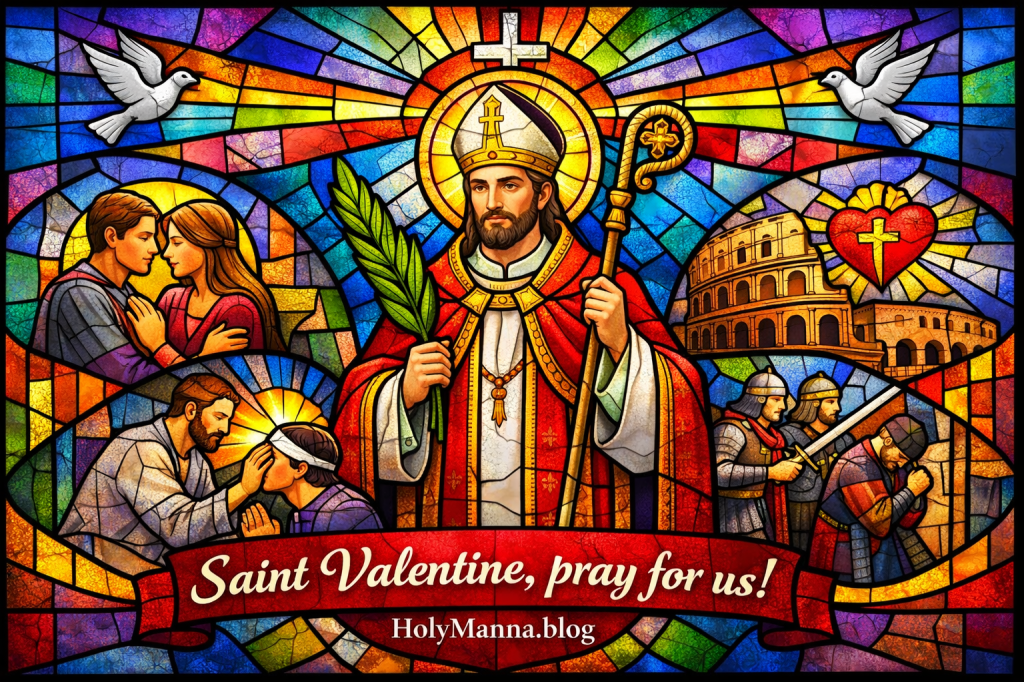
The Saint Behind the Date
Saint Valentine is one of those saints whose name is known almost everywhere, yet his real story is almost never told. The world usually thinks of romance and greeting cards, but the Church remembers something far more serious and far more beautiful. Saint Valentine is honored as a bishop and martyr, which means he was a spiritual father to his people and a public witness to Jesus Christ in a time when that witness could cost a man his life. That is why he matters, and that is why the Church still speaks his name with reverence.
Early Christian records mention more than one martyr named Valentine, which is why traditions can overlap and details can vary. Catholic sources are honest about that complexity, and there is no need to pretend every detail is equally certain. Still, the Church’s memory is steady on what counts most. Saint Valentine belongs to that heroic generation of Christians who held the faith with both hands and refused to let go even when the state demanded compromise. The Catechism teaches “Martyrdom is the supreme witness given to the truth of the faith.” (CCC 2473). This is the lens for understanding Saint Valentine, because his feast is not a celebration of sentiment. It is a celebration of fidelity.
A Bishop Formed in the Fire of the Early Church
Catholic tradition connects Saint Valentine to Interamna, which is modern day Terni in Italy. Very little is securely preserved about his childhood, his parents, or his early education, and that lack of detail can actually teach something important. The early Church did not preserve saints because they had interesting hobbies or impressive resumes. The Church preserved saints because they lived and died in union with Christ, and because their witness strengthened the faithful.
To be a bishop in those centuries was not safe, comfortable, or respected by society. A bishop was expected to preach the apostolic faith, guard the Church from error, protect the poor, and build unity among believers who were often pressured from every side. Saint Valentine’s life shows what a deep conversion looks like even without a dramatic conversion scene. He accepted the responsibilities of spiritual fatherhood at a time when Rome could punish that choice. That kind of leadership is the fruit of a heart surrendered to God.
There is also a reason Catholic devotion later connected Saint Valentine with engaged couples and married love. The Church does not honor him because he represents a shallow version of romance. The Church honors him because Christian love is a covenant, a sacrifice, and a vocation. The Catechism teaches that marriage is a covenant ordered toward the good of the spouses and the gift of children, rooted in God’s design and elevated by Christ (CCC 1601). A bishop who lived with courage and died with fidelity becomes a strong patron for people who want their love to be holy and lasting.
Healings That Led Souls to Christ
Catholic tradition often remembers Saint Valentine as a healer, and that fits the way the Lord has always worked through His saints. Miracles in the Church are never meant to be entertainment. They are meant to be signs that awaken faith, soften hardened hearts, and draw people toward conversion, baptism, and the sacraments. When Christ heals through a saint, the deeper goal is always salvation.
One longstanding tradition associated with Valentine of Terni tells of a Roman figure named Craton whose son suffered from a severe illness. The story presents Valentine as a man who did not rely on clever speech or social influence. He relied on prayer, on preaching, and on the power of God. The healing is described as a turning point that led to conversions, showing that mercy and truth belong together in Christian witness. Healing opened the door, but faith in Christ was the destination.
Because early sources mention more than one martyr named Valentine, some miracle stories connected to Saint Valentine in general are not always easy to assign with absolute certainty to the bishop of Terni alone. A faithful Catholic approach respects tradition while avoiding exaggeration. The essential point still lands with force. Saint Valentine is remembered because people experienced the compassion of Christ through him. His life becomes a reminder that holiness is never merely private, because real holiness overflows into love for the suffering and courage in preaching the truth.
The Cross He Carried
In the Roman world, Christianity was not treated as a harmless private belief. Christians refused to worship idols, and they confessed that Jesus Christ is Lord. That confession challenged the religious and political expectations of the empire. A bishop was a visible leader of that confession, and the authorities understood that pastors could not be ignored forever.
Catholic tradition says that Saint Valentine’s preaching and the conversions connected to his ministry drew attention and brought persecution. He was arrested, imprisoned, and condemned. Many accounts describe his martyrdom as beheading, and they connect it with Roman authority and the region of the Via Flaminia. Some traditions also emphasize that the execution was carried out quietly, as if the authorities feared that public martyrdom would strengthen the Church instead of weakening it. That kind of fear makes sense, because martyrdom often does the opposite of what persecutors intend.
Traditions also preserve the memory of disciples who honored his body and kept his witness alive, including names such as Proculus, Ephebus, and Apollonius. The historical precision of every detail is not the main reason the Church honors him. The reason is that the Church recognizes the pattern of sanctity. A faithful bishop served, suffered, and died as a witness to Christ. His death was not a defeat. It was his final homily, a sermon preached not with words but with blood.
A Living Legacy
The Church does not treat saints as distant heroes locked in the past. The Church believes the saints live in Christ and intercede for the faithful, and that belief shapes how Catholics speak about Saint Valentine after his death. The Catechism teaches that the saints in heaven do not cease to intercede for the Church, and that their prayer is part of the Communion of Saints (CCC 956-957). This is why devotion to Saint Valentine continued across centuries and across borders.
Catholic tradition holds that his body was brought back to Terni and venerated there, and that a basilica eventually rose in his honor. Over time, the shrine became a place where the faithful came not only to remember a martyr, but to ask for his intercession. Devotion to relics is never worship. It is a reverent honor given to what God has done in His saints, and a reminder that the Christian life is lived in the body and sanctified by grace.
One of the most striking expressions of Saint Valentine’s continuing influence is how Catholics have connected him to the vocation of marriage. In places of living devotion, engaged couples have come to seek blessing and prayer, not as superstition, but as a humble acknowledgment that love needs grace. A faithful marriage is not built by chemistry alone. It is built by sacrifice, prayer, and the decision to love as Christ loves. Saint Valentine’s martyrdom makes him an unexpected but powerful patron for couples who want love that lasts.
February 14 Reclaimed
A surprising detail many Catholics never learn is that Saint Valentine is not celebrated universally in the Church’s general calendar on February 14 in the way popular culture assumes, even though he remains honored in the Church’s official memory of saints. That reality reflects the Church’s careful approach to history and devotion, especially when multiple early figures share the same name. It also shows something else. The Church refuses to let cultural noise drown out the Gospel.
Over the centuries, February 14 gathered customs that linked the day with lovers and romance. Catholics do not need to panic about that. What needs to happen is purification. Romance is not evil, but romance without truth becomes shallow and selfish. Saint Valentine’s witness calls the day back to the altar, back to vows that mean something, back to chastity that protects love, and back to sacrifice that proves love is real.
No reliably verified quotations from Saint Valentine survive, and many sayings attributed to him belong to later legend rather than dependable history. That is not a disappointment. A martyr’s most believable words are written in his life. The truest line for his feast comes from The Gospel of John: “Greater love has no man than this, that a man lay down his life for his friends.” (The Gospel of John 15:13). That is exactly what Saint Valentine did, and that is why his name still carries weight in the Church.
The Difference Between Love and Sentiment
Saint Valentine’s life raises a question that modern culture often avoids. What if love is not mainly about being affirmed, but about offering the self in truth? His story does not push anyone toward dramatic gestures once a year. It pushes toward daily fidelity, daily prayer, and daily sacrifice, because that is where real love is formed.
For single Catholics, Saint Valentine is a reminder that chastity is not repression but freedom. It is the strength to love without using people and without turning desire into an idol. For engaged couples, his witness encourages serious preparation, because a vow is not a performance. It is a sacred promise made before God. For married couples, Saint Valentine offers a blunt and hopeful reminder that love grows through patience, forgiveness, and sacrifice, and that the sacraments are the fuel for perseverance. When Sunday Mass is nonnegotiable, Confession is normal, prayer is practiced, and charity is lived in the home, love becomes strong enough to endure storms.
A practical way to honor Saint Valentine is to choose one hidden act of love today and do it with a clean heart. Offer a sacrifice for someone else without announcing it. Pray for a spouse, a future spouse, or a struggling marriage with sincerity. Ask God to purify the heart so love becomes a gift instead of a demand. Ask Saint Valentine to intercede so that love becomes holy, because holiness is the only kind of love that lasts.
Engage With Us!
Share your thoughts and reflections in the comments below. Saint Valentine has been turned into a symbol of romance by the world, but the Church remembers him as a martyr who teaches what love really is.
- Where has love become more about feelings than faithfulness, and what would it look like to correct that?
- How can relationships be more intentionally rooted in the sacraments, especially Sunday Mass and Confession?
- What is one concrete sacrifice that can be offered this week for the good of a spouse, a fiancé, a friend, or a family member?
- When thinking about the future, is prayer leading the decisions, or is pressure from the world leading them?
Keep walking forward in faith and let love be shaped by truth. Choose purity over impulse and sacrifice over selfishness, because that is the road Christ walked. Do everything with the love and mercy Jesus taught us, and trust that a life offered to God will never be wasted.
Saint Valentine, pray for us!
Follow us on YouTube, Instagram and Facebook for more insights and reflections on living a faith-filled life.

 Holy Manna!
Leave a comment