Memorial of Saints Cyril, Monk, and Methodius, Bishop – Lectionary: 334
When Fear Builds Idols, Christ Builds a Table
Some days in Scripture feel like a spotlight turning slowly onto the human heart, exposing what it clings to when life feels uncertain. Today’s readings circle one hard question that never goes out of date: Will God be trusted enough to be worshiped as He is, or will fear create a substitute that feels safer and easier to control?
The first reading from 1 Kings drops the listener into a fractured kingdom. After Solomon, Israel splits, and Jeroboam rules the north with a nervous eye on Jerusalem. He knows that worship shapes loyalty, so he tries to manage the people’s hearts by managing their pilgrimage. Instead of letting Israel return to the Temple, he manufactures a rival religion, complete with golden calves, counterfeit feasts, and priests chosen for convenience rather than covenant. It is a tragic story of how political fear can masquerade as spiritual practicality, and how quickly worship gets twisted when communion with God is treated like a threat.
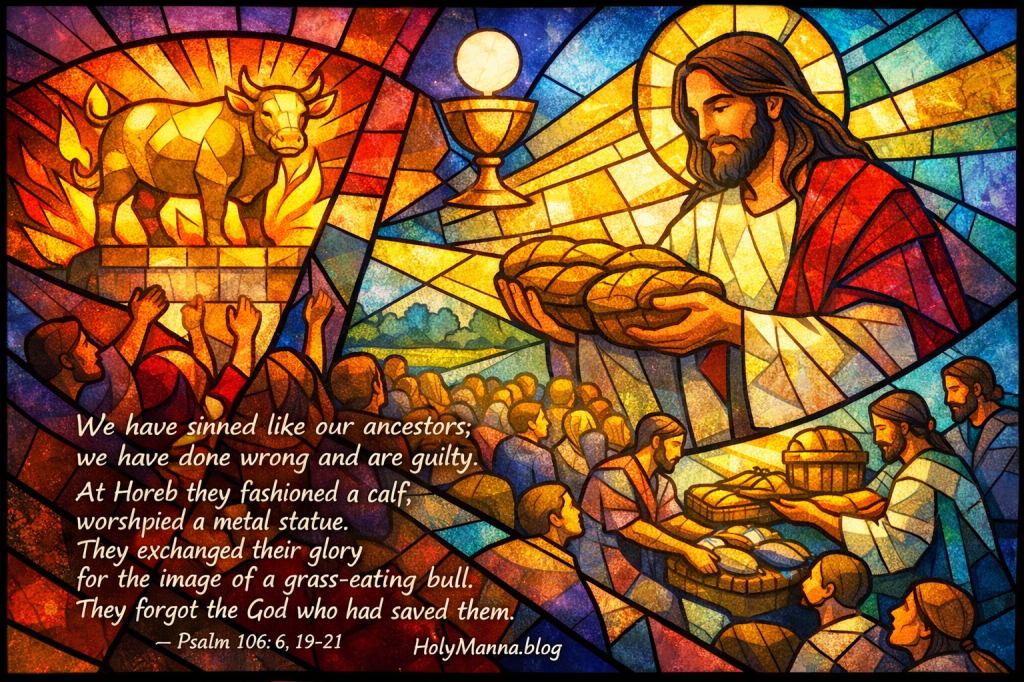
The response in Psalm 106 does not let anyone pretend this is only ancient history. It confesses that God’s people have a pattern of forgetting. The Psalm recalls the calf at Horeb and names the real exchange at the center of idolatry, trading glory for something smaller, visible, and manageable. The prayer is both sorrowful and hopeful because it asks the Lord to remember His people even when they have failed to remember His mercy.
Then The Gospel of Mark shows what true kingship looks like. In a deserted place, Jesus does not manipulate the crowd for power. He is moved with pity. He takes what little the disciples have, blesses it, breaks it, and feeds thousands until they are satisfied. Where Jeroboam builds a false altar to keep people close to himself, Jesus prepares a banquet that draws people back to the Father. The whole day quietly points toward the Church’s Eucharistic life, where Christ still feeds the hungry, not with a symbol of control, but with the gift of Himself.
On the Memorial of Saints Cyril and Methodius, the theme becomes even more personal. These saints were missionaries who refused to offer a watered down faith that would be easier to accept. They trusted that Christ Himself is the true Bread for every nation, and they worked so whole peoples could receive the Gospel in truth, in worship, and in unity with the Church. Today’s readings prepare the heart to choose the same path, rejecting the idols fear invents and returning to the God who feeds His people with mercy and with life.
First Reading – 1 Kings 12:26-32; 13:33-34
When Fear Rewrites Worship
Israel has just been torn in two. After Solomon’s reign, the kingdom fractures into the north and the south, and Jeroboam becomes king over the northern tribes. That political break quickly becomes a spiritual crisis, because the Lord’s Temple is still in Jerusalem, which belongs to the southern kingdom. Jeroboam realizes that true worship shapes true loyalty, and he panics at the thought of his people traveling to Jerusalem, praying there, and slowly reuniting their hearts with the house of David. Instead of converting his own heart, he tries to control the people’s hearts by controlling their religion. He offers something that looks familiar enough to feel safe, but it is cut off from the covenant God established.
This reading fits today’s theme because it shows how fear produces counterfeit worship, and how counterfeit worship always produces sin. When trust in God is replaced by anxiety, worship becomes a tool, truth becomes negotiable, and spiritual life becomes something a person tries to manage instead of receiving. The tragedy is not just that Jeroboam makes idols, but that he builds an entire system designed to keep people from the place God chose for His Name. It is a warning for every age, especially any time faith is tempted to become more convenient than obedient.
1 Kings 12:26-32; 13:33-34 – New American Bible (Revised Edition)
12:26 Jeroboam thought to himself: “Now the kingdom will return to the house of David. 27 If this people go up to offer sacrifices in the house of the Lord in Jerusalem, the hearts of this people will return to their master, Rehoboam, king of Judah, and they will kill me and return to Rehoboam, king of Judah.” 28 The king took counsel, made two calves of gold, and said to the people: “You have been going up to Jerusalem long enough. Here are your gods, O Israel, who brought you up from the land of Egypt.” 29 And he put one in Bethel, the other in Dan. 30 This led to sin, because the people frequented these calves in Bethel and in Dan. 31 He also built temples on the high places and made priests from among the common people who were not Levites.
Divine Disapproval. 32 Jeroboam established a feast in the eighth month on the fifteenth day of the month like the pilgrimage feast in Judah, and he went up to the altar. He did this in Bethel, sacrificing to the calves he had made. He stationed in Bethel the priests of the high places he had built.
13:33 Even after this, Jeroboam did not turn from his evil way, but again made priests for the high places from among the common people. Whoever desired it was installed as a priest of the high places. 34 This is the account of the sin of the house of Jeroboam for which it was to be cut off and destroyed from the face of the earth.
Detailed Exegesis
Verse 12:26 – “Jeroboam thought to himself: ‘Now the kingdom will return to the house of David.’”
Jeroboam’s problem begins in the mind before it ever reaches the altar. He is not thinking like a shepherd responsible to God. He is thinking like a ruler protecting a fragile throne. The phrase reveals a heart ruled by suspicion, and it sets the stage for spiritual manipulation. In Scripture, when fear becomes the lens for decision-making, sin is never far behind.
Verse 27 – “If this people go up to offer sacrifices in the house of the Lord in Jerusalem, the hearts of this people will return to their master, Rehoboam, king of Judah, and they will kill me and return to Rehoboam, king of Judah.”
This verse names the temptation plainly. Jeroboam believes that right worship will weaken his control. He treats the Lord’s house like a political threat rather than a place of mercy. The deeper tragedy is that he recognizes the power of worship but refuses to submit to it. Worship is never neutral. It forms the heart, and Jeroboam fears what it will form.
Verse 28 – “The king took counsel, made two calves of gold, and said to the people: ‘You have been going up to Jerusalem long enough. Here are your gods, O Israel, who brought you up from the land of Egypt.’”
Jeroboam does not act alone. He “took counsel,” meaning he builds consensus around rebellion, which is how sin often becomes socially acceptable. The golden calves deliberately echo the ancient rebellion at Sinai, and his words imitate the language of deliverance while stripping God out of the story. This is how idolatry often works. It borrows religious language and redirects it to a false object, so the lie feels familiar.
Verse 29 – “And he put one in Bethel, the other in Dan.”
These locations are not random. They create convenient pilgrimage centers at the southern and northern edges of the kingdom, making the counterfeit religion accessible. Jeroboam is building a rival map of worship. He is telling the people, without saying it directly, that obedience is optional if the alternative is easier.
Verse 30 – “This led to sin, because the people frequented these calves in Bethel and in Dan.”
Scripture does not romanticize what happens next. The system works, and that is the problem. People begin to “frequent” the idols, which means habit forms desire, and desire forms loyalty. Sin is rarely a single dramatic leap. It is often a steady walk toward what feels convenient, until the heart forgets what is true.
Verse 31 – “He also built temples on the high places and made priests from among the common people who were not Levites.”
Jeroboam reshapes religious authority itself. In the Old Covenant, the priesthood was not a personal project or a political appointment. It was a sacred calling bound to the covenant. Jeroboam replaces covenant with preference. He chooses priests the way a manager chooses staff, not the way God consecrates servants. This is a direct attack on right worship because right worship requires right order, not for the sake of elitism, but for the sake of fidelity.
Verse 32 – “Jeroboam established a feast in the eighth month on the fifteenth day of the month like the pilgrimage feast in Judah, and he went up to the altar. He did this in Bethel, sacrificing to the calves he had made. He stationed in Bethel the priests of the high places he had built.”
He does not only change places and priests. He changes the calendar. He mimics the true feast “like” Judah’s feast, creating a religious imitation meant to replace the real thing. The detail that he personally “went up to the altar” shows how deeply invested he is in making this new worship feel official. He is not merely tolerating sin. He is leading it liturgically.
Verse 13:33 – “Even after this, Jeroboam did not turn from his evil way, but again made priests for the high places from among the common people. Whoever desired it was installed as a priest of the high places.”
This verse reveals the hardness of heart that comes after repeated compromise. Jeroboam refuses repentance. Worse, he turns worship into something anyone can claim simply because they “desired it.” The priesthood becomes a self-appointed role, and religion becomes self-expression. That is always a sign that God is no longer at the center.
Verse 34 – “This is the account of the sin of the house of Jeroboam for which it was to be cut off and destroyed from the face of the earth.”
The conclusion is sobering. Scripture frames this as a dynastic sin, not merely a private fault. Jeroboam’s choices shape generations because leaders do not only make policies. They make paths. When worship is corrupted, the damage spreads outward, and judgment is described as the bitter fruit of rejecting the Lord who saves.
Teachings
This reading teaches a timeless Catholic truth: idolatry is not only bowing to statues. It is any time something created takes the place of God in the heart, the imagination, and the practical decisions of life. Jeroboam’s calves are visible, but the engine beneath them is fear, and fear is often the quiet idol people obey without realizing it.
The Catechism speaks directly about what idolatry is and why it is so destructive. CCC 2112 teaches that idolatry is not limited to paganism, and it can take countless forms in any age. “Idolatry not only refers to false pagan worship. It remains a constant temptation to faith.” CCC 2112. That line fits Jeroboam perfectly. His temptation is not atheism. His temptation is to keep religious language while redirecting worship away from the living God.
The Catechism also describes the deeper spiritual mechanism behind this sin. CCC 2113 names the moment when worship is diverted to a creature rather than the Creator. “Idolatry consists in divinizing what is not God.” CCC 2113. Jeroboam divinizes political stability, then he gives that political idol a religious costume so it can be defended as “for the good of the people.”
Saints and Doctors of the Church repeatedly warn that this kind of distortion can look respectable on the surface. Saint Augustine describes the misery of worshiping lesser goods as if they were ultimate goods. He insists that the heart was made for God, and it becomes restless and disordered when it clings to substitutes. That is why Jeroboam’s story feels so sharp. The heart does not become free by choosing easier gods. It becomes enslaved.
There is also a lesson here about true worship requiring true communion. Jeroboam’s entire project is built on separation. He does not want Israel gathered where the Lord commanded worship. He wants Israel gathered around his own system. In Catholic life, this is a serious warning against remaking the faith to fit preferences, treating the Church like a tool for identity, or treating worship like a product to be customized. God is not honored by convenience that costs fidelity.
The historical tragedy in Israel is that Jeroboam’s counterfeit worship becomes a pattern for the northern kingdom. Scripture later judges many kings by whether they walked “in the way of Jeroboam,” because his choices normalized a religious life detached from the Lord’s commands. That is why the reading ends with judgment. The Lord is patient, but covenant betrayal carries consequences, especially when it is institutionalized.
Reflection
Jeroboam’s story is not only about ancient idols. It is about what happens when fear becomes more persuasive than faith. Many people never intend to rebel against God. They simply start making small compromises to feel safe, and over time those compromises become a new normal.
A practical way to live this reading is to notice where the heart tries to rewrite worship. Whenever prayer becomes optional because life feels busy, whenever Sunday Mass becomes negotiable because entertainment feels necessary, whenever moral teachings are softened because obedience feels costly, the old Jeroboam instinct is at work. It is the temptation to build a more convenient altar so the heart never has to risk trusting God.
This reading also invites a renewed respect for the way God establishes worship and authority. Jeroboam chose priests based on desire and convenience, but God calls and consecrates. In Catholic life, that becomes a reminder to love the Church’s sacramental order, to pray for priests, and to resist the modern instinct to treat spiritual authority as something self-appointed or merely personal.
Most of all, this passage calls for honest self-examination. What fear is quietly steering decisions right now? Where has the desire for control made prayer feel like an inconvenience instead of a lifeline? What “calf” is being offered as a substitute for trust in the Lord’s providence?
The path forward is not complicated, but it is demanding. Repentance means returning to the Lord without negotiating terms. It means choosing worship that is true, not merely convenient. It means asking God for the courage to obey even when the heart feels anxious, trusting that the Lord who delivered His people before can still be trusted to lead them now.
Responsorial Psalm – Psalm 106:4, 6-7, 19-22
When God Is Forgotten, Idols Feel Familiar
This Psalm is a public confession meant to be prayed out loud by a people who know their own history. Psalm 106 looks back over Israel’s pattern of rebellion, not to shame the faithful, but to heal them through truth. It names a hard spiritual reality: sin often begins when memory of God’s mercy grows dim. The Psalmist pleads for the Lord’s saving help, admits guilt without excuses, and then recalls the golden calf at Horeb as a warning that still stings.
This fits perfectly with today’s theme because Jeroboam’s sin in 1 Kings is not an isolated scandal. It is a replay of an older failure. God had already delivered His people from Egypt with “fearsome deeds at the Red Sea,” and still they traded glory for a metal statue. The Psalm teaches that idolatry is not merely a bad idea. It is an act of forgetfulness, a betrayal of relationship, and a foolish exchange of the living God for something that cannot save. When this Psalm is prayed after the first reading, it is like holding up a mirror and admitting that the same weakness can live in any generation, including this one.
Psalm 106:4, 6-7, 19-22 – New American Bible (Revised Edition)
4 Remember me, Lord, as you favor your people;
come to me with your saving help,6 We have sinned like our ancestors;
we have done wrong and are guilty.7 Our ancestors in Egypt
did not attend to your wonders.
They did not remember your manifold mercy;
they defied the Most High at the Red Sea.19 At Horeb they fashioned a calf,
worshiped a metal statue.
20 They exchanged their glory
for the image of a grass-eating bull.
21 They forgot the God who had saved them,
who had done great deeds in Egypt,
22 Amazing deeds in the land of Ham,
fearsome deeds at the Red Sea.
Detailed Exegesis
Verse 4 – “Remember me, Lord, as you favor your people; come to me with your saving help,”
The Psalm opens with a humble cry, not a demand. The speaker asks to be included in God’s covenant favor. In the Bible, “remember” is not about God having a bad memory. It is a covenant word. When the Lord “remembers,” He acts to save and remain faithful. This verse is the posture of a repentant heart that knows salvation is gift, not a paycheck.
Verse 6 – “We have sinned like our ancestors; we have done wrong and are guilty.”
This is not vague spirituality. It is direct confession. The Psalmist speaks in the plural because sin is not only personal. It spreads through cultures, families, and habits. The line is also a refusal to pretend that “our ancestors were the problem.” It admits continuity. The same human heart still struggles with the same temptations. This verse teaches real contrition, which is essential for conversion.
Verse 7 – “Our ancestors in Egypt did not attend to your wonders. They did not remember your manifold mercy; they defied the Most High at the Red Sea.”
This verse gives the diagnosis: they did not attend, they did not remember, and they defied. Forgetfulness is described as the first crack, because when God’s wonders are ignored, His mercy becomes abstract, and obedience starts to feel optional. The mention of the Red Sea is important because it represents undeniable rescue. If a people can forget that, they can forget anything. This is why Scripture constantly calls God’s people to remembrance, especially through worship.
Verse 19 – “At Horeb they fashioned a calf, worshiped a metal statue.”
Horeb is another name for Sinai, where the covenant was being sealed. That detail makes the sin even darker. The people commit idolatry not in a season of ignorance, but in the presence of revelation. They “fashioned” the calf, which highlights that idols are man-made. They are not discovered as truth. They are constructed as substitutes.
Verse 20 – “They exchanged their glory for the image of a grass-eating bull.”
This is one of the sharpest lines in the Psalms. It describes idolatry as an exchange, a trade, a bargain. Israel’s “glory” is the Lord Himself, who dwells with His people and dignifies them. They trade that glory for something ridiculous, an animal that eats grass. The point is not only that idols are evil. The point is that idols are humiliating. They shrink the soul.
Verse 21 – “They forgot the God who had saved them, who had done great deeds in Egypt,”
The Psalm repeats the central sin: forgetting. The Lord is identified as Savior, the One who acts in history. Israel’s identity is tied to deliverance, yet forgetfulness breaks the bond of gratitude. A forgotten Savior becomes a neglected Savior, and a neglected Savior becomes replaced. This verse explains why idolatry is always relational betrayal.
Verse 22 – “Amazing deeds in the land of Ham, fearsome deeds at the Red Sea.”
“Land of Ham” is an ancient way of referring to Egypt. The Psalmist piles up descriptions to emphasize how obvious God’s power was. These were not subtle blessings. They were “amazing” and “fearsome,” meaning God’s works were visible enough to produce awe and reverence. When a heart forgets deeds like that, the problem is not lack of evidence. The problem is spiritual hardness.
Teachings
This Psalm teaches that repentance begins with truth and is sustained by memory. God’s people are saved people, and saved people are supposed to remember. When remembrance fades, worship weakens, and when worship weakens, idols become attractive.
The Catechism explains why forgetting God is so spiritually dangerous, because it is never neutral. It pulls the heart toward substitutes. CCC 2112 gives a line that belongs beside this Psalm. “Idolatry not only refers to false pagan worship. It remains a constant temptation to faith.” CCC 2112.
That is exactly what Psalm 106 is exposing. The temptation is constant because the human heart constantly looks for something visible to lean on, especially when patience is required.
Then The Catechism names the inner content of idolatry in a way that fits the Psalm’s language of “exchange.” CCC 2113 teaches: “Idolatry consists in divinizing what is not God.” CCC 2113.
When Israel “exchanged their glory,” they divinized a created thing. In every age, the same temptation shows up whenever money, status, pleasure, politics, or personal control is treated like a savior.
Saint Augustine helps frame this Psalm with classic clarity. He teaches that sin is a disorder of love, loving lesser things more than greater things, and loving created things in place of the Creator. In that light, the golden calf is not only a statue. It is a picture of disordered love. The people love certainty more than covenant, and they love control more than communion.
This Psalm also carries a quiet liturgical lesson. In Israel, worship was meant to preserve memory of God’s mighty deeds, especially the exodus. In Catholic life, the same logic is fulfilled in the sacred liturgy. The Mass is not a mental recollection exercise. It is the Church’s living remembrance of salvation, because Christ’s sacrifice is made present sacramentally. When Catholics drift from worship, it is not only a missed obligation. It is a forgetting that makes the soul vulnerable.
Reflection
This Psalm invites a simple but demanding practice: remember on purpose. A busy life makes spiritual amnesia feel normal. Days fill up, prayers get shortened, gratitude gets squeezed out, and suddenly the heart starts looking for a “calf,” something quick and visible that promises comfort.
A strong response begins with confession that is honest and unembarrassed. The Psalm does not say, “Mistakes were made.” It says guilt out loud. That kind of confession frees the soul because it stops the game of self-justification. It also opens the door to a deeper habit, deliberate remembrance.
One concrete step is to build a daily rhythm of recalling God’s deeds. That can be as simple as reviewing the day and naming where the Lord provided, protected, or corrected. Another step is to stay close to the Church’s worship, because liturgy is where God trains His people to remember. A person who stays anchored in worship is less likely to trade glory for grass.
This Psalm also asks for a brave kind of honesty. What has been treated like a savior lately? What has been leaned on for comfort more than prayer? Where has gratitude faded, and where has complaining taken its place? What would change if God’s past faithfulness was remembered before making today’s decisions?
The Psalm ends by pointing back to the Red Sea, almost like it is saying, “Look at what God has already done.” That is the medicine for fear. When the heart remembers that the Lord saves, it becomes harder to bow to anything else.
Holy Gospel – Mark 8:1-10
The God Who Refuses to Send His People Away Hungry
This scene unfolds in a “deserted place,” the kind of setting that carries deep biblical meaning. In the Old Testament, the wilderness is where God tests His people, humbles them, and teaches them that man does not live by bread alone. It is also where the Lord provides manna when there is no other explanation. By the time The Gospel of Mark is written, Israel knows the wilderness story by heart, so the details matter. A great crowd is far from home, their resources are gone, and the disciples cannot imagine how provision is possible. That is the perfect stage for Jesus to reveal who He is, not only as a teacher, but as the Shepherd and the true Provider.
This Gospel fits today’s theme with striking contrast. Jeroboam tried to hold onto power by building counterfeit worship that would keep people dependent on his system. Psalm 106 confessed that when God is forgotten, the heart trades glory for a lifeless idol. Here, Jesus does the opposite of every false shepherd. He is moved with pity. He does not manipulate the crowd, and He does not send them away empty. He feeds them in a way that echoes God’s past mercies and points forward to the Church’s Eucharistic life, where Christ still nourishes His people with divine generosity.
Mark 8:1-10 – New American Bible (Revised Edition)
The Feeding of the Four Thousand. 1 In those days when there again was a great crowd without anything to eat, he summoned the disciples and said, 2 “My heart is moved with pity for the crowd, because they have been with me now for three days and have nothing to eat. 3 If I send them away hungry to their homes, they will collapse on the way, and some of them have come a great distance.” 4 His disciples answered him, “Where can anyone get enough bread to satisfy them here in this deserted place?” 5 Still he asked them, “How many loaves do you have?” “Seven,” they replied. 6 He ordered the crowd to sit down on the ground. Then, taking the seven loaves he gave thanks, broke them, and gave them to his disciples to distribute, and they distributed them to the crowd. 7 They also had a few fish. He said the blessing over them and ordered them distributed also. 8 They ate and were satisfied. They picked up the fragments left over—seven baskets. 9 There were about four thousand people.
He dismissed them 10 and got into the boat with his disciples and came to the region of Dalmanutha.
Detailed Exegesis
Verse 1 – “In those days when there again was a great crowd without anything to eat, he summoned the disciples and said,”
The phrase “again” signals that this is not an isolated miracle but part of a pattern of divine provision. Jesus “summons” the disciples because He intends to form them. He is not only solving a practical problem. He is teaching them to see the world through faith, not scarcity.
Verse 2 – “My heart is moved with pity for the crowd, because they have been with me now for three days and have nothing to eat.”
This verse reveals the Heart of Jesus. His compassion is not sentimental. It is attentive love. The crowd has stayed with Him for three days, which suggests endurance, hunger for His word, and real sacrifice. Jesus notices, and His pity becomes action. This is how God’s mercy behaves, not as an abstract idea, but as a personal response to human need.
Verse 3 – “If I send them away hungry to their homes, they will collapse on the way, and some of them have come a great distance.”
Jesus’ care is specific. He thinks about the road, the weakness, and the distance. A false shepherd protects his own security first. Christ protects His people first. This verse also exposes a spiritual pattern. When people come a great distance to seek the Lord, the Lord does not treat their need as a nuisance.
Verse 4 – “His disciples answered him, ‘Where can anyone get enough bread to satisfy them here in this deserted place?’”
The disciples speak with practical realism that has not yet matured into trust. They see the desert and assume impossibility. This echoes Israel’s old wilderness complaints, and it also mirrors the human tendency to measure God’s future help by present conditions. The disciples are not wicked. They are still learning.
Verse 5 – “Still he asked them, ‘How many loaves do you have?’ ‘Seven,’ they replied.”
Jesus begins with what they have, not with what they lack. He invites cooperation, which is a common way God works. He draws the disciples into the miracle, not because He needs them, but because they need to learn how providence works. The number seven suggests fullness and completeness in biblical symbolism, and it hints that Jesus is about to act with abundance, not barely enough.
Verse 6 – “He ordered the crowd to sit down on the ground. Then, taking the seven loaves he gave thanks, broke them, and gave them to his disciples to distribute, and they distributed them to the crowd.”
This verse is packed with meaning. The crowd is told to sit, like a people being prepared for a banquet rather than a scramble for scraps. Jesus takes, gives thanks, breaks, and gives. These actions echo the Eucharistic pattern that will be fully revealed at the Last Supper. He also chooses to feed the crowd through the hands of the disciples. The Lord’s generosity is personal, but it is also ecclesial. He involves His chosen servants in the distribution of His gifts.
Verse 7 – “They also had a few fish. He said the blessing over them and ordered them distributed also.”
The addition of fish emphasizes that Christ’s provision is not limited to one category of gift. He blesses what is offered, even if it seems small. The blessing shows that nourishment is not only physical. It is received as gift from God. The disciples again distribute, reinforcing their role as instruments, not owners.
Verse 8 – “They ate and were satisfied. They picked up the fragments left over, seven baskets.”
Two phrases matter here: “satisfied” and “left over.” In God’s economy, generosity is not stingy. The crowd is not left anxious, still calculating whether there will be enough. They are satisfied. The leftovers show superabundance, and the seven baskets again suggest fullness. Christ does not merely solve hunger. He reveals the kind of Giver God is.
Verse 9 – “There were about four thousand people.”
The number highlights the magnitude of the miracle. This is not a trick, not a symbolic gesture, and not a private moment. It is a public act of divine provision witnessed by thousands. The Lord acts in history so faith can be grounded in reality, not fantasy.
Verse 10 – “He dismissed them and got into the boat with his disciples and came to the region of Dalmanutha.”
Jesus dismisses the crowd with dignity, not as consumers but as people cared for. Then He moves on, continuing His mission. The boat journey with the disciples signals that formation continues. Miracles are not meant to create a comfort bubble. They are meant to build faith for the road ahead.
Teachings
This Gospel teaches that the true God is not the idol of control, but the Father who provides, and the Son whose compassion feeds the hungry. It also teaches that Christ’s generosity points beyond the moment to the sacramental life of the Church.
The Catechism explicitly connects the multiplication of loaves to the Eucharist. CCC 1335 says: “The miracles of the multiplication of the loaves, when the Lord says the blessing, breaks and distributes the loaves through his disciples to feed the multitude, prefigure the superabundance of this unique bread of his Eucharist.” CCC 1335. That is exactly what is happening in Mark 8. The verbs and the structure prepare the Church to recognize the Eucharistic pattern. Christ feeds through His disciples, and the result is abundance and satisfaction, not scarcity and fear.
This also reveals something about the priesthood and the Church’s ministry. Jesus could have fed the crowd directly, but He chooses to distribute through the disciples. That foreshadows how Christ will feed His people through the apostolic ministry of the Church. The lesson is not that disciples are the source. The lesson is that Christ is generous enough to involve His servants in His saving work.
Saint John Chrysostom often emphasized that Christ’s miracles were not performed to impress, but to reveal mercy and to train hearts away from hardness. In this Gospel, Jesus’ pity comes first, and the miracle flows from that pity. The Church reads this as a revelation of divine charity, the kind of love that sees need and acts.
There is also a quiet lesson that speaks directly against Jeroboam’s spirit. Jeroboam used religion to secure power. Jesus uses power to serve love. That reversal is the signature of the Kingdom. Where idols demand sacrifice and give nothing back, Christ gives Himself and leaves His people strengthened for the journey.
Reflection
This Gospel invites a person to look honestly at how the heart reacts in the wilderness. When resources feel low, when answers feel far away, and when the road looks long, the temptation is to do what the disciples did at first, stare at the desert and assume impossibility. That mindset can quietly become a spiritual habit. It can create anxious prayer, cramped generosity, and a constant fear that there will not be enough.
A strong first step is to name what is actually in hand. Jesus asks, “How many loaves do you have?” That question still matters. God often begins with what is already present, time that can be offered, patience that can be practiced, a small act of charity that can be done, a confession that can be made, a Mass that can be attended with renewed seriousness. The point is not that the offering is impressive. The point is that Christ blesses what is surrendered.
This Gospel also challenges the modern temptation to treat faith as a private experience rather than a lived communion. Jesus feeds the crowd through the disciples, which teaches that God’s provision often comes through the hands, prayers, and sacrifices of others. That should build humility and gratitude. It should also build responsibility, because disciples who receive bread are meant to become distributors of mercy.
The questions worth carrying today are simple and searching. Where has the heart been acting like the desert is bigger than Christ’s compassion? What has been treated like a scarcity problem that should be treated like a providence lesson? What “loaves” are being held back because they seem too small to matter? How would daily life change if the Eucharistic pattern was lived more deeply, receiving from Christ with gratitude and then giving to others with trust?
The miracle ends with satisfaction and leftover baskets. That is the Lord’s way of teaching that the God who saves is not a tight-fisted provider. He is generous, faithful, and attentive, and He does not send His people away hungry when they have come to Him for life.
Choose the True Altar and Receive the True Bread
Today’s readings tell one clear story from three angles, and it is a story every heart recognizes. Fear builds counterfeit altars, but Christ builds a table. Jeroboam panicked about losing control, so he rewrote worship, reshaped the priesthood, and offered Israel a convenient substitute that looked religious but led straight into sin. Psalm 106 answers that tragedy with honesty, admitting that God’s people have a long history of forgetfulness, trading glory for lifeless images because they stopped attending to the Lord’s wonders and stopped remembering His mercy. Then the Gospel reveals the Father’s heart in the Son, because Jesus refuses to send the crowd away hungry, and He feeds them with compassion that does not count the cost.
The key message is simple and demanding. Worship is never just a hobby or a background detail. Worship forms loyalty, shapes desire, and decides what a person becomes. When worship gets distorted, life gets distorted. When God is forgotten, idols start to feel familiar, and they always promise safety while quietly taking freedom. But when Christ is sought, even in a deserted place, He provides. He takes what seems small, blesses it, breaks it, and multiplies it until there is real satisfaction and even abundance left over.
This is the invitation for the day. Turn away from every “golden calf” that has been pretending to be a savior, whether it is comfort, control, approval, entertainment, or anxiety dressed up as prudence. Return to the living God with the honesty of the Psalm, and let gratitude become stronger than fear. Stay close to Jesus in the Church’s worship, because the Lord still feeds His people, not with a counterfeit promise, but with real grace for the journey.
Let the next step be concrete and unromantic, because holiness usually is. Choose one habit that restores remembrance, like daily prayer that actually slows down, or a serious return to confession, or a more faithful Sunday rooted in Mass rather than distraction. Choose one act of charity that helps someone else not collapse on the road. Then carry this question into the day and refuse to dodge it: What would change if trust in Christ’s provision became stronger than the instinct to control everything?
Engage with Us!
Readers are invited to share reflections in the comments below, because faith grows stronger when it is spoken, tested, and encouraged within the Church’s family.
- First Reading, 1 Kings 12:26-32; 13:33-34: Where does fear tempt the heart to compromise, especially in ways that quietly reshape worship, priorities, or obedience to God? What practical step can be taken this week to choose fidelity over convenience?
- Responsorial Psalm, Psalm 106:4, 6-7, 19-22: What specific mercy or “wonder” from God has been forgotten lately, and how would daily life change if that memory was brought back into prayer with gratitude? What is the “exchange” being made when lesser things are treated like saviors?
- Holy Gospel, Mark 8:1-10: Where does life feel like a deserted place right now, and what would it look like to place the available “seven loaves” into Christ’s hands with trust instead of anxiety? How is Jesus inviting a deeper hunger for Him through the Eucharistic pattern of receiving and then giving to others?
Keep walking forward with confidence, because the Lord does not abandon His people in the wilderness. Live a life of faith that refuses counterfeit comforts, clings to true worship, and does everything with the love and mercy Jesus taught us.
Sacred Heart of Jesus, we trust in You!
Immaculate Heart of Mary, pray for us!
Saint Michael the Archangel, defend us in battle!
Follow us on YouTube, Instagram and Facebook for more insights and reflections on living a faith-filled life.

 Holy Manna!
Leave a comment