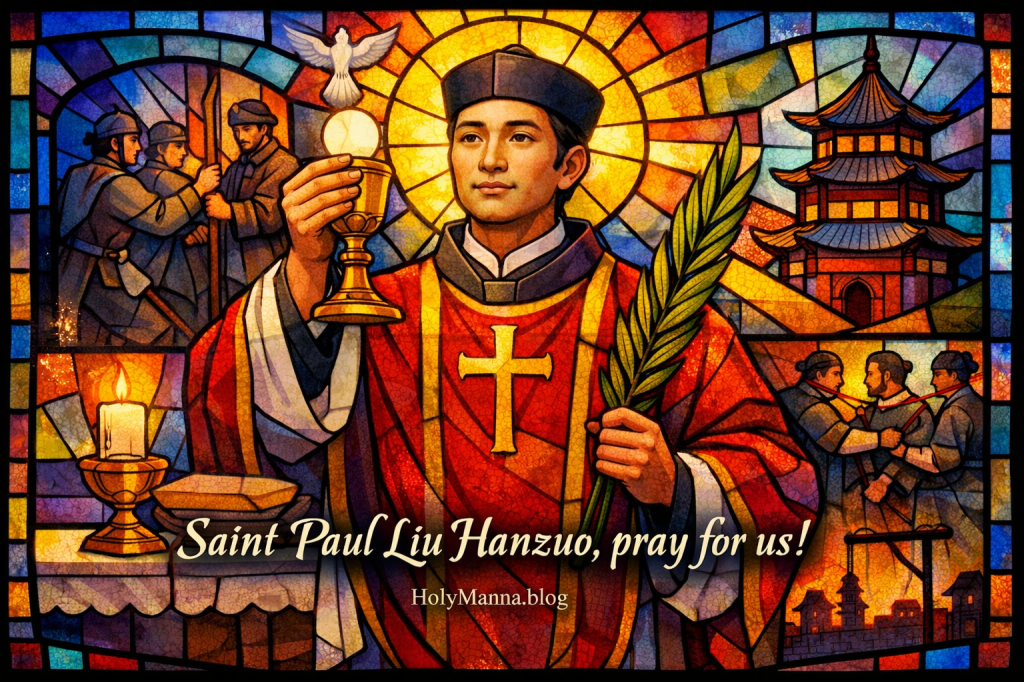
The Martyr Who Refused to Leave the Altar
Saint Paul Liu Hanzuo was a Catholic priest from Sichuan, China, and one of the Martyr Saints of China canonized by the Church. He lived at a time when the Christian faith was treated as a threat, and Catholic communities often had to worship quietly, sometimes in homes, sometimes in hidden chapels, always with the awareness that discovery could bring imprisonment or death. Yet he kept serving anyway, not because he enjoyed danger, but because he believed the sacraments were worth any cost.
The most remembered scene from his life is simple and powerful. Authorities arrived to arrest him while he was celebrating Mass, and he asked for only one thing: permission to finish the Eucharistic sacrifice before he surrendered himself. That request has echoed through Catholic memory because it reveals how he saw reality. The Mass was not an inspiring ritual to him. It was the sacrifice of Christ made present for the salvation of souls. The Catechism calls the Eucharist “the source and summit of the Christian life” (CCC 1324), and Saint Paul Liu’s life shows what that teaching looks like when faith is tested.
He was later honored among the saints because his death was not a defeat. It was a witness that Jesus Christ is worth more than comfort, reputation, and even life itself. The Catechism teaches that martyrdom is the supreme witness to the truth of the faith (CCC 2473). Saint Paul Liu did not die for politics or pride. He died because he would not renounce Christ or abandon the Church.
From Poverty to Priesthood in Sichuan
Paul Liu Hanzuo was born in 1778 in Lezhi, in Sichuan province. Catholic accounts describe him as coming from a poor Christian family, spiritually rich but materially limited. That poverty shaped his early years, not only in what he owned, but in the opportunities he lacked. Schooling was difficult, work began early, and life demanded endurance. Some Catholic summaries describe him as working as a shepherd, which fits the humble pattern of many saints whose greatness was formed in ordinary labor and long obedience.
His conversion was not a sudden switch from unbelief to faith, because he was raised in a Christian home. His conversion was the slower kind that deepens through time, the kind where a person begins to realize that God is asking for everything, not only for Sunday devotion. He felt drawn to the priesthood and entered seminary around the age of twenty four, already behind what most people would call an ideal timeline. He also faced a serious obstacle. He did not know Latin, which in that era often stood as a gatekeeper for priestly studies.
Here the story becomes quietly encouraging. He persevered, and permission was granted for him to study philosophy and theology in Chinese. That detail shows the Church taking root in local soil, forming native clergy, and raising up shepherds from within the people themselves. He eventually became a priest serving the mission territory around Deyang in Sichuan. Catholic descriptions of his priesthood return again and again to poverty and humility, as if to underline that he lived without show and served without needing applause.
A Hidden Ministry That Kept the Faith Alive
A priest in persecuted times learns to live quietly, not because the faith is ashamed, but because the flock must be protected. Saint Paul Liu’s ministry unfolded in that hidden way. Catholic accounts describe him traveling to care for scattered Catholics who could not always gather openly. The heroism was not only in the day of his death, but also in the long years before it. He kept the sacraments available, encouraged families to remain faithful, and strengthened communities that could have easily collapsed under fear.
This matters because martyrdom usually arrives after long seasons of ordinary fidelity. The Church survives because men like this keep praying, keep teaching, keep baptizing, keep hearing confessions, and keep offering Mass, even when the world says it is dangerous or pointless. In many standard Catholic summaries, there are no reliably documented miracles attributed to him during his lifetime. That does not make his witness smaller. It actually highlights a kind of holiness that modern people desperately need, the kind built on perseverance rather than spectacle.
His life quietly echoes what the Church teaches about vocation and grace. God does not call the perfect. God perfects the called. A poor shepherd boy with limited education became a priest who held the line for his people, and that steady faith became the foundation for his final witness.
Betrayed and Arrested at Mass
Sometimes persecution begins with an empire. Sometimes it begins with something painfully small. One Catholic account preserves a striking detail that a local craftsman reported him after feeling insulted during a dispute connected to work for an oratory, including a canopy intended for sacred use. In a moment of wounded pride, the craftsman’s accusation opened the door for authorities to act. That detail is sobering because it shows how fragile life becomes when faith is criminalized. A minor conflict becomes an excuse for violence.
He was arrested while celebrating Mass, and Catholic retellings emphasize that he asked to finish the celebration before being taken away. That request is the center of his story because it reveals what his priesthood was anchored in. The Catechism teaches that the Eucharist is the heart of the Church’s life (CCC 1324), and he lived that teaching with the clarity of someone who knew time was short.
After arrest, he was brought before local officials, questioned, and pressured to abandon the faith. Accounts describe harsh treatment, including beatings and humiliations. He was also offered an option to secure freedom through money, a ransom that could not be gathered. Yet even if money had appeared, the deeper issue remained. The authorities wanted submission and apostasy, and he refused both. He openly confessed that he was a priest and that he would rather die than deny the Lord he served.
Prison, Sentence, and the Crown of Martyrdom
After imprisonment and repeated pressure, he was condemned, and the sentence was confirmed. Catholic sources describe his endurance as steady rather than dramatic. He did not escape, and there is no widely preserved story of a miraculous rescue. Instead, the “miracle” was the grace to remain faithful when fear and pain would have crushed most people. The Catechism describes martyrdom as the supreme witness to faith (CCC 2473), and his death fits that definition in its purest form.
Saint Paul Liu Hanzuo was executed by strangulation on February 13, 1818, at Dongjiaochang near Lezhi in Sichuan. His death was meant to silence the Church, but the opposite happened. The Church remembered his name, cherished his witness, and held him up for the faithful as proof that Christ is worth everything.
No verified personal quotations from him are widely preserved in Catholic sources. His most enduring “statement” is the choice he made at the altar, when finishing the Mass mattered more than saving his life.
Memory That Outlasts Persecution
Saint Paul Liu’s story did not disappear into the dust of an execution ground. The Church gathered the memory of these martyrs, honored their witness, and eventually recognized them publicly. He was beatified in 1900 and later canonized in 2000 among the Martyr Saints of China, grouped under Saint Augustine Zhao Rong and Companions. His canonization was not a political gesture. It was a spiritual proclamation that holiness was present in the Chinese Church and that the blood of martyrs belongs to the whole Catholic family.
In standard Catholic summaries, there are no consistently documented, saint specific posthumous miracles attributed to Saint Paul Liu Hanzuo. Martyrs are often venerated primarily for their witness, and the Church recognizes their sanctity through the truth of their death for Christ. Still, the fruit of his martyrdom is real. His story continues to strengthen Catholics who feel pressured to dilute the faith, and his name is invoked as an intercessor by those who ask for courage, fidelity, and love for the Eucharist.
He is remembered individually on February 13 in martyrology tradition, and the group of the Chinese martyrs is commemorated on July 9 in many Catholic calendars. This ongoing remembrance is itself a quiet victory. It means the Church refuses to forget the ones the world tried to erase.
Living His Lesson in a Modern World
Saint Paul Liu Hanzuo is a saint for Catholics who want faith to be real, not performative. His story challenges the modern habit of treating religion as something to fit in after everything else is handled. When authorities arrived, he asked to finish Mass. That does not mean he felt no fear. It means he had ordered his life around what mattered most, and he would not let the altar become secondary.
There is also a lesson in the way his persecution began. A careless conflict, a wounded ego, a betrayal. That detail invites Catholics to practice prudence and charity in speech, especially when tensions are high. Holiness is not only about dying well. It is also about living wisely, correcting with gentleness, forgiving quickly, and staying faithful even when others act unjustly.
His early life offers another gift. Poverty, limited education, and late starts did not stop God’s plan. The call was answered step by step. That should encourage anyone who feels behind, unworthy, or unprepared. God builds saints out of perseverance.
What would change if Sunday Mass were treated as nonnegotiable, not because of guilt, but because of love?
Where has fear of inconvenience started to shape spiritual habits?
What kind of courage is needed right now, not the dramatic kind, but the steady kind?
Engage with Us!
Share thoughts and reflections in the comments below. This saint’s story is simple but intense, and it tends to expose where faith has become casual.
- What detail from Saint Paul Liu Hanzuo’s life hit hardest, and why?
- What is one concrete way to make Sunday and the Eucharist more central this week?
- Where is pressure felt to keep faith private or quiet, and what would gentle courage look like there?
- When life feels inconvenient, what helps return to prayer and the sacraments instead of drifting?
Keep walking forward in faith. Keep choosing Christ when it is easy and when it is costly. Keep showing mercy, speaking truth with love, and doing everything with the love and mercy Jesus taught us.
Saint Paul Liu Hanzuo, pray for us!
Follow us on YouTube, Instagram and Facebook for more insights and reflections on living a faith-filled life.

 Holy Manna!
Leave a comment