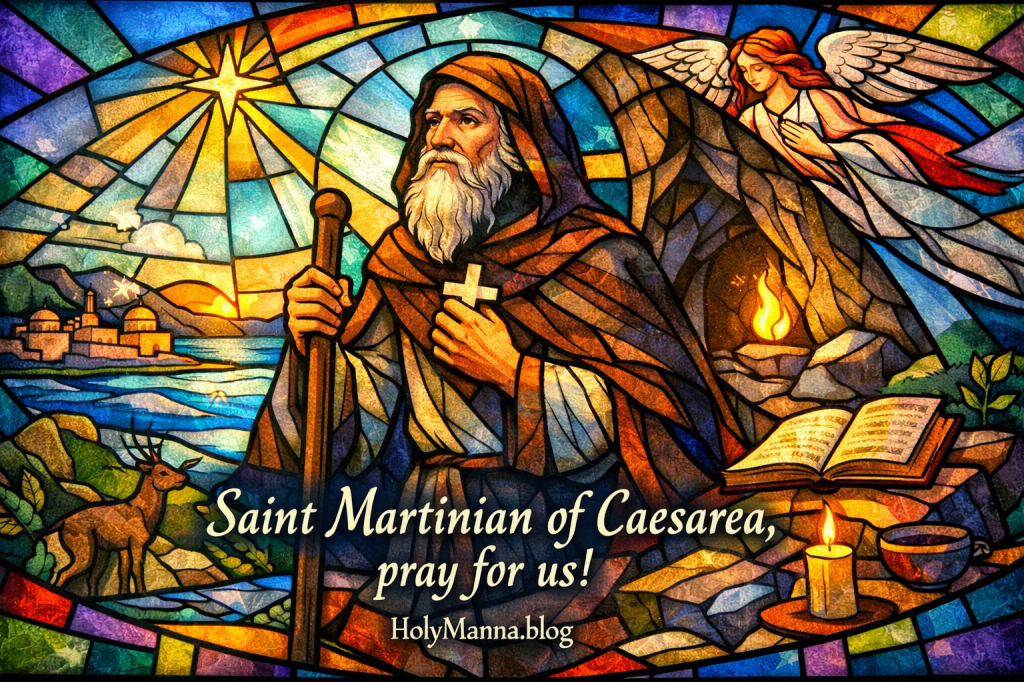
Fire, Waves, and a Guarded Heart
Saint Martinian is remembered as a desert hermit whose whole life teaches one blunt truth: temptation is real, and grace is stronger. The Church commemorates him as a man who lived the eremitical life near Caesarea in Palestine and later died in Athens, leaving behind a legacy that still speaks to anyone trying to live with a clean heart and a steady soul. His story is not famous because it is comfortable. It is famous because it is honest, and because it shows how quickly mercy moves when repentance is real.
This witness lines up with what The Catechism of the Catholic Church teaches about the Christian life as spiritual combat and about chastity as an ordered, integrated love, not a shallow rule that only applies to a few people. Chastity is a virtue that trains desire to serve love, and it grows through grace, discipline, and humility, not through pride or self-trust alone. This is why Saint Martinian is not just for monks in caves. He is for ordinary Catholics trying to follow Christ in a world that constantly invites compromise.
The Desert Years That Built a Man
Tradition places Martinian in the region of Caesarea in Palestine, and it says that around the age of eighteen he withdrew to a mountain near Caesarea known as the Place of the Ark. For many years he lived a hidden life of prayer, fasting, and manual labor. He embraced the desert rhythm that shaped so many early saints, where silence becomes a teacher and solitude becomes a mirror. In that quiet place, the heart stops performing for other people and starts learning how to stand before God.
The tradition also says that Martinian was regarded as a holy man and even described as being endowed with the gift of miracles. The surviving Catholic retellings do not preserve a neat catalogue of healings, but they consistently preserve something more important for the spiritual life. They preserve the portrait of a man who took eternity seriously, who worked out his salvation with fear of the Lord, and who learned that prayer is not a mood, but a battle. The Catechism explains that prayer is often experienced as struggle because it confronts distraction, discouragement, and temptation in the most personal way. A hermit’s victory is not the absence of struggle. A hermit’s victory is fidelity in the struggle.
Fire in the Night
The most famous episode in Saint Martinian’s life begins with a woman named Zoe. She arrived late at night, presenting herself as a poor traveler in distress. The account says she persuaded him to let her stay, and by morning she revealed her intention and tried to seduce him. The story is preserved in Catholic tradition precisely because it refuses to pretend that a holy life is immune to the pull of sin. It even says Martinian began to consent inwardly, which is a hard detail to hear, but it is a merciful warning for anyone who has ever thought, “That kind of fall could never happen.”
Then grace broke through. Martinian stepped away, remorse hit him, and he chose repentance with a seriousness that still shocks modern readers. He built a fire and thrust his feet into it as an alarm to his conscience, not as a model for others to imitate. The Church never teaches self-harm as holiness. The point of the story is the spiritual wake-up call: sin destroys, and eternity is real. In that moment he cried out the line that Catholic retellings preserve as his best-known saying: “Ah! if I cannot bear this weak fire, how can I endure that of hell?”
That sentence is not meant to trap a soul in fear. It is meant to rescue a soul from pretending that sin is harmless. The Catechism of the Catholic Church teaches that conversion is a profound reorientation of the whole life, a return to the Father with the whole heart. This is what happened in that moment. Zoe, shaken by his repentance and the seriousness of his fear of God, repented too. She helped care for him and then went to Bethlehem, where she embraced a life of penance among consecrated women, traditionally connected to the monastic world associated with Saint Paula. The story becomes a double witness: a man turning away from sin, and a woman turning toward God.
Healing, Humility, and a Rock in the Sea
The tradition says Martinian’s burns were severe enough that he could not rise for seven months. That long recovery matters because it shows that sin leaves consequences even when God forgives. Repentance heals the soul, but it does not always erase the scars. When Martinian finally regained strength, he chose an even more radical way of life. He withdrew to a rock surrounded by the sea, living exposed to the elements and seeing no one except a boatman who brought provisions only a couple times a year. He supported himself by weaving baskets, trading his work for what he needed to survive.
This part of his life is best understood as a dramatic symbol of what every Catholic must learn in a practical way. The Lord teaches His disciples to pray, “lead us not into temptation,” and The Catechism explains that this petition asks for the grace of vigilance and the refusal to step into temptation through compromise. Saint Martinian’s rock becomes a living image of boundaries. Most people will never be called to an island, but many are called to delete the app, change the routine, stop visiting the place, end the relationship, or confess the sin before it grows roots again. The rock is not the point. The refusal to negotiate is the point.
Shipwreck Mercy
After several years on that rock, a ship was wrecked by the sea. Everyone died except a young woman who managed to cling to a plank and drift close enough to cry out for help. Martinian rescued her. The story makes it clear that his commitment to purity did not turn him into a cold man who refused mercy. When someone was in danger, he acted. Love of holiness is never an excuse to ignore suffering.
Then came the second test. The boatman was not expected for a long time, and Martinian feared being alone with her on the rock. Instead of pretending he was beyond temptation, he chose humility. He gave her provisions, arranged for her rescue as best he could, and then he threw himself into the sea and swam away to the mainland. Some traditions add dramatic details about how he was delivered to shore, but the stable Catholic point remains simple and strong: he fled because he wanted holiness more than he wanted to prove something about himself.
This is a lesson modern Catholics need to hear without embarrassment. Fleeing temptation is not weakness. Fleeing temptation is wisdom. The Catechism teaches that the spiritual battle includes vigilance and perseverance, and it is often won through humility, not bravado. Saint Martinian’s second flight is not a rejection of mercy. It is the protection of mercy’s work in his own soul.
A Quiet Death in Athens
After leaving the sea behind, Martinian lived a wandering penitential life and eventually reached Athens, where he died in peace. Catholic sources differ on the exact year, but they consistently place his death around the turn of the fifth century. That uncertainty does not weaken his witness. It highlights the way ancient saints are carried forward less by perfect chronology and more by the Church’s living memory of holiness.
His name endured in the Church’s prayer, including his commemoration on February 13 in the Roman Martyrology. He also became widely venerated in the Christian East, and Catholic retellings acknowledge that devotion to him spread beyond his homeland. In some places, devotion includes the honoring of relics and local patronage, which shows that his story did not remain trapped on the pages of old hagiography. It became part of the way real communities learned to name the battle for purity and the hope of conversion.
A Catholic Way to Live His Message Today
Saint Martinian’s life presses one question into the heart: What happens when temptation feels stronger than good intentions? His answer is not self-confidence. His answer is repentance, humility, prayer, and practical boundaries. He shows that a person can fall inwardly, wake up quickly, and still become a saint whose story saves other people. That is not a soft message. That is a hopeful message.
His story also brings Catholic teaching down to street level. Chastity is not only about saying no. Chastity is about learning to love rightly, with integrity, patience, and self-mastery, as The Catechism of the Catholic Church teaches. Conversion is not a one-time mood. Conversion is a repeated return to the Father, especially through confession, prayer, and a serious refusal to keep walking toward the edge. Saint Martinian is proof that holiness is possible even for people who know their weakness intimately.
What habit has been quietly feeding temptation instead of feeding virtue? What boundary has been avoided because pride keeps insisting that everything is under control? What would change this week if confession became a priority instead of a last resort? When these questions are taken seriously, Saint Martinian’s story becomes more than a dramatic tale. It becomes a practical guide to freedom.
Engage With Us!
Share your thoughts and reflections in the comments below, because Saint Martinian’s story speaks to struggles that many people carry quietly and fight daily.
- What part of Saint Martinian’s story felt the most challenging to hear, and why?
- Where does temptation most often slip into daily life through stress, loneliness, boredom, or something else?
- What practical boundary could be set this week to avoid the near occasion of sin?
- How can repentance be lived with confidence in God’s mercy instead of discouragement?
Go live a life of faith with courage and humility. Do everything with the love and mercy Jesus taught us, and when the heart stumbles, get up quickly, return to the sacraments, and keep walking toward holiness.
Saint Martinian of Caesarea, pray for us!
Follow us on YouTube, Instagram and Facebook for more insights and reflections on living a faith-filled life.

 Holy Manna!
Leave a comment