Friday of the Fifth Week in Ordinary Time – Lectionary: 333
Ephphatha for a Fractured Heart
Some days in the Church’s calendar feel like a gentle invitation, but today feels more like a loving interruption, the kind that stops a person mid stride and asks what voice has really been guiding the heart. The readings move like one story told from three angles, and the central theme is clear: God calls His people to listen with obedience, because spiritual deafness always leads to division, and only the Lord can open what sin has shut.
In 1 Kgs 11:29-32; 12:19, the kingdom of Israel begins to splinter in a way that looks political on the surface but is spiritual at the root. A prophet tears a cloak into twelve pieces, and the image is as blunt as it is unforgettable. When the heart of the people turns from the Lord, unity does not quietly fade, because it rips. This is not the fall of a nation caused by weak strategy alone. It is the fruit of covenant infidelity, the slow drift into trusting power, convenience, and idols more than the God who chose them. The tragedy is sharpened by the memory of David and Jerusalem, because God remains faithful even when His people wobble, and He preserves a remnant for the sake of His promise.
The Responsorial Psalm, Ps 81:9-15, sounds like the Lord speaking with both authority and sorrow. The command is simple and absolute: “There shall be no foreign god among you”, because every idol eventually demands what it cannot give. Then comes a tender image of divine generosity: “Open wide your mouth that I may fill it”, as if the Lord is saying that He is not only worthy of worship, but also eager to provide, to feed, to satisfy. Yet the heartbreak follows immediately, because God names the real problem as refusal to listen, and the consequence as being left to one’s own plans. In the language of The Catechism, this is the drama of human freedom and its weight, because love cannot be forced, and grace can be resisted, even when it is offered with mercy.
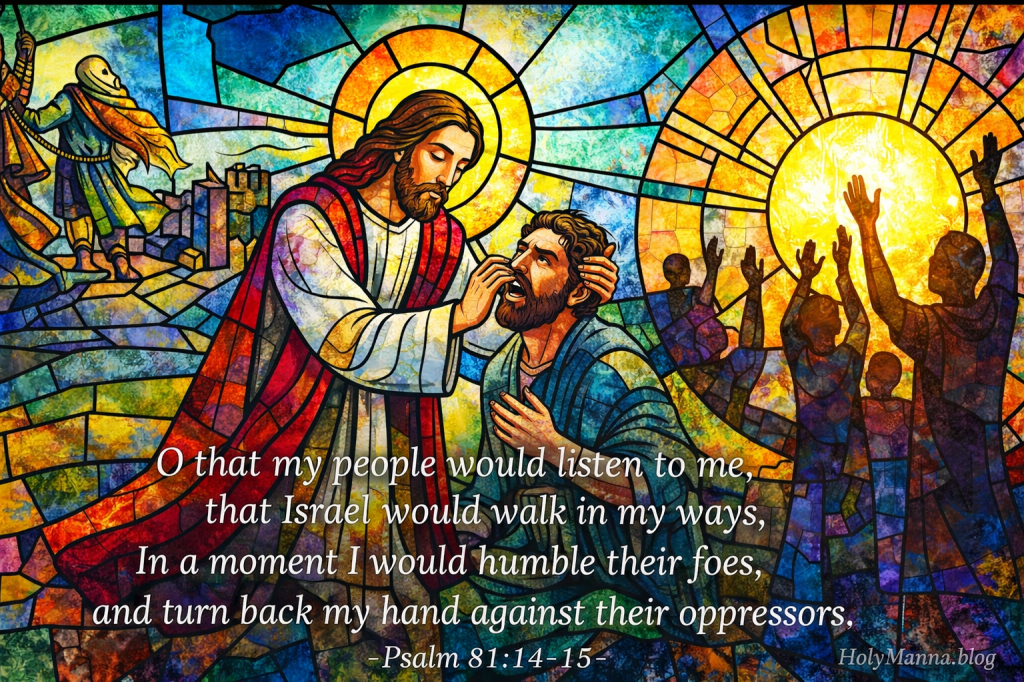
Then the Gospel, Mk 7:31-37, brings the theme to life through a man who cannot hear and cannot speak clearly. Jesus does not heal from a distance like a magician showing off. He draws the man aside, touches him, looks up to heaven, and speaks a single word that feels like it was meant for the whole Church: “Ephphatha”, which means “Be opened!” The miracle is physical, but the sign is spiritual. The Messiah opens ears so the Word can be received, and He loosens tongues so faith can be confessed, because the Kingdom is not built by those who merely observe God, but by those who listen and respond. How many divisions in the soul begin with a habit of not listening to God, and how many healings begin with allowing Christ to open what has been closed for years?
First Reading – 1 Kings 11:29-32; 12:19
A Torn Cloak, A Torn Kingdom, A Warning for Every Heart
The story opens near the end of Solomon’s reign, when Israel looks strong on the outside but is cracking on the inside. Solomon inherited a unified kingdom and the promises made to David, yet his later years were marked by compromise, especially in worship, as Israel’s heart drifted from the Lord. In that world, politics and religion were never separated, because the king’s faith shaped the people’s future. So when God sends the prophet Ahijah, He does not deliver a polite memo. He stages a sign that cannot be ignored: a new cloak is ripped into twelve pieces, and the nation is shown what happens when a covenant people stops listening. This reading fits today’s theme with painful clarity, because spiritual deafness never stays private. It fractures families, communities, and even kingdoms, until the Lord opens what pride and idolatry have shut.
1 Kings 11:29-32; 12:19 – New American Bible (Revised Edition)
11:29 At that time Jeroboam left Jerusalem, and the prophet Ahijah the Shilonite met him on the road. The prophet was wearing a new cloak, and when the two were alone in the open country, 30 Ahijah took off his new cloak, tore it into twelve pieces, 31 and said to Jeroboam: “Take ten pieces for yourself. Thus says the Lord, the God of Israel: I am about to tear the kingdom out of Solomon’s hand and will give you ten of the tribes. 32 He shall have one tribe for the sake of my servant David, and for the sake of Jerusalem, the city I have chosen out of all the tribes of Israel.
12:19 And so Israel has been in rebellion against the house of David to this day.
Detailed Exegesis
Verse 29 “At that time Jeroboam left Jerusalem, and the prophet Ahijah the Shilonite met him on the road. The prophet was wearing a new cloak, and when the two were alone in the open country.”
This moment is quiet, almost ordinary, and that is part of the power. Jeroboam is leaving Jerusalem, the city tied to David’s line and to the worship of the Lord, and he meets a prophet from Shiloh, a place with a long memory of Israel’s early worship. The “new cloak” is not a random detail. In Scripture, clothing often signals identity, mission, and authority, and God is preparing a visible message that will match the hidden spiritual reality. The fact that they are alone matters too, because God often speaks decisive words away from crowds, where a man cannot hide behind public opinion.
Verse 30 “Ahijah took off his new cloak, tore it into twelve pieces.”
Prophets in Israel do not only speak. They act out God’s word so the people can see it. Tearing the cloak is a symbolic judgment on a unity that has already been weakened by sin. The twelve pieces clearly point to the twelve tribes, the people God formed into one nation through covenant. When worship is corrupted, unity eventually becomes fragile, and what should have been mended by repentance is instead ripped by consequence.
Verse 31 “And he said to Jeroboam: ‘Take ten pieces for yourself. Thus says the Lord, the God of Israel: I am about to tear the kingdom out of Solomon’s hand and will give you ten of the tribes.’”
Jeroboam is not taking power by sheer ambition in this moment. The prophecy insists that the Lord is the One who “tears” the kingdom, because God is not a spectator to Israel’s covenant life. This is discipline, not chaos. It is also a warning that God’s gifts do not cancel human responsibility. Solomon’s throne was a gift, but a gift can be wounded by disobedience. The ten tribes represent the coming northern kingdom, and the act of taking “ten pieces” shows that what is about to happen is not merely a shift of leadership, but a fracture of the nation’s shared life.
Verse 32 “‘He shall have one tribe for the sake of my servant David, and for the sake of Jerusalem, the city I have chosen out of all the tribes of Israel.’”
Judgment is not the whole story. God preserves “one tribe” for David’s sake and for Jerusalem’s sake, because God’s faithfulness runs deeper than Israel’s failures. Even when the people break covenant, the Lord does not break His promise. This verse quietly points forward to the messianic hope, because the Davidic line is being safeguarded for the day when the true Son of David will gather what sin has scattered. It is also a reminder that God’s choices are not sentimental. Jerusalem is “the city I have chosen,” meaning worship is meant to be received on God’s terms, not reinvented to fit fear, convenience, or politics.
Verse 12:19 “And so Israel has been in rebellion against the house of David to this day.”
This final line lands like a scar. What begins as a tearing becomes a long-standing condition. Rebellion becomes normalized, and division becomes tradition. Scripture is showing how quickly a people can adjust to disunity when they have already adjusted to spiritual compromise. Once the ear of the heart is closed, even obvious wounds can start to feel ordinary.
Teachings
This reading teaches that idolatry and disobedience do not remain internal, because sin has social consequences. A king’s compromises become a nation’s habits, and a nation’s habits become generational fractures. The Lord’s action here reveals both justice and mercy: justice, because covenant infidelity matters; mercy, because God preserves the Davidic promise and keeps a path open for restoration.
The Catechism is direct about the root issue behind the tearing of the kingdom. CCC 2113 says, “Idolatry not only refers to false pagan worship. It remains a constant temptation to faith. Idolatry consists in divinizing what is not God. Man commits idolatry whenever he honors and reveres a creature in place of God, whether this be gods or demons, power, pleasure, race, ancestors, the state, money, etc.” That is the spiritual engine underneath the political collapse. When God is not adored as God, something else takes His place, and that substitute cannot hold a people together.
The reading also teaches that real faith is not a vague spirituality, because it is a listening obedience that shapes choices. CCC 143 describes that posture with precision: “By faith, man completely submits his intellect and his will to God. With his whole being man gives his assent to God the revealer.” The tragedy of Solomon’s legacy is that Israel’s assent became partial, and partial assent eventually becomes refusal.
Historically, this prophecy belongs to the breaking of the united monarchy after Solomon, when the northern tribes formed a separate kingdom under Jeroboam and the southern kingdom remained tied to David’s line in Jerusalem. In Israel’s memory, this was not just a national breakup, because it became a religious crisis. The heart of the conflict was always worship, because a people’s unity is never stronger than what they worship together.
Reflection
A torn cloak is not only ancient history. It is a mirror held up to modern life, because the same pattern still repeats in quieter forms. A heart drifts, worship becomes casual, compromises become routine, and then relationships start to fray. The Lord’s warning is not meant to produce paranoia, but honesty. When God is treated as optional, something else quietly becomes absolute, and that “something” eventually demands loyalty that belongs to God alone.
A practical way to live this reading is to take spiritual listening seriously again, because listening is where unity begins. That can mean showing up to prayer even when it feels dry, returning to Confession before patterns harden, and making a clean break with whatever regularly competes with God for attention and affection. It also means refusing the easy lie that private sin stays private. Every choice trains the heart, and trained hearts shape homes.
Where has worship been subtly reshaped to fit comfort instead of conversion? What “foreign god” tries to rule the schedule, the imagination, or the priorities, even if it never gets named out loud? If the Lord tore away whatever is false in order to save what is true, what would He be trying to heal before it spreads into deeper division?
Responsorial Psalm – Psalm 81:9-15
God’s Heartbreak and God’s Promise When His People Finally Listen
This psalm sounds like a sacred courtroom scene where the Lord speaks plainly to His own people, not to shame them, but to wake them up. In Israel’s worship life, psalms like this were sung in the context of feast days and covenant remembrance, when the nation would celebrate God’s saving acts, especially the Exodus. That is why the Lord begins by reminding Israel who rescued them and who fed them. The religious background is covenant fidelity: Israel is not just a tribe with traditions, but a people bound to the living God who delivered them from Egypt and claimed their worship. This fits today’s theme perfectly because the First Reading shows what happens when hearts drift into stubbornness, and the Gospel shows what happens when Christ opens what is closed. Here, the Lord diagnoses the same sickness that tears kingdoms apart: not merely ignorance, but refusal to listen. Yet the psalm also holds out a mercy that feels almost unbelievable, because God still says He wants to fill His people if they will only open themselves to Him.
Psalm 81:9-15 New American Bible (Revised Edition)
9 ‘Listen, my people, I will testify against you
Selah
If only you will listen to me, Israel!
10 There shall be no foreign god among you;
you shall not bow down to an alien god.
11 ‘I am the Lord your God,
who brought you up from the land of Egypt.
Open wide your mouth that I may fill it.’
12 But my people did not listen to my words;
Israel would not submit to me.
13 So I thrust them away to the hardness of their heart;
‘Let them walk in their own machinations.’
14 O that my people would listen to me,
that Israel would walk in my ways,
15 In a moment I would humble their foes,
and turn back my hand against their oppressors.
Detailed Exegesis
Verse 9 “Listen, my people, I will testify against you. If only you will listen to me, Israel!”
God begins with an urgent appeal. This is not distant theology. It is relational language, because the Lord addresses them as “my people,” which recalls covenant love. The phrase “testify against you” signals that God’s word carries moral weight, since Israel’s worship is supposed to shape Israel’s life. The repeated call to listen highlights the core issue behind so much spiritual collapse: the ear of the heart is closed, not because God is silent, but because the soul has learned to tune Him out.
Verse 10 “There shall be no foreign god among you; you shall not bow down to an alien god.”
This is the First Commandment stated with covenant clarity. Israel lived among nations filled with idols and rival cults, and the temptation was not always to reject the Lord outright, but to blend Him with other loyalties. This verse forbids mixing. It also exposes a principle that still holds: worship always forms identity. Bowing down is not only a physical gesture, because it is the soul’s surrender. Whatever receives that surrender becomes the functional god.
Verse 11 “I am the Lord your God, who brought you up from the land of Egypt. Open wide your mouth that I may fill it.”
God grounds the command in His own saving action. He is not asking Israel to obey a stranger. He is the One who already proved His love through liberation. The image of opening the mouth is tender and bold at the same time. It is like the Lord is saying that He wants to provide and satisfy, not merely demand. In the story of Israel, God fed His people with manna in the wilderness, and that feeding becomes a foundational memory of trust. In the Church’s hearing, this verse naturally points toward the way God still feeds His people, because the Lord does not only rescue from slavery, He nourishes for the journey.
Verse 12 “But my people did not listen to my words; Israel would not submit to me.”
This line reveals that the crisis is not lack of information. The people “did not listen,” and they “would not submit,” which describes a willful refusal. Submission here is not humiliation. It is the right order of love, where a creature receives life from the Creator. When that order is rejected, the result is not freedom, but confusion, because the soul cannot live without worship. It will simply choose a different altar.
Verse 13 “So I thrust them away to the hardness of their heart; let them walk in their own machinations.”
This is one of the most sobering sentences in the psalms. It describes a form of judgment that feels like abandonment, yet it is actually God honoring human freedom. The “hardness of heart” is a spiritual condition where a person becomes resistant to grace, not because God refuses to give it, but because the soul refuses to receive it. “Their own machinations” means their own plans, schemes, and self-made pathways. The punishment here is letting stubbornness play out, because sin carries its own consequences. This is what happens when the Lord’s voice becomes background noise and the self becomes the final authority.
Verse 14 “O that my people would listen to me, that Israel would walk in my ways.”
Here the tone shifts into longing. God is not pleased by judgment. This verse shows divine desire for conversion and communion. “Walk in my ways” is covenant language, describing daily living shaped by God’s commands. The Lord is offering a path, not merely a rulebook. He wants Israel to move with Him, to let obedience become a way of life.
Verse 15 “In a moment I would humble their foes, and turn back my hand against their oppressors.”
God promises protection and victory, but it is connected to listening and walking in His ways. This is not a prosperity slogan. It is covenant reality: when Israel is faithful, the Lord fights for them, because they live under His lordship. The phrase “in a moment” emphasizes that God’s power is not limited. The obstacle is not God’s strength. The obstacle is Israel’s refusal to trust.
Teachings
This psalm teaches that idolatry is not a harmless hobby, because it reshapes the soul and eventually reshapes society. When God says there shall be no foreign god, He is protecting His people from the fragmentation that idols create. The First Reading shows a kingdom torn, and this psalm explains why the tearing happens: hearts stop listening, and then they start bowing.
The Catechism names the deep problem with precision. CCC 2113 says, “Idolatry not only refers to false pagan worship. It remains a constant temptation to faith. Idolatry consists in divinizing what is not God. Man commits idolatry whenever he honors and reveres a creature in place of God, whether this be gods or demons, power, pleasure, race, ancestors, the state, money, etc.” This is Psalm 81 in doctrinal form. Israel’s “foreign god” was often a carved idol, but the modern heart can manufacture idols without ever picking up a chisel.
The psalm also teaches that God does not coerce love. He calls, warns, and invites, but He allows refusal. CCC 1730 says, “God created man a rational being, conferring on him the dignity of a person who can initiate and control his own actions. ‘God willed that man should be “left in the hand of his own counsel,” so that he might of his own accord seek his Creator and freely attain his full and blessed perfection by cleaving to him.’” The line about being left to “their own machinations” reflects that frightening possibility: a person can insist on self-rule long enough that the heart hardens into habit.
Saint Augustine often speaks about disordered love as the root of sin, because the problem is not that people love nothing, but that they love the wrong thing as ultimate. The psalm is essentially asking whether the Lord will be loved first, or whether something else will sit on the throne. When love is rightly ordered, obedience stops feeling like oppression and starts feeling like freedom, because the soul is finally aligned with the truth of who God is.
Historically, Israel’s temptations toward foreign gods were not theoretical. Surrounding cultures offered fertility cults, political alliances sealed by shared worship, and social pressure to blend practices. The psalm stands as a liturgical refusal, a sung act of resistance against assimilation. It is a reminder that God’s people are always tempted to blend in, and God’s word always calls them back to belong.
Reflection
This psalm is honest enough to name what many people avoid admitting: spiritual deafness is often chosen. The Lord says, “If only you will listen to me”, because He knows how many prayers turn into monologues and how many hearts keep God at arm’s length while still wanting His blessings. The psalm invites a sober question: is God treated like a living King, or like a helpful resource?
A practical starting point is to take one area of life where stubbornness has become normal and place it under the First Commandment again. That might mean refusing entertainment that forms the imagination toward impurity, breaking the habit of constant noise that kills silence, or confronting resentment that has been treated like a personal right. The psalm’s promise is not that life becomes effortless, but that when the Lord is first, the soul becomes whole, and the Lord’s help becomes real in concrete ways.
This is also a good day to pray with the line “Open wide your mouth that I may fill it” as a way of preparing for the Eucharist with hunger instead of routine. God does not want polite distance. God wants receptive trust. When the heart opens, the Lord fills it with what idols can never provide.
What has been acting like a “foreign god” lately, even if it never gets called that out loud? Where has the heart stopped listening because it is afraid of what obedience would require? If the Lord stopped arguing and simply allowed the heart to follow its “own machinations,” where would that road actually end?
Holy Gospel – Mark 7:31-37
Ephphatha: The Lord Who Opens Ears, Loosens Tongues, and Restores the Whole Person
Jesus is moving through Gentile territory again, traveling from Tyre toward Sidon and into the region of the Decapolis, a set of largely non Jewish cities shaped by Greek and Roman culture. In the world of The Gospel of Mark, that geography is not a throwaway detail, because it shows the Messiah’s mercy spilling beyond Israel’s borders. The people bring a man who is deaf and struggles to speak, and they beg for a healing touch. What happens next is not a quick, impersonal miracle. Jesus pulls the man away from the crowd, uses physical signs that the man can understand, looks up to heaven, groans with compassion, and speaks a single Aramaic command that sounds like it is meant for every closed heart: “Ephphatha!” The central theme of today becomes visible here. When God’s people stop listening, kingdoms tear. When the Lord opens what is shut, the human person is restored and praise breaks out.
Mark 7:31-37 – New American Bible (Revised Edition)
The Healing of a Deaf Man. 31 Again he left the district of Tyre and went by way of Sidon to the Sea of Galilee, into the district of the Decapolis. 32 And people brought to him a deaf man who had a speech impediment and begged him to lay his hand on him. 33 He took him off by himself away from the crowd. He put his finger into the man’s ears and, spitting, touched his tongue; 34 then he looked up to heaven and groaned, and said to him, “Ephphatha!” (that is, “Be opened!”) 35 And [immediately] the man’s ears were opened, his speech impediment was removed, and he spoke plainly. 36 He ordered them not to tell anyone. But the more he ordered them not to, the more they proclaimed it. 37 They were exceedingly astonished and they said, “He has done all things well. He makes the deaf hear and [the] mute speak.”
Detailed Exegesis
Verse 31 “Again he left the district of Tyre and went by way of Sidon to the Sea of Galilee, into the district of the Decapolis.”
This route highlights Jesus intentionally entering a region associated with the nations. It signals that the Kingdom is not a tribal project, but God’s saving work for all peoples. It also echoes the Old Testament longing that the nations would come to know the Lord. Jesus is not only teaching Israel. He is reclaiming the world.
Verse 32 “And people brought to him a deaf man who had a speech impediment and begged him to lay his hand on him.”
The community acts like intercessors, carrying the suffering man to Christ. The request for Jesus to lay hands reflects a biblical and human instinct that God’s power is not abstract. God touches. God heals. This verse also reveals how disability can isolate a person, because deafness often separates someone from community life, worship, and ordinary relationships. The crowd believes Jesus can bridge that separation.
Verse 33 “He took him off by himself away from the crowd. He put his finger into the man’s ears and, spitting, touched his tongue.”
Jesus chooses intimacy over spectacle. He does not turn the man into a public display. He draws him aside, protecting his dignity. Then Jesus uses gestures the man can grasp. Fingers to ears and touch to tongue communicate what is about to happen in a language beyond words. In the ancient world, saliva was sometimes associated with healing, but in this Gospel it is not magic. It is a sign that healing is personal and incarnational. God does not save humanity from a distance. The Word became flesh, and the flesh of Christ reaches into human weakness.
Verse 34 “Then he looked up to heaven and groaned, and said to him, ‘Ephphatha!’ that is, ‘Be opened!’”
Jesus looks to the Father, showing that His mission is rooted in communion with God. The groan reveals compassion, a holy sorrow at human suffering and at the brokenness of creation. The Aramaic word is preserved because it is memorable and weighty. “Be opened!” is more than a command to ears. It sounds like a command to the whole person. It also fits today’s theme as a direct answer to the psalm’s lament that God’s people would not listen. Here the Lord Himself opens the ability to hear.
Verse 35 “And immediately the man’s ears were opened, his speech impediment was removed, and he spoke plainly.”
The healing is total and immediate. Hearing returns, and speech becomes clear. This is not partial repair. It is restoration. In biblical symbolism, hearing and speaking are connected to faith itself, because the believer hears the word of God and then confesses it. This verse quietly shows what grace does: it restores what sin and suffering distort, and it makes communion possible again.
Verse 36 “He ordered them not to tell anyone. But the more he ordered them not to, the more they proclaimed it.”
Jesus often commands silence in The Gospel of Mark because the crowd can misunderstand His identity, reducing Him to a miracle worker rather than receiving Him as the Messiah who saves through the Cross. Yet joy overflows. A true encounter with Christ tends to spill into witness. The paradox is that Jesus seeks to prevent shallow hype, but His goodness naturally generates proclamation.
Verse 37 “They were exceedingly astonished and they said, ‘He has done all things well. He makes the deaf hear and the mute speak.’”
Their praise sounds like more than excitement. It echoes the language of creation’s goodness and the prophetic hope that, in God’s salvation, the deaf would hear and the mute would speak. The crowd is recognizing that Jesus is not only fixing a problem. He is restoring the world. This is why the Church hears in this line a summary of the Lord’s mission: He makes things whole again.
Teachings
This Gospel teaches that Christ’s miracles are not entertainment, because they are signs of the Kingdom and invitations to faith. The Catechism explains why Jesus performs signs like this. CCC 547 says, “Jesus accompanies his words with many ‘mighty works and wonders and signs’, which manifest that the Kingdom is present in him and attest that he was the promised Messiah.” The miracle is evidence that God’s reign is arriving in the person of Jesus.
It also teaches that faith involves hearing and responding. The Catechism describes faith as obedience, not as vague sentiment. CCC 144 says, “To obey in faith is to submit freely to the word that has been heard, because its truth is guaranteed by God, who is Truth itself.” The healed man becomes a living parable of what grace does spiritually. Christ opens the ears of the heart so the word can be received, and He loosens the tongue so faith can be confessed.
There is also a deep sacramental echo here. The Church has long connected “Ephphatha” with baptismal grace, because baptism opens a person to receive the Word and profess the Creed. CCC 1235 describes this ancient gesture within the baptismal rite: “The touching of the ears and mouth symbolizes the opening to receive the Word and to profess the faith.” The Gospel miracle is not identical to the sacrament, but it points to the same Lord who heals, opens, and restores communion.
Saint Gregory the Great reads miracles like this with both realism and spiritual depth. He often emphasizes that Christ heals bodies to awaken souls. The physical cure is merciful in itself, yet it also points toward a deeper healing: the deafness that keeps a person from hearing God, and the muteness that keeps a person from praising Him or speaking truth. The Gospel is reminding believers that the Lord cares for the whole human person, body and soul, and that His salvation is not an idea but a restoration.
Reflection
This Gospel lands close to home because spiritual deafness is common, even in religious people. The world is loud, the schedule is crowded, and the heart can start to treat God’s voice like background noise. Then the soul wonders why peace is thin and why worship feels flat. The scene in Mk 7:31-37 shows a different path. The man is brought to Jesus, Jesus draws him aside, and the healing begins in closeness, not in noise. That is a strong hint for daily life: the Lord often opens what is shut when a person is willing to step away from the crowd, the constant input, and the endless commentary.
A practical step is to ask Christ to repeat His word over the places where listening has broken down. That might mean listening to a spouse without defensiveness, listening to Scripture without rushing, listening to conscience without bargaining, and listening to the Church without treating her teachings as optional suggestions. Another step is to imitate the crowd in the best way by carrying others to Christ through intercession, especially those who feel stuck, numb, or ashamed.
Where has the heart grown deaf to God because it has been trained to crave noise instead of silence? What truths have become hard to speak because the fear of people has gotten louder than the fear of the Lord? If Jesus pulled someone aside today and said “Be opened!”, what habit, attachment, or hidden compromise would need to loosen its grip so the soul could hear again and speak plainly?
When the Lord Says “Be Opened”, Everything Changes
Today’s readings tell one sober story with one hopeful ending. In 1 Kgs 11:29-32; 12:19, a new cloak is torn, and a kingdom follows, because hearts that stop listening to God eventually stop walking together. In Ps 81:9-15, the Lord speaks like a Father who loves too much to stay quiet, warning against false gods and pleading, “If only you will listen to me”, because He knows that stubborn freedom can become a hardened prison. Then in Mk 7:31-37, Jesus steps into the mess human sin and human suffering create, and He does not simply lecture about listening. He heals a man who cannot hear, and He commands what every soul needs to hear sooner or later: “Ephphatha!” “Be opened!” The message is simple and strong. When people refuse God’s voice, life fractures. When Christ opens what is shut, wholeness returns, and praise becomes impossible to hide.
This is a day to stop treating faith like background music and start treating it like the voice that leads to life. The Lord still asks for the same thing Israel struggled to give, which is a listening heart that refuses idols and chooses covenant love. That begins with honesty in prayer, silence that makes room for God’s Word, repentance that breaks the habit of compromise, and reverence that turns worship into real surrender. The Lord is still willing to fill the hungry soul, but the mouth has to open, and the heart has to stop negotiating with what cannot save.
What would change if Christ’s “Be opened!” reached the exact place where stubbornness has been protected the most? Let today be the day the ear of the heart turns back toward the Lord, and let the tongue be loosed for the right kind of speech, which is truth, confession, gratitude, and praise. When God’s people listen again, division loses its grip, and the story moves from tearing to healing.
Engage with Us!
Readers are invited to share their reflections in the comments below, because God often deepens understanding when His people listen together and speak with humility.
- First Reading 1 Kgs 11:29-32; 12:19 – What small compromise has been quietly tearing at unity in life, whether in the heart, the home, or relationships, and what concrete act of obedience could begin repairing what has been strained?
- Responsorial Psalm Ps 81:9-15 – What “foreign god” tries to take first place in daily life, and what would it look like to take God seriously when He says “Open wide your mouth that I may fill it”?
- Holy Gospel Mk 7:31-37 – Where does the heart most need to hear Jesus say “Ephphatha” “Be opened!”, and what habit of silence, prayer, repentance, or courage could help make space for that healing?
Keep walking forward with steady faith, because the Lord still opens what is closed, heals what is broken, and teaches His people to live with courage, charity, and mercy. Let every choice today be shaped by the love of God, and let every word and action reflect the compassion Jesus taught, so life becomes a quiet witness that He still “has done all things well.”
Sacred Heart of Jesus, we trust in You!
Immaculate Heart of Mary, pray for us!
Saint Michael the Archangel, defend us in battle!
Follow us on YouTube, Instagram and Facebook for more insights and reflections on living a faith-filled life.

 Holy Manna!
Leave a comment