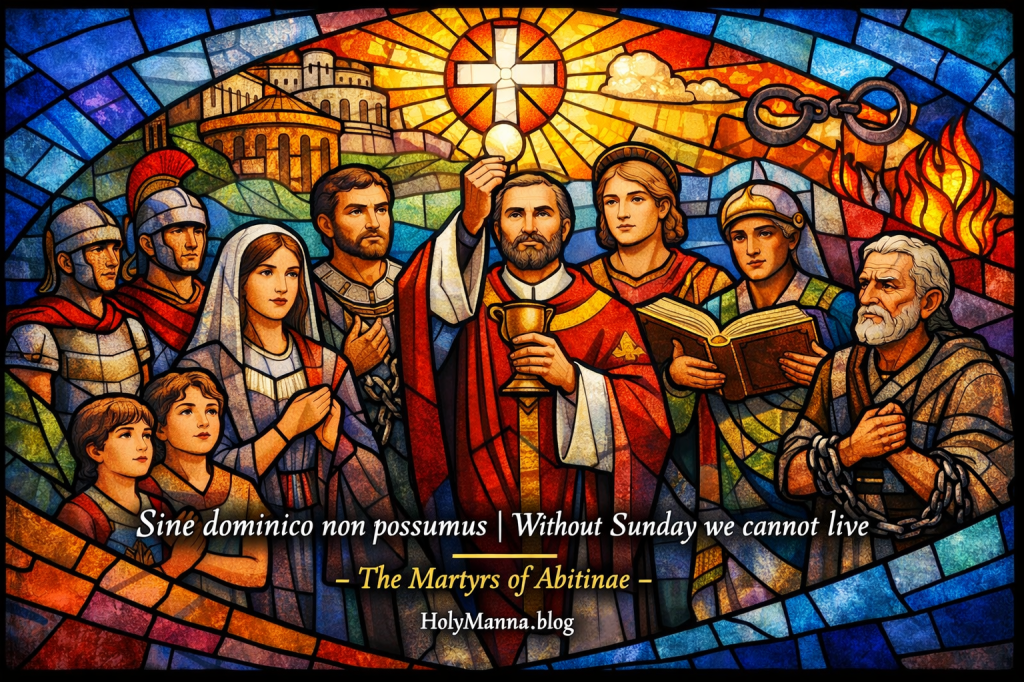
The Sunday Catholics Who Would Not Quit
The Martyrs of Abitinae were a whole community of Catholics in Roman North Africa who refused to let the Empire decide whether Jesus could be worshiped on Sunday. They were not remembered for building institutions or writing theological treatises. They are remembered because they kept the Lord’s Day holy and kept the Eucharist at the center of life, even when that choice brought chains, torture, and death. Their story still feels sharp because it confronts a modern temptation to treat Sunday Mass like an accessory instead of a necessity. Their witness matches what The Catechism teaches about the Sunday Eucharist being foundational for Christian life, because the Mass is where Catholics are formed by the Word and strengthened by the Sacrifice of Christ.
A Hidden Church
The sources the Church has preserved do not offer long biographies for each martyr, but they do reveal something intimate and personal about their lives. This was not a group of isolated heroes trying to prove a point. This was a parish, a Christian neighborhood, and a family of faith that included men and women, clergy and laity, and people of different ages. The tradition remembers forty nine martyrs in all, including many women, which matters because it shows that courage was not limited to one type of person. Saint Saturninus is remembered as a priest, which means he carried the responsibility of feeding Christ’s people with the sacraments in a dangerous time. Saint Emeritus is remembered as a lector, a man shaped by proclaiming the Scriptures in the assembly. Saint Dativus is remembered in later tradition as a man of status, sometimes described as a senator, which highlights that the Gospel had taken root across social lines and was not confined to the poor or powerless.
A painful detail often included in the background of this story is the mention of a local bishop, Fundanus, who complied with imperial demands and surrendered sacred books. In that moment of weakness and scandal, the faithful of Abitinae faced a choice about whether compromise would become the new normal. Many of them looked to the priest Saturninus and chose the harder road, continuing to gather for Sunday worship anyway. Their conversion shows itself here, not as a sudden emotional event, but as the deepening of faith into decisive fidelity. How often does faith become real only when it costs something?
Faith That Would Not Hide
The heart of their story is simple, but it is not small. They gathered for the Sunday Eucharist even though the state forbade Christian assemblies. They met in a private home, which makes the scene feel close and human, like the earliest days of the Church. That detail also reveals something important about Catholic life. The Mass does not depend on social approval, and the Eucharist does not become optional when the world disapproves. The Church is the Church wherever Christ gathers His people, whether in a cathedral or in a living room.
The tradition remembers that Emeritus openly acknowledged the gathering took place in his house. He did not dodge responsibility or hide behind someone else. He accepted the consequences of hospitality offered to the Lord. Some accounts also remember that Saturninus was not alone when the authorities arrived. Members of his own household were among those arrested, including children and a daughter, and the tradition even mentions an infant. That detail hits hard because it shows the faith being handed on inside the home and lived as something normal and concrete. Their holiness was not limited to private prayer. It was embodied in weekly worship and in the courage to keep worshiping when it would have been easier to stay quiet.
What the Empire Feared
During the persecution under Emperor Diocletian, Christians were pressured to surrender sacred books and to stop gathering for worship. The martyrs of Abitinae were arrested and brought to Carthage for judgment before the proconsul Anullinus. The questioning was designed to break them, to make them betray leaders, and to make them accept that Caesar had the final word over conscience and worship. This is why their story still matters, because it reveals a truth the world often resists. Worship is never merely private, and the Eucharist forms a loyalty that no government can fully control.
Dativus stands out in the preserved narrative because he was pressured to name who led the forbidden Eucharist. Under interrogation and torture, he resisted betraying the community. The accounts also include a striking moment involving a Christian woman named Victoria. An advocate named Fortunatianus, described as her brother, tried to shame the Christians by accusing Dativus of dragging young women into an illegal gathering. Victoria’s response is remembered because it cuts through the manipulation and clarifies that she came freely, not as a victim but as a believer. Her courage shows that Christian worship was not built on coercion or schemes. It was built on conviction, freely chosen, even when it hurt.
When Dativus was pressed again to identify the instigator, the response remembered in tradition is communal and honest. “The priest Saturninus and all of us.” That line reveals the heart of martyrdom. It was not one heroic man dragging others into danger. It was a united people choosing the Eucharist together, as one Body. The suffering that followed was not simply political oppression. It was spiritual warfare against worship, because the Empire was trying to cancel the Mass and break the Church’s weekly heartbeat.
The Words That Became Their Sermon
The most famous line connected to these martyrs comes from Emeritus. When asked why he violated the emperor’s command, he answered with words that became one of the most quoted sentences in Catholic preaching about Sunday and the Eucharist. “Sine dominico non possumus.” Those words are often translated as “Without Sunday we cannot live,” but the meaning runs deeper because the phrase points to the Lord’s Day and to what belongs to the Lord on that day, the Eucharist itself. Their point was not stubbornness. Their point was spiritual realism, because a Christian without the Eucharist is like a body trying to live without food.
Another line preserved in the martyr tradition captures their love for the Word of God in a time when sacred books were targeted. “Scripturas dominicas habeo, sed in corde meo.” This line is translated as: “the Scriptures can be held in the heart, not only in the hand.” Even when books are confiscated, the Word can remain planted inside the believer. Their story also includes the memory of prayer under suffering, expressed in a line preserved in the tradition: “Rogo, Christe, da sufferentiam. Spes est in te.” These words, which in english mean “I ask you, Christ, grant endurance. My hope is in you,” show a soul that has stopped negotiating with fear and started leaning entirely on Christ.
Their martyrdom did not necessarily unfold in one single moment for every person. Some were executed, while others died as a result of torture and imprisonment. Either way, the Church recognizes the same offering. Their bodies were beaten, but their faith remained steady, and their unity did not crack.
Calling Catholics Back to Mass
The Church’s memory of the Abitinae martyrs does not revolve around a large catalogue of posthumous miracles or famous shrines filled with recorded healings. Their legacy is carried through liturgy, catechesis, and the conversion of hearts, which is its own kind of miracle. Their names were treasured and remembered together because their witness was communal. They are commemorated in the Church’s calendar, and their story was preserved in ancient accounts of their trial. Their testimony also became especially meaningful in North Africa when the Church faced painful internal disputes about those who surrendered Scriptures under pressure. In those moments, the martyrs stood as a reminder that compromise is never harmless when it touches worship and truth.
Their witness still supports the moral clarity found in CCC 2181 to 2182, where the Church teaches that participation in Sunday Mass is a serious obligation when it is possible. The martyrs make that teaching feel real, because they show what the Eucharist is worth. Their lives preach that the Mass is not a reward for the strong. The Mass is food for the weak, strength for the tempted, and communion for the lonely.
A Practical Road to Imitate Them
The Martyrs of Abitinae make holiness feel both challenging and reachable. Their story does not demand dramatic gestures that only a few could ever live. It demands fidelity, and fidelity begins with worship. A person who wants to imitate them can start by treating Sunday Mass as the center of the week instead of a weekend option. It helps to plan around it, protect it, and prepare for it with intention, because love is shown by what is prioritized. It also helps to recover a simple Catholic instinct: Sunday belongs to God, and the soul needs the Eucharist.
The modern battle is often quieter than prison and torture, but it is still real. It shows up as apathy, distraction, overcommitment, and the habit of treating worship as something to fit in only if nothing else is happening. The martyrs challenge that drift without shaming anyone. They simply remind Catholics what is priceless. Their words still ring out as a steady warning and a steady promise, because without the Lord’s Day and without the Eucharist, Christian life slowly collapses. “Sine dominico non possumus.” What would change if Sunday Mass were treated like spiritual oxygen instead of a spiritual accessory?
Engage with Us!
Readers are invited to share thoughts and reflections in the comments below, because the saints are not museum pieces. The saints are friends, and their stories are meant to spark real change in real life.
- What tends to crowd out Sunday Mass, and what would it look like to protect the Lord’s Day more intentionally?
- How does the Eucharist strengthen the soul in ordinary life, especially when faith feels dry or routine?
- What does “Sine dominico non possumus” reveal about the difference between cultural Christianity and real discipleship?
- What is one concrete step that can be taken this week to prepare for Sunday Mass with more reverence and attention?
May the Martyrs of Abitinae pray for strong, joyful Catholics who love the Eucharist, honor the Lord’s Day, and live with the steady courage that comes from Jesus Christ. May every day be lived by faith, and may every action be done with the love and mercy Jesus taught us.
Blessed Martyrs of Abitinae, pray for us!
Follow us on YouTube, Instagram and Facebook for more insights and reflections on living a faith-filled life.

 Holy Manna!
Leave a comment