Steady Hands in a Shaking Church
Saint Meletius of Antioch lived when being Catholic meant living inside a storm. The fourth century was full of pressure from emperors, noisy factions, and theological confusion that did not stay in lecture halls. It poured into parishes and families and split communities that should have been united around one altar. The fight was ultimately about Jesus Christ. Was He truly God, equal to the Father, or was He something less. Saint Meletius became a calm, stubborn witness to the faith the Church still professes every Sunday in the Creed. The Church remembers him as a confessor, a shepherd who suffered exile and rejection for the truth, yet refused to let bitterness harden his heart.
This saint matters because he defended the center of Christian worship. The Church teaches that the mystery of the Trinity is not a theory but the living reality of who God is, one God in three Persons, Father, Son, and Holy Spirit. The Son is not a lesser being or a created messenger. He is eternal God, “consubstantial” with the Father, and the salvation of the world depends on that truth, as taught in CCC 232 to 267 and CCC 242 to 243. Meletius kept that confession steady even when the world tried to turn doctrine into politics.
A Quiet Beginning That Formed a Strong Shepherd
Meletius was born in the East at Melitene in Lesser Armenia. Catholic memory describes him as a man shaped early by discipline, prayer, and a serious interior life. Even before public conflict marked his name, he was learning the kind of self-government that later made him capable of guiding others. His temperament was known for gentleness and love of peace, but that gentleness was not weakness. It was the strength of a man who did not need to dominate others in order to be faithful.
Before Antioch, he served briefly as bishop of Sebaste. It was not an easy post, because local tensions were already high and people were attached to earlier leadership. Meletius did not cling to authority for the sake of pride. He stepped back rather than inflame conflict, which reveals a rare kind of humility in an age when religious office could easily become a power game. That same humility would later help him endure exile without becoming a resentful man.
Three Fingers, One Faith
Antioch was one of the most important cities in the ancient Christian world, and it was also one of the most divided. Meletius was chosen in a moment when many expected a compromise bishop, someone who could keep peace by softening doctrine. Instead, the people received a teacher who refused to shrink the truth about Christ. The Arian controversy was pressing the Church to describe Jesus as less than God, and that would have poisoned everything from worship to salvation. The Catholic faith is clear that Jesus is the eternal Son of God made flesh, and only God can save, which is why the divinity of Christ is not negotiable, as explained in CCC 456 to 460 and CCC 242 to 243.
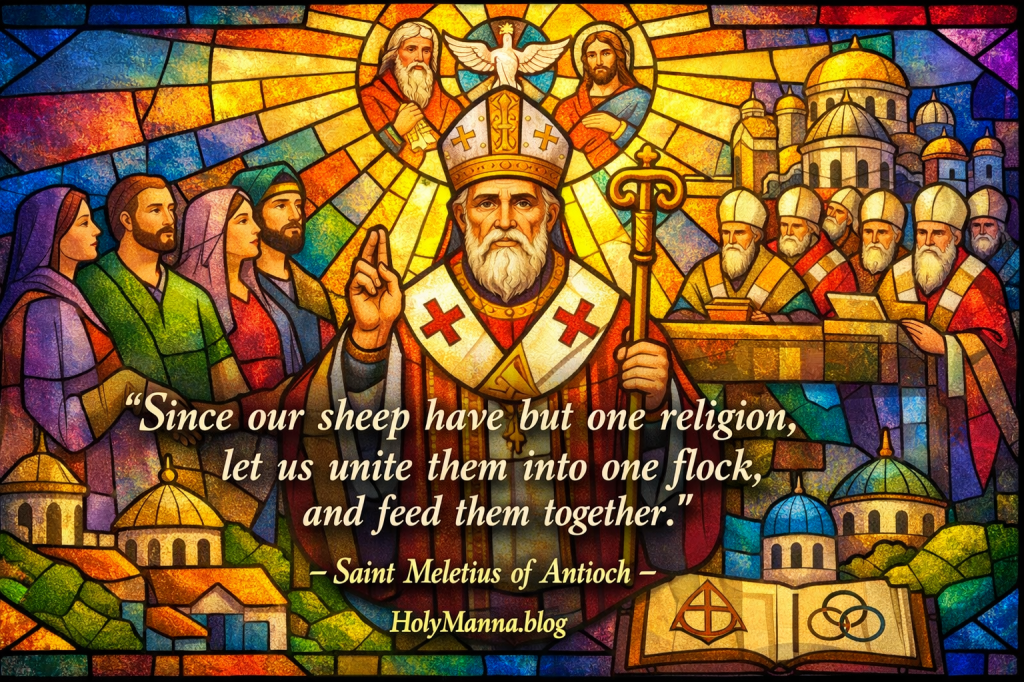
One of the most famous moments associated with Meletius is how he taught the Trinity in a way ordinary believers could grasp. Tradition remembers him using a simple gesture and a short line to express both the distinction of Persons and the unity of God. The saying attributed to him is remembered like this: “Three Persons are conceived in the mind but it is as though we addressed one only.” His enemies wanted vagueness, but he offered clarity, and that clarity was a kind of mercy for the faithful who were being pushed and pulled by competing voices.
Meletius became deeply loved by the people of Antioch. The affection was not shallow fandom. It was gratitude for a father who would not play games with the faith. His name became a sign of stability in a city that had learned to expect confusion. That popular love would become even stronger as he began to suffer for the truth he preached.
The Long Road of Patient Fidelity
Meletius’s life became a cycle of exile and return. He was driven out more than once because he would not compromise the Church’s confession of Christ. Exile is not only a punishment of distance. It is the slow ache of watching a flock suffer while being unable to protect it. It is the humiliation of being treated as a problem when the real “crime” is fidelity. Meletius endured that suffering without becoming a harsh man, and that kind of patience is its own quiet miracle.
His story is also tied to what later came to be called the Meletian schism, a painful division in Antioch that involved rival lines of leadership and hardened suspicion. The name makes it sound like Meletius caused it, but the deeper truth is that Antioch’s wounds came from a tangled mix of politics, fear, and impatience. This part of the story is a warning for every generation. Church division does not always begin with open heresy. Sometimes it begins with pride, with rushing ahead instead of waiting for peace, and with treating fellow Catholics as enemies.
Meletius never treated unity as a cheap slogan. He wanted unity rooted in truth, because unity without truth is just a temporary truce. A line attributed to him reveals the pastoral heart behind his endurance and his hope: “Since our sheep have but one religion, let us unite them into one flock, and feed them together.” That desire for communion reflects the Church’s teaching that the Church is one, and that true unity is a gift of Christ that must be protected through charity and fidelity, as taught in CCC 815 to 822.
Courage Without Cruelty
When people think of saints, they often want dramatic miracle stories. Meletius is remembered in Roman Catholic tradition more for the miracle of steadfastness. He did not win by charisma. He did not dominate by force. He simply refused to let the Church drift into a smaller Jesus. That kind of holiness is desperately needed today, because modern culture still pressures Christianity to become vague, polite, and harmless.
Meletius also shows how clarity can be charitable. He did not speak with cruelty or contempt. His gentleness was often noted, and that matters because the defense of doctrine can easily become personal pride if the heart is not purified. Meletius is a reminder that the truth should never be defended in a way that looks unlike Christ. The goal of defending the faith is not to score points but to protect souls, because salvation and worship are at stake.
A Holy Death in Service
Near the end of his life, Meletius went to the great council at Constantinople in 381, a council linked closely with the Church’s confession of the Trinity. In that moment, the Church was working to secure what she had always believed and to silence the confusion that kept returning under new disguises. Meletius played an important role in that gathering, and he died during the council itself. His death feels almost symbolic. He spent his life defending the faith, and he died while still serving the Church’s mission of clarity and unity.
The grief that followed was intense, and the devotion surrounding his death shows how powerfully the faithful recognized sanctity. People clung to his memory with love, and stories describe the desire to keep reminders of him close. This is not the Church encouraging superstition. It is the human reality of Catholics loving their spiritual fathers, and it fits with the Church’s teaching on the communion of saints, the truth that the faithful remain united in Christ beyond death, as taught in CCC 946 to 962.
The Quiet Strength of His Legacy
Miracles after death are not preserved in Catholic sources for Meletius as a long list of verified healings. What is preserved is the enduring power of his witness. His burial and memory were honored, and his name remained a sign of orthodoxy in the life of the Church. His influence also lived on through the saints shaped by that era. Saints do not only leave relics. They leave spiritual fruit, and the fruit of Meletius’s fidelity strengthened the Church’s confidence in the Creed and helped form leaders who would feed generations with orthodox preaching.
His legacy also teaches an important lesson about the Church’s life in history. Even when saints disagree about complicated local situations, the Holy Spirit continues to guide the Church toward unity and truth over time. Meletius did not live to see every wound fully healed, but he remained faithful to the end. That is often how sanctity works. God asks for fidelity, not control.
Living the Meletius Way
Meletius teaches that clarity is not arrogance when the truth is being attacked. The Creed deserves more than routine recitation. It deserves attention and love. The Trinity is not an abstract puzzle. The Trinity is the central mystery of Christian faith and life, as taught in CCC 234 and CCC 253 to 256. Meletius shows that ordinary Catholics can hold tight to the faith even when leaders fail and culture pressures the Church to compromise.
This saint also teaches patience inside the Church. Confusion happens. Conflict happens. The temptation is to become tribal, cynical, or cruel. Meletius shows another path. Stay rooted in doctrine. Stay rooted in prayer. Stay rooted in charity. Learn the Creed slowly, line by line, and let it shape how Jesus is spoken about at home and in public. Choose peace without surrendering truth, and choose truth without surrendering peace.
How does the example of Saint Meletius challenge the heart to stay faithful when the Church feels messy and the culture feels hostile? That question is worth bringing into prayer, because his life was not lived for easy comfort. It was lived for Christ.
Engage With Us!
Share thoughts and reflections in the comments below. Saint Meletius lived through confusion, exile, and division, yet he kept the faith and fought for unity without surrendering truth. That is a witness worth bringing into everyday life.
- Where does the modern world pressure the faith to become vague, and how can clarity be practiced with charity?
- When disagreements arise in the Church, what helps the heart stay humble instead of becoming tribal or harsh?
- What part of the Creed needs deeper understanding and more intentional prayer this week?
- How can patience and peace be practiced at home, at work, and online without compromising the truth?
May Saint Meletius teach courage without pride, peace without compromise, and fidelity that lasts. Let every day be lived with faith, and let every act be done with the love and mercy Jesus taught us.
Saint Meletius of Antioch, pray for us!
Follow us on YouTube, Instagram and Facebook for more insights and reflections on living a faith-filled life.

 Holy Manna!
Leave a comment