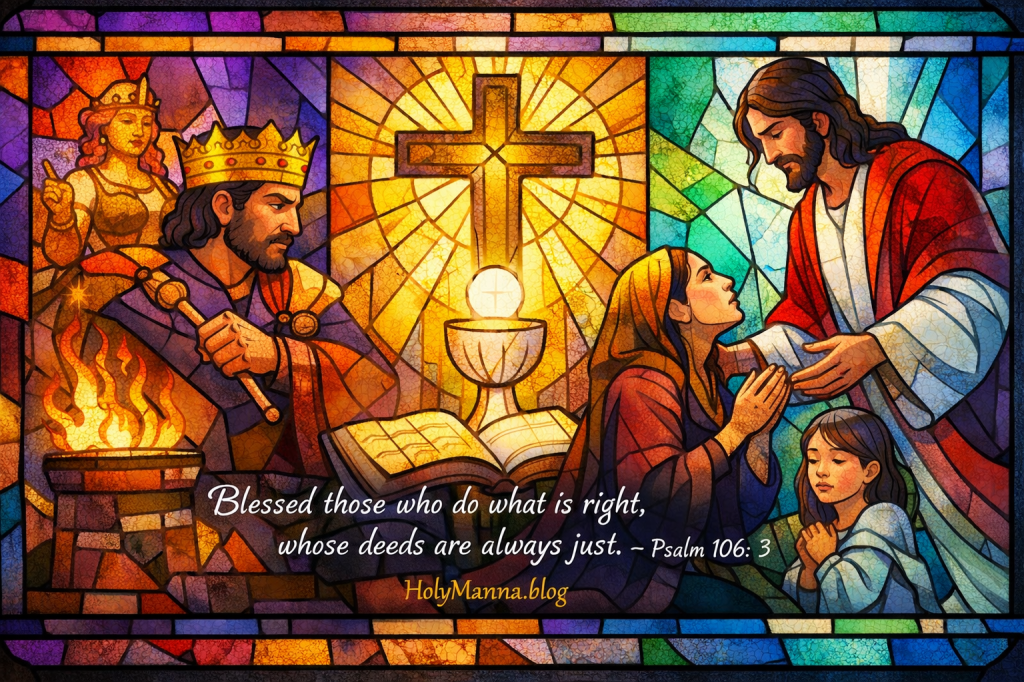
Thursday of the Fifth Week in Ordinary Time – Lectionary: 332
When the Heart Splits and Mercy Finds a Way In
There is a quiet moment that comes for every believer, usually when life settles down and the routine feels normal again, when the real question finally surfaces: what has the heart been serving all along. Today’s Mass readings circle that question from three angles and land on one central theme. A divided heart drifts into bondage, but a humble heart clinging to the Lord finds freedom.
The first reading from 1 Kings is set in the golden age of Israel’s monarchy, when Solomon’s wisdom, wealth, and temple-building made it seem like the covenant was secure. Yet the story turns painfully human. Solomon’s downfall is not framed as an accident of politics, but as a slow spiritual compromise. In the ancient Near East, kings often formed alliances through marriage, and those alliances carried religious pressure with them. The gods of surrounding nations were not just private devotions; they were public loyalties, cultural identities, and sometimes tools of power. When Solomon builds high places for foreign deities, it is not simply a personal weakness. It is the heart of the kingdom splitting its worship. The covenant God who revealed Himself to Israel refuses to be treated like one option among many, because the Lord is not a tribal idol. The Lord is the living God.
That is why Psalm 106 sounds like a sorrowful commentary on the same collapse. Israel “mingled” with the nations, not in the sense of loving neighbors well, but in the sense of absorbing their idols and losing the distinctiveness of worship. Idolatry always promises sophistication and peace, but it delivers slavery. The psalm’s language is strong because the spiritual reality is strong. When a people forget the Lord, worship does not disappear. It just gets redirected, and what replaces God never stays gentle.
Then the Gospel from The Gospel of Mark brings the story to a surprising place: the region of Tyre, Gentile territory, outside the familiar borders of Israel. While Solomon’s heart opens itself to foreign gods and loses the kingdom, a foreign woman opens her heart to the true God and finds deliverance. She approaches Jesus with a persistence that does not demand entitlement, and with a humility that refuses to let hope die. The encounter is intense because it reveals God’s plan unfolding in history. Israel is chosen first, but not chosen to keep salvation locked up. Israel is chosen so that the Messiah might be given to the world, and that includes the woman kneeling at His feet.
The readings together set the stage for a hard and hopeful examination. The heart can be divided by compromise, swallowed by the spirit of the age, and quietly led into patterns that look normal but are spiritually deadly. Yet the Lord still listens to the one who comes in trust, even when that person feels unworthy, unseen, or outside the circle. The day’s message is not complicated, but it is demanding. God wants the whole heart, and God is merciful enough to heal it when it finally returns.
First Reading – 1 Kings 11:4-13
When Compromise Builds an Altar Across from the Temple
The story of Solomon often begins like a Catholic success story. He receives wisdom, builds the Temple, and presides over a kingdom that looks stable and blessed. Yet today’s passage opens late in his life, when the quiet decisions of the heart finally show their fruit. In the ancient world, royal marriages were not merely romantic choices. They were political alliances, cultural bridges, and often religious doorways. Foreign wives brought foreign customs, and those customs brought foreign worship. What begins as diplomacy becomes devotion, and devotion becomes betrayal when it turns the heart away from the Lord.
This reading fits perfectly into today’s theme because it shows how a divided heart does not stay divided for long. It eventually chooses a rival god. Solomon’s fall is not portrayed as ignorance, because the Lord had appeared to him and commanded him clearly. The tragedy is that Solomon, who once sought wisdom, begins to tolerate compromise, and compromise eventually becomes public idolatry. This is why the Church treats idolatry as more than an ancient mistake. It is a spiritual pattern that can still creep into modern life, especially when faith is reduced to one priority among many.
1 Kings 11:4-13 – New American Bible (Revised Edition)
4 When Solomon was old his wives had turned his heart to follow other gods, and his heart was not entirely with the Lord, his God, as the heart of David his father had been. 5 Solomon followed Astarte, the goddess of the Sidonians, and Milcom, the abomination of the Ammonites. 6 Solomon did what was evil in the sight of the Lord, and he did not follow the Lord unreservedly as David his father had done. 7 Solomon then built a high place to Chemosh, the abomination of Moab, and to Molech, the abomination of the Ammonites, on the mountain opposite Jerusalem. 8 He did the same for all his foreign wives who burned incense and sacrificed to their gods.
9 The Lord became angry with Solomon, because his heart turned away from the Lord, the God of Israel, who had appeared to him twice 10 and commanded him not to do this very thing, not to follow other gods. But he did not observe what the Lord commanded. 11 So the Lord said to Solomon: Since this is what you want, and you have not kept my covenant and the statutes which I enjoined on you, I will surely tear the kingdom away from you and give it to your servant. 12 But I will not do this during your lifetime, for the sake of David your father; I will tear it away from your son’s hand. 13 Nor will I tear away the whole kingdom. I will give your son one tribe for the sake of David my servant and for the sake of Jerusalem, which I have chosen.
Detailed Exegesis
Verse 4 “When Solomon was old his wives had turned his heart to follow other gods, and his heart was not entirely with the Lord, his God, as the heart of David his father had been.”
This verse is written like a spiritual diagnosis. The problem is not primarily Solomon’s age, but the long accumulation of choices that have shaped him. Scripture measures his interior life against David, not because David was sinless, but because David repented and returned. A heart can fail in many ways, but the most dangerous failure is the one that becomes comfortable with divided loyalty. In biblical terms, the “heart” is not only feelings. It is the center of decision, worship, and identity.
Verse 5 “Solomon followed Astarte, the goddess of the Sidonians, and Milcom, the abomination of the Ammonites.”
The text names the idols because idolatry always becomes specific. It is never merely “being open-minded.” Astarte was associated with fertility cults and distorted sexuality, and Milcom is tied to the Ammonite religious system. Scripture calls Milcom an “abomination” to underline that this worship is not harmless cultural flavor. It is spiritually destructive.
Verse 6 “Solomon did what was evil in the sight of the Lord, and he did not follow the Lord unreservedly as David his father had done.”
This is the turning point. Solomon’s actions are called “evil” because they contradict the covenant. The First Commandment is not one rule among many. It is the foundation of Israel’s identity and the foundation of Christian life as well. The line about “unreservedly” reveals what God desires: not a partial commitment, but whole-hearted worship.
Verse 7 “Solomon then built a high place to Chemosh, the abomination of Moab, and to Molech, the abomination of the Ammonites, on the mountain opposite Jerusalem.”
This verse is chilling because it moves from inner compromise to public construction. A “high place” is a worship site, and Solomon funds it. The location matters too. It is “opposite Jerusalem,” like an insult carved into the landscape. Molech worship is infamous in the biblical tradition for practices involving child sacrifice. Even if every historical detail is not provided here, Scripture’s moral judgment is unmistakable: this worship is not just wrong, it is monstrous.
Verse 8 “He did the same for all his foreign wives who burned incense and sacrificed to their gods.”
Idolatry multiplies when it is tolerated. Solomon’s concessions are no longer isolated. They become normalized. This is how spiritual compromise usually works. It rarely stays private, and it rarely stays small. It spreads into routines, household patterns, and public witness.
Verse 9 “The Lord became angry with Solomon, because his heart turned away from the Lord, the God of Israel, who had appeared to him twice.”
God’s anger here is not petty irritation. It is the righteous response of a faithful God to a covenant betrayal. The text emphasizes that the Lord “appeared to him twice,” which highlights Solomon’s responsibility. When grace is given clearly, rejecting it is not merely weakness. It is a form of hardened refusal.
Verse 10 “And commanded him not to do this very thing, not to follow other gods. But he did not observe what the Lord commanded.”
This verse removes every excuse. Solomon knew the command, and he chose otherwise. In Catholic moral language, sin is not only falling short. It is disobedience that ruptures communion. The heartbreak is that Solomon’s wisdom did not protect him from temptation, because wisdom without fidelity becomes intelligence serving a divided heart.
Verse 11 “So the Lord said to Solomon: Since this is what you want, and you have not kept my covenant and the statutes which I enjoined on you, I will surely tear the kingdom away from you and give it to your servant.”
The phrase “this is what you want” is sobering. God treats Solomon as a moral agent whose choices have direction. Divine judgment here is also a kind of unveiling. Solomon’s inner division will now appear as political division. What the heart fractures, life eventually reflects.
Verse 12 “But I will not do this during your lifetime, for the sake of David your father; I will tear it away from your son’s hand.”
Even in judgment, mercy is present. God delays the consequences, honoring His covenant with David. Catholic readers can recognize a pattern here: God’s fidelity is stronger than human infidelity, and God often protects a future that the present generation does not deserve. The Davidic line will continue, and it will matter for salvation history.
Verse 13 “Nor will I tear away the whole kingdom. I will give your son one tribe for the sake of David my servant and for the sake of Jerusalem, which I have chosen.”
The remnant is preserved. Jerusalem, the chosen city, remains tied to God’s plan. This is not sentimentality. It is providence. God disciplines His people, but He does not abandon His promises. The preservation of “one tribe” points forward to the way God keeps a faithful thread alive even when leaders fail.
Teachings
This reading is a living illustration of what the Church teaches about the First Commandment. Idolatry is not only bowing to statues. Idolatry is the heart giving absolute loyalty to something that is not God. That is why The Catechism calls it a constant temptation and describes its spiritual logic with precision. The Catechism teaches: “Idolatry not only refers to false pagan worship. It remains a constant temptation to faith. Idolatry consists in divinizing what is not God.” CCC 2113.
Solomon’s story also shows that idolatry is not neutral. It enslaves. It distorts love. It breaks communion. It trains a person to treat God as one option among many, and once God becomes optional, everything else becomes negotiable too. This is why The Catechism describes idolatry as a perversion of worship itself. It teaches: “Idolatry is a perverse form of religiosity.” CCC 2114. Solomon still looks religious on the outside, but his worship is now fractured, and fractured worship eventually fractures the kingdom.
The historical consequence implied here becomes a major turning point in Israel’s story: the kingdom will be divided after Solomon, and the people will live with the wound of that division for generations. Yet the passage also reveals a deeper truth that runs through salvation history. God remains faithful to His covenant with David, preserving a remnant and protecting Jerusalem as a chosen place. This prepares the way for the true Son of David, Jesus Christ, whose kingship will not be built on compromise, but on perfect obedience and self-giving love.
Saint Augustine often describes sin as disordered love, meaning that the problem is not always loving bad things, but loving good things in the wrong way or in the wrong place. Solomon’s alliances, status, and desire for peace could sound reasonable, but once those goods demanded worship, they became idols. The reading warns that the heart can be sophisticated and still be unfaithful, and it can be successful and still be spiritually poor.
Reflection
Solomon’s fall is not written to make readers feel superior, but to make readers vigilant. Many people do not wake up planning to betray God. They simply stop guarding the heart, and little accommodations become lasting habits. A person can start by tolerating what should be resisted, then slowly rearrange life around it, and eventually build a “high place” that sits quietly across from the Lord’s Temple. Today’s reading asks for honesty about what is being built in the interior life.
A concrete step for daily life is to name one recurring compromise that keeps pulling the heart off-center, and then to choose one act of fidelity that pushes back. This could look like removing one source of temptation, making a firm choice about what entertainment is allowed in the home, restoring a daily time of prayer that does not get negotiated away, or taking confession seriously before sin becomes a routine. The goal is not anxious scrupulosity. The goal is an undivided heart that is free to love God first.
Where has the heart been making peace with something that slowly weakens faith?
What “high place” has been allowed to remain standing because it feels normal, convenient, or culturally acceptable?
If the Lord asked for one clear act of loyalty today, what would obedience look like in the next twenty four hours?
Solomon shows what happens when the heart drifts and worship becomes shared. The good news, especially when read alongside the Gospel of today, is that God does not merely expose divided hearts. God also heals them when they return. The first step is to stop pretending that idols are harmless, and to start treating fidelity as the foundation of peace.
Responsorial Psalm – Psalm 106:3-4, 35-37, 40
When a People Forget Who Saved Them
There is a reason the Church places Psalm 106 next to Solomon’s collapse in 1 Kings. It is not just history, and it is not merely poetry. This psalm is a sober retelling of Israel’s spiritual pattern: God rescues, the people forget, and forgetting turns into imitation, and imitation turns into idolatry. In the biblical world, worship was never a private hobby. Worship shaped a people’s identity, laws, family life, and future. When Israel “mingled with the nations,” it could have meant learning to live peacefully among neighbors, but the psalm is describing something darker. It is describing a slow surrender of the covenant, where God’s people begin copying the spiritual habits of cultures that did not know the Lord.
That is why this psalm fits today’s theme so well. A divided heart does not stay neutral. It drifts toward whatever is loudest, easiest, and most praised by the world. The psalm is both confession and warning, and it also carries a hint of hope. Even when the people fail, the prayer still dares to ask God to remember and save. The story of sin is not the end of the story if repentance remains possible.
Psalm 106:3-4, 35-37, 40 – New American Bible (Revised Edition)
3 Blessed those who do what is right,
whose deeds are always just.
4 Remember me, Lord, as you favor your people;
come to me with your saving help,35 But mingled with the nations
and imitated their ways.
36 They served their idols
and were ensnared by them.
37 They sacrificed to demons
their own sons and daughters,40 So the Lord grew angry with his people,
abhorred his own heritage.
Detailed Exegesis
Verse 3 “Blessed those who do what is right, whose deeds are always just.”
This verse opens with a beatitude-like blessing, which sets the tone: holiness is not an abstract idea. It is lived. “Doing what is right” and having “deeds” that are “always just” points to the biblical unity of faith and action. In Catholic teaching, grace does not cancel moral responsibility. Grace empowers it. This verse echoes the truth that genuine worship produces real justice, because love of God is meant to form love of neighbor in daily choices.
Verse 4 “Remember me, Lord, as you favor your people; come to me with your saving help.”
This is the voice of intercession from within a wounded community. In Scripture, when the psalmist asks God to “remember,” it is not because God forgets facts. It is a plea for covenant faithfulness, for God to act with the same mercy He has shown before. The prayer is personal, but it is not self-centered. It is spoken as someone who wants to belong to the Lord’s people and share in the Lord’s rescue.
Verse 35 “But mingled with the nations and imitated their ways.”
The danger here is subtle. God’s people were never called to isolation or hatred of outsiders. The Old Testament repeatedly commands care for the stranger. The problem is imitation of sinful ways, especially in worship. This verse describes the moment when the people stop being distinct. When the covenant identity becomes blurry, faith becomes fragile.
Verse 36 “They served their idols and were ensnared by them.”
This verse shows the spiritual mechanics of idolatry. Idols do not simply sit there. They trap. The word “ensnared” suggests bondage, like an animal caught in a net. In Catholic language, sin enslaves because it disorders love and weakens freedom. What begins as fascination becomes dependence, and dependence becomes spiritual captivity.
Verse 37 “They sacrificed to demons their own sons and daughters,”
The psalm refuses to romanticize pagan worship as harmless spirituality. It sees a demonic dimension behind idolatry, because turning away from the living God opens the door to spiritual darkness. The mention of “sons and daughters” also shows the generational cost. Idolatry is never private. It wounds families, culture, and the future. Even when modern people do not literally perform such sacrifices, the spiritual principle remains: idols demand offerings, and those offerings often include the very people who should have been protected.
Verse 40 “So the Lord grew angry with his people, abhorred his own heritage.”
This line is meant to jolt the listener awake. God calls Israel His heritage, His chosen possession, and yet sin can make the relationship feel repulsive because it is a betrayal of love. Divine anger is not a temper tantrum. It is God’s holy opposition to what destroys His people. This verse also shows how serious covenant life is. The Lord is not indifferent to idolatry because idolatry is not neutral. It is spiritual poison.
Teachings
Psalm 106 is a liturgical examination of conscience. It teaches that salvation history includes both God’s mercy and the human tendency to relapse into false worship. It also teaches that the Church is right to speak about idolatry in every age, because idolatry is not limited to statues and ancient shrines. It is the heart giving ultimate devotion to something other than God.
The Catechism defines this with clarity that sounds almost like a commentary on Verse 36. It teaches: “Idolatry not only refers to false pagan worship. It remains a constant temptation to faith. Idolatry consists in divinizing what is not God.” CCC 2113. It also warns that this temptation can take many forms, including the kind that looks sophisticated and socially acceptable. The Catechism teaches: “Superstition is the deviation of religious feeling and of the practices this feeling imposes.” CCC 2111. That matters because a person can still speak religious language while drifting into spiritual habits that are not from God.
The psalm’s language about demons also fits Catholic spiritual realism. The Church does not treat evil as a metaphor for bad moods. The Church teaches the existence of fallen angels and the reality of spiritual warfare. The Catechism states: “The power of Satan is, nonetheless, not infinite. He is only a creature.” CCC 395. That truth keeps fear from taking over, but it also keeps believers sober. Idolatry is never just preference. It is a doorway.
Historically, Psalm 106 belongs to Israel’s tradition of reflecting on the cycles of sin and deliverance, especially in the shadow of national catastrophe like exile. The point is not nostalgia. The point is repentance. It trains the people to confess not only personal sins but communal patterns, because a community can normalize what God forbids.
Reflection
This psalm is a mirror for modern life because “mingling” and “imitating” still happen in quieter ways. Culture always catechizes. It teaches what to desire, what to fear, what to worship, and what to mock. The psalm’s warning is that God’s people can begin to absorb the world’s spiritual instincts without noticing, and then one day realize that prayer feels dull and virtue feels impossible. That is often the moment when the person finally recognizes that an idol has been quietly fed for years.
A practical way to respond is to reclaim small acts of covenant identity that break the spell of imitation. A daily examination of conscience at night can expose what has been served all day. A weekly confession can cut the ropes of hidden snares. A deliberate choice to guard the home, especially what enters through screens, can protect sons and daughters from being offered up to the modern gods of lust, rage, vanity, and despair.
Where has imitation replaced discernment, so that choices are being made because “everybody does it”?
What pattern in daily life has begun to feel normal even though it slowly weakens love for God and neighbor?
If the Lord’s “saving help” arrived today, what would need to be surrendered so that freedom could actually be received?
The psalm does not end with hopelessness, because the prayer still dares to say, “Remember me, Lord”. That is the doorway back. God’s people are not saved by pretending they never sinned. They are saved by returning to the Lord with honest repentance, trusting that the God who rescued before can rescue again.
Holy Gospel – Mark 7:24-30
A Mother’s Humility That Pulls Mercy Across the Border
After hearing about Solomon’s divided heart and praying Israel’s confession in Psalm 106, the Gospel feels like stepping into a living scene. Jesus leaves familiar Jewish territory and enters the district of Tyre, a Gentile region shaped by different customs, languages, and religious assumptions. For many in the first century, boundaries like these were not only geographic. They were spiritual and cultural lines that marked who belonged to the covenant people and who did not. Yet Jesus crosses that border, and a Gentile woman crosses an even greater border by approaching Him with faith.
This moment fits today’s theme because it shows the opposite of Solomon’s compromise. Solomon opened his heart to foreign gods and lost his kingdom. This woman opens her heart to the true God and finds freedom for her child. Instead of a divided loyalty, she brings a single desire, a mother’s plea that refuses to let go. In a world where religious identity often meant pride and separation, her humility becomes the key that unlocks mercy. The scene also hints at God’s larger plan: Israel is “first,” not as a closed club, but as the beginning of a salvation meant to reach the nations.
Mark 7:24-30 – New American Bible (Revised Edition)
The Syrophoenician Woman’s Faith. 24 From that place he went off to the district of Tyre. He entered a house and wanted no one to know about it, but he could not escape notice. 25 Soon a woman whose daughter had an unclean spirit heard about him. She came and fell at his feet. 26 The woman was a Greek, a Syrophoenician by birth, and she begged him to drive the demon out of her daughter. 27 He said to her, “Let the children be fed first. For it is not right to take the food of the children and throw it to the dogs.” 28 She replied and said to him, “Lord, even the dogs under the table eat the children’s scraps.” 29 Then he said to her, “For saying this, you may go. The demon has gone out of your daughter.” 30 When the woman went home, she found the child lying in bed and the demon gone.
Detailed Exegesis
Verse 24 “From that place he went off to the district of Tyre. He entered a house and wanted no one to know about it, but he could not escape notice.”
Jesus intentionally goes into Gentile territory. Tyre was a coastal city with deep Old Testament associations, sometimes connected to pagan wealth and pride, and often seen as outside Israel’s spiritual center. Jesus seeks quiet, but His presence cannot remain hidden. The detail suggests that the light of the Messiah draws attention even when He does not court it. In Catholic life, this also hints at the mission of the Church. Christ does not belong to one corner of the map. He is Lord over every land.
Verse 25 “Soon a woman whose daughter had an unclean spirit heard about him. She came and fell at his feet.”
The woman hears, comes, and falls. Those verbs describe a movement of faith. Her daughter’s suffering is described in spiritual terms, not merely psychological terms, because the Gospel is not embarrassed to name the reality of evil. The mother’s posture is significant because falling at His feet is an act of reverence and pleading. It is also a kind of wordless confession: Jesus is greater, and He alone can save.
Verse 26 “The woman was a Greek, a Syrophoenician by birth, and she begged him to drive the demon out of her daughter.”
Mark emphasizes her identity. She is a Gentile, and she is not from Israel’s covenant community. Yet she begs anyway. Her request is direct and confident, not because she thinks she is entitled, but because she believes Jesus has real authority over demons. This is important. She is not asking for a vague blessing. She is asking for deliverance.
Verse 27 “He said to her, ‘Let the children be fed first. For it is not right to take the food of the children and throw it to the dogs.’”
This is the hard saying that makes modern readers flinch. Jesus speaks using an image of household order. “Children” refers to Israel’s priority in salvation history, because the covenant, the promises, and the Messiah come first to Israel. “First” is not the same as “only,” but it does establish an order. The word “dogs” in the cultural setting could be a sharp insult, yet the household imagery points to a test of faith more than a dismissal. Jesus is drawing out what is in her heart, and the scene is preparing for a revelation: true faith can be found beyond expected borders.
Verse 28 “She replied and said to him, ‘Lord, even the dogs under the table eat the children’s scraps.’”
Her reply is brilliant and humble. She accepts the order without resentment and still clings to hope. She does not demand the place of a “child” at the table. She asks for what mercy can spare, trusting that even a small share of Christ’s power is enough to defeat darkness. This is humility that refuses despair. It is also a model of prayer: persistence without pride, boldness without entitlement.
Verse 29 “Then he said to her, ‘For saying this, you may go. The demon has gone out of your daughter.’”
Jesus responds decisively. The deliverance is granted not after a long ritual but through His authority and her faith-filled persistence. The phrase “for saying this” highlights that her words expressed a genuine interior disposition. Catholic theology recognizes that faith is not magic words, but a surrender of the heart to the truth about who Jesus is.
Verse 30 “When the woman went home, she found the child lying in bed and the demon gone.”
The miracle is confirmed in the ordinary setting of home. The daughter is lying peacefully, and the demon is gone. The scene ends quietly, which is fitting. Deliverance often looks like the restoration of normal life, the return of peace, and the end of torment. It is also worth noticing that the mother’s faith obtains help for the child. Love becomes intercession, and intercession becomes a channel of mercy.
Teachings
This Gospel teaches that Jesus Christ is the Savior not only of Israel but of the nations, and it reveals that humility is a doorway into God’s gifts. The order of salvation history remains real, because Christ is the fulfillment of Israel’s promises, but the horizon is universal, because the Messiah comes to draw all peoples to Himself.
The Church’s teaching on prayer fits this moment with precision. This woman’s plea is not casual. It is persevering petition. The Catechism describes this kind of prayer as something that shapes the heart as much as it requests help. It teaches: “The prayer of petition is the expression of our awareness of our relationship with God. As creatures, we are not our own beginning.” CCC 2629. Her posture shows creaturely truth. She does not act as though she is her own savior. She comes to the Savior.
Her humility is also deeply Catholic. Humility is not self-hatred. Humility is truth, and truth makes room for grace. The Catechism states: “Humility is the foundation of prayer. Only when we humbly acknowledge that ‘we do not know how to pray as we ought,’ are we ready to receive freely the gift of prayer.” CCC 2559. The woman does not pretend to control the encounter. She receives.
The Gospel also confronts the reality of demons and deliverance, which the Church speaks about with sobriety. Evil spirits are real, but they are not equals to Christ. Christ’s authority is immediate and total. The Catechism teaches: “The power of Satan is, nonetheless, not infinite. He is only a creature, powerful from the fact that he is pure spirit, but still a creature.” CCC 395. That is why the woman’s confidence is not naïve. It is rational faith. She believes Jesus can command what terrifies everyone else.
Saint Augustine’s insight about prayer also helps interpret her persistence. He often emphasized that God sometimes delays, not to refuse, but to deepen desire and enlarge the heart’s capacity to receive. This woman shows a desire that refuses to shrink. She stays low, stays respectful, and stays trusting, and mercy comes rushing in.
Historically, this episode also foreshadows the Church’s mission beyond Israel, especially after the Resurrection when the Gospel is preached to all nations. The scene in Tyre is like a small opening in the wall, previewing the worldwide harvest that will come when Christ sends His disciples out.
Reflection
This Gospel speaks to anyone who has ever felt unworthy to ask God for help. The Syrophoenician woman does not pretend she deserves a miracle, and she does not allow shame to silence her. She brings her need to Jesus with humility and persistence. That combination is rare, and it is powerful. Many people either demand from God as if He owes them, or they withdraw from God because they feel like a lost cause. This woman shows the better way. She approaches Jesus as Lord, and she refuses to leave her daughter trapped.
In daily life, this can look like learning to pray without drama and without quitting. It can look like returning to confession after failure instead of hiding in discouragement. It can look like fasting from the idols that have been “feeding” the heart, so that the heart can hunger for God again. It can also look like interceding for a child, a spouse, or a friend with steady faith, even when the situation feels stubborn and humiliating.
Where has pride kept prayer from being honest, because the heart wants to appear strong instead of admitting need?
Where has discouragement kept prayer from being persistent, because the heart assumes God will not answer?
What would change if prayer became as simple and relentless as this mother’s plea, trusting that even a “scrap” of Christ’s mercy is enough to drive out darkness?
The readings today show two paths. Solomon compromises and builds altars that break a kingdom. A Gentile mother humbles herself and finds mercy that heals a home. The heart that divides itself will eventually lose peace, but the heart that clings to Jesus, even from under the table, will find that the Lord is not stingy with salvation.
One Table, One King, One Undivided Heart
Today’s readings tell one unified story, even though they unfold in different places and centuries. 1 Kings 11:4-13 shows what happens when the heart tries to keep God close while still making room for rival gods. Solomon’s compromise does not stay private, and it does not stay small. It becomes visible, it becomes public, and it eventually fractures the kingdom. Psalm 106 steps in like a sorrowful chorus, naming the pattern with uncomfortable honesty. God’s people “mingled,” “imitated,” “served,” and then became “ensnared,” because idols always demand more than they promise. The psalm is a confession, but it is also a warning that forgetting God is never neutral. Worship will always go somewhere.
Then The Gospel of Mark 7:24-30 offers the bright reversal. While Solomon turns toward foreign gods and loses peace, a foreign woman turns toward the true God and finds freedom for her child. She does not approach Jesus with entitlement, and she does not retreat in shame. She comes with humility, persistence, and faith that refuses to let hope die. The Lord answers her, not because she has status, but because her heart is rightly ordered. She shows what an undivided heart looks like when it kneels, trusts, and clings to Christ.
The key message is simple enough to remember and serious enough to change a life: God does not want a divided heart, because a divided heart will eventually become a trapped heart. Idols do not just compete with God. They replace God, and then they enslave. Yet the Lord is not only a Judge who exposes false worship. The Lord is also a Savior who welcomes humble prayer and drives out darkness with a word.
This is the invitation for today. Let the heart come back to one center. Let whatever has been quietly competing with God be named honestly and surrendered deliberately. Let prayer become steadier, simpler, and more persistent, especially in the places where shame or pride has kept it silent. Let confession be a regular doorway back to freedom, and let the Eucharist be received with the kind of humility that knows every gift is mercy.
What would change this week if the heart stopped negotiating with idols and started choosing the Lord without reservation?
What would change in the home if prayer became as persistent as that mother’s plea, steady enough to carry someone else to Jesus?
What would change in the soul if faith became less about image and more about surrender?
The Lord who could not escape notice in Tyre is still the Lord who cannot be replaced. The only lasting peace comes when worship belongs to Him alone. Come back to the table, come back to the King, and let the heart become whole again.
Engage with Us!
Readers are invited to share their reflections in the comments below, especially any line that convicted the heart or gave fresh hope today. The Word of God is meant to be lived in the real world, and holy conversation can help it sink deeper and bear fruit.
- First Reading, 1 Kings 11:4-13: Where has the heart been tempted to “make room” for something that competes with God, and what concrete step can be taken this week to tear down that hidden altar?
- Responsorial Psalm, Psalm 106:3-4, 35-37, 40: In what ways has daily life been “imitating” the world’s values instead of God’s, and what habit of prayer or repentance can help break that pattern?
- Holy Gospel, The Gospel of Mark 7:24-30: What is one need that should be brought to Jesus with the Syrophoenician woman’s humility and persistence, trusting that His mercy is enough to drive out darkness?
Go forward today with courage and simplicity, choosing fidelity over compromise, repentance over excuses, and prayer over discouragement. Everything can be done with the love and mercy Jesus taught, so that homes grow more peaceful, hearts become more undivided, and faith becomes something real enough to share.
Sacred Heart of Jesus, we trust in You!
Immaculate Heart of Mary, pray for us!
Saint Michael the Archangel, defend us in battle!
Follow us on YouTube, Instagram and Facebook for more insights and reflections on living a faith-filled life.

 Holy Manna!
Leave a comment