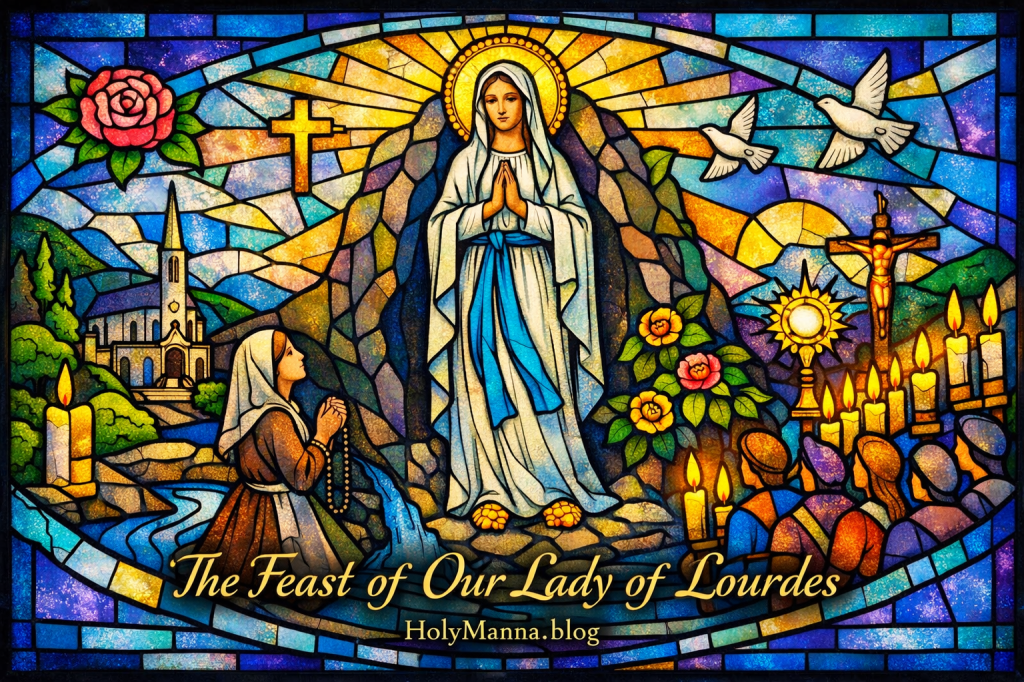
The Grotto Where Mercy Heals
The Feast of Our Lady of Lourdes, celebrated on February 11, remembers a quiet moment in France when heaven touched earth and the Church listened with patience and sobriety. This memorial does not said celebrate a new doctrine or a private spirituality for a few chosen people. It celebrates a Marian title that pulls Catholic hearts back to the center of the Gospel: prayer, conversion, penance, and steady trust in Jesus Christ.
Our Lady of Lourdes is especially beloved because it shows Mary acting like a real mother. A good mother does not flatter her children into comfort, and she does not lie to keep the peace. She tells the truth, calls her children home, and stays close when life hurts. Lourdes carries that tone and that strength. It speaks to sinners without despair, and it speaks to the sick without pity or embarrassment. It also reminds the faithful that grace is not an idea and the sacraments are not religious decorations. Christ heals, strengthens, and sanctifies His people through the Church in ways that are ordinary and supernatural at the same time.
This feast sits naturally beside the Church’s prayer for the sick, because Catholics do not treat suffering like it is meaningless. The Cross is not an accident in Christianity. Lourdes became a worldwide sign that the sick and the weak are not pushed to the sidelines in the Church, because they are not pushed to the sidelines in the heart of Christ. This is why the Church’s yearly remembrance of Lourdes often feels like an examination of conscience for how believers treat those who suffer.
Bernadette and the Place Nobody Wanted
In 1858, Lourdes was not a famous destination. It was a small town in the foothills of the Pyrenees, and the grotto of Massabielle was not treated like sacred ground. It was rocky, damp, and ignored, the kind of place people passed by without a second thought. That detail matters because God often chooses settings that force humility. Lourdes did not begin with candles and choirs. It began in the cold and ordinary rhythm of poverty.
The visionary was Bernadette Soubirous, a fourteen year old girl from a struggling family. She was poor, physically fragile, and socially insignificant, which is part of why Lourdes still hits so hard today. God chose someone who could not easily benefit from attention or manipulate the story for social gain. Bernadette’s simplicity was not weakness. It was a kind of strength that kept her steady when pressure came from every direction.
On February 11, 1858, Bernadette went out with others to gather firewood. Near the grotto, she experienced something that stopped her in her tracks. She saw a Lady dressed in white, with a blue sash, and golden roses on her feet. Bernadette responded the way a Catholic child would respond when startled by something holy. She reached for prayer and began the Rosary. The Lady joined her silently, calm and gentle, and that quiet beginning set the tone for everything that followed.
From the start, the story was not treated like a fairy tale. Bernadette faced questions from family, neighbors, local officials, and Church authorities. The Church’s caution is part of the Lourdes story, because the Church tests claims carefully and refuses to build devotion on wishful thinking. Lourdes grew through a process of investigation and discernment, not through emotional hype, and that careful approach is one reason the devotion remains so solid.
Eighteen Encounters and One Clear Message
Bernadette reported eighteen apparitions between February and July of 1858. These encounters were not filled with complicated riddles or elite secrets. The message was strikingly direct, and it carried a rhythm that still shapes the pilgrimage today. Mary called for prayer, especially prayer for sinners, and she insisted on penance with words that became unforgettable: “Penance! Penance! Penance! Pray to God for sinners.” Catholics should hear that in the voice of a mother trying to rescue her children, not in the voice of a judge trying to crush them.
Mary also gave Bernadette a promise that sounds hard until it is heard with eternity in mind: “I do not promise to make you happy in this world, but in the next.” That line is not meant to make anyone bitter. It is meant to keep the soul awake. The goal is heaven. Comfort is not the final standard. God’s love is not proven by an easy life. God’s love is proven by the Cross and the Resurrection, and the path to joy runs through fidelity.
One of the most dramatic moments came when Mary told Bernadette to go drink and wash at a place that looked like mud. Bernadette obeyed, scraped at the ground, and a spring began to flow. This scene explains how Lourdes works. The sign required humility, and it required obedience. It looked foolish before it looked holy, and that is often how grace begins in a human life. The spring became a lasting sign, and it drew the suffering and the hopeful in ways nobody could have predicted.
Mary also insisted that the message be brought to the priests, and she asked that a chapel be built and that people come in procession. That detail keeps Lourdes firmly Catholic. Mary does not build private religions or do it yourself spirituality. She gathers her children into the Church, into worship, into public prayer, and into a sacramental life centered on Jesus Christ.
There were also signs around Bernadette that drew attention, including moments during ecstasy when observers claimed unusual calm and even physical phenomena. These stories should never be treated like entertainment. In the Catholic mind, signs exist to point beyond themselves. Lourdes does not ask anyone to chase experiences. Lourdes asks for conversion.
Mud, Water, and the Mystery of Healing
Lourdes became associated with healing almost immediately, but the Church has always insisted on a careful way of thinking about healings. Lourdes water is not magic and it is not a sacrament. Catholics should not treat it like a religious shortcut. The most Catholic way to understand the spring is as a sign that points to deeper realities: purification, renewal, and God’s freedom to heal in the way that best serves salvation.
Many have reported physical healings at Lourdes, and the Church has approached those claims with seriousness rather than excitement. This is why Lourdes developed a rigorous process of medical documentation and review. The Church does not declare miracles lightly, and it does not use miracles as propaganda. Claims are examined carefully, and only a small number are officially recognized after strong scrutiny. That caution is not a lack of faith. It is respect for truth and protection for the faithful.
Even when a physical cure does not occur, Lourdes often produces a kind of healing that is harder to measure and easier to ignore. Many pilgrims speak of conversions, reconciliations, restored faith, and the grace to suffer with peace. Those are not consolation prizes. In Catholic teaching, the body matters, but the soul is made for eternity. Lourdes insists that mercy reaches both, and it reminds the faithful that the sick are not problems to manage. They are persons to love.
If the story of the spring teaches anything, it teaches that grace often begins where pride feels embarrassed. The mud is where the water starts. The humble act is where the miracle begins, and that lesson applies to the interior life just as much as it applies to the body.
“I Am the Immaculate Conception”
The most theologically important line of Lourdes came when the Lady gave her name. She said, “I am the Immaculate Conception.” That title is not sentimental poetry. It is Catholic doctrine spoken in a way that made the whole world pay attention. It points directly to the Church’s teaching that Mary was preserved from original sin by a singular grace, in view of the merits of Jesus Christ.
The Catechism explains that Mary is “full of grace” and that this fullness is entirely God’s gift, preparing her to be the Mother of the Savior, a sign of what grace can do in a human life and a promise of what God desires to do in His people (CCC 490-492). Lourdes does not replace the dogma. It points back to it with a maternal urgency that ordinary people can understand.
Lourdes also highlights the Church’s teaching about private revelation. The Church teaches that public Revelation is complete in Jesus Christ, and that later private revelations do not improve or complete what God has definitively revealed. They can help people live it more faithfully in a particular time and place (CCC 67). Lourdes fits that perfectly. Its message does not compete with Scripture. It pushes believers back to Scripture and back to sacramental life.
The emphasis on penance also connects directly to Catholic teaching on conversion. True penance is not an emotional collapse or a self punishment routine. It is a real turning back to God that expresses itself in prayer, repentance, confession, and concrete acts of reparation and mercy (CCC 1430-1433). Lourdes is a school of that conversion, spoken in the voice of a mother.
The Heartbeat of Lourdes
Lourdes is not a place where Catholics go to be entertained. It is a place where Catholics go to be converted, and the pilgrimage rhythm itself teaches the faith. Prayer is central, especially the Rosary, which is not treated like a lucky charm. It is treated like what it truly is: a contemplative prayer that keeps the mind close to the mysteries of Christ with Mary as guide.
Processions are another defining feature. Mary asked that people come in procession, and Lourdes responded with public acts of prayer that are both beautiful and demanding. Candlelight processions express hope in the dark, and Eucharistic processions place Jesus at the center, because the Church knows that Marian devotion that forgets the Eucharist is no longer Marian in a Catholic sense.
The care of the sick is one of Lourdes’ most powerful devotions. The sick are welcomed, accompanied, and served by volunteers with remarkable tenderness. This is not just humanitarian kindness. It is Catholic love rooted in the conviction that the suffering member of the Body of Christ is not a burden. The sick reveal Christ, and serving them is a way of loving Jesus in the flesh.
Lourdes also became home to great basilicas and sacred spaces built to welcome pilgrims and honor Mary’s request for a chapel. The Church received the grace and built a stable home for it, so that the faithful could pray, confess, worship, and return to their daily lives strengthened.
A Feast That Changed Catholic Memory
The impact of Lourdes spread far beyond France, and it shaped Catholic culture in a way that is still visible. Replicas of the Lourdes grotto appeared at parishes, schools, convents, and retreat houses across the world. That is not an obsession with geography. It is a Catholic instinct to remember grace with tangible signs and to bring holy memory into ordinary places.
The feast also shaped how Catholics speak about illness and dignity. Lourdes became a public reminder that the sick belong at the center of Christian love, not because suffering is pleasant, but because Christ is present. This is one reason February 11 also became associated with the Church’s prayer for those who suffer, including the World Day of the Sick established by Pope Saint John Paul II. The date itself became a yearly moment to ask whether believers treat weakness as an inconvenience or as an invitation to love.
Local celebrations of the feast often include Marian hymns, Rosary gatherings, candlelight processions, and parish prayers for healing. In many places, the day becomes a moment to teach Catholics what the Sacrament of the Anointing of the Sick truly is and who it is for, so that devotion stays rooted in the sacraments rather than drifting into vague spiritual comfort. This feast keeps Catholics grounded in the truth that mercy is not denial. Mercy is God stepping into the mess to save.
How to Live Lourdes Without Leaving Home
The central lesson of Lourdes is not that every problem will disappear. The central lesson is that Jesus Christ is worth trusting, even when life hurts, and that Mary is a mother who teaches believers how to return to Him. Lourdes begins with a poor child praying the Rosary in the cold. It continues with a call to penance that refuses to flatter sin. It includes a spring that begins in mud and becomes a sign of cleansing. It culminates in a title that proclaims grace: “I am the Immaculate Conception.” Each element can be lived anywhere.
Prayer can become steady again, not because feelings cooperate, but because God deserves fidelity. Confession can become normal again, not because anyone becomes perfect, but because mercy is real and the soul needs cleansing. Penance can become hopeful again, not because suffering is good, but because love requires sacrifice. Care for the sick can become personal again, not because it is convenient, but because Christ is present in the suffering.
Where is conversion being delayed because comfort feels safer than truth? What would change if prayer became as non negotiable as eating? How might the Lord be asking for a small act of penance that opens the heart to grace instead of closing it?
Engage with Us!
Share thoughts and reflections in the comments below, especially any personal experiences with Lourdes devotion, praying for the sick, or learning to trust God in suffering.
- What part of Lourdes feels most challenging right now: prayer, penance, trusting God with suffering, or returning to the sacraments with honesty?
- How can devotion to Our Lady of Lourdes help a Catholic see the sick differently, not as interruptions but as neighbors to be loved like Christ loves?
- What is one concrete step that can be taken this week to answer Lourdes’ call to conversion, especially through confession, the Rosary, or an act of mercy?
Keep walking forward in faith. Keep turning back to Jesus when the heart drifts. Keep clinging to the sacraments when life gets heavy. Under the guidance of the Blessed Mother, growth in holiness is not only possible, it is exactly what God desires.
Our Lady of Lourdes, pray for us!
Follow us on YouTube, Instagram and Facebook for more insights and reflections on living a faith-filled life.

 Holy Manna!
Leave a comment