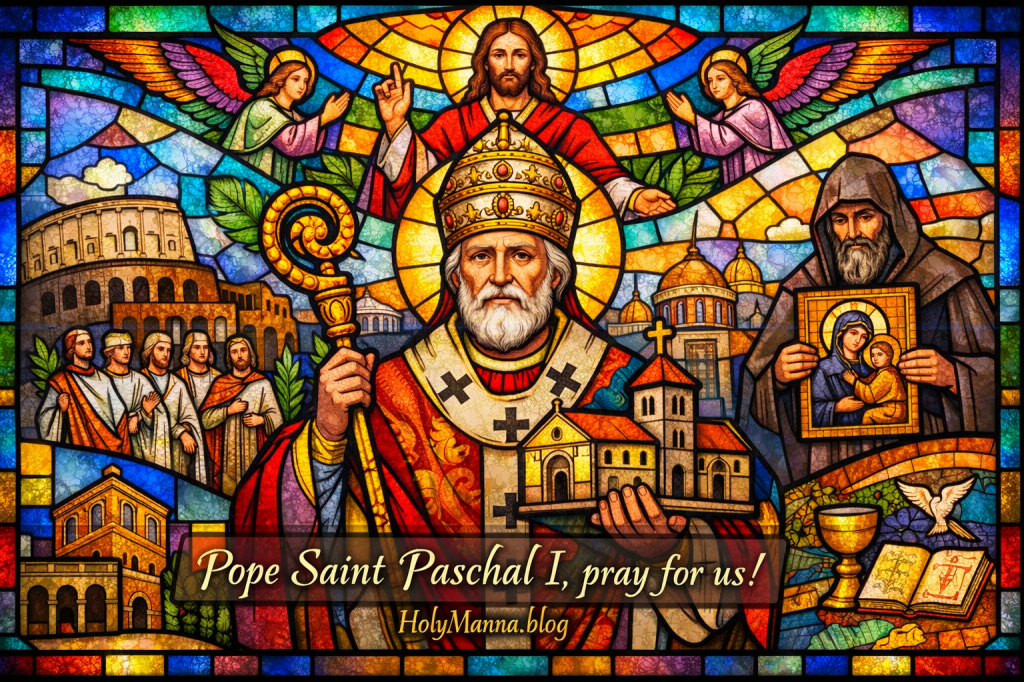
The Pope Who Gathered the Martyrs and Lit Up Rome
Pope Saint Paschal I lived in a century when the Church had to fight for the basics of Christian truth. People were arguing about whether sacred images should exist at all, whether the Church could keep her freedom, and whether the memory of the martyrs would be protected or forgotten. Paschal did not respond with panic, and he did not respond with compromise. He responded like a Catholic shepherd who believed the faith is not an idea but a living reality that must be guarded and handed on.
His sanctity is most visible in two things that still endure. He defended the Catholic tradition of honoring holy images in a time when that tradition was threatened, and he gathered the relics of martyrs and placed them where the faithful could venerate them safely near the altars where the Eucharist is offered. That combination tells the whole story. Paschal knew that the Church is built on Christ, and that she is strengthened when the faithful can see the faith, touch the faith, and pray the faith through reverent worship, holy places, and the communion of saints. The Catechism teaches that devotion to the saints strengthens the Church’s unity in the Spirit and draws the faithful closer to Christ (CCC 956).
Formed in Rome’s Prayer
Paschal was born in Rome and formed close to the heart of the Church’s daily life. Catholic memory places his education and formation around the Lateran, where Sacred Scripture, liturgy, and Church discipline shaped young clerics for service. Even when sources are sparse on family details, the shape of his early life is clear. He was trained in the rhythms of prayer and responsibility, not in the chase for status. This kind of formation matters because it shows how the Church builds leaders, not by celebrity, but by fidelity to worship and truth.
Before becoming pope, he served as abbot of the monastery of Saint Stephen near Saint Peter’s, a role connected to the care of pilgrims who traveled to Rome to pray at the tombs of the apostles. He learned what it means to receive strangers as Christ, and he learned that the Church’s strength is often built through quiet acts of patience, charity, and consistency. In a world that loves headlines, this saint grew in the hidden places where the Lord forms steady souls.
When Pope Stephen IV died in January 817, Paschal was elected and consecrated quickly. In that era, speed could protect the Church from outside interference and political manipulation. The moment also shows the trust he already had among the clergy and the Roman people. He was not a risky experiment. He was a known servant of the Church, shaped by prayer and proven in responsibility.
Defending the Incarnation With Sacred Images
Paschal’s papacy unfolded during renewed turmoil over Iconoclasm in the Byzantine world. Iconoclasm was not just a debate about art, because it touched the heart of the Christian mystery. The Church’s defense of sacred images rests on the truth that the Son of God truly took flesh. Because Christ entered the visible world, matter can serve worship without becoming an idol. The Catechism explains that Christian veneration of holy images is not contrary to the First Commandment because the honor given to an image passes to the one represented (CCC 2131 to 2132).
In practical terms, Paschal supported orthodox defenders of sacred images and extended protection to monks who suffered for remaining faithful to the Church’s tradition. Many of these monks carried the discipline of monastic prayer and the richness of Eastern Christian devotion. Rome did not simply tolerate them. Under Paschal, Rome received them as brothers, which is what the Church does when she is acting like herself.
This was not only a theological position. It was a pastoral one. When the faithful are confused, sacred images can teach the faith without a single lecture. They can lift the heart to Christ, remind the soul of the saints, and keep devotion grounded in the mysteries of the Lord’s life. Paschal defended this not as a hobby, but as part of Catholic life that strengthens ordinary believers.
Building Churches That Preach
Paschal renewed the city by rebuilding major churches, especially Santa Prassede, Santa Cecilia in Trastevere, and Santa Maria in Domnica. These were not vanity projects. They were catechesis in stone and gold, built to serve the Mass, strengthen devotion, and keep the Church’s memory alive. In the mosaics connected to his building program, Paschal is sometimes depicted offering a model of a church, which is a visual confession that a shepherd’s job is to build up God’s house, not his own name.
Some of these mosaics portray Paschal with a square halo, a convention used in some periods to indicate a living person portrayed as a donor. That detail becomes its own lesson. His life was not about worshiping himself or winning arguments. It was about handing on the faith and shaping a Rome where the faithful could worship with reverence and clarity.
This love for beauty fits a deeply Catholic instinct. Beauty is not decoration for its own sake. Beauty can form the heart. It can teach the mind. It can make the Gospel feel real. When Paschal filled churches with luminous mosaics, he was preaching Christ in a language that even the illiterate could understand.
The Pope of the Martyrs
Paschal is often remembered for translating relics of martyrs into the city. In that era, the catacombs outside the walls could be vulnerable, and protecting the relics was both practical and spiritual. He brought the saints close to the faithful, placing their relics where the Church gathered for Mass and prayer. This was not superstition. It was a sign of the Church’s conviction that the saints are alive in Christ, and that the faithful on earth remain united to them.
The Catechism explicitly names the veneration of relics and pilgrimages as part of the Church’s living tradition of popular piety, when ordered properly toward Christ and the sacraments (CCC 1674). The saints are not mascots. They are witnesses. They remind Catholics that holiness is possible, and their intercession remains real. The Catechism teaches that the saints do not cease to intercede for the faithful, and that their care strengthens the Church’s unity in the Spirit (CCC 956).
In Santa Prassede, Paschal’s devotion to the martyrs became almost overwhelming in its scale. Tradition associates the basilica with a vast gathering of relics from many martyrs, turning the church into a kind of visible proclamation that Rome is not built only on emperors and politics. Rome is built on witnesses who loved Christ more than life.
A Troubled Rome and a Steady Shepherd
Paschal’s papacy was not peaceful, and his story proves that holiness does not always look tidy from the outside. Rome could be brutal, factions could turn deadly, and pressure from powerful rulers was always present. Paschal had to manage relationships with the Carolingian world, including Emperor Louis the Pious, and later he crowned Lothair as emperor in Rome. These events show a pope trying to preserve the Church’s freedom while navigating a world where rulers often wanted spiritual authority on their own terms.
One of the most painful episodes connected to his reign involved the killing of two prominent officials, Theodore and Leo, who were blinded and murdered by men associated with the papal household. Paschal was accused, and historical accounts describe him defending himself with a solemn oath and enduring the fallout of scandal and investigation. The existence of that controversy matters because it prevents sentimental readings of history. This was a hard century. The Church carried burdens. God still brought lasting fruit out of fidelity.
Paschal did not die a martyr, but he did carry a kind of martyrdom of endurance. He bore the strain of doctrinal conflict, political pressure, and scandal, and he did not abandon the Church’s worship or tradition. That kind of perseverance can be heroic, especially when staying faithful would have been easier to replace with a quieter compromise.
A Legacy Still Visible Today
After Paschal’s death in 824, his legacy did not fade into footnotes. His tomb and memory remained closely tied to Santa Prassede, the church that became a jewel box of Roman Christianity because of his rebuilding and decoration. Pilgrims still walk into that basilica and immediately see what Paschal believed. They see Christ enthroned in glory. They see saints surrounding Him. They see the Church not as a political movement but as a supernatural family gathered around the Lord.
One of the most moving parts of his legacy is the Chapel of Saint Zeno at Santa Prassede, associated with his mother, Theodora. The chapel is famous for its luminous mosaics and for how it feels like a small glimpse of heaven tucked inside a Roman church. Even the memory of his mother is preserved in the language of faith and devotion, reflecting the Catholic belief that family holiness matters and that praying for the dead is part of Christian love. The Catechism teaches that the communion of saints unites the faithful on earth with those being purified and with the saints in heaven, and that this communion is a real spiritual exchange in Christ (CCC 946 to 962).
Miracles after Paschal’s death are not preserved as a popular catalog attached to his name, but Catholic life does not measure sanctity only by miracle lists. The ongoing veneration of the martyrs he gathered, the pilgrimages that still draw the faithful to those churches, and the way sacred art continues to form hearts are themselves a kind of quiet testimony. The saints remain close because Christ remains close.
Living the Paschal Spirit
Saint Paschal I offers a message that lands hard in modern life. The world pushes faith toward privacy, minimalism, and embarrassment. Paschal shows a faith that is visible, embodied, and confident without being arrogant. He shows love for sacred beauty that is not aesthetic snobbery, but a form of evangelization. He shows devotion to the saints that is not nostalgic, but strong, real, and anchored in Christ.
A practical way to imitate Paschal is to recover reverence and consistency. Sunday Mass cannot be treated like an optional hobby. Prayer cannot be treated like a spare-time activity. Sacred images cannot be treated like decor. A home can become a place where holiness feels normal, where prayer is natural, and where children learn that saints are real people who loved Christ to the end.
This saint also teaches realism. Church history includes scandal, conflict, and confusion, even near leadership. That should never become an excuse to leave. It should become a reason to cling more tightly to Jesus Christ, to His sacraments, and to the holiness that the Church safeguards even in messy times. The Church is holy because Christ is holy, and He does not abandon His Bride. The Catechism teaches that Sacred Scripture must be read within the living Tradition of the Church and with attention to the unity of the whole plan of God, which keeps faith stable when emotions and headlines try to shake it (CCC 112 to 114).
How is the Lord asking for a stronger, more visible faith that does not compromise under pressure, but also refuses bitterness and fear? This is where Paschal’s witness becomes personal. He shows that the Church’s answer is not panic. The Church’s answer is worship, fidelity, beauty ordered toward God, and love for the saints who remind Catholics what courage looks like.
Engage with Us!
Share thoughts and reflections in the comments below, because the saints are not museum pieces. They are family.
- Where has the modern world pressured faith to compromise, and what would it look like to hold the line with charity and courage like Saint Paschal I?
- How can sacred beauty in a home, a parish, or a daily routine become a real help to prayer rather than a distraction?
- What is one concrete way to honor the communion of saints this week, through prayer, learning, or a visit to a church or shrine?
- When Church history includes messy political conflict, how can trust remain in Christ’s holiness rather than in the perfection of any era?
Keep walking forward in faith. Keep the heart close to Jesus Christ, and do everything with the love and mercy He taught, because that is how saints are made.
Pope Saint Paschal I, pray for us!
Follow us on YouTube, Instagram and Facebook for more insights and reflections on living a faith-filled life.

 Holy Manna!
Leave a comment