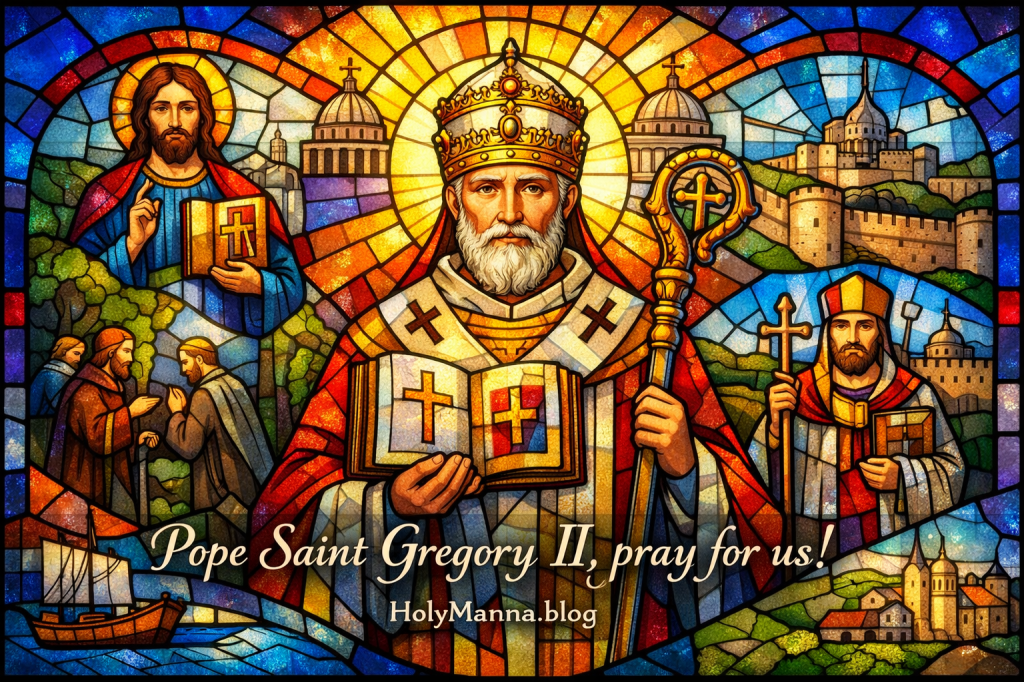
The Pope Who Would Not Let Us Forget the Face of Christ
Pope Saint Gregory II took up the burden of the papacy when Rome and the wider Church were living through a storm. Italy was threatened by conflict, alliances shifted without warning, and the Eastern emperor tried to reach into the Church’s worship as if doctrine were a political tool. Gregory is revered because he held the line with steady Catholic courage. He defended sacred images when iconoclasm began to spread, he protected the city of Rome with practical leadership, and he helped ignite missionary work that would transform the future of Europe.
His sanctity shows up in the kind of strength that does not need to perform for attention. He led like a father who stays calm when the house is shaking, because he knows panic never saves anyone. He also proves that holiness is not only found in solitude and silence. Holiness can be found in governing well, speaking clearly, and refusing to let the world redefine how the Church worships Jesus Christ.
A Roman Childhood Formed by Prayer
Gregory was born in Rome to Marcellus and Honesta, and he grew up in a city that still lived close to the memory of the Apostles. His early formation included the schola cantorum, the Roman school where sacred singing and liturgical discipline were cultivated for the Church’s worship. That detail matters because it explains why he would later defend worship so fiercely. A man trained to pray the faith with his whole voice tends to recognize immediately when someone is trying to silence the Church’s song.
Before he became pope, he served in important roles that required both competence and charity. He was made a subdeacon and served as sacellarius, an office tied to the Church’s resources and care for the poor. Catholic tradition also remembers him as being entrusted with the papal library, highlighting him as an early example of a Roman leader who loved the Church’s memory and learning while also serving the Church’s daily needs.
His life included serious experience beyond Rome as well. He accompanied Pope Constantine to Constantinople to face tensions surrounding the Quinisext Council and the pressure of an emperor who expected the Church to bend. Gregory’s calm intelligence in that setting helped prepare him for what would later become the defining fight of his pontificate. It also taught him a lesson every Catholic needs. Respect for civil authority is real, but obedience to Christ is absolute.
Building Walls and Strengthening Souls
When Gregory was elected pope in 715, he took immediate steps to protect the people of Rome. He ordered repairs to the city walls, because danger was not theoretical. The Lombards had threatened the region, and the Mediterranean world was changing in ways that made many Christians fear raids and instability. His response was not sentimental. He combined prayer with action, which is exactly what Catholic life should look like when families and communities are under pressure.
Rome also suffered severe hardship during his pontificate, including devastating flooding from the Tiber. Even with those setbacks, Gregory continued governing steadily, refusing to let crisis turn into paralysis. He welcomed pilgrims to Rome and strengthened the bonds of faith that connected distant Christian communities to the Apostolic See. Anglo Saxon pilgrims came in significant numbers, including Abbot Ceolfrid, who brought the famous biblical manuscript known as the Codex Amiatinus. King Ina also helped establish the “Schola Anglorum,” an English community in Rome that served pilgrims and fostered unity. These stories show that Gregory’s Rome was not isolated. It was a living center of Catholic identity that received the faithful and sent them back out strengthened.
Gregory also supported monastic life because he understood its importance for the Church’s renewal. After the death of his mother, he turned his family home into a monastery. He also helped found and restore monastic communities, including supporting the restoration of Monte Cassino. This mattered because monasteries formed saints, preserved learning, and kept the light of Christian culture burning when political structures were crumbling.
Sending Missionaries with Peter’s Authority
Gregory II was not only a defender of Rome. He was also a missionary pope with a wide horizon. He supported efforts toward the conversion of Bavaria and sent preachers into that region, including support connected to Saint Corbinian. Yet the missionary partnership that defined his legacy was his relationship with Saint Boniface, the great apostle to the German peoples.
Gregory commissioned Boniface to preach among peoples still trapped in pagan belief and confusion. He did not treat this as a casual project or personal adventure. He treated it as the Church’s mission, carried out in communion with Rome and anchored in apostolic authority. In his commission to Boniface, Gregory sent him forth “by the irrefragable authority of Blessed Peter”, and urged him “go forth and preach the truths of both Testaments.” Those words are striking because they show how Catholic mission is meant to work. It is rooted in Scripture, it is grounded in the unity of the Church, and it is strengthened by the authority Christ entrusted to Peter.
This missionary spirit aligns with The Catechism’s teaching that the Church is missionary by her very nature and that she is sent by Christ to bring the Gospel to all nations. This also connects to the Catholic understanding of the papacy as a visible source of unity, as explained in CCC 880 to 882. Gregory did not cling to power for its own sake. He used his authority to strengthen the faith and to send the Gospel outward.
Standing Firm When the Emperor Attacked Sacred Images
Gregory II is remembered most for his resistance to the iconoclasm promoted by Emperor Leo III. In 727, Leo began issuing decrees against sacred images and tried to impose his will over the Church’s worship. Gregory resisted because the issue was never merely political. It was Christological. Christianity proclaims the Incarnation, meaning the Son of God truly took flesh, entered history, and revealed the Father in a human face. Because Christ is truly human and truly divine, sacred images can serve as signs that lead hearts to prayer and worship.
The Church later articulated this clearly in The Catechism, teaching that Christian veneration of sacred images is rooted in the mystery of the Incarnation and is not idolatry. This is exactly the instinct Gregory defended when the empire attempted to control how Christians prayed. He also opposed illegal taxation that harmed the Church’s ability to serve the people and represented an attempt to dominate Rome from afar.
This conflict became dangerous. Catholic historical tradition reports that imperial agents plotted against Gregory’s life. Yet he endured, and his survival became a sign of providence. At the same time, he refused to let righteous anger turn into reckless rebellion. He resisted imperial interference in matters of faith while maintaining a measured approach to civil order, showing a rare combination of courage and prudence. That balance is needed today, because Catholics are often tempted either to compromise too quickly or to become needlessly hostile. Gregory shows a better path. He kept the faith intact without burning down what could still be preserved.
He also helped address Church tensions closer to home by working toward peace in the long dispute connected to the ancient See of Aquileia and related patriarchal claims in northern Italy. That effort reflects another form of holiness: protecting unity when division feels convenient. His papacy was marked by complicated diplomacy with Lombard leaders and the realities of Byzantine weakness in Italy. Yet again and again, Gregory used influence, negotiation, and firm Catholic conviction to keep the Church from being swallowed by either violence or compromise.
A Legacy That Grew After His Death
Gregory II died in February 731 and was buried at Saint Peter’s. The Church commemorates him in the Roman Martyrology on February 13, remembering him especially for opposing the impiety of Leo and for sending Saint Boniface to preach the Gospel in Germany. His story does not feature a widely preserved catalog of dramatic healing miracles in the standard Catholic summaries. His enduring signs are the fruits that remained.
Those fruits are enormous. The mission he strengthened helped shape the Christian future of German speaking Europe for centuries. The monastic life he supported helped preserve learning and prayer across unstable generations. The doctrine he defended helped keep Christian worship from becoming cold and abstract, reminding the faithful that God truly entered the material world in Jesus Christ.
There is also a quiet Catholic beauty in his burial at Saint Peter’s. His life was spent acting with the authority entrusted to Peter, and his body rests near Peter’s tomb, as if history itself is making a simple point. Gregory lived and died in communion with the apostolic faith, and that communion outlasted empires.
Courage That Protects
Saint Gregory II teaches that holiness is often a long obedience in the same direction. It is easy to admire courage from a distance, but Gregory’s kind of courage had to show up every day in difficult decisions, tense negotiations, and real danger. His defense of sacred images invites Catholics to deepen prayer by remembering that the faith is not a private philosophy. The faith is a lived encounter with the living Christ. Sacred images in a home are not decoration when they lead the family into prayer and remind the heart that Jesus truly took flesh and walked among men.
Gregory’s missionary zeal challenges comfortable Catholicism. The Gospel is meant to be shared. Sometimes that sharing looks like supporting missionaries and priests. Sometimes it looks like a calm conversation with someone who has drifted from the Church. The Church’s mission is not about winning arguments. It is about offering Christ.
His life also encourages prayer for the pope and for bishops, especially in seasons when leadership is tested and criticized from every side. The Catechism teaches that the pope is a visible source and foundation of unity, and Gregory shows what that looks like when pressures are intense. A Catholic does not need to panic when the culture shakes. A Catholic needs to stay faithful, pray, and act with charity and truth.
Engage With Us!
Share your thoughts and reflections in the comments below. Conversations like this help the whole community grow in faith and courage.
- Where is the Lord asking for stronger conviction right now, especially when the culture pressures people to stay quiet about the faith?
- What place do sacred images have in daily life, and how could they become more intentional reminders to pray and to live like Christ is truly present?
- Who is one person that could benefit from a simple, respectful invitation back to the Church, and what would a wise next step look like this week?
May Saint Gregory II teach every heart to be steady when the world shakes. May his example inspire a life of faith that defends what is holy, shares the Gospel with confidence, and does everything with the love and mercy Jesus taught us.
Pope Saint Gregory II, pray for us!
Follow us on YouTube, Instagram and Facebook for more insights and reflections on living a faith-filled life.

 Holy Manna!
Leave a comment