Wednesday of the Fifth Week in Ordinary Time – Lectionary: 331
When the Heart Listens, the World Notices
Some days in the Church’s calendar feel like a quiet mirror held up to the soul. The readings for today invite an honest look at what is happening beneath the surface, not just what appears on the outside. They speak to anyone who has ever wondered why some faith feels alive and convincing, while other faith feels like a performance that never reaches the heart. The central theme running through every passage is simple and demanding: God wants a listening heart, because a listening heart becomes a purified heart, and a purified heart becomes a sign that draws others to the Lord.
In the world of 1 Kings, Solomon sits at the height of Israel’s golden age, when the Temple has been built and the nations are watching. The Queen of Sheba arrives from far away not merely to admire a successful king, but to test whether the wisdom she has heard about is real. Her visit reflects an ancient reality: rulers and kingdoms judged one another not only by wealth and power, but by order, justice, worship, and the kind of wisdom that could steady a nation. When she witnesses Solomon’s wisdom and the beauty of worship offered in the house of the Lord, her amazement becomes praise of Israel’s God, because true wisdom is never meant to terminate in the self. It is meant to reveal the Lord, who establishes judgment and justice and who blesses His people with enduring love.
The Responsorial Psalm quietly explains what makes that kind of life possible. Wisdom does not float above a person like a halo. The Psalm describes righteousness as something rooted within, because God’s teaching is carried in the heart, and that interior anchor shapes speech, choices, and stability in distress. The righteous person is not presented as someone who never struggles, but as someone who takes refuge in the Lord and is rescued by Him. In other words, the outward fruit comes from an inward commitment.
Then the Holy Gospel cuts straight to the root. In The Gospel of Mark, Jesus refuses to let religion stay on the level of appearances and rituals detached from conversion. He teaches that defilement is not mainly a matter of what comes from outside, because food passes through the body. Defilement is what flows from within, from the heart, where desires, thoughts, and consent are formed. This is why the Church insists that holiness is not cosmetic. It is a work of grace that reforms the inner person, so that what comes out in words and deeds matches what God is planting within.
Taken together, today’s readings reveal a single path. The Lord forms a heart that listens, steadies that heart in righteousness, and purifies it so that life becomes coherent and credible. This is the kind of faith that makes strangers take a long journey just to see whether the rumor is true. What would change if the week ahead was lived as a choice to guard the heart, listen deeply, and let God’s wisdom become visible through a life that is ordered toward worship, justice, and purity?
First Reading – 1 Kings 10:1-10
The Queen Who Would Not Settle for Rumors
Israel is living through a high point in its history. The Temple has been built, the kingdom is stable, and Solomon’s reputation has traveled far beyond Jerusalem. In the ancient world, kings were judged not only by military strength, but by wisdom, justice, order, and the seriousness of their worship. That is why the Queen of Sheba does not send a polite letter or a small gift. She comes in person, with the wealth of long-distance trade and the boldness of someone who refuses to live on secondhand stories. She arrives to test Solomon with “subtle questions,” and what she finds is more than a clever ruler. She finds a kingdom whose visible beauty points beyond itself to the Lord. This fits today’s theme with force and clarity. A listening heart becomes a wise heart, and a wise heart becomes a witness that can draw even outsiders toward God.
1 Kings 10:1-10 – New American Bible (Revised Edition)
Solomon’s Listening Heart: The Queen of Sheba. 1 The queen of Sheba, having heard a report of Solomon’s fame, came to test him with subtle questions. 2 She arrived in Jerusalem with a very numerous retinue, and with camels bearing spices, a large amount of gold, and precious stones. She came to Solomon and spoke to him about everything that she had on her mind. 3 King Solomon explained everything she asked about, and there was nothing so obscure that the king could not explain it to her. 4 When the queen of Sheba witnessed Solomon’s great wisdom, the house he had built, 5 the food at his table, the seating of his ministers, the attendance and dress of his waiters, his servers, and the burnt offerings he offered in the house of the Lord, it took her breath away. 6 “The report I heard in my country about your deeds and your wisdom is true,” she told the king. 7 “I did not believe the report until I came and saw with my own eyes that not even the half had been told me. Your wisdom and prosperity surpass the report I heard. 8 Happy are your servants, happy these ministers of yours, who stand before you always and listen to your wisdom. 9 Blessed be the Lord, your God, who has been pleased to place you on the throne of Israel. In his enduring love for Israel, the Lord has made you king to carry out judgment and justice.” 10 Then she gave the king one hundred and twenty gold talents, a very large quantity of spices, and precious stones. Never again did anyone bring such an abundance of spices as the queen of Sheba gave to King Solomon.
Detailed Exegesis
Verse 1: “The queen of Sheba, having heard a report of Solomon’s fame, came to test him with subtle questions.”
The queen represents the serious seeker, the kind of person who hears about God’s work and insists on seeing whether it is real. Her “subtle questions” are not petty traps. They are the hard, probing questions that reveal whether wisdom is deep or merely polished. In Solomon’s story, wisdom is never presented as a private talent. It is a gift meant to serve the covenant people and to reveal the Lord’s glory among the nations.
Verse 2: “She arrived in Jerusalem with a very numerous retinue, and with camels bearing spices, a large amount of gold, and precious stones. She came to Solomon and spoke to him about everything that she had on her mind.”
This is diplomacy, but it is also pilgrimage. Spices, gold, and precious stones were the currency of royal honor and the fruit of major trade routes. Yet the most valuable thing she brings is her honesty. She speaks “about everything” on her mind. That phrase matters because it shows that authentic seeking does not hide behind vague spirituality. It brings real questions into the light.
Verse 3: “King Solomon explained everything she asked about, and there was nothing so obscure that the king could not explain it to her.”
Solomon’s wisdom appears here as clarity. It is not the kind of intelligence that wins arguments but leaves the soul empty. It is wisdom that can illuminate what feels obscure. In the biblical tradition, that kind of clarity is tied to listening. Earlier in Solomon’s life, he begged for an understanding heart. Now the fruit is visible. His answers are not evasive, and they are not shallow.
Verse 4: “When the queen of Sheba witnessed Solomon’s great wisdom, the house he had built,”
She does not evaluate Solomon by a single conversation. She observes his whole life and the world he has built. Wisdom is not only what someone says. It is what someone orders, what someone prioritizes, and what someone builds over time.
Verse 5: “the food at his table, the seating of his ministers, the attendance and dress of his waiters, his servers, and the burnt offerings he offered in the house of the Lord, it took her breath away.”
The queen is struck by coherence. Everything is ordered, and the climax is worship. The “burnt offerings” in the Lord’s house show that Solomon’s kingdom is not centered on Solomon. The best part of the spectacle is not luxury but liturgy, the public acknowledgment that Israel’s life belongs to God.
Verse 6: “The report I heard in my country about your deeds and your wisdom is true,” she told the king.
Her first confession is straightforward. The rumors were not exaggeration. Yet what follows shows that the truth is even bigger than she expected.
Verse 7: “I did not believe the report until I came and saw with my own eyes that not even the half had been told me. Your wisdom and prosperity surpass the report I heard.”
This is the moment when secondhand faith gives way to personal encounter. The queen’s language is almost like the experience of someone who finally encounters the living God after years of hearing about Him. The reality surpasses the rumor. The Church recognizes this pattern again and again. God can be introduced by testimony, but He is known by encounter.
Verse 8: “Happy are your servants, happy these ministers of yours, who stand before you always and listen to your wisdom.”
Happiness is attached to listening. That is not modern self-help talk. It is a biblical claim that joy grows where truth is received. The ministers are “happy” not because they are powerful, but because they are close to wisdom and formed by it. A kingdom becomes stable when its leaders are listeners before they are talkers.
Verse 9: “Blessed be the Lord, your God, who has been pleased to place you on the throne of Israel. In his enduring love for Israel, the Lord has made you king to carry out judgment and justice.”
This is the heart of the reading. The queen blesses the Lord, not Solomon. She names God’s “enduring love” and connects kingship to “judgment and justice.” In other words, authority is for service, and wisdom is for righteousness. The queen recognizes that the throne is not a trophy. It is a vocation under God.
Verse 10: “Then she gave the king one hundred and twenty gold talents, a very large quantity of spices, and precious stones. Never again did anyone bring such an abundance of spices as the queen of Sheba gave to King Solomon.”
Her gifts are a royal response to what she has seen. Yet the deepest gift is her praise of the Lord. Wealth can be offered without conversion, but here the offering comes after wonder, recognition, and blessing. This is what happens when wisdom is real. It does not merely impress. It moves the heart toward reverence.
Teachings
The queen’s journey makes sense because the Church teaches that the human heart is built for God and will keep searching until it finds Him. The Catechism states this plainly in CCC 27: “The desire for God is written in the human heart, because man is created by God and for God; and God never ceases to draw man to himself. Only in God will he find the truth and happiness he never stops searching for.” That is the Queen of Sheba in motion, and it is every restless soul who refuses to settle for spiritual rumors.
This reading also highlights wisdom as a gift that comes from above, not a personality upgrade. The Catechism lists the gifts of the Holy Spirit in CCC 1831: “The seven gifts of the Holy Spirit are wisdom, understanding, counsel, fortitude, knowledge, piety, and fear of the Lord.” Solomon’s greatness is not self-made brilliance. It is the fruit of a heart taught by God, and the queen can sense the difference.
Her words about “judgment and justice” land in a world that often treats justice as a political slogan. The Church treats it as a moral virtue grounded in truth. The Catechism teaches in CCC 1807: “Justice is the moral virtue that consists in the constant and firm will to give their due to God and neighbor. Justice toward God is called the virtue of religion. Justice toward men disposes one to respect the rights of each and to establish in human relationships the harmony that promotes equity with regard to persons and to the common good.” The queen is not impressed by wealth alone. She is impressed by order directed toward worship and justice.
Saint Augustine captures the queen’s hunger with a line that has pulled countless hearts back to God. In Confessions he prays, “You have made us for yourself, O Lord, and our heart is restless until it rests in you.” The queen’s travel, questions, and wonder are a living image of that restlessness turning into worship.
Finally, this scene points forward to Christ, because the longing of the nations does not end with Solomon. Jesus later speaks of the Queen of the South as a witness against indifference, saying in The Gospel of Matthew 12:42, “She came from the ends of the earth to hear the wisdom of Solomon, and there is something greater than Solomon here.” Solomon’s wisdom is real, but it is also a signpost. The fullness of wisdom is a Person.
Reflection
The Queen of Sheba is a challenge because she refuses lazy faith. She travels, she asks, she observes, and she allows herself to be moved. Many lives stay stuck because curiosity is replaced by cynicism, and subtle questions are buried under distraction. Today’s reading suggests a better path. When questions rise up, they can be carried to the Lord with seriousness. When the heart is hungry, it can be fed with truth instead of noise. When worship is offered, it can be offered with reverence instead of routine.
A concrete step worth taking today is to practice the queen’s honesty before God. Bring “everything that is on your mind” into prayer, especially the questions that feel too complicated, too embarrassing, or too persistent. Wisdom tends to grow where truth is spoken plainly. Another step is to examine whether life is coherent in the way that amazed the queen. A home, a schedule, a table, and a way of worship can either point toward the Lord or point toward self. The queen was overwhelmed by the order that led to worship. That is a strong invitation to let daily life become intentionally ordered toward God again.
Which subtle question has been avoided because it might require change, repentance, or deeper commitment? Where has faith become secondhand, built on what others say, instead of being anchored in real encounter with Christ in prayer, Scripture, and the sacraments? If someone observed the patterns of daily life closely, would they see a heart that listens, a mouth that speaks wisely, and a life that quietly points toward the Lord?
Responsorial Psalm – Psalm 37:5-6, 30-31, 39-40
A Quiet Psalm for Loud Times
Psalm 37 comes from Israel’s wisdom tradition, the kind of prayer sung in public worship to form ordinary people in extraordinary fidelity. It was written for moments when it looks like the wicked are winning and the faithful are wasting their time. Instead of feeding anxiety, the Psalm teaches patience, trust, and moral clarity. That is why it fits today’s readings so well. The Queen of Sheba is stunned by Solomon’s ordered life and God-centered worship, because wisdom is visible when the heart listens. Jesus then goes straight for the root and teaches that the heart is where defilement begins. The Psalm stands between them like a bridge. It shows what a listening heart looks like over time. It is a life committed to the Lord, a tongue trained in truth, and steps that do not collapse when trouble comes.
Psalm 37:5-6, 30-31, 39-40 – New American Bible (Revised Edition)
5 Commit your way to the Lord;
trust in him and he will act
6 And make your righteousness shine like the dawn,
your justice like noonday.30 The mouth of the righteous utters wisdom;
his tongue speaks what is right.
31 God’s teaching is in his heart;
his steps do not falter.39 The salvation of the righteous is from the Lord,
their refuge in a time of distress.
40 The Lord helps and rescues them,
rescues and saves them from the wicked,
because they take refuge in him.
Detailed Exegesis
Verse 5: “Commit your way to the Lord; trust in him and he will act.”
The Psalm speaks in the language of a journey. A “way” is not a hobby or a mood. It is a whole direction of life, including decisions, relationships, and priorities. To “commit” that way to the Lord means placing the weight of life on God’s faithfulness instead of personal control. This is not passive resignation. It is active trust, the kind that keeps choosing obedience even when outcomes are unclear. It also explains why Solomon’s wisdom could bless others. A heart that entrusts itself to the Lord becomes capable of steady judgment.
Verse 6: “And make your righteousness shine like the dawn, your justice like noonday.”
Righteousness and justice are not described as hidden private virtues. They are described as light. Dawn begins quietly, but it keeps spreading until the whole horizon changes. That is how God works in a faithful life. He brings truth into view over time, and He vindicates what is righteous even when it is mocked. The queen in the first reading sees this kind of brightness in Solomon’s kingdom. It is a life ordered toward worship and justice, not toward ego.
Verse 30: “The mouth of the righteous utters wisdom; his tongue speaks what is right.”
This verse insists that wisdom is not merely stored inside. It eventually comes out through speech. Words reveal formation. They reveal what a person loves, what a person fears, and what a person has been feeding in secret. That is exactly why today’s Gospel matters. Jesus teaches that what comes out from within is what defiles. The Psalm shows the opposite. When the heart belongs to God, the mouth becomes a channel of wisdom rather than a fountain of poison.
Verse 31: “God’s teaching is in his heart; his steps do not falter.”
This is the center of the Psalm and the key to the day’s theme. God’s teaching is not merely on the lips or on a shelf. It is in the heart, which means it shapes instincts, choices, and reactions. The promise that “his steps do not falter” does not mean life becomes easy. It means the faithful person has an interior anchor that prevents collapse when pressure comes. It is a picture of integrity, where the inner life and outer life match.
Verse 39: “The salvation of the righteous is from the Lord, their refuge in a time of distress.”
The Psalm refuses the fantasy of self-salvation. The righteous do not rescue themselves by willpower alone. Their salvation comes from the Lord. The word “refuge” evokes a stronghold, a place of safety when enemies threaten. Spiritually, it means the faithful do not run first to distractions, addictions, or bitterness. They run to God.
Verse 40: “The Lord helps and rescues them, rescues and saves them from the wicked, because they take refuge in him.”
The verse repeats “rescues” like a father repeating a promise to a frightened child. God does not merely watch distress. He helps. He saves. Yet the Psalm also names the human posture that receives that help. It is refuge. Trust is not a vague optimism. It is a concrete decision to take shelter in the Lord.
Teachings
The Psalm’s first command, “trust,” is not sentimental. It is theological. The Church describes faith as a virtue that rests on God’s truthfulness, not on shifting circumstances. CCC 1814 teaches: “Faith is the theological virtue by which we believe in God and believe all that he has said and revealed to us, and that Holy Church proposes for our belief, because he is truth itself.” This is why the Psalm can speak so confidently. Trust is not pretending trouble is not real. Trust is resting on the God who is truth itself.
The Psalm also assumes divine providence, the conviction that God is not absent from daily life. Scripture does not present God as distant, only intervening for dramatic miracles. It presents Him as actively caring for His creation. CCC 303 says: “The witness of Scripture is unanimous that the solicitude of divine providence is concrete and immediate; God cares for all, from the least things to the great events of the world and its history.” That teaching gives the Psalm its backbone. The Lord “will act” because the Lord is already caring, already guiding, already present.
When the Psalm praises justice, it is not talking about political fashion. It is talking about the virtue of giving what is due to God and neighbor. That is why the Queen of Sheba praises the Lord for placing Solomon on the throne “to carry out judgment and justice.” CCC 1807 teaches: “Justice is the moral virtue that consists in the constant and firm will to give their due to God and neighbor.” The Psalm’s vision of a righteous life includes truth on the tongue and stability in the feet, because justice is not a slogan. It is a habit formed by grace and practiced in daily choices.
Saint Teresa of Avila captured the Psalm’s spirit in words that have strengthened countless Catholics under pressure: “Let nothing disturb you, let nothing frighten you, all things are passing, God never changes. Patience obtains all things. Whoever has God lacks nothing. God alone suffices.” This is not denial. It is refuge. It is the steady heart the Psalm describes.
Reflection
This Psalm is a practical invitation to stop living like everything depends on control. It teaches a steadier rhythm. Commit the way to the Lord at the start of the day, not after the mess begins. Trust that God can bring righteousness into the light over time, even when doing the right thing feels unnoticed. Guard speech, because the mouth tends to reveal what the heart has been rehearsing. Put God’s teaching into the heart through Scripture, the sacraments, and honest examination of conscience, because an unformed heart will eventually form itself around fear, pride, or desire.
A simple practice that matches this Psalm is to choose one moment each day to “take refuge” on purpose. That refuge can be a quiet decade of the Rosary, a short visit to the Blessed Sacrament, or a sincere prayer spoken in the car before walking into work. The point is not performance. The point is training the soul to run to God instead of running to sin, sarcasm, or distraction.
Where has life been treated like a personal project instead of a path entrusted to the Lord? What has been coming out of the mouth lately, and what does that reveal about what has been living in the heart? If the Lord made righteousness shine like dawn in one area of life, which area would most clearly change the way family, friends, or coworkers see the faith?
Holy Gospel – Mark 7:14-23
Clean Hands Are Not Enough
In the world of Second Temple Judaism, purity laws were not random religious habits. They were part of Israel’s identity as a people set apart for the Lord, shaped by the Torah, and trained to treat God as holy in a world full of idols. Ritual washings and dietary distinctions marked boundaries between sacred and common, Israel and the nations. Yet by the time of Jesus, many leaders had built layers of human tradition around these laws, and the danger was real. External observance could start to feel like the whole point, while the heart remained unconverted. That is why Jesus calls the crowd and speaks with urgency. He does not weaken God’s call to holiness. He deepens it. He teaches that the true source of defilement is not what enters from outside, but what rises from within. This connects directly to today’s theme. Solomon’s wisdom began with a listening heart. The Psalm describes God’s teaching living in the heart. Now Jesus names the heart as the place where purity is either protected or betrayed.
Mark 7:14-23 – New American Bible (Revised Edition)
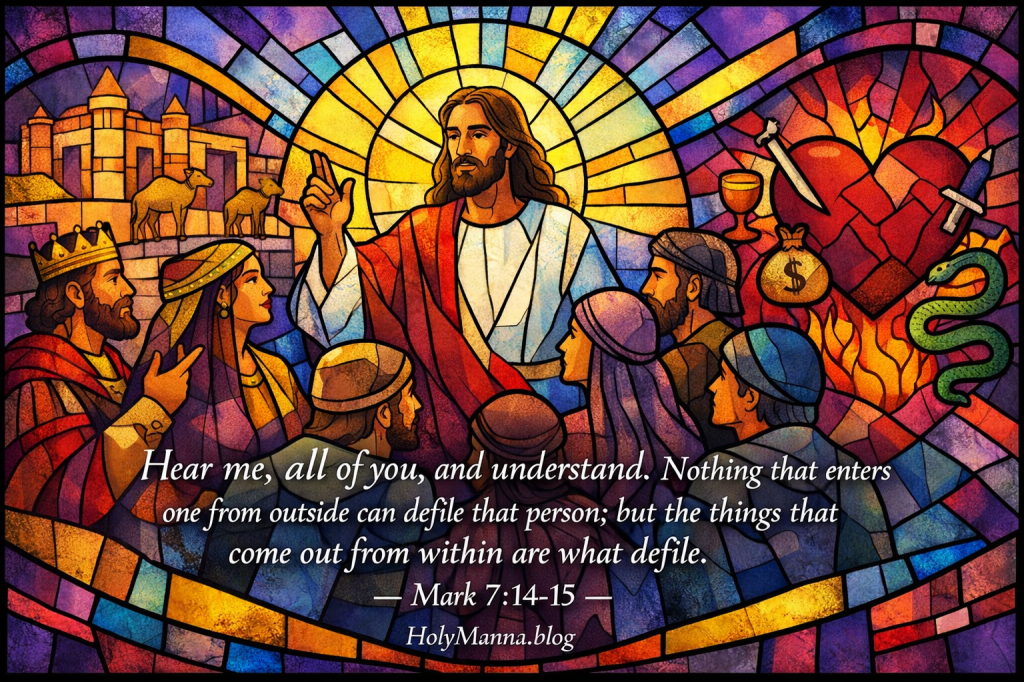
14 He summoned the crowd again and said to them, “Hear me, all of you, and understand. 15 Nothing that enters one from outside can defile that person; but the things that come out from within are what defile.” [16 ]
17 When he got home away from the crowd his disciples questioned him about the parable. 18 He said to them, “Are even you likewise without understanding? Do you not realize that everything that goes into a person from outside cannot defile, 19 since it enters not the heart but the stomach and passes out into the latrine?” (Thus he declared all foods clean.) 20 “But what comes out of a person, that is what defiles. 21 From within people, from their hearts, come evil thoughts, unchastity, theft, murder, 22 adultery, greed, malice, deceit, licentiousness, envy, blasphemy, arrogance, folly. 23 All these evils come from within and they defile.”
Detailed Exegesis
Verse 14: “He summoned the crowd again and said to them, ‘Hear me, all of you, and understand.’”
Jesus speaks publicly because this is not a niche debate for scholars. He is forming the conscience of the people. The command to “hear” echoes Israel’s foundational prayer, the Shema, which begins with hearing and leads to love and obedience. Jesus is demanding more than attention. He is demanding understanding, because shallow religion cannot heal a broken heart.
Verse 15: “Nothing that enters one from outside can defile that person; but the things that come out from within are what defile.”
This sounds shocking unless the goal is understood. Jesus is not praising carelessness or mocking the Law. He is exposing a false center of gravity. Food and external contact do not reach the moral core of the person. What defiles is what the heart chooses and then expresses through words and actions. The Lord is revealing that the real purity God desires is interior, a purity that can only come from conversion and grace.
Verse 16: “”
Some translations include a line here that is familiar from different places in Scripture: “Whoever has ears to hear ought to hear.” The meaning remains clear, Jesus is calling for serious listening, because the heart can either receive truth or harden against it.
Verse 17: “When he got home away from the crowd his disciples questioned him about the parable.”
The disciples do not pretend they understand. They ask. That is already a lesson. A listening heart is humble enough to admit confusion, and faithful enough to seek clarity from the Lord. The setting also matters. Jesus forms disciples both publicly and privately, because conversion has a public face but it is forged in personal relationship.
Verse 18: “He said to them, ‘Are even you likewise without understanding? Do you not realize that everything that goes into a person from outside cannot defile,’”
Jesus presses them, not to shame them, but to wake them up. If the disciples, who live close to Him, can still misunderstand, then anyone can. The question is not whether confusion happens. The question is whether a person stays confused out of laziness or pride. Jesus is training them to think morally and spiritually, not merely ritually.
Verse 19: “since it enters not the heart but the stomach and passes out into the latrine?’ (Thus he declared all foods clean.)”
Jesus speaks plainly about the body to make a spiritual point. Food goes through the digestive system, not into the moral center. Mark then adds a crucial interpretive note: all foods are declared clean. This is a major development in salvation history because it anticipates the Church’s mission to the Gentiles. The barrier is no longer dietary separation but holiness of heart. The New Covenant will gather the nations without requiring them to become culturally Jewish first. What matters is conversion, faith, baptism, and life in Christ.
Verse 20: “‘But what comes out of a person, that is what defiles.’”
Jesus repeats the core teaching because the heart is slippery. People love to blame external pressure, circumstances, and other people. Jesus does not deny that temptations exist, but He insists that the defilement comes from within, from what the heart entertains and consents to.
Verse 21: “From within people, from their hearts, come evil thoughts, unchastity, theft, murder,”
Jesus begins the list at the level of thought, because sin often starts long before it becomes action. Evil thoughts are not merely intrusive temptations. They become defiling when they are welcomed, savored, planned, and chosen. Then Jesus names sins that rupture purity and neighbor-love. Unchastity twists the meaning of the body and of love. Theft violates justice. Murder destroys the image of God in the other.
Verse 22: “adultery, greed, malice, deceit, licentiousness, envy, blasphemy, arrogance, folly.”
The list moves across the landscape of the fallen heart. Adultery breaks covenant. Greed makes possessions into idols. Malice rejoices in harm. Deceit corrupts trust. Licentiousness is the refusal of restraint. Envy resents another’s good. Blasphemy attacks God’s holiness. Arrogance enthrones the self. Folly is not mere silliness. It is moral stupidity, the heart choosing darkness while calling it freedom.
Verse 23: “All these evils come from within and they defile.”
Jesus closes the loop. The source is within, which means the solution must also reach within. That is why the Gospel is not moral coaching. It is salvation, grace, repentance, and a new heart. External polish cannot cure interior corruption.
Teachings
The Church teaches that the heart is the decisive place where moral life is formed. CCC 2563 states: “The heart is the dwelling place where I am, where I live; according to the Semitic or biblical expression, the heart is the place ‘to which I withdraw.’ The heart is our hidden center, beyond the grasp of our reason and of others; only the Spirit of God can fathom the human heart and know it fully. The heart is the place of decision, deeper than our psychic drives. It is the place of truth, where we choose life or death. It is the place of encounter, because as image of God we live in relation: it is the place of covenant.” This is why Jesus does not let the debate remain about washings and foods. He is talking about the hidden center where covenant is either honored or betrayed.
Jesus’ list includes unchastity and adultery, and the Church treats this with seriousness because it directly contradicts the dignity of the human person and the meaning of the body. CCC 2337 teaches: “Chastity means the successful integration of sexuality within the person and thus the inner unity of man in his bodily and spiritual being.” When the heart is divided, the body becomes a tool. When the heart is purified, the body becomes a gift offered in love.
Jesus also names greed and envy, which reveal how easily the heart can be captured by possessions or comparison. The Church warns that these are not small issues. CCC 2536 states: “The tenth commandment forbids greed and the desire to amass earthly goods without limit. It forbids the inordinate desire, born of the passion for riches, for power acquired through them.” Greed is not simply having money. It is the heart being owned by money.
This Gospel also matters historically because it points toward the Church’s mission beyond Israel. Mark’s note that Jesus declared all foods clean prepares for the apostolic preaching to the Gentiles, where the dividing line becomes faith in Christ and the moral life formed by grace. The Church does not abandon holiness. The Church spreads holiness by calling every nation to conversion of heart, not to ritual boundary markers.
Saint John Chrysostom preached often on this interior battle. He insisted that it is possible to fast from food while still devouring others with the tongue, and he warned that external religion without interior change becomes hypocrisy. His point matches Jesus. If the heart is not guarded, even religious habits can become a mask instead of medicine.
Reflection
This Gospel is uncomfortable in the best way, because it blocks the favorite escape routes. It prevents blaming culture, upbringing, stress, or other people as if those things force sin. It also prevents the opposite mistake, which is obsessing over externals to avoid dealing with interior patterns. Jesus is inviting a simpler, harder honesty. The question is not whether the world is messy. The question is what the heart is doing with what it sees, desires, and fears.
A good first step is to practice custody of the heart. That means noticing what is being allowed to live inside, especially through entertainment, social media, conversations, and private fantasies. A second step is to take Jesus’ list seriously and choose one category to bring into confession with clarity. The sacrament is not for perfect people. It is for people who want a new heart. A third step is to replace what defiles with what heals. Prayer, Scripture, Eucharistic adoration, and disciplined habits are not cosmetic add-ons. They are the way grace retrains the inner person, so the mouth, eyes, and hands can become instruments of love.
Which item in Jesus’ list has been treated like a minor flaw instead of a real spiritual threat? What has been coming out in speech when tired, stressed, or irritated, and what does that reveal about what has been stored in the heart? If God’s teaching truly lived in the heart, what would change this week in the way work is handled, relationships are treated, and temptations are resisted?
Let Wisdom Become Visible
Today’s readings tell one continuous story about where holiness actually begins and why it matters more than most people think. The Queen of Sheba travels far because she refuses to live on rumors, and she discovers that true wisdom does not simply impress the mind. True wisdom orders a whole life around God. She sees it in Solomon’s answers, in the structure of his kingdom, and especially in worship, and her amazement turns into praise as she blesses the Lord who loves His people and establishes justice. The Responsorial Psalm then explains the secret behind that kind of life. It is not luck, personality, or image management. It is a heart that commits its way to the Lord, trusts Him, and carries His teaching within, so that speech becomes wise and steps do not collapse when pressure comes. Then the Holy Gospel completes the lesson with the clarity only Jesus can bring. Clean hands are not enough, because defilement does not begin in the stomach or in circumstances. Defilement begins in the heart, where thoughts are entertained, desires are fed, and choices are made.
The message is both sobering and hopeful. It is sobering because it removes excuses and exposes the interior habits that shape everything else. It is hopeful because it means change is possible at the root. God is not asking for a polished religious mask. God is offering a new heart through grace, truth, and the steady medicine of the sacramental life. A listening heart can become a purified heart, and a purified heart can become a witness strong enough to draw others toward the Lord, just like Solomon’s kingdom drew the queen from the ends of the earth.
The call to action is simple, but it is not easy. Choose to become a listener today. Listen to the Lord in Scripture with attention instead of rushing. Listen in prayer with honesty instead of pretending. Listen in examination of conscience with courage instead of defensiveness. Then take one concrete step that proves the heart is serious. Bring one hidden sin into the light through confession. Cut off one source of temptation that keeps feeding what defiles. Practice one act of justice that gives God and neighbor their due. Trust that the Lord will act, because He delights to make righteousness shine like dawn in a life that truly belongs to Him.
What would happen if the week ahead was lived with a guarded heart, a disciplined tongue, and a deliberate choice to take refuge in the Lord before anything else?
Engage with Us!
Readers are invited to share reflections in the comments below, because faith grows when the heart listens and the family of God encourages one another toward holiness. Today’s readings are rich, and a few focused questions can help turn them from information into transformation.
- First Reading, 1 Kings 10:1-10: What “subtle question” has been kept at a safe distance from God, and what would change if it was brought honestly into prayer this week? How can daily life become more coherent and God-centered, so that work, home, and worship quietly point others toward the Lord the way Solomon’s kingdom did?
- Responsorial Psalm, Psalm 37:5-6, 30-31, 39-40: Where has anxiety replaced trust, as if everything depends on personal control instead of the Lord’s providence? What has been coming out in speech lately, and what does that reveal about whether God’s teaching is truly living in the heart?
- Holy Gospel, Mark 7:14-23: Which item in Jesus’ list feels uncomfortably close right now, and what practical step can be taken to bring that area into the light through repentance, confession, and accountability? What habit, entertainment choice, or private pattern has been feeding what defiles, and what is one concrete boundary that can be set today to guard the heart?
May the Lord give the grace to live with a listening heart and a clean heart, and may every word, decision, and relationship be carried out with the love and mercy Jesus taught, so that faith becomes visible, credible, and truly life-giving.
Sacred Heart of Jesus, we trust in You!
Immaculate Heart of Mary, pray for us!
Saint Michael the Archangel, defend us in battle!
Follow us on YouTube, Instagram and Facebook for more insights and reflections on living a faith-filled life.

 Holy Manna!
Leave a comment