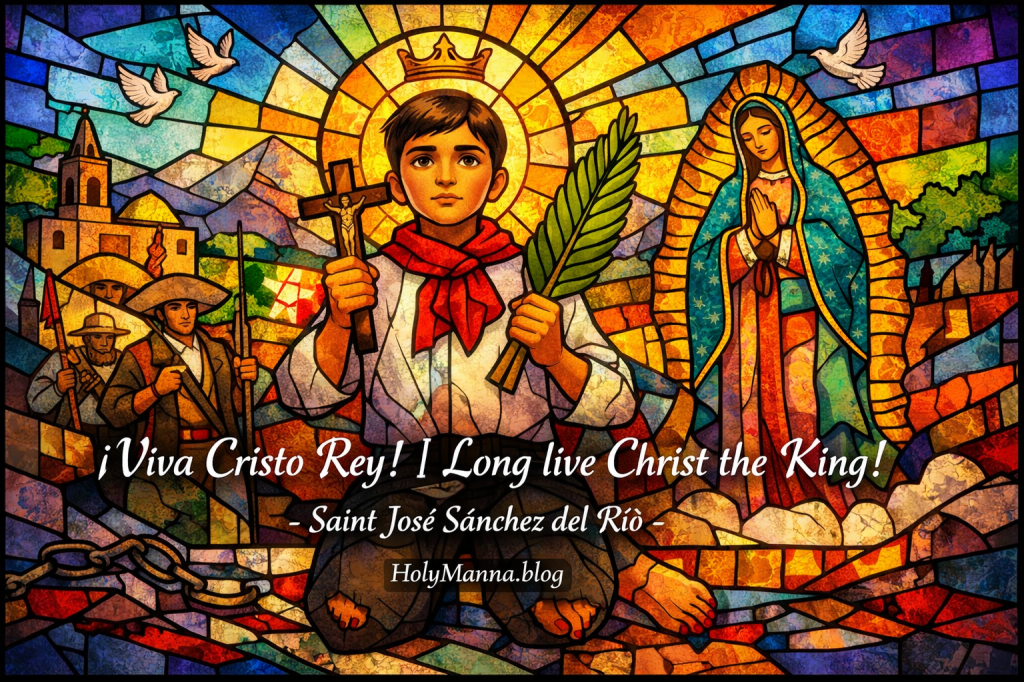
The Teenage Martyr Who Would Not Trade Christ
Saint José Sánchez del Río, often affectionately called Joselito, is one of those saints who shakes a person awake. He lived in Mexico during the Cristero persecution, a time when the practice of the Catholic faith was violently restricted and believers were pressured to deny Christ publicly. José was still a teenager, yet his heart was already anchored in the truth that Jesus is not only a comforting figure but the rightful King of every human life. The Church venerates him as a martyr, and The Catechism teaches that martyrdom is the supreme witness to the truth of the faith, because it means bearing witness to Christ even unto death (CCC 2473–2474).
José’s story is not preserved because Catholics enjoy tragedy. His story is preserved because it reveals how grace can make a young person unbreakable. It also reveals what happens when a state tries to replace God, demanding a loyalty it does not deserve. The confession that echoes through José’s life is simple, direct, and deeply Catholic: “¡Viva Cristo Rey!” “Long live Christ the King!” It is a profession of faith that Christ has ultimate authority, and it is a reminder that a Catholic cannot treat the Lordship of Jesus as optional or merely private.
The Quiet Strength of a Catholic Home
José was born on March 28, 1913, in Sahuayo, Michoacán, Mexico. Catholic sources consistently emphasize that he was not a strange child set apart from ordinary life. He grew up in a faithful environment where prayer, devotion, and love for the Church were part of the air the family breathed. That is important because it shows how the Lord forms saints through steady, ordinary Catholic life. The Church teaches that grace builds on nature and elevates the human person, making real holiness possible for the baptized who cooperate with God’s gifts (CCC 1996–2001).
As anti-Catholic laws and violence pressed in, José did not retreat into fear or cynicism. His faith deepened into conviction, and Catholic accounts preserve a remarkable detail: he asked God for the grace of martyrdom before his final trial arrived. That was not a teenager chasing danger. That was a teenager who believed Heaven is real and that fidelity matters more than comfort. Among the Cristeros he became known for his prayerfulness, and he was nicknamed “Tarsicio,” recalling Saint Tarcisius, the youthful martyr associated in Catholic tradition with love for the Eucharist. The nickname points to a central Catholic truth: the faith is not an ideology. The faith is a relationship with Christ, nourished by the sacraments, especially the Eucharist, which The Catechism calls the source and summit of the Christian life (CCC 1324).
José’s life also makes concrete the Church’s teaching on religious freedom. The Catechism insists that no one should be forced to act against conscience in religious matters and that the right to religious liberty flows from human dignity (CCC 2106–2109). José did not become holy by being loud. He became holy by refusing to betray what is true.
Faithful Courage
José wanted to serve the Cristero cause even though he was young. Those around him hesitated because they knew what persecution could do to a child, but he persisted. He took on roles suited to his age, and Catholic retellings often highlight that he was a boy who prayed, encouraged others, and led with a surprisingly steady spirit. That detail matters because it shows that courage is not primarily a personality trait. Courage is a virtue strengthened by prayer, discipline, and grace, until it becomes a stable readiness to do what is right.
One of the most remembered events in his story shows that his road to martyrdom was paved with self-giving love. During conflict, a Cristero leader needed to escape. José gave up his own horse to help him flee, and that sacrifice led to José being captured. It is difficult to overstate how Catholic that moment is. It looks like Christ’s own pattern in The Gospel of John, where the Lord lays down His life for His friends (Jn 15:13). José’s courage did not begin as a dramatic final stand. It began as a young boy choosing to protect another person.
When it comes to miracles during José’s lifetime, the Church does not primarily present him as a wonderworker known for healings or public signs. His witness is different and still profoundly supernatural. The “miracle” that stands out is the miracle of fidelity itself, the way grace strengthens a teenager to endure pressure that would crush many adults. José’s life is proof that sanctity is not reserved for the elderly or the educated. Sanctity is for the baptized who say yes to God, even when the cost becomes painful.
Faith That’s Not for Sale
José was captured in early February 1928 and brought to Sahuayo, where he was imprisoned and pressured to deny Christ. Catholic accounts emphasize a detail that feels almost symbolic: the church connected to his baptismal life also became tied to his imprisonment, as if the Lord was gathering his whole life into one final testimony. Authorities tried to break him with threats and offers, including promises aimed at a teenager’s desires for a future, status, or security. The goal was not merely punishment. The goal was apostasy.
Witness testimony preserved in Catholic tradition includes the line “My faith is not for sale.” Those words summarize his interior freedom. He could not be bribed because his heart had already chosen its treasure. His love for his family also shines through in what he wrote from prison. Catholic sources preserve a letter to his mother in which he urged her to accept God’s will with faith. The line is often quoted in Spanish: “Resígnate a la voluntad de Dios.” “Resign yourself to the will of God.” That sentence is not cold. It is the voice of a son trying to comfort a mother with the only foundation that holds when everything is shaking.
Catholic memory also preserves a line attributed to him that reveals his clarity as death approached: “Nunca ha sido tan fácil ganarse el cielo.” “It has never been so easy to gain Heaven.” He was not saying suffering is pleasant. He was saying that fidelity opens a straight road to eternal life. As his torment intensified, he continued to profess Christ’s kingship and to call on the Blessed Virgin Mary. His final acclamations are remembered as the cry of a Catholic heart refusing to be owned by the state: “¡Viva Cristo Rey!” “Long live Christ the King!” and “¡Viva Santa María de Guadalupe!” “Long live Holy Mary of Guadalupe!”
José was killed on February 10, 1928, not yet fifteen years old. The Church does not glorify violence, but she does honor martyrs because their blood proclaims that Christ is worth more than life itself. The Catechism teaches that the martyr bears witness to Christ who died and rose, united with Him in the sacrifice of love (CCC 2473).
Devotion That Keeps Spreading
After José’s death, devotion to him grew quickly, especially in Mexico, because Catholic families recognized something precious in him. He became a model for young people pressured to hide their faith. He became a source of strength for parents raising children in a hostile culture. He became a reminder that persecution is not only a historical category. Persecution can also look like coercion, ridicule, and the steady demand to keep Jesus quiet.
The Church’s canonization process includes careful investigation of miracles, not as entertainment, but as signs that God still acts and that the communion of saints is real. A medically inexplicable healing of an infant, attributed to José’s intercession, was recognized in connection with the steps that led to his canonization. That matters because it keeps José from being only a tragic figure of the past. In Catholic life, the saints are alive in Christ, and The Catechism teaches that their intercession continues to help the faithful who still walk the pilgrim road (CCC 956).
His relics and places of veneration have carried his witness beyond Mexico. Pilgrimages and public devotion connected to his life continue to draw people who need courage and purity of heart. His story has also reached wider audiences through Catholic storytelling, helping many Catholics discover the Cristero martyrs and the cost of religious freedom. His feast is celebrated on February 10, and the cry associated with his witness still stirs Catholic hearts toward a simple question: who is truly King?
Lessons for Everyday Catholic Life
Saint José Sánchez del Río is a saint for anyone who feels squeezed by the modern world. He teaches that discipleship is not a mood and not a weekend identity. Discipleship is allegiance to Christ, in private and in public, even when it costs something. His life calls out halfhearted Catholicism that appears only when convenient and disappears when it becomes socially expensive.
José can be imitated without dramatic persecution. His witness can be lived by making Sunday Mass non negotiable, by returning regularly to confession, and by refusing to normalize sin. His story can also inspire a more serious fight for purity, especially in a world that floods the eyes and imagination with temptation. His courage shows that a person does not need to be loud to be faithful, but a person does need to be clear about what belongs to God. His Marian devotion also teaches a deeply Catholic truth: authentic love for Mary always leads to deeper loyalty to Christ. The Catechism describes Marian devotion as intrinsic to Christian worship, because Mary’s whole mission is to lead the faithful to her Son (CCC 971).
José also challenges adults to raise expectations. Too many people assume teenagers cannot be serious about holiness. José proves the opposite. Young Catholics are capable of heroic fidelity when they are given the faith in its fullness and invited to live it with courage.
Engage with Us!
Share your thoughts and reflections in the comments below. Saint José’s story hits people differently depending on what they are carrying right now, and it is worth talking about.
- Where is the biggest pressure to compromise the faith right now, and what would it look like to choose fidelity in that exact situation?
- What daily habit could be strengthened this week so courage becomes a virtue and not just an emotion?
- How does the cry “Viva Cristo Rey” challenge the way life decisions are made, especially decisions about work, relationships, and entertainment?
- What would it look like to entrust fears to Our Lady of Guadalupe and ask for the kind of courage Saint José had?
May Saint José Sánchez del Río intercede for every heart that feels intimidated, tired, or tempted to go silent. May his witness stir up a stronger love for Jesus, a deeper loyalty to the Church, and a cleaner, braver life. Keep walking in faith, keep choosing truth, and do everything with the love and mercy Jesus taught us.
Saint José Sánchez del Río, pray for us!
Follow us on YouTube, Instagram and Facebook for more insights and reflections on living a faith-filled life.

 Holy Manna!
Leave a comment