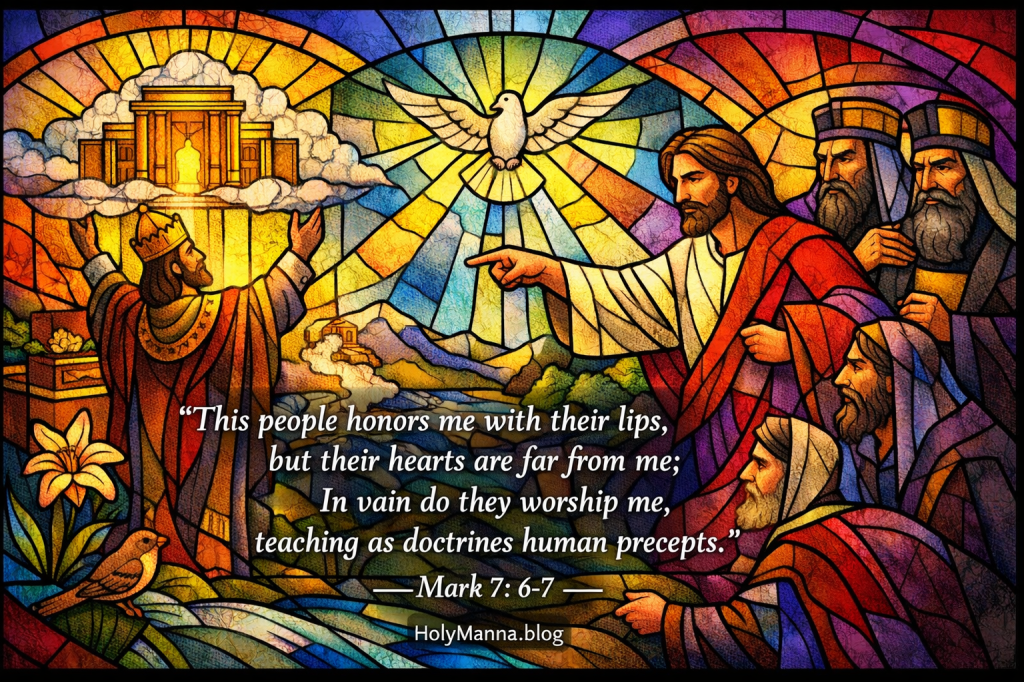
Memorial of Saint Scholastica, Virgin – Lectionary: 330
When God Comes Close, the Heart Must Be True
There is a hunger in the human soul that no routine can satisfy, a longing for a real encounter with the living God, not just the comfort of familiar religious habits. Today’s readings gather around one central theme: God desires to dwell with His people, but His presence is received through a faithful and obedient heart, not through outward performance or manmade loopholes.
The First Reading places the listener in Jerusalem at a turning point in Israel’s history. Solomon stands before the newly built Temple, the visible sign of God’s covenant love and Israel’s worship. Yet the king prays with striking humility, confessing that the Lord cannot be contained by stone walls or human achievement. The Temple matters because God chose it as a place for His name, but Solomon insists that what matters even more is that God listens, forgives, and keeps covenant with servants who walk before Him with their whole heart. This is the spiritual logic of biblical worship: God is utterly holy, His people are dependent, and mercy is always the door back home.
The Responsorial Psalm gives that same truth a voice filled with longing. It is the song of pilgrims who know that God’s dwelling is not simply a location, but a living relationship. The psalmist aches for the courts of the Lord, not as a tourist seeking a sacred landmark, but as a believer who has tasted enough of the world to know it cannot replace the joy of being near God. When the heart is awake, even standing at the threshold of God’s house feels richer than settling comfortably anywhere else.
Then the Holy Gospel sharpens the theme with the clarity only Jesus can bring. The Lord confronts a form of religion that looks serious while quietly avoiding conversion. Ritual practices had a place in Israel’s life, but Jesus exposes what happens when human tradition is treated as a shield against God’s commandments. He quotes the prophet Isaiah to name the real danger: lips that honor God while the heart stays distant. He even shows how religious language can become a convenient excuse to abandon moral duty, including the sacred obligation to honor father and mother. In other words, worship becomes hollow when it stops shaping the way a person loves.
This is why the Memorial of Saint Scholastica fits so naturally alongside these passages. Her witness is often remembered as a simple, powerful lesson: genuine prayer flows from genuine love, and genuine love always seeks God with sincerity. Her life points to the same reality the readings proclaim. God is not looking for a performance. God is drawing near. The question is whether the heart is ready to meet Him.
First Reading – 1 Kings 8:22-23, 27-30
A temple of stone cannot hold God
The scene unfolds at a high point in Israel’s history, when Solomon dedicates the Temple in Jerusalem. This was not merely a grand building project, because the Temple became the center of Israel’s worship, sacrifice, and prayer. It represented the Lord’s covenant closeness to His people, especially the promise that God’s “Name” would rest there, marking it as a holy place where Israel could turn in repentance and hope.
At the same time, Solomon refuses to treat the Temple like a spiritual cage for God. The king prays with open hands and a sober mind, confessing that the Lord is greater than the heavens and yet merciful enough to listen to the cries of sinners who turn toward Him. This is how the reading locks into today’s theme. God truly draws near, but His presence is never something to control. His dwelling among His people is received through humility, obedience, and a heart that seeks forgiveness.
1 Kings 8:22-23, 27-30 – New American Bible (Revised Edition)
Solomon’s Prayer. 22 Solomon stood before the altar of the Lord in the presence of the whole assembly of Israel, and stretching forth his hands toward heaven, 23 he said, “Lord, God of Israel, there is no God like you in heaven above or on earth below; you keep covenant and love toward your servants who walk before you with their whole heart,
27 “Is God indeed to dwell on earth? If the heavens and the highest heavens cannot contain you, how much less this house which I have built! 28 Regard kindly the prayer and petition of your servant, Lord, my God, and listen to the cry of supplication which I, your servant, utter before you this day. 29 May your eyes be open night and day toward this house, the place of which you said, My name shall be there; listen to the prayer your servant makes toward this place. 30 Listen to the petition of your servant and of your people Israel which they offer toward this place. Listen, from the place of your enthronement, heaven, listen and forgive.
Detailed Exegesis
Verse 22 – “Solomon stood before the altar of the Lord in the presence of the whole assembly of Israel, and stretching forth his hands toward heaven,”
Solomon prays publicly, not as a performer but as an intercessor. The posture matters because raised hands express surrender, dependence, and praise. The king stands before the altar because worship is not self-invented spirituality. It is a response to God who has revealed Himself and established covenant worship for His people.
Verse 23 – “he said, ‘Lord, God of Israel, there is no God like you in heaven above or on earth below; you keep covenant and love toward your servants who walk before you with their whole heart,’”
Solomon begins where real prayer always begins, with who God is. The Lord is incomparable, faithful, and loving. The phrase “whole heart” is not poetic filler. In the Scriptures, the heart is the center of the person, the place where decisions are made. Solomon is already aiming at the interior life, because covenant love is not maintained by appearances, but by a heart that walks with God in loyalty.
Verse 27 – “‘Is God indeed to dwell on earth? If the heavens and the highest heavens cannot contain you, how much less this house which I have built!’”
This verse keeps the Temple in its proper place. God is truly present, but never contained. Solomon’s awe protects Israel from turning worship into superstition. The Temple is holy because God chooses it, not because human hands can manufacture holiness. This also prepares the soul for the fullness of revelation, when God will dwell among His people in a way Solomon could only glimpse, not through stone walls but through the Incarnation and the life of grace.
Verse 28 – “‘Regard kindly the prayer and petition of your servant, Lord, my God, and listen to the cry of supplication which I, your servant, utter before you this day.’”
Solomon prays like a servant who knows he needs mercy. He asks God to “listen,” which is covenant language, because it assumes relationship. The king is not bargaining with God. He is pleading from within a bond God Himself established.
Verse 29 – “‘May your eyes be open night and day toward this house, the place of which you said, My name shall be there; listen to the prayer your servant makes toward this place.’”
The “eyes” of God are a human way of speaking about God’s attentive care. The Temple is the place where God’s Name rests, meaning it is a stable sign of His faithfulness and an invitation to return. Praying “toward this place” shows that Israel’s prayer is not vague or self-directed. It is anchored in God’s promise and directed to the Lord who hears.
Verse 30 – “‘Listen to the petition of your servant and of your people Israel which they offer toward this place. Listen, from the place of your enthronement, heaven, listen and forgive.’”
This is the heartbeat of the passage. Solomon holds together God’s transcendence and God’s mercy. The Lord is enthroned in heaven, and yet He listens to prayers offered on earth. The request culminates in forgiveness, because sin is the real barrier to communion. The goal is not to impress God with religious activity. The goal is restored relationship.
Teachings
Solomon’s prayer teaches that authentic worship is always humble, always covenant-rooted, and always aimed at conversion of heart. The Temple matters, but it does not replace obedience. It becomes a privileged place of turning back to God, precisely because God is the one who initiates the relationship.
The Catechism draws directly from this moment and explains what is happening beneath the surface of Solomon’s words. CCC 2580 teaches: “The Temple of Jerusalem, the house of prayer that David wanted to build, will be the work of his son, Solomon. The prayer at the dedication of the Temple relies on God’s promise and covenant, on the active presence of his name among his People, recalling his mighty deeds at the Exodus. The king lifts his hands toward heaven and begs the Lord, on his own behalf, on behalf of the entire people, and of the generations yet to come, for the forgiveness of their sins and for their daily needs, so that the nations may know that He is the only God and that the heart of his people may belong wholly and entirely to him.” That last line is the test of real faith, whether the heart belongs wholly to God. This is why the interior life cannot be treated as optional, because prayer is not primarily about words. It is about a lived covenant.
The Catechism also describes prayer as a relationship God begins and sustains. CCC 2567 teaches: “God calls man first. Man may forget his Creator or hide far from his face; he may run after idols or accuse the deity of having abandoned him; yet the living and true God tirelessly calls each person to that mysterious encounter known as prayer. In prayer, the faithful God’s initiative of love always comes first; our own first step is always a response. As God gradually reveals himself and reveals man to himself, prayer appears as a reciprocal call, a covenant drama. Through words and actions, this drama engages the heart. It unfolds throughout the whole history of salvation.” Solomon’s posture and plea show that prayer engages the heart through both words and actions. The attitude of the soul matters, because God is not fooled by noise.
This same point is stated with sharp clarity in CCC 2570, which highlights what makes prayer real in the first place: “Such attentiveness of the heart, whose decisions are made according to God’s will, is essential to prayer, while the words used count only in relation to it.” Solomon’s prayer is full of words, but it is powered by attentiveness, awe, and obedience.
The saints echo this truth with the kind of realism that lands in everyday life. Saint Augustine famously captures the soul’s longing for God in a line that fits Solomon’s prayer perfectly, because it names the ache underneath every sincere act of worship: “You have made us for Yourself, and our hearts are restless until they rest in You.” The Temple is beautiful, but the deepest “rest” is found when the heart returns to God in truth.
Reflection
Solomon stands in front of a magnificent Temple and still admits that it is not big enough for God. That humility is medicine for a culture that constantly tempts people to shrink God down, to treat Him like a spiritual tool, or to approach Him only when it feels convenient. The Lord is not a mascot for personal plans. The Lord is the living God, enthroned in heaven, who still bends down to listen and forgive.
A practical step is to pray with Solomon’s balance. God should be approached with reverence, not casual entitlement, and with confidence, not fear, because He invites His people to cry out for mercy. Another practical step is to stop treating prayer like an add-on to a busy life and start treating it like the place where the heart is re-ordered. A distracted soul does not become holy by accident. It becomes holy by turning toward God again and again, asking Him to listen and forgive.
Is prayer becoming a routine that sounds right, while the heart stays guarded and unchanged? Is the Lord being treated like someone to manage, rather than someone to adore? What would change this week if the prayer became simple, direct, and honest, “Lord, listen and forgive,” and then the day was lived like that forgiveness actually mattered?
Responsorial Psalm – Psalm 84:2-5, 10-11
The soul is starving for the living God
This psalm rises from the pilgrimage life of Israel. Faithful Jews traveled up to Jerusalem for the great feasts, and the Temple was the beating heart of that worship. It was where sacrifices were offered, where praise was sung, and where God’s covenant presence was honored. Psalm 84 gives words to what those pilgrims felt on the road: not mere religious obligation, but a deep homesickness for the Lord.
That is why this psalm fits today’s theme so perfectly. Solomon’s prayer in the First Reading insists that God cannot be contained, and yet God chooses to make His Name dwell among His people. The psalm responds with the cry of desire. It reveals what true worship looks like on the inside. It is not the posture of someone trying to look holy. It is the ache of someone who knows that life is flat without God. This psalm also prepares the heart for the Gospel, because Jesus warns that worship becomes empty when the heart is far away. Psalm 84 is what a near heart sounds like.
Psalm 84:2-5, 10-11 – New American Bible (Revised Edition)
2 How lovely your dwelling,
O Lord of hosts!
3 My soul yearns and pines
for the courts of the Lord.
My heart and flesh cry out
for the living God.
4 As the sparrow finds a home
and the swallow a nest to settle her young,
My home is by your altars,
Lord of hosts, my king and my God!
5 Blessed are those who dwell in your house!
They never cease to praise you.
Selah10 O God, watch over our shield;
look upon the face of your anointed.11 Better one day in your courts
than a thousand elsewhere.
Better the threshold of the house of my God
than a home in the tents of the wicked.
Detailed Exegesis
Verse 2 – “How lovely your dwelling, O Lord of hosts!”
The psalmist calls God “Lord of hosts,” which points to the Lord as the King of heaven’s armies, sovereign over all creation. The “dwelling” is lovely not because of architecture, but because it is associated with God’s presence. This verse is praise rooted in awe. It teaches that worship begins with wonder, not with self-focus.
Verse 3 – “My soul yearns and pines for the courts of the Lord. My heart and flesh cry out for the living God.”
This is not polite religion. It is desire strong enough to be felt in the body. “Heart and flesh” means the whole person longs for God, not just the mind. The psalmist does not say the soul longs for blessings, but for God Himself. That is the difference between using religion and seeking the Lord. When the psalm says “living God,” it rejects every idol and every substitute. It is a confession that God is not an idea, but a Person who can be loved.
Verse 4 – “As the sparrow finds a home and the swallow a nest to settle her young, My home is by your altars, Lord of hosts, my king and my God!”
The image is gentle, but the meaning is intense. Even the smallest birds can find rest near the sacred place. The psalmist wants that same security near God’s altars. The word “altars” matters because altars are places of sacrifice. The psalm is not sentimental nostalgia for a holy space. It is longing for communion with God through the worship God provides. The phrases “my king” and “my God” make it personal. This is covenant language. The Lord is not distant. He is claimed and loved.
Verse 5 – “Blessed are those who dwell in your house! They never cease to praise you. Selah”
“Blessed” is the language of happiness rooted in God. To dwell in God’s house means to live close to His presence and to let life become praise. The phrase “never cease” is not saying that someone must sing hymns nonstop. It is describing a life oriented toward God, where gratitude and reverence become the atmosphere of the soul.
Verse 10 – “O God, watch over our shield; look upon the face of your anointed.”
Here the psalm turns outward and intercedes. In Israel, the king was often called the “anointed,” and he was seen as the protector or “shield” of the people. The psalm asks God to guard the one who guards the nation. Read in the light of the fullness of revelation, this verse also points toward the true Anointed One, Jesus Christ, whose face the Father beholds with perfect delight. It reminds the faithful that worship is not only personal longing. It is also the prayer of a people, asking God to preserve what is good and holy.
Verse 11 – “Better one day in your courts than a thousand elsewhere. Better the threshold of the house of my God than a home in the tents of the wicked.”
This verse draws a hard line. The presence of God is not one option among many lifestyle choices. It is better than everything else, even when the “elsewhere” looks easier, richer, or more comfortable. The “threshold” image is powerful because it is the lowest place. The psalmist would rather be near God at the edge than live comfortably in the center of wickedness. This verse is an examination of priorities. It exposes whether the heart is truly close to God or just maintaining religious appearance.
Teachings
Psalm 84 teaches that worship without desire becomes dry, and desire without worship becomes confused. God forms desire through worship, and worship becomes alive through desire. The psalm reveals the interior dimension Jesus defends in the Gospel. God is not satisfied with lips that say the right things while the heart clings to the world. God wants the heart, because the heart is where the person truly lives.
The Catechism describes this longing as part of what prayer actually is. CCC 2566 teaches: “Man, in his search for God, discovers certain ways of coming to know him. These are also called ‘proofs for the existence of God,’ not in the sense of proofs in the natural sciences, but rather in the sense of ‘converging and convincing arguments,’ which allow us to attain certainty about the truth. These ‘ways’ of approaching God from creation have as their starting point: the physical world, and the human person.” This matters because Psalm 84 shows both starting points at once. The psalmist’s “heart and flesh” cry out, and creation’s little birds become a living parable of home and refuge near God.
The Church also teaches that this longing is not accidental. It is built into the human person. CCC 27 teaches: “The desire for God is written in the human heart, because man is created by God and for God; and God never ceases to draw man to himself. Only in God will he find the truth and happiness he never stops searching for.” This is the heartbeat of Psalm 84. The soul does not pine for God because the psalmist is unusually emotional. The soul pines for God because the human person is made for communion with Him.
Saint Augustine’s witness fits this psalm like a key fits a lock, because he names that restless longing as universal. “You have made us for Yourself, and our heart is restless until it rests in You.” This line is not a slogan. It is a spiritual diagnosis. It explains why the world can be full of noise and still feel empty, and why even one quiet hour near God can reset an entire week.
Historically, Israel’s pilgrimage worship also points forward to the Church’s pilgrimage life. The faithful still journey, not only to holy places, but week after week toward the altar at Mass. The desire of the psalmist finds a deeper fulfillment in the Eucharist, where the Lord does not merely allow His people to stand near His altar. He feeds them with His own life.
Reflection
This psalm confronts a modern problem that hides in plain sight. Life becomes crowded, fast, and overstimulated, and the soul slowly forgets what it is hungry for. The result is not always obvious rebellion. Often it is spiritual numbness. The mouth still says the prayers, but the heart does not yearn. Psalm 84 calls the heart back to honesty.
A practical step is to ask for desire, because desire can be prayed for. Another practical step is to build small pilgrimages into ordinary life. A brief visit to a church, a deliberate moment of silence before the day begins, and a Sunday Mass treated as the summit of the week rather than a chore can begin to reawaken the longing the psalm describes. The psalm also invites a sober choice about “elsewhere.” Some habits look harmless but slowly pull the heart away. This is where a faithful examination of conscience becomes an act of love rather than guilt.
What does the soul pine for when no one is watching and the phone is finally quiet? Does the heart actually believe that one day with God is better than a thousand days of distraction? If standing at the threshold of God’s house is better than settling in the tents of the wicked, what threshold needs to be crossed today, and what tent needs to be left behind?
Holy Gospel – Mark 7:1-13
When religion becomes a loophole the heart drifts
This Gospel unfolds in the thick of first century Jewish religious life, where holiness was taken seriously and where traditions had developed around ritual purity. Many of these practices were meant to protect reverence for God’s law and to keep daily life oriented toward worship. The conflict is not about basic hygiene. It is about ceremonial washing and the broader web of customs often called “the tradition of the elders,” which helped shape Jewish identity under foreign pressure and constant cultural threat.
Jesus does not attack reverence, and He does not mock true tradition. He exposes something far more dangerous, a religious mindset that can carefully polish the outside while quietly dodging God’s commandments on the inside. That is why this Gospel fits today’s theme so sharply. Solomon teaches that God cannot be contained, and the psalmist shows a heart that yearns for the living God. Jesus now insists that God’s dwelling is not welcomed through external performance. God is honored when the heart is near, and when worship produces obedience, especially in love of neighbor.
Mark 7:1-13 – New American Bible (Revised Edition)
The Tradition of the Elders. 1 Now when the Pharisees with some scribes who had come from Jerusalem gathered around him, 2 they observed that some of his disciples ate their meals with unclean, that is, unwashed, hands. 3 (For the Pharisees and, in fact, all Jews, do not eat without carefully washing their hands, keeping the tradition of the elders. 4 And on coming from the marketplace they do not eat without purifying themselves. And there are many other things that they have traditionally observed, the purification of cups and jugs and kettles [and beds].) 5 So the Pharisees and scribes questioned him, “Why do your disciples not follow the tradition of the elders but instead eat a meal with unclean hands?” 6 He responded, “Well did Isaiah prophesy about you hypocrites, as it is written:
‘This people honors me with their lips,
but their hearts are far from me;
7 In vain do they worship me,
teaching as doctrines human precepts.’8 You disregard God’s commandment but cling to human tradition.” 9 He went on to say, “How well you have set aside the commandment of God in order to uphold your tradition! 10 For Moses said, ‘Honor your father and your mother,’ and ‘Whoever curses father or mother shall die.’ 11 Yet you say, ‘If a person says to father or mother, “Any support you might have had from me is qorban”’ (meaning, dedicated to God), 12 you allow him to do nothing more for his father or mother. 13 You nullify the word of God in favor of your tradition that you have handed on. And you do many such things.”
Detailed Exegesis
Verse 1 – “Now when the Pharisees with some scribes who had come from Jerusalem gathered around him,”
The presence of scribes from Jerusalem signals seriousness. Jerusalem was the religious center, and scribes were trained experts in the law. This is not casual curiosity. This is scrutiny. The Gospel shows that Jesus’ authority and influence have become impossible to ignore.
Verse 2 – “they observed that some of his disciples ate their meals with unclean, that is, unwashed, hands.”
“Unclean” here refers to ritual impurity, not moral filth. The concern is religious status, whether a person is in proper condition to participate in sacred life. The danger is that religious categories can become a substitute for the deeper question of holiness of heart.
Verse 3 – “For the Pharisees and, in fact, all Jews, do not eat without carefully washing their hands, keeping the tradition of the elders.”
Mark explains the practice for readers who are not familiar with it. The “tradition of the elders” refers to interpretive customs passed down to apply the law to daily situations. Some traditions supported fidelity, but Jesus will show how traditions can become corrupted when they gain the weight of divine command.
Verse 4 – “And on coming from the marketplace they do not eat without purifying themselves. And there are many other things that they have traditionally observed, the purification of cups and jugs and kettles [and beds].”
The marketplace was a place of contact with Gentiles and with all sorts of items whose ritual status was uncertain. These purification rites aimed at maintaining separation from impurity. The problem emerges when ritual attention becomes the main measure of righteousness.
Verse 5 – “So the Pharisees and scribes questioned him, ‘Why do your disciples not follow the tradition of the elders but instead eat a meal with unclean hands?’”
The accusation is framed as a failure to follow tradition, not as a violation of God’s law. This is the key tension. The charge is that Jesus’ disciples are not conforming to a religious culture that has taken on an authority of its own.
Verse 6 – “He responded, ‘Well did Isaiah prophesy about you hypocrites, as it is written:”
Jesus answers with Scripture, placing the dispute at the level of God’s word. The term “hypocrites” points to a divided life, where the outward display does not match the inward reality. Jesus is not condemning sincere zeal. He is condemning a performative holiness that masks a distant heart.
Verse 7 – “‘This people honors me with their lips, but their hearts are far from me; In vain do they worship me, teaching as doctrines human precepts.’”
Jesus quotes Isaiah to expose the spiritual sickness. Worship becomes “vain” when it is disconnected from obedience and conversion. The heart is the center of the person, so a distant heart means a distant life. Teaching human precepts as doctrine means treating manmade rules as if they were divine law.
Verse 8 – “‘You disregard God’s commandment but cling to human tradition.’”
This is the core indictment. It is possible to appear faithful while actually disregarding God. The tragedy is that clinging to human tradition can feel like devotion, even as it pushes God’s commandments to the side.
Verse 9 – “He went on to say, ‘How well you have set aside the commandment of God in order to uphold your tradition!’”
The tone is cutting because the stakes are high. Jesus is not scolding minor mistakes. He is calling out a system that rewards outward compliance while allowing moral evasion.
Verse 10 – “For Moses said, ‘Honor your father and your mother,’ and ‘Whoever curses father or mother shall die.’”
Jesus anchors the debate in the Decalogue. Honoring parents is not a negotiable custom. It is a commandment. By pairing it with a severe warning, Jesus highlights the seriousness with which God treats this duty.
Verse 11 – “Yet you say, ‘If a person says to father or mother, “Any support you might have had from me is qorban”’ (meaning, dedicated to God),”
“Qorban” refers to something dedicated to God, often connected to offerings. Jesus exposes the loophole. A person could declare resources “dedicated” and use that religious label to refuse supporting parents. The result is a holy sounding excuse that hides a hard heart.
Verse 12 – “you allow him to do nothing more for his father or mother.”
This shows how religious systems can enable sin. The leaders are not only tolerating the evasion. They are permitting it. The vulnerable suffer when religion becomes a cover for selfishness.
Verse 13 – “You nullify the word of God in favor of your tradition that you have handed on. And you do many such things.”
Jesus concludes with a warning that goes beyond one example. The danger is widespread. Whenever tradition becomes untethered from God’s commandments, it can nullify God’s word in practice, even while quoting God’s name.
Teachings
This Gospel is a masterclass in the Catholic understanding of the heart, worship, and tradition. Jesus is not condemning all tradition. He is condemning traditions that contradict God’s word and that excuse disobedience. This distinction matters because the Catholic faith holds both Sacred Scripture and Sacred Tradition as gifts of divine revelation, while rejecting purely human traditions that distort the Gospel.
The Catechism explains what “tradition” means in the Catholic sense, and why Jesus’ critique does not threaten the Church’s life. CCC 83 teaches: “Tradition is to be distinguished from the various theological, disciplinary, liturgical or devotional traditions, born in the local Churches over time. These are the particular forms, adapted to different places and times, in which the great Tradition is expressed. In the light of Tradition, these traditions can be retained, modified or even abandoned under the guidance of the Church’s Magisterium.” This directly matches Jesus’ point. Human traditions can be helpful, but they are never allowed to cancel God’s commandments.
Jesus also puts a spotlight on the Fourth Commandment, which remains a real moral duty, not a sentimental idea. CCC 2214 teaches: “The divine fatherhood is the source of human fatherhood; this is the foundation of the honor owed to parents. The respect of children, whether minors or adults, for their father and mother is nourished by the natural affection born of the bond uniting them. It is required by God’s commandment.” The Gospel’s example makes it clear that “honor” includes tangible responsibility, not just polite words.
The Church further clarifies that adult children have obligations when parents are in need. CCC 2218 teaches: “The fourth commandment reminds grown children of their responsibilities toward their parents. As much as they can, they must give them material and moral support in old age and in times of illness, loneliness, or distress.” Jesus is defending this exact principle against a religious excuse that allows neglect.
The saints and Fathers also saw in this passage a warning against empty religion. Saint Augustine often returned to the idea that God demands the heart, not merely the mouth. His spiritual realism fits Jesus’ rebuke, because it names how easily people can deceive themselves with outward religion. “God does not ask for words, but for the heart.” This line captures the direction of the Gospel. Lip honor without heart obedience becomes vanity.
Historically, this confrontation also helps explain why Jesus’ ministry provoked intense opposition. He did not merely debate minor customs. He challenged a system that could protect reputations while overlooking justice and mercy. That threat to religious control is one reason the conflict escalated toward the Cross.
Reflection
This Gospel lands in a world that loves branding, including spiritual branding. It is easy to look faithful, talk faithful, and share faithful content, while quietly keeping the heart at a distance. Jesus does not allow that comfortable split. He insists that worship without obedience is empty, and that religious rules become dangerous when they turn into loopholes that protect selfishness.
A practical step is to examine what has become untouchable in daily religious routine. If certain habits, preferences, or opinions create a sense of being righteous while patience, charity, and duty toward family are neglected, then something is out of order. Another practical step is to take the Fourth Commandment seriously in concrete ways. Honoring parents can mean a phone call, an honest conversation, a visit, practical help, or financial support when needed. It can also mean refusing to justify distance and bitterness with spiritual sounding language.
This Gospel also invites a deeper interior check. The hands can be clean and the heart can still be hard. The lips can speak prayers and the life can still refuse repentance. God’s dwelling is welcomed through humility and obedience, not through performance.
Is there a habit of “religious correctness” that is quietly replacing conversion of heart? Is there any duty to family being avoided with a holy sounding excuse, even if it is framed as being busy with good things? If God looked at the heart today, would He find a soul that truly yearns for Him, or a soul that is satisfied with appearances?
Come Home With a Whole Heart
Today’s readings tell one story with three voices. Solomon stands before the Temple and reminds everyone that the Lord cannot be contained, controlled, or reduced to a religious routine. The psalmist responds with the voice of a pilgrim, aching not for a sacred building as an object, but for the living God who alone can satisfy the human heart. Then Jesus speaks with a surgeon’s clarity, warning that worship becomes empty when the heart is far away and when human customs are used to cancel God’s commandments, especially the duty to honor father and mother.
Taken together, the message is simple and demanding. God truly draws near, but He is not impressed by appearances. God listens to the prayer offered in humility, and He forgives the sinner who turns back in truth. God delights in a heart that longs for Him like a pilgrim longing for home. God is also not fooled when religious language becomes a shield for selfishness, because real worship always produces real obedience and real charity.
This is a good day to choose sincerity over performance. It is a good day to step back into prayer with Solomon’s reverence, to let Psalm 84 reawaken desire for God, and to let the Gospel examine what has been drifting into hypocrisy. A warm and practical way forward is to bring one concrete area of life back under God’s commandments, especially where family duty, charity, and integrity have been neglected. Another strong step is to treat worship as a meeting with the living God, not as a weekly box to check, and to ask the Lord for a heart that is truly near.
The Lord is still opening His ears to His people. The Lord is still welcoming pilgrims into His courts. The Lord is still calling hearts back from distance and excuses into truth and love. The day’s invitation is to stop circling the threshold and to come home with a whole heart.
Engage with Us!
Readers are invited to share reflections in the comments below, especially where today’s readings challenged the heart or rekindled hope. Honest faith grows in the light, and a thoughtful comment can help someone else take the next step closer to God.
- First Reading, 1 Kings 8:22-23, 27-30: Where is there a temptation to treat God like someone to manage, rather than someone to adore and obey, and what would change if prayer became a humble daily plea, “listen and forgive”?
- Responsorial Psalm, Psalm 84:2-5, 10-11: What does the soul truly yearn for when distractions fade, and what concrete habit could help the heart believe that one day in God’s courts is better than a thousand elsewhere?
- Holy Gospel, Mark 7:1-13: Is there any religious routine, preference, or excuse that is quietly canceling God’s commandments, especially the call to honor parents and practice real charity, and what act of obedience needs to happen this week?
Keep walking as a pilgrim, not as a performer. Live a life of faith with a clean heart, strong courage, and steady prayer, and do every ordinary duty with the love and mercy Jesus taught, because real worship always becomes real charity.
Sacred Heart of Jesus, we trust in You!
Immaculate Heart of Mary, pray for us!
Saint Michael the Archangel, defend us in battle!
Follow us on YouTube, Instagram and Facebook for more insights and reflections on living a faith-filled life.

 Holy Manna!
Leave a comment