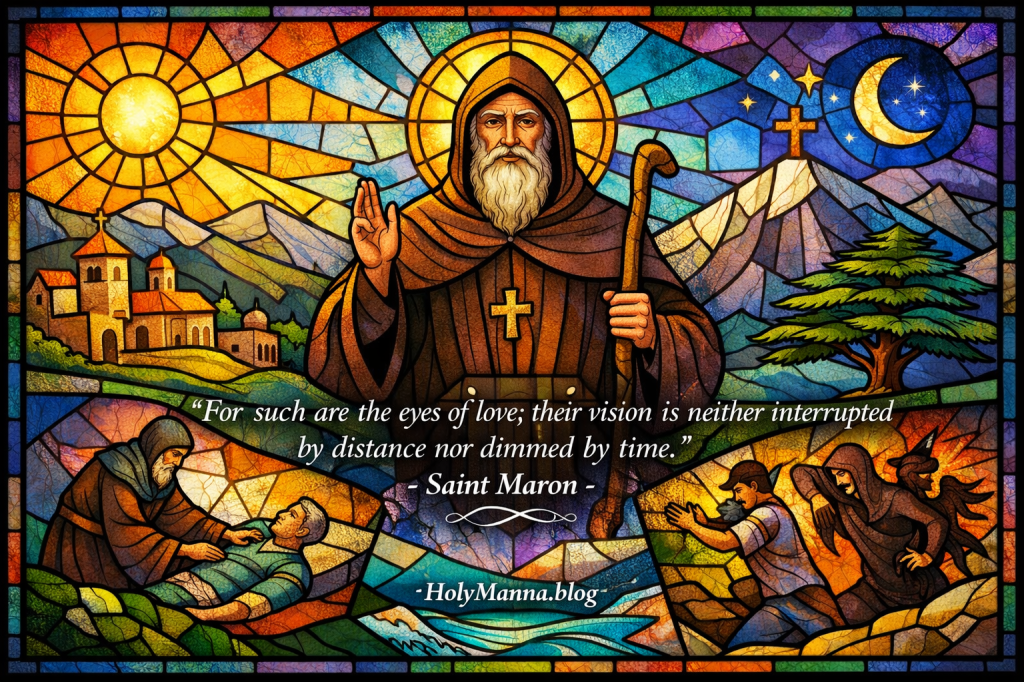
Saint of the Day: Saint Maron (Maroun)
Under the Open Sky: The Hermit Who Quietly Built a People
A Hidden Saint With a Worldwide Echo
Saint Maron is one of those saints whose life proves that God does not need a spotlight to shape the world. He was a priest and hermit in Syria in the late fourth and early fifth century, and he is remembered as the spiritual father whose disciples helped form what became the Maronite Catholic Church, a tradition that remains fully Catholic and in communion with Rome. The details of his earliest years are not preserved in the way they are for many later saints, but the Church still has something solid: early Christian testimony about his way of life, his reputation for holiness, and the unmistakable fruit that followed him.
Saint Maron is revered because he shows what happens when a soul becomes single-minded about God. He did not build a public platform, write volumes of theology, or travel the world preaching. Instead, he became a living sign of the Kingdom through prayer, penance, and spiritual fatherhood. His story also widens the horizon for Catholics who only know the Latin tradition, because Eastern Catholic Churches like the Maronite Church carry ancient treasures of worship, fasting, and fidelity that belong to the whole Catholic family. This is the kind of holiness that feels hidden in the moment, but proves later that grace multiplies quietly.
Formed in the Desert School of Prayer
Not much is known about Saint Maron’s childhood, family, or formal education, and it is better to be honest than to fill in blanks. What Catholic tradition preserves is that he lived near the region of Cyrrhus in Syria and learned the spiritual life in the company of other holy ascetics. Maronite tradition remembers him as a disciple of the hermit Zebinas, a man known for intense prayer. That detail matters because it shows Saint Maron did not invent his path out of thin air. He received a living tradition, then lived it with such purity that it drew others into the same love.
His conversion story is not a dramatic tale of an overnight turnaround. His conversion is seen in the kind of choices most Catholics are actually called to make: the steady surrender of the will, the daily turning of the heart toward God, and the refusal to let comfort or approval become the center. This is the kind of conversion that looks ordinary from the outside, but becomes heroic because it is faithful.
Saint Maron is most known for embracing the open-air life as a hermit. He chose to live exposed to heat, cold, wind, and rain with minimal shelter, using a small tent rarely. This was not a stunt or a performance. It was a wordless homily that said God is worth everything, and that the body can be trained to serve the soul instead of dragging it around. This fits the Church’s understanding of eremitic life, which The Catechism describes as a stricter separation from the world and a hidden witness that God is enough, even when no one applauds it, as taught in CCC 920-921.
A Mountain Reclaimed for Christ
There is a powerful piece of tradition that gives Saint Maron’s life a missionary edge. He lived on a mountain site associated with pagan worship, and the space was reclaimed for the worship of the true God. This is more than a historical footnote. It is a spiritual image that speaks directly to modern life, because every generation has its “high places” that compete with God. Saint Maron did not only avoid what was dark. He planted prayer right where darkness once claimed ground, and the place became a sign of conversion.
That matters because the Christian life is not just about personal improvement. It is about consecration. Christ does not want only part of a life. He wants the whole heart, the whole schedule, the whole home, and even the spaces where temptation tries to settle in. The Catechism teaches that the Christian life is a call to holiness, a real transformation by grace, and not merely moral self-help, as seen throughout CCC 2012-2015. Saint Maron’s mountain becomes a mirror for modern Catholics: the Lord still calls His people to reclaim the interior life for Him.
Healings, Deliverance, and Spiritual Fatherhood
Saint Maron’s solitude did not make him distant from people. It made him spiritually strong, and people recognized that strength. Early Christian testimony about him describes healings of the sick and liberation from spiritual oppression. Tradition remembers relief from fevers and other illnesses, and it also remembers deliverance from demonic affliction. Catholics do not treat this as entertainment or superstition. The Church has always taught that God can work signs through His holy ones, and that spiritual warfare is real, even if modern culture tries to pretend otherwise.
One of the most striking parts of Saint Maron’s reputation is that he was remembered not only for physical cures but also for helping people heal morally and spiritually. He helped people confront anger, greed, injustice, and lack of self-control. That kind of healing is a mercy many people forget to ask God for, yet it is the kind that rebuilds families and restores peace. This lines up with the Church’s teaching that virtue is formed through grace and repeated choices, and that God’s healing often reaches deeper than symptoms, into the heart itself, as reflected in CCC 1803-1811.
Saint Maron also became a spiritual father to disciples who wanted to imitate his life of prayer and penance. His fruit was not limited to one hillside. His disciples multiplied and carried his spirit forward, which is why his name did not disappear after his death. A saint does not have to travel far to change the world. He only has to be deeply rooted in God.
A Letter That Reveals His Reputation
There is a rare and important historical detail that strengthens confidence in Saint Maron’s place in the early Church. Saint John Chrysostom wrote to him, treating him as a respected priest and monk and asking for his prayers. That kind of letter only makes sense if Maron was known for holiness and intercession even while he lived. One line often preserved from that correspondence is “For such are the eyes of love; their vision is neither interrupted by distance nor dimmed by time.” This line fits the Catholic sense of communion in Christ, where charity is stronger than separation, and where holiness creates real bonds across suffering.
This also reflects the Catholic belief that prayer is never wasted and that intercession is part of God’s plan for His people. The Catechism teaches that intercession is a prayer of communion that conforms believers to Jesus, and it also teaches that the saints continue to intercede for the Church, as taught in CCC 2634-2636 and CCC 956. Saint Maron’s story is not only about a hermit. It is about the Church as a family that prays for one another across time.
The Daily Martyrdom of Penance
Saint Maron is not typically remembered as a martyr by public execution, but his life still carried a real form of martyrdom. It was the slow, daily martyrdom of penance. Living under the open sky, fasting, embracing discomfort, and refusing the easy path is not glamorous. It is a cross carried quietly, and it is a deeply Catholic way of living. The point is not to punish the body. The point is to train the heart, to refuse slavery to comfort, and to make room for God.
His hardships also included the spiritual burden of guiding souls. A real spiritual father does not only affirm. He calls people to repentance and to truth, and that takes courage. This is why the Church often recognizes that holiness will draw opposition, misunderstanding, and temptation. Yet Saint Maron’s reputation endured because his counsel was anchored in prayer and fidelity, not in pleasing crowds.
A Legacy Tested by Conflict and Fidelity
Suffering followed Saint Maron’s spiritual family after his death. The monastic communities associated with his name lived through conflicts tied to doctrinal controversy and political violence in the region. Maronite historical memory preserves that monks connected with the monastery bearing his name endured attacks, and that fidelity came with a real cost. The details belong to a complex period, but the spiritual lesson is simple: clinging to orthodox faith and living it publicly has always required courage.
This is part of why Saint Maron remains relevant. His life shows that holiness is not a hobby. It is spiritual warfare shaped by love. The Catechism teaches that Christian life involves struggle against sin and the temptations of the evil one, and that perseverance in faith is part of discipleship, as reflected in CCC 409 and CCC 2015. Saint Maron’s story is not meant to make people anxious. It is meant to make people serious, hopeful, and steady.
A Holy Death That Kept Bearing Fruit
Maronite tradition remembers that when Saint Maron died, neighboring villages disputed over his body, believing that burial near a holy man would bring blessing. A larger village ultimately took his body and built a church connected with his tomb. This detail is strange to modern ears, but it makes sense in Catholic logic. The faithful believed that God’s holiness leaves a real mark on a saint’s life and memory, not because the saint is a magician, but because God loves to glorify His friends.
Stories of miracles after his death grew alongside his veneration, with healings and favors attributed to his intercession and devotion connected to his relics. Catholics venerate relics because the body matters, the Incarnation matters, and grace truly sanctifies the human person. This is why the Church speaks positively of sacramentals and holy signs when they lead people to Christ and strengthen faith, as reflected in CCC 1667-1670. The greatest fruit of his life is not only the stories of favors. It is the living tradition that continued to grow from his disciples.
A Feast That Still Gathers the Faithful
Saint Maron is celebrated with special devotion in the Maronite Church, especially on February 9. His feast is not only a historical memory. It is a living celebration of what God can do through a hidden life. His name continues to unite communities across the world, especially in Lebanon and throughout the Maronite diaspora, and it continues to remind Catholics that the Church is truly universal, with many legitimate liturgical and cultural expressions all centered on the one faith.
This kind of living memory is part of the Catholic understanding of Tradition. The faith is handed on, lived, prayed, and celebrated, not as nostalgia, but as a real participation in the life of Christ. The Catechism teaches that Tradition is the living transmission of the Gospel in the Church, as seen in CCC 78-83. Saint Maron’s legacy is not a museum. It is a living river.
Living Saint Maron’s Spirit
Saint Maron’s life can sound intense, but it is not meant to feel unreachable. His example translates into modern life more directly than many people expect. He shows that prayer is not an accessory. It is spiritual oxygen. He shows that discipline is not personality. It is virtue, built by grace and practiced through choices.
A Catholic trying to imitate Saint Maron does not need to sleep outdoors or flee to a mountain. The imitation starts with reclaiming space for God. It means setting a real time for silent prayer each day and guarding it like it matters, because it does. It means fasting from whatever has been weakening the will, whether that is endless scrolling, comfort-driven habits, or constant entertainment. It means taking confession seriously, because repentance is one of the most practical forms of spiritual warfare and one of the clearest ways Christ heals souls.
Saint Maron also teaches that hidden faithfulness multiplies. A father who prays changes a household. A mother who sacrifices quietly changes a family’s atmosphere. A young adult who chooses chastity changes the future. A parishioner who intercedes changes a parish. This is how the Kingdom spreads. It does not always move through headlines. It moves through saints, and it often begins with the simple decision to love God more than comfort.
Engage With Us!
Share your thoughts and reflections in the comments below. Saint Maron’s hidden life raises the kind of questions that can change the way everyday faith is lived.
- Where is God inviting a deeper conversion right now, not through drama, but through steady fidelity?
- What comfort or habit has started to compete with prayer and needs to be surrendered?
- What “space” in life needs to be reclaimed for God, such as a room, a routine, a relationship, or a screen?
- How can discipline be embraced this week, not as punishment, but as love offered to Christ?
- When life feels unseen, how can trust grow that God is still building something real through hidden faithfulness?
Keep walking forward in faith. Keep choosing the good. Keep praying when it feels dry and keep repenting when it feels hard. A life done with the love and mercy Jesus taught is never wasted, and even small acts of holiness can become a light that reaches farther than anyone expects.
Saint Maron, pray for us!
Follow us on YouTube, Instagram and Facebook for more insights and reflections on living a faith-filled life.

 Holy Manna!
Leave a comment