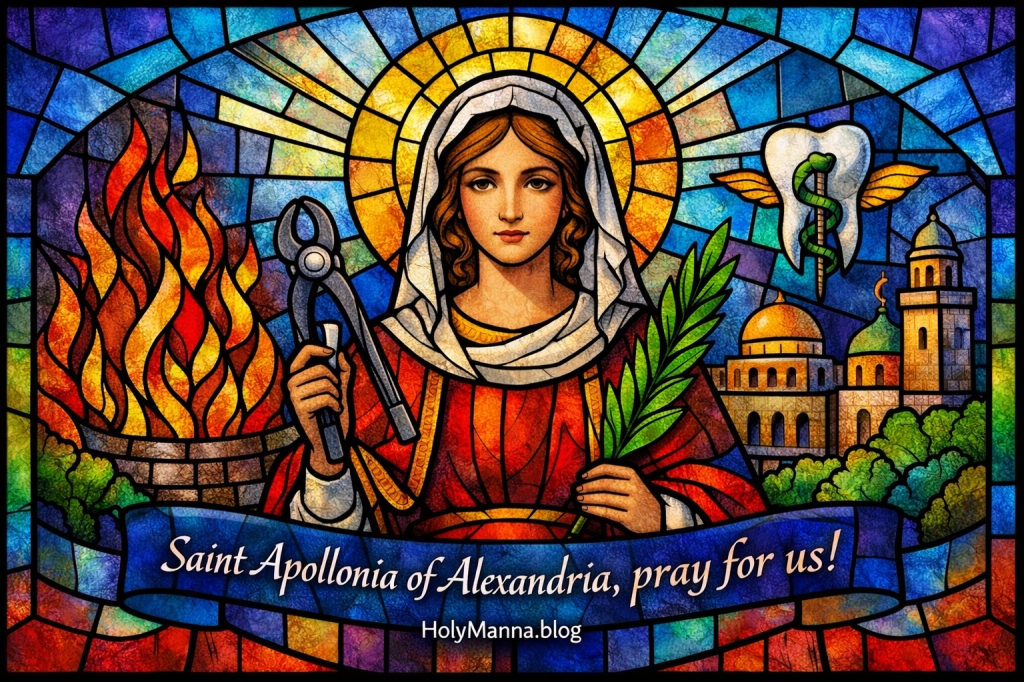
Teeth, Fire, and Fearless Faith
Saint Apollonia is one of those early Christian witnesses whose story refuses to fade, not because it is stuffed with legendary details, but because the heart of it is so raw and so real. She lived in Alexandria, Egypt, and the Church remembers her as a consecrated virgin and martyr from the third century. Her witness is treated with special seriousness because the central account of her martyrdom is anchored in early Church testimony associated with Saint Dionysius of Alexandria and preserved by the Church historian Eusebius.
Apollonia is also one of the most recognizable saints in popular Catholic devotion. She is widely honored as a patroness of dentists and of those suffering toothaches or dental disease. That patronage is not a novelty. It is a reminder that God can take even the most specific suffering and turn it into a channel of grace, and it is a reminder that the saints are not distant figures trapped in stained glass. They are living members of the Communion of Saints who still intercede for the Church on earth, as The Catechism teaches about the saints’ continuing love and prayer for us in CCC 956.
A Quiet Consecration That Became a Public Stand
Almost nothing is known about Apollonia’s childhood, her family, or the ordinary details of her daily routine, and that silence is worth respecting. The Church does not venerate saints because every chapter of their biography is available. The Church venerates saints because Christ’s grace shines through them, even when history preserves only a few scenes.
The earliest testimony describes her as an “aged virgin,” which points to a woman publicly known in the Christian community for a life of chastity and dedication to the Lord. That one phrase suggests a long fidelity, a steady life of prayer and discipline, and a heart trained to belong to Christ when no one was applauding. Her “conversion story,” at least as the historical record allows it to be told, is not a dramatic tale of a pagan past suddenly replaced by Christian joy. It looks more like a lifetime of faithful belonging to Jesus, the kind of hidden holiness that only becomes visible when the pressure arrives and the heart shows what it truly loves.
This matters for modern Catholics because most people will never have a cinematic conversion moment. Most people are called to build holiness slowly, through daily prayer, daily obedience, and daily choices that strengthen the soul. Apollonia’s life shows that when that slow faith is real, it becomes a fortress when the storm hits.
The “Miracle” That Does Not Sparkle
When many people hear the word saint, they expect stories of healings, prophecies, or public wonders. With Saint Apollonia, Catholic sources do not preserve reliable accounts of miracles performed during her lifetime. The earliest record focuses on persecution and martyrdom, and later legendary accounts are treated cautiously because they do not carry the same historical weight.
That does not make her witness smaller. It makes her witness sharper. Her “sign” is the miracle of grace working in a human soul under pressure, the kind of miracle that does not sparkle but changes everything. The Catechism describes martyrdom as the supreme witness to the truth of the faith in CCC 2473-2474. It also teaches that fortitude enables a person to conquer fear, even fear of death, and to face trials and persecutions in CCC 1808. Apollonia’s life is an icon of both teachings, because her courage was not a personality trait. It was a supernatural strength rooted in belonging to Christ.
Her story answers a question the modern world rarely asks honestly. What happens when faith stops being a private preference and becomes a public liability. Apollonia shows what it looks like when a believer chooses truth over safety, not because suffering is enjoyable, but because Jesus is worth more than comfort.
A Woman Marked for Christ
Apollonia’s martyrdom took place during a violent outbreak in Alexandria. Catholic sources describe a local anti-Christian eruption that began in the city before the wider imperial persecution fully intensified. The earliest testimony connects the violence to agitation stirred by a local figure described as a poet and prophet, someone who inflamed the crowd and helped turn public anger into organized brutality against Christians.
This setting matters because persecution is not always tidy. Sometimes it is not a courtroom scene with a judge and a transcript. Sometimes it is a crowd that decides Christians are the problem, and the mob becomes judge, jury, and executioner. That also means cultural stability can collapse quickly. One week someone is a respected neighbor. The next week the same person is treated like an enemy of the people.
In that chaos Apollonia was seized, and the torture was specific and horrifying. The earliest testimony records the detail that shaped her iconography and her patronage ever since. “They knocked out all her teeth by striking her on the jaws.” The mob prepared a fire and threatened to burn her alive unless she spoke words that would deny Christ.
Here is where her witness becomes painfully direct. The persecutors were not only trying to kill her. They were trying to make her use her own mouth to betray the Lord. She asked for a brief moment, and then she chose the flames rather than apostasy. The Church remembers her as a martyr because her death is understood as fidelity under coercion and imminent execution, not despair. This is why Catholic tradition has long treated her act within the moral framework that distinguishes martyrdom from self-destruction, while also acknowledging that the scene is intense and demands careful understanding. This also harmonizes with the Church’s broader moral teaching on the dignity of human life in CCC 2280-2283 and the unique glory of martyrdom in CCC 2473-2474.
Apollonia’s courage only makes sense if Heaven is real and if Jesus is truly Lord. Her story is a blunt reminder that the early Christians were not playing symbolic games. They lived and died for a living Christ.
A Patron Saint for Toothaches
After her death devotion to Apollonia spread widely, especially tied to the particular suffering she endured. Because her teeth were targeted in her torture, the faithful began invoking her especially for toothaches and dental anxiety, and she became widely known as a patroness of dentists and of those suffering dental pain. Her image in sacred art is often simple and direct, showing her holding pincers or forceps with a tooth, sometimes also holding the palm branch of martyrdom.
This iconography is not meant to be creepy. It is meant to preach without words. It says the Christian body matters, suffering is real, and holiness is not a fantasy. It also says God can take what was used to humiliate a believer and turn it into a sign of victory. It is a quiet proclamation that no cruelty has the last word over a soul that belongs to Christ.
When it comes to miracles after her death, Catholic sources do not preserve early, formally investigated miracle accounts attached to her in the way later canonization causes sometimes do. Her “miracle tradition” is primarily the long stream of favors and answered prayers associated with her intercession, especially in moments of dental pain and fear. This devotion fits the Church’s teaching on the Communion of Saints, because The Catechism teaches that those who are with Christ continue to pray for the Church on earth in CCC 956. Her feast is traditionally associated with February 9, and her memory remains alive in the Church’s liturgical tradition and in the steady prayer of the faithful, even in places where she is not prominent on the local parish calendar.
Lessons for Catholics Who Want a Serious Faith
Saint Apollonia’s story is not mainly about teeth. It is about the mouth and what it is willing to say when fear takes over. The mob demanded words of betrayal, and she refused. That is why her witness still matters in a world that pressures Christians to soften the faith, hide it, or treat it like an embarrassing hobby.
Apollonia teaches that compromise often shows up dressed like “common sense.” It is the small sentence that keeps the peace, the laugh that signals approval, the silence that avoids conflict, and the convenient half-truth that protects comfort. Her life pushes back and reminds Catholics that words matter because truth matters. Her witness also teaches a deeply Catholic way of living with suffering. Pain is never something to chase, but pain can become an offering when it is united to Christ. A cross carried with faith becomes a place where grace works, and it becomes a prayer with weight.
Apollonia also speaks to chastity and consecration in a way that is not sentimental. She is remembered as a virgin, meaning her life was shaped by an undivided love for the Lord. That does not make her story irrelevant to married people or young adults. It makes her a sign that every Catholic vocation is called to integrity of body and soul, and that every disciple is called to belong to Christ without secret exceptions.
Most of all, she teaches fortitude without theatrics. She was not trying to create a headline. She was simply refusing to deny the One who had saved her. That kind of courage is still possible today, and it is still needed.
Engage with Us!
Share your thoughts and reflections in the comments below.
- Where does modern life pressure Christians to stay quiet about Jesus or to compromise the truth?
- What is one concrete way to practice fortitude this week, especially when fear or people pleasing shows up?
- How can today’s sufferings, even small ones, be offered to Christ as a prayer for someone else?
- When pain or anxiety hits, does the heart turn toward prayer or toward escape, and what would help that habit change?
Saint Apollonia’s life is a call to live awake, live loyal, and live unafraid. Keep walking in faith, keep choosing courage over compromise, and keep doing everything with the love and mercy Jesus taught us.
Saint Apollonia of Alexandria, pray for us!
Follow us on YouTube, Instagram and Facebook for more insights and reflections on living a faith-filled life.

 Holy Manna!
Leave a comment