Monday of the Fifth Week in Ordinary Time – Lectionary: 329
When God Comes Close, Everything Changes
Some days in Scripture feel like watching a door open that most people forget is even there. Today is one of those days, because every reading circles one central truth: God does not stay distant. God chooses to dwell with His people, and when that holy Presence is welcomed with reverence and sought with faith, hearts are steadied, worship is purified, and the broken begin to heal.
In the First Reading, Israel is not improvising a new religion or chasing a trend. Israel is bringing the Ark of the Covenant into the Temple, placing at the center the sign of God’s promises, the Law given through Moses, and the covenant that formed a people out of slavery. When the Ark is enthroned in the Holy of Holies, a cloud fills the house, and Solomon dares to say what every believer has to learn sooner or later: “The LORD intends to dwell in the dark cloud” (1 Kgs 8:12). That mysterious cloud is not confusion. It is a reminder that God is near, but never tame, and His glory is not something to control, only something to adore.
The Psalm answers that moment with the voice of worship. It speaks like a pilgrim finally reaching the place of encounter, saying, “Let us enter his dwelling; let us worship at his footstool” (Ps 132:7), and crying out, “Arise, LORD, come to your resting place, you and your mighty ark” (Ps 132:8). It is a prayer that ties holiness to joy and justice, because when God is truly welcomed, worship does not remain a private feeling. It becomes a way of life.
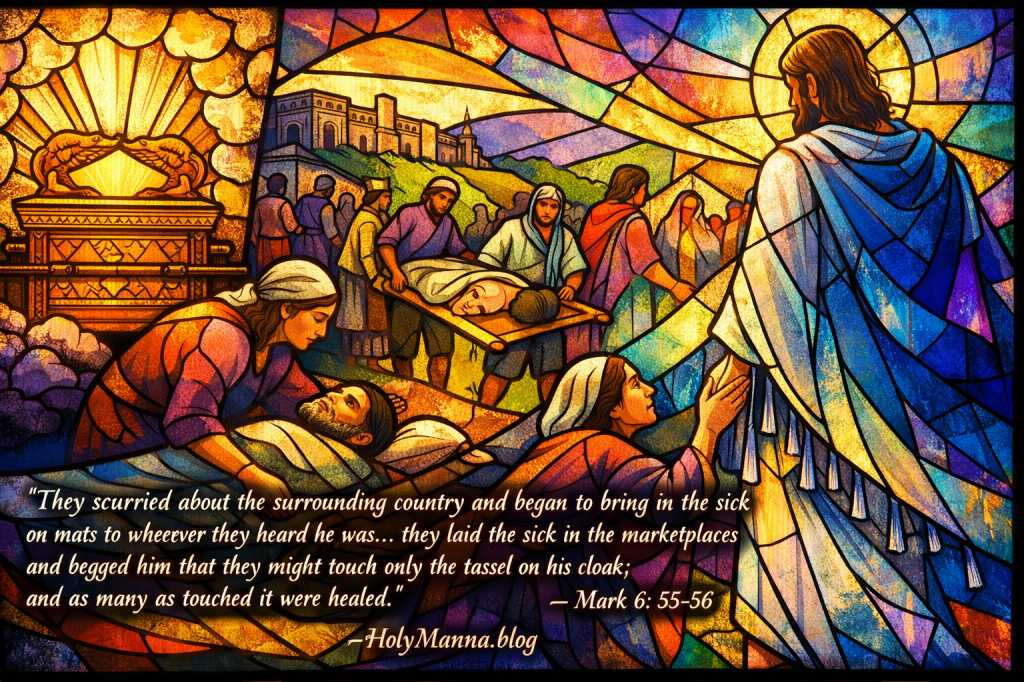
Then the Gospel shows what the Temple was always pointing toward. Jesus steps onto the shore at Gennesaret, and people run to Him with the urgent hope that even the fringe of His garment is enough. They beg “that they might touch only the tassel on his cloak” (Mk 6:56), and the Gospel says with stunning simplicity that “as many as touched it were healed” (Mk 6:56). Those tassels were a cultural and religious sign in Israel, meant to remind God’s people of His commandments and covenant. Now the people reach for that sign because they sense that the covenant is no longer hidden behind a veil. The covenant is walking through their towns in the flesh.
The thread tying it all together is clear and personal. God’s Presence is not just a memory from Solomon’s Temple or a miracle on a lakeshore. God still desires to be with His people, to be approached with reverence, and to heal what sin and suffering have wounded. How close is God allowed to come, and how seriously is His Presence treated when He does?
First Reading – 1 Kings 8:1-7, 9-13
When God Takes His Seat Among His People
Solomon’s Temple is not just a beautiful building project. It is the moment Israel’s worship becomes visibly centered, with the Ark of the Covenant carried into the Holy of Holies like a royal throne being set in place. The Ark is the covenant heart of Israel’s story, because it holds the tablets of the Law, the concrete sign that the Lord truly bound Himself to His people and taught them how to live as His own. When the Ark arrives, a cloud fills the Temple so intensely that the priests cannot continue their ministry. This is the Bible’s way of saying that God is not an idea hovering in the background. God is present, God is holy, and God chooses to dwell with His people in a way that demands reverence and awakens faith. This reading fits today’s theme perfectly because it shows the pattern that will reach its fullness in Christ: God comes close, and those who draw near must learn how to respond with worship, humility, and trust.
1 Kings 8:1-7, 9-13 – New American Bible (Revised Edition)
Dedication of the Temple. 1 Then Solomon assembled the elders of Israel and all the heads of the tribes, the princes in the ancestral houses of the Israelites. They came to King Solomon in Jerusalem, to bring up the ark of the Lord’s covenant from the city of David (which is Zion). 2 All the people of Israel assembled before King Solomon during the festival in the month of Ethanim (the seventh month). 3 When all the elders of Israel had arrived, the priests took up the ark; 4 and they brought up the ark of the Lord and the tent of meeting with all the sacred vessels that were in the tent. The priests and Levites brought them up. 5 King Solomon and the entire community of Israel, gathered for the occasion before the ark, sacrificed sheep and oxen too many to number or count. 6 The priests brought the ark of the covenant of the Lord to its place, the inner sanctuary of the house, the holy of holies, beneath the wings of the cherubim. 7 The cherubim had their wings spread out over the place of the ark, sheltering the ark and its poles from above.
9 There was nothing in the ark but the two stone tablets which Moses had put there at Horeb, when the Lord made a covenant with the Israelites after they went forth from the land of Egypt. 10 When the priests left the holy place, the cloud filled the house of the Lord 11 so that the priests could no longer minister because of the cloud, since the glory of the Lord had filled the house of the Lord. 12 Then Solomon said,
“The Lord intends to dwell in the dark cloud;
13 I have indeed built you a princely house,
the base for your enthronement forever.”
Detailed Exegesis
Verse 1 – Then Solomon assembled the elders of Israel and all the heads of the tribes, the princes in the ancestral houses of the Israelites. They came to King Solomon in Jerusalem, to bring up the ark of the Lord’s covenant from the city of David (which is Zion).
This is a national act, not a private devotion. Israel’s leaders gather because the covenant is the foundation of their identity. Bringing the Ark from Zion into the Temple is a way of saying that God’s kingship is the center of the kingdom. The political order is being placed under the covenant, which is a strong reminder that Israel does not belong to Solomon first. Israel belongs to the Lord.
Verse 2 – All the people of Israel assembled before King Solomon during the festival in the month of Ethanim (the seventh month).
The timing matters. The seventh month is a sacred season in Israel’s calendar, tied to remembrance, repentance, and worship. It is a month that naturally calls to mind the wilderness years, when God led His people by His presence and taught them to rely on Him day by day. The Temple is new, but the lesson is old: God’s people must never treat God as a decoration for their success. God is the source of their life.
Verse 3 – When all the elders of Israel had arrived, the priests took up the ark;
The Ark is not moved like ordinary cargo. The priests take it up because holy things are handled according to God’s instruction, not human convenience. This detail teaches that reverence is not just a feeling. Reverence becomes obedience, order, and care in worship.
Verse 4 – and they brought up the ark of the Lord and the tent of meeting with all the sacred vessels that were in the tent. The priests and Levites brought them up.
This is a transition from the portable worship of the wilderness to the settled worship of the Promised Land. The tent of meeting and its vessels connect the Temple to everything God already did in Israel’s history. Nothing here is meant to erase the past. It is meant to fulfill it, like a promise coming to maturity.
Verse 5 – King Solomon and the entire community of Israel, gathered for the occasion before the ark, sacrificed sheep and oxen too many to number or count.
The abundance of sacrifice shows the seriousness of the moment. Worship is not cheap because love is not cheap. Israel is saying with actions what words alone cannot say: the Lord is worthy. Sacrifice also teaches that communion with God is not casual. It involves offering, atonement, and gratitude, all of which prepare the heart for deeper covenant fidelity.
Verse 6 – The priests brought the ark of the covenant of the Lord to its place, the inner sanctuary of the house, the holy of holies, beneath the wings of the cherubim.
The Holy of Holies is the center of the Temple, set apart for God’s presence. The Ark is placed there to show that God is enthroned in the midst of His people, not as a tame idol, but as the living Lord. The cherubim imagery recalls the guardianship of Eden and the heavenly court. It quietly teaches that worship is not entertainment. Worship is contact with heaven.
Verse 7 – The cherubim had their wings spread out over the place of the ark, sheltering the ark and its poles from above.
The wings create a picture of covering and protection. It is not that God needs protection, but that the sacred is being honored as sacred. The visual symbolism teaches that God’s presence is a gift that must be received with awe, not grabbed at with familiarity that forgets Who God is.
Verse 9 – There was nothing in the ark but the two stone tablets which Moses had put there at Horeb, when the Lord made a covenant with the Israelites after they went forth from the land of Egypt.
This line brings everything back to the covenant. The tablets represent God’s word, God’s moral order, and God’s fatherly instruction. The heart of Israel’s worship is not a vague spirituality. It is a relationship shaped by God’s revealed truth. The Temple is glorious, but the Law inside the Ark reminds Israel that true glory includes obedience.
Verse 10 – When the priests left the holy place, the cloud filled the house of the Lord
The cloud signals the Lord’s mysterious presence. In Scripture, a cloud often means God is truly near while remaining beyond human control. God reveals Himself, but never becomes a possession. The cloud also protects Israel from reducing God to something manageable.
Verse 11 – so that the priests could no longer minister because of the cloud, since the glory of the Lord had filled the house of the Lord.
This is holy interruption. The priests stop, not because worship has failed, but because God’s glory has taken the initiative. This teaches a hard and beautiful lesson: sometimes the most genuine worship is silence, stillness, and surrender, because God is doing what only God can do.
Verse 12 – Then Solomon said, “The Lord intends to dwell in the dark cloud;
Solomon names the paradox. God dwells, but in a way that remains mysterious. The “dark cloud” does not mean God is absent. It means God is present in a way that humbles the mind and purifies the heart. Faith grows when God is not reduced to a problem to solve, but received as a Lord to trust.
Verse 13 – I have indeed built you a princely house, the base for your enthronement forever.”
Solomon speaks of permanence, and yet the Bible will later teach that no building can contain the living God. The Temple is a real gift and a true meeting place, but it is also a sign pointing forward. It prepares the way for the fullness of God’s dwelling with His people, which Christians recognize in Jesus Christ, the true and definitive presence of God among us.
Teachings
This reading teaches that God’s closeness is always both comforting and demanding. Comforting, because the Lord chooses to be with His people and to establish real places and real acts of worship where they can draw near. Demanding, because God’s presence is holy, and holiness is not something to be treated like common space. The Ark holds the tablets, reminding every generation that worship cannot be separated from covenant life. When the Law is ignored, worship becomes performance. When the Law is loved, worship becomes communion.
Catholic tradition sees the Temple as a providential sign that points beyond itself. The Temple gathers God’s people, forms them through sacrifice and prayer, and teaches reverence through sacred space. At the same time, the Old Covenant signs prepare the world for something greater than stone and gold: God’s dwelling in the flesh, and God’s dwelling in His Church through grace and sacrament. The cloud that halts the priests is a vivid reminder that God is not controlled by technique, personality, or planning. God is adored, listened to, and obeyed.
A helpful line from the saints captures the longing underneath today’s scene, the deep desire for God’s true dwelling and true rest: “You have made us for yourself, and our heart is restless until it rests in you.” (St Augustine, Confessions 1.1). The Temple is a sign of that rest, but it also reveals why restlessness exists in the first place. A heart that forgets God has no true center.
Reflection
Solomon’s Temple dedication can sound distant until daily life begins to resemble a scattered kingdom. Distractions multiply, priorities shift, and the “holy place” becomes crowded with noise. This reading calls for a return to the center. It invites a serious question about what sits on the throne of the heart, because every life has a center, whether it is named or not.
A practical way to live this reading is to treat worship as the anchor of the week, not an optional add on. Another practical step is to reclaim reverence in small ways that shape the soul, such as arriving early to Mass, making silence normal again, and treating prayer like a real meeting with a real Person. It also helps to build a “temple habit” at home, which can be as simple as a consistent place and time for prayer, where the mind learns to kneel even when the emotions do not cooperate. The “dark cloud” can even become a comfort, because life often includes confusion, waiting, and unanswered questions, and yet God can be truly present in the mystery.
Where has life become noisy enough that God’s presence is treated like background instead of the center?
What would change if worship were approached with the seriousness of a covenant, not the casualness of a routine?
When the “dark cloud” settles in the form of uncertainty or suffering, will faith interpret it as abandonment, or as a call to trust the God who still chooses to dwell near His people?
Responsorial Psalm – Psalm 132:6-10
The Cry of a Pilgrim Heart Seeking God’s Dwelling
This psalm sounds like a crowd on the move, because it comes from a tradition of worship that was never meant to stay locked inside private feelings. Psalm 132 is tied to Zion, to David, and to the Ark of the Covenant, which had a real history in Israel’s memory. The Ark had been lost, recovered, and kept for a time at Kiriath-jearim, before David brought it up toward Jerusalem with reverence and trembling joy. In today’s liturgy, this psalm becomes the people’s response to Solomon bringing the Ark into the Temple, and it sets the tone for the Gospel where crowds press toward Jesus with the same urgency. The theme is consistent: God chooses to be near, and faithful people respond by seeking His presence, honoring His holiness, and begging Him not to turn away.
Psalm 132:6-10 – New American Bible (Revised Edition)
6 “We have heard of it in Ephrathah;
we have found it in the fields of Jaar.
7 Let us enter his dwelling;
let us worship at his footstool.”
8 “Arise, Lord, come to your resting place,
you and your mighty ark.
9 Your priests will be clothed with justice;
your devout will shout for joy.”
10 For the sake of David your servant,
do not reject your anointed.
Detailed Exegesis
Verse 6 – “We have heard of it in Ephrathah; we have found it in the fields of Jaar.”
This line remembers a real search, like someone tracing family stories until the truth becomes personal. “Ephrathah” evokes Bethlehem and the region of Judah, and “Jaar” points toward Kiriath-jearim, associated with the Ark’s resting place in earlier generations. The psalm is teaching that God’s presence is not a rumor to discuss. God’s presence is a reality to pursue. The heart of worship is not novelty. The heart of worship is finding again what was always meant to be central.
Verse 7 – “Let us enter his dwelling; let us worship at his footstool.”
This is the posture of reverence. The “dwelling” and “footstool” language makes clear that Israel approaches God as King. Worship is not casual familiarity that forgets who God is. Worship is love that kneels. Spiritually, this verse trains the soul to enter sacred space with intention, because the point is not to consume an experience but to adore the Lord who is truly present and truly holy.
Verse 8 – “Arise, LORD, come to your resting place, you and your mighty ark.”
This is a bold prayer, not because it commands God, but because it asks God to take His rightful place among His people. The “resting place” is not God getting tired. It is covenant language for God establishing His presence in the midst of worship. The Ark represents the Lord’s nearness and His promises, and the prayer reveals something important: God’s people do not want an empty religion. They want God Himself.
Verse 9 – “Your priests will be clothed with justice; your devout will shout for joy.”
Holiness and joy belong together. Priests “clothed with justice” signals that worship cannot be separated from righteousness, integrity, and fidelity to God’s covenant. When those who lead worship are shaped by justice, the people rejoice, because the community senses order, truth, and peace returning. This verse also quietly warns that when worship is cut off from moral life, joy collapses into noise.
Verse 10 – “For the sake of David your servant, do not reject your anointed.”
This is covenant memory turned into petition. Israel appeals to God’s promises to David, asking the Lord to remain faithful to His word and to protect the king He has chosen. In the light of the full biblical story, this line also looks forward, because the Davidic covenant is a road that leads to the Messiah. The psalm is not only about yesterday’s kings. It is about God’s enduring faithfulness and the hope of the true Anointed One.
Teachings
This psalm teaches the Church how to pray like a pilgrim people. It gives language for seeking God’s presence with reverence, and it connects worship to moral integrity. It also teaches that sacred history matters, because God forms His people through real events, real promises, and real covenants that shape how prayer is understood.
The Church puts the psalms on the lips of believers constantly because they are not merely ancient poetry. They are God-given school for prayer. The Catechism says, “The Psalms both nourish and express the prayer of the People of God. Composed for singing, accompanied by musical instruments, they are an integral part of the Church’s liturgy. They are suitable for men of all conditions and times. They express the prayer of the people chosen by God.” (CCC 2585).
This psalm also highlights the meaning of entering God’s dwelling, which matters because Catholic worship is not abstract. It is embodied, communal, and ordered toward adoration. The Catechism teaches, “A church, ‘a house of prayer in which the Eucharist is celebrated and reserved, where the faithful assemble, and where is worshiped the presence of the Son of God our Savior offered for us on the sacrificial altar,’ is a visible sign of the Church living in this place, the dwelling of God with men reconciled and united in Christ.” (CCC 1181).
Saints often echo this same theme of reverent approach, because genuine worship shapes genuine life. Saint Augustine captures the goal with bracing clarity: “Become what you receive.” This simple line has been cherished in Catholic tradition because it insists that worship is not meant to stay at the surface. When God draws near, the human person is meant to be changed.
Reflection
This psalm gives a healthy correction to the modern habit of treating worship like a personal preference. It reminds the soul that worship is pilgrimage, and pilgrimage requires leaving comfort behind. A pilgrim does not drift into God’s presence by accident. A pilgrim chooses the road, takes the steps, and keeps going even when the heart feels dry.
A practical way to live this psalm is to reclaim the art of arriving. It helps to approach worship with preparation, such as reading the day’s readings ahead of time, guarding silence before Mass, and letting the body participate through reverent posture and attentive listening. It also helps to take verse 9 seriously by asking whether daily choices match the prayers being offered. The psalm links priests clothed with justice to a people shouting for joy, which means joy is not built on denial. Joy grows where truth is honored and sin is resisted.
Is worship being treated like a weekly habit, or like an encounter with the living God who deserves reverence and attention?
What would change if prayer were approached as a pilgrimage that requires preparation, discipline, and love, rather than a mood to chase?
Is the heart more eager to be entertained, or more eager to “enter his dwelling” and worship with the humility of someone standing at the King’s footstool?
Holy Gospel – Mark 6:53-56
The Healing Presence That Cannot Be Hidden
This Gospel scene moves fast, because the need is urgent and the hope is real. Jesus and the disciples land at Gennesaret on the northwestern shore of the Sea of Galilee, a busy region of villages and farmland where news travels quickly and crowds gather easily. Mark places this moment right after the Lord’s mighty works across the water, which matters because it shows a pattern: Christ reveals His authority, then He steps into ordinary human spaces where suffering lives. This is not a controlled setting like Solomon’s Temple, but the theme is the same as the First Reading and the Psalm. God comes close. God makes His dwelling among His people. When that happens, faithful people do not stay at a distance. They draw near with reverence and trust, convinced that holiness is not meant to crush the weak but to heal them.
Mark 6:53-56 – New American Bible (Revised Edition)
The Healings at Gennesaret. 53 After making the crossing, they came to land at Gennesaret and tied up there. 54 As they were leaving the boat, people immediately recognized him. 55 They scurried about the surrounding country and began to bring in the sick on mats to wherever they heard he was. 56 Whatever villages or towns or countryside he entered, they laid the sick in the marketplaces and begged him that they might touch only the tassel on his cloak; and as many as touched it were healed.
Detailed Exegesis
Verse 53 – “After making the crossing, they came to land at Gennesaret and tied up there.”
Mark’s calm description hides a profound truth. Jesus enters real places with real names, because salvation is not a myth floating above history. This landing also signals stability after the crossing, almost like a quiet arrival of God’s presence into the everyday world. The Lord does not wait for people to become impressive before approaching them. He comes first, and His coming creates the moment of encounter.
Verse 54 – “As they were leaving the boat, people immediately recognized him.”
Recognition is the spark that ignites everything else. Word has already spread about Jesus’ teaching and power, and this recognition shows that His reputation is not built on hype but on lived experience. It also hints at something spiritual: hearts can become trained to notice the Lord when He draws near, even if the setting is ordinary.
Verse 55 – “They scurried about the surrounding country and began to bring in the sick on mats to wherever they heard he was.”
This verse is a picture of communal charity. The sick are not coming alone. Others carry them. That detail matters because it reveals a basic Christian instinct before it is even named as such: love moves people to become bridges for the vulnerable. The mats also underline the reality of suffering. These are not symbolic illnesses. These are bodies that cannot stand on their own, and the community refuses to leave them behind.
Verse 56 – “Whatever villages or towns or countryside he entered, they laid the sick in the marketplaces and begged him that they might touch only the tassel on his cloak; and as many as touched it were healed.”
Mark emphasizes the wide sweep of Jesus’ presence, because Christ is not a private healer serving a select circle. The marketplaces are public and crowded, which means the healings are not hidden. The request to touch the tassel is not superstition. In Israel, tassels were a covenant sign connected to remembering God’s commandments, so reaching for the tassel expresses a longing to grasp the holiness of God’s promises. The line that follows is breathtaking in its simplicity: “as many as touched it were healed”. The physical touch reveals a spiritual posture. They believe that even the smallest contact with Jesus is enough, because the power is not in fabric. The power is in the living Lord who allows Himself to be approached.
Teachings
This passage teaches that Christ’s holiness is not fragile, and it is not reserved for the perfect. Holiness flows outward from Jesus, and it restores what is broken. That is why the Church has always understood the Lord’s miracles as signs of the Kingdom. They are not party tricks meant to impress a crowd. They are revelations of what God desires for humanity: liberation from the misery that entered the world through sin, and a foretaste of the final restoration God promises.
This Gospel also teaches something deeply Catholic about how God works with human beings. The people beg to touch, and Mark does not correct them for reaching through something material. That detail harmonizes with the Church’s sacramental vision of reality. God created human beings as embodied souls, and He regularly uses visible signs to communicate invisible grace. The Lord who once filled the Temple with glory now walks into villages and lets the sick draw near. In other words, God’s presence is not only proclaimed. God’s presence is encountered.
This is also why the Church takes seriously the Lord’s ongoing healing mission through prayer, charity, and sacrament. Scripture gives a clear pattern for the Church’s care of the sick, not as a replacement for Christ, but as an extension of His mercy through His Body. The apostolic instruction is plain: “Is anyone among you sick? He should summon the presbyters of the church, and they should pray over him and anoint him with oil in the name of the Lord, and the prayer of faith will save the sick person, and the Lord will raise him up.” (Jas 5:14-15). The Lord who healed in the marketplaces continues to act through His Church, always calling people to faith, repentance, and trust in God’s providence, whether the healing is immediate, gradual, or ultimately fulfilled in eternal life.
Reflection
This Gospel sounds simple, but it challenges the modern habit of treating Jesus like a distant figure from the past. The people of Gennesaret do not merely admire Him. They move toward Him, and they bring others with them. That is the kind of faith that can reshape a week. It is faith that refuses isolation, faith that turns compassion into action, and faith that believes Christ is not repelled by weakness.
A practical way to live this reading is to imitate the crowd’s holy urgency without their franticness. Prayer becomes more honest when it is brought directly to Christ instead of being postponed until life feels easier. Charity becomes more real when someone else’s suffering is treated as personal responsibility, not as background noise. Worship becomes more intentional when Jesus is approached with reverence, because the Lord is not a mascot for human plans. The Lord is the healer who deserves trust, obedience, and humble closeness.
Who needs to be carried to Christ right now through prayer, encouragement, or practical help, in the same way the crowds carried the sick on mats?
What would change if reaching for Jesus became the first response to suffering instead of the last resort after everything else fails?
Is the heart asking only for quick relief, or is it also asking for the deeper healing of holiness, repentance, and a life reordered around God’s presence?
From the Temple Cloud to the Hem of His Cloak
Today’s readings tell one clear story from beginning to end: the living God does not stay far away. In 1 Kings 8:1-7, 9-13, the Ark is carried into the Holy of Holies, and the glory of the Lord fills the Temple in a cloud so heavy the priests cannot continue their work. The message is not that God is hiding. The message is that God is truly present, and His presence is holy, mysterious, and sovereign. In Psalm 132:6-10, the people answer with the voice of pilgrimage and worship, longing to enter God’s dwelling, begging Him to take His rightful place, and pleading for priests clothed with justice and a faithful people overflowing with joy. Then Mark 6:53-56 brings the theme down to the dust of ordinary life, where Jesus steps into towns and marketplaces, and the suffering run toward Him with a faith so simple it is almost shocking, because they believe even touching the tassel of His cloak will be enough.
The same God who filled the Temple with glory now walks among the people in Jesus Christ, and the same question is placed before every heart: will God be treated like background noise, or like the King who deserves the center? The readings push back against casual religion and half-hearted faith. They call for reverence that is real, prayer that is honest, and trust that refuses to stay at a distance. They also offer hope, because God’s holiness is not meant to crush the weak. God’s holiness is meant to heal them, to restore them, and to gather them into a life that finally makes sense.
This is a good day to take one concrete step toward the Lord with the humility of a pilgrim and the confidence of a child. It could be a more intentional approach to worship, a quieter and more serious prayer life, a sincere repentance that stops making peace with sin, or a deliberate act of charity for someone who cannot carry themselves right now. The crowds in the Gospel did not wait for perfect conditions. They moved toward Jesus because they believed He was worth it. Will the heart take that same step today, reaching toward Christ with reverence and faith, trusting that closeness to Him is where true healing begins?
Engage with Us!
Share reflections in the comments below, because the Word of God is meant to be received, prayed, and lived, and it helps to hear how these readings are stirring hearts in real life.
- First Reading, 1 Kgs 8:1-7, 9-13: What would change if God’s presence were treated as the center of daily life instead of a spiritual accessory, and what practical step could help restore reverence in prayer and worship this week?
- Responsorial Psalm, Ps 132:6-10: Where is the heart being invited to “enter his dwelling” with more intention, and what would it look like to let justice and integrity shape prayer instead of keeping faith compartmentalized?
- Holy Gospel, Mk 6:53-56: Who needs to be carried to Jesus through prayer, encouragement, or concrete help right now, and what is one way to reach for Christ with greater trust instead of waiting until life feels easier?
Keep walking forward in faith, keep drawing near to the Lord with reverence and trust, and keep choosing to do everything with the love and mercy Jesus taught, because a life anchored in God’s presence becomes a light that quietly changes the world.
Sacred Heart of Jesus, we trust in You!
Immaculate Heart of Mary, pray for us!
Saint Michael the Archangel, defend us in battle!
Follow us on YouTube, Instagram and Facebook for more insights and reflections on living a faith-filled life.

 Holy Manna!
Leave a comment