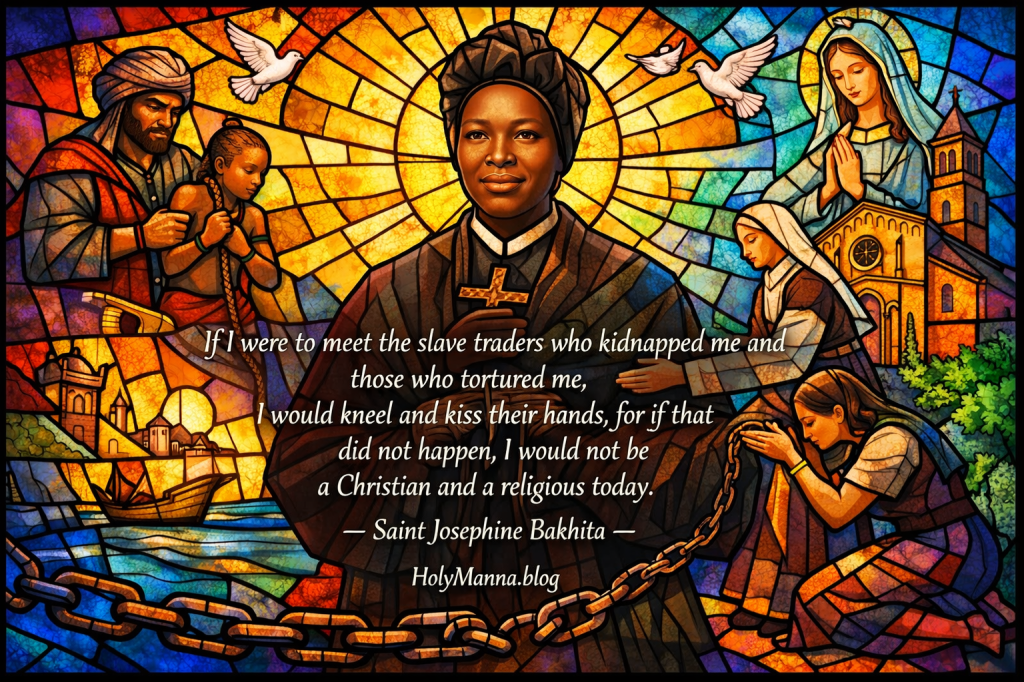
The Saint Who Could Not Be Owned
Saint Josephine Bakhita is one of those saints whose story does not feel real until the Church places her in front of the world and says, “Look closely. This is what grace can do.” She was kidnapped as a child in Sudan, trafficked through slave markets, and treated like property. She carried scars that were meant to brand her forever, yet she became a Catholic sister in Italy whose presence felt like peace to everyone who met her.
Her significance is not only that she survived. Her holiness is that she refused to let suffering teach her to hate. She lived the kind of freedom Jesus promises, the freedom that begins in the soul and then reshapes how a person loves. Her feast day on February 8 is now closely associated in Catholic life with prayer and awareness against human trafficking, because her witness forces the world to face evil honestly and still proclaim the dignity of every human person.
Where does this story touch the heart right away, in sorrow, in anger, or in hope?
Kidnapped and Scarred
Bakhita was born around 1869 in the region of Darfur in what is now Sudan. Her childhood was ordinary until the day she was abducted while still very young. The violence of that moment shattered her life so completely that she later could not remember her birth name. Slave traders imposed a new name, “Bakhita,” a name often rendered as “fortunate,” which at first sounds like cruel irony in the face of what followed.
She was sold and resold, moved through slave markets, and subjected to repeated cruelty. One of the most horrifying episodes of her enslavement involved being cut over and over again and then having salt rubbed into her wounds so permanent scars would form. Those scars were meant to declare ownership, but God would later turn them into a testimony that evil can wound the body without owning the soul.
Even before she knew Christ, something in her kept searching for goodness and truth. In time, an Italian man, Callisto Legnani, obtained her in Khartoum and treated her with a measure of protection. Through him, she traveled to Italy in 1884, and what looked like a change of geography became the beginning of a new life.
Her freedom was not only spiritual but also legal. When she was expected to return to Africa with the household she served, she refused. An Italian court recognized that she could not be held as a slave, and in that judgment a public truth was spoken that matches Catholic teaching. A human being is a person, never property, and The Catechism condemns enslaving human beings as a grave violation of human dignity. See CCC 2414.
Baptized Into a New Name and a New Family
Bakhita’s conversion was not a quick emotional moment. It was a slow awakening, like dawn after a long night, and it happened as she encountered the faith through the Canossian Sisters. She learned that God was not a cruel master who demands fear, but a Father who loves and saves. In Jesus Christ she discovered someone who suffers with the suffering and who sets captives free from the inside out.
On January 9, 1890, she received Baptism, Confirmation, and First Holy Communion. The Church teaches that Baptism makes a person a new creation and an adopted child of God, not a thing to be owned but a son or daughter to be loved. See CCC 1213 and CCC 1265. That is why her Baptism matters so much. It was not simply a new religious identity. It was the healing beginning of a new belonging.
In time she chose religious life with the Canossian Sisters and professed her vows. This choice is quietly heroic, because a woman who had been controlled and possessed by others chose to belong entirely to Christ in love. Her spiritual wisdom often came out in simple counsel that sounded like it came from a mother’s heart, yet carried the weight of a saint’s faith. “Be good, love the Lord, pray for those who do not know Him.”
What would change in daily life if faith were lived with that kind of simplicity and confidence?
The Miracle of Forgiveness
After entering religious life, Bakhita spent many years in quiet service, especially in Schio. She served as cook, sacristan, and doorkeeper, and the people who came to the convent often left feeling calmer, seen, and strengthened. Her holiness was not dramatic, but it was steady, warm, and unmistakably rooted in prayer.
If there are no widely documented public miracles attributed to her during her lifetime, her life still reveals a miracle that the Church never stops preaching. It is the miracle of forgiveness that does not deny evil, yet refuses to let evil shape the soul. Her most famous quotation expresses that supernatural freedom in a way that still stuns modern ears. “If I were to meet the slave traders who kidnapped me and those who tortured me, I would kneel and kiss their hands, for if that did not happen, I would not be a Christian and a religious today.”
This line makes sense only in the light of Christ. In The Gospel of Matthew Jesus commands, “Love your enemies and pray for those who persecute you” (Mt 5:44). The Catechism explains that forgiving from the heart participates in God’s mercy and breaks the cycle of retaliation. See CCC 2840–2845. Bakhita did not only admire these teachings. She lived them, and her life becomes a real examination of conscience for anyone tempted to hold onto bitterness as if it were strength.
A Heart Held by Our Lady
Bakhita’s later years reveal a truth that many wounded people need to hear. Holiness does not require pretending everything is fine. A person can be deeply healed in Christ and still carry echoes of old pain. During her final illness, she reportedly cried out asking for chains to be loosened, as if the memory of captivity returned in flashes. This detail is painful, but it is also consoling, because it shows that the Lord’s grace remains present even when suffering resurfaces.
She endured her last years with patience and prayer, and her Marian devotion shone especially near the end. Her reported last words were “Our Lady! Our Lady!” She died on February 8, 1947, and the woman who had been stolen from protection as a child fell asleep calling on the Mother who never abandons her children.
Is there a wound that still flares up sometimes and needs to be placed more intentionally into the hands of Jesus and Our Lady?
A Worldwide Witness Against Modern Slavery
After her death, devotion to Bakhita spread as people shared stories of her holiness and began asking for her intercession. Reports of favors and answered prayers helped her cause for sainthood move forward through the Church’s careful process. Because she was not a martyr, the Church required miracles attributed to her intercession for canonization, and Catholic accounts commonly reference a healing connected to her cause involving a woman in Brazil suffering severe diabetic complications who recovered after prayers through Bakhita’s intercession. The Church treats such claims with seriousness, using medical and theological review, because authentic miracles glorify God and strengthen faith rather than stir up superstition.
She was beatified in 1992 and canonized in 2000 by Pope Saint John Paul II, and her canonization was more than a personal honor. It was the Church proclaiming that genuine emancipation begins with truth about the human person. Every human being is created in the image of God, and no one is disposable. See CCC 1700–1706.
Her legacy now reaches far beyond one convent in Italy. Her feast day, February 8, has become a natural moment in Catholic life for prayer and awareness against human trafficking. In a world that still buys and sells human beings in new ways, Saint Josephine Bakhita stands as a living contradiction to despair. She proves that grace can restore dignity, purify the heart, and turn suffering into a witness that awakens the conscience of the world.
Walking in Bakhita’s Freedom Today
Saint Josephine Bakhita teaches that freedom is not only political or economic, even though those freedoms matter deeply. She teaches that the deepest freedom is spiritual, because a heart united to Christ cannot be owned by fear, bitterness, or shame. Her life calls Catholics to reject every form of exploitation and to live the Church’s teaching on human dignity with clarity and courage. It also calls believers to look honestly at the smaller chains that can bind the soul, including resentments, addictions, and the quiet habits that make the heart colder than it should be.
Her example points toward practical holiness that is not complicated. Pray for victims of trafficking, and pray for the conversion of traffickers, because the Gospel commands prayer even for enemies. Seek healing through the sacraments, especially Confession and the Eucharist, because Jesus loosens chains through His mercy. Ask Our Lady for a heart that can forgive without excusing evil, because Mary teaches the soul how to stay faithful at the foot of the Cross.
Saint Josephine Bakhita proves that a scar does not mean defeat. In Christ, scars can become testimony, and suffering can become a place where hope is purified. That is why her life still matters, and why the Church keeps saying her name.
Engage with Us!
Share your thoughts and reflections in the comments below, because saints like Bakhita are not meant to stay in history books. They are meant to wake up courage in ordinary Catholic life.
- Where does Saint Josephine Bakhita’s story challenge the heart the most, in forgiveness, trust, or hope?
- Is there a place in life that still feels like a chain, such as fear, resentment, addiction, or shame, that needs to be handed to Jesus in prayer and the sacraments?
- How can concrete charity be practiced this week, whether through prayer, education, or support for the vulnerable, so that faith becomes visible love?
- What would it look like to ask Our Lady for the grace to forgive without excusing evil, and to seek healing without losing courage?
May Saint Josephine Bakhita teach every heart to live in the freedom of Christ. Keep walking in faith, keep choosing the good, and keep doing everything with the love and mercy Jesus taught, because that is how saints are made in the real world.
Saint Josephine Bakhita, pray for us!
Follow us on YouTube, Instagram and Facebook for more insights and reflections on living a faith-filled life.

 Holy Manna!
Leave a comment