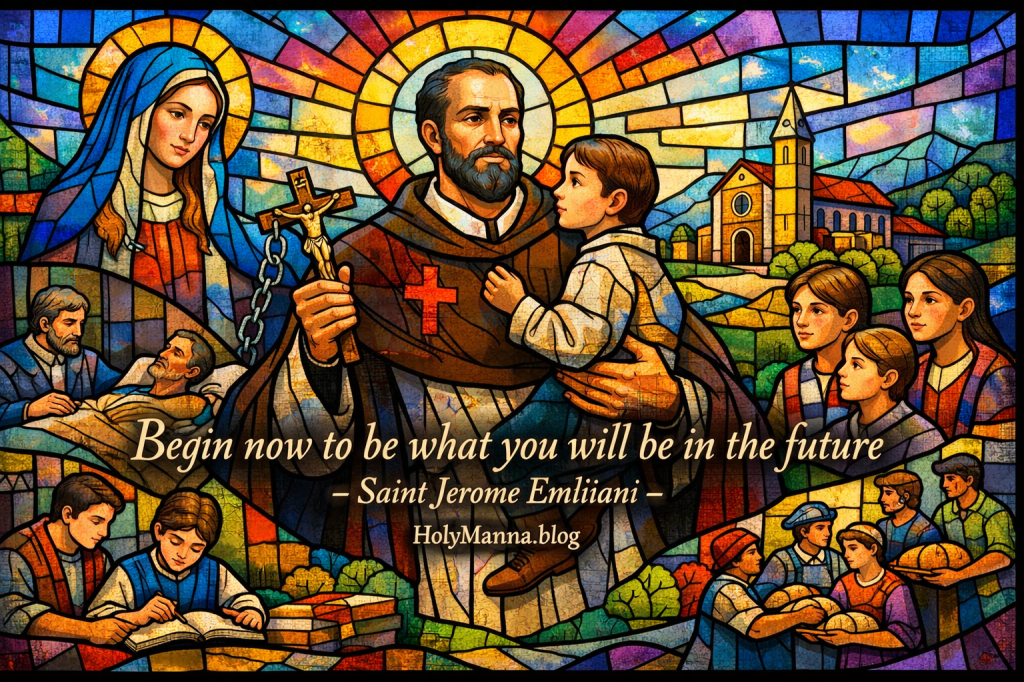
From Prison Chains to Children’s Homes
Saint Jerome Emiliani was a Venetian nobleman who became a priest and a founder, but he is remembered most as a spiritual father to orphans and abandoned youth. His holiness did not stay inside church walls because it spilled into hospitals, streets, and crowded rooms filled with children who had been left behind. The Church reveres him because he turned conversion into action and charity into something organized, stable, and lasting. His life still speaks loudly today because it shows what happens when a man stops living for himself and starts living for Christ.
Jerome’s legacy lives on through the Clerics Regular of Somasca, often called the Somascans, a community formed to care for the poor and educate the young. He is also honored as a patron of orphans and abandoned children, which is a title that fits him perfectly because he made the forgotten feel seen. His feast is celebrated on February 8, and his witness remains a strong reminder that Christian love is meant to be concrete, not sentimental.
A Wounded Beginning and a Proud Young Soldier
Jerome was born in Venice in the late 1400s into a noble family whose stability had been shaken. Catholic accounts note that his childhood carried serious pain, including the tragic death of his father. That kind of early sorrow can leave a person searching for meaning in power, achievement, or pleasure, and Jerome did what many young men do when they feel unsteady inside. He chased the kind of glory that looks impressive on the outside, and he pursued a military career for the Republic of Venice.
As a soldier, he leaned into a life shaped by ambition and confidence. He knew how to command and how to fight, but his heart was not yet trained in humility or trust. Providence, in God’s strange mercy, did not abandon him to that path. Instead, the Lord allowed a collapse that became the doorway to conversion, and the battlefield became the road back to prayer.
A Dungeon That Became a Chapel
During conflict, Jerome was captured and imprisoned, and Catholic tradition describes him chained in a harsh dungeon. In that place, he faced what pride always tries to avoid, which is helplessness. He could not negotiate his way out, and he could not force the door open with strength. He had to look upward, and that is where his conversion began to take real shape.
In prison Jerome began to pray seriously and to call on the Blessed Virgin Mary for help, making a vow that his life would change if he were delivered. After his release, he treated freedom as a gift, not an accident, and he went in thanksgiving to honor the Mother of God. He returned to Scripture and sought spiritual guidance, letting the Lord rebuild his priorities from the ground up. A saying associated with him fits this moment well: “Begin now to be what you will be in the future.” It sounds simple, but it is demanding, because it calls for a real change in habits, not just a new mood.
A Priest Who Turned Crisis Into a Work of Mercy
Jerome did not come out of conversion looking for comfort. He returned to Venice, took responsibility for family obligations, and moved steadily toward priesthood, eventually being ordained. When plague and famine hit, he did not keep a safe distance from suffering. He entered it, serving the sick and giving his resources to the poor, and he kept his eyes on the most vulnerable people in a collapsing society. He saw abandoned children in particular, and he refused to treat them like a sad statistic.
Jerome began gathering children into shelter and giving them more than food. He gave them structure, formation, and a sense of dignity. He also worked for those who were socially discarded, including women seeking to leave prostitution behind and begin again through repentance and a new way of life. His charity was not soft or naïve, and it was never separated from the call to conversion. This is part of why he feels so authentically Catholic, because mercy and truth were held together in the way Jesus holds them together.
Prayer and Work Under One Roof
Jerome understood that caring for a child means caring for a whole life. He did not only feed hungry mouths, he formed minds and souls, and he trained young people to live with purpose. In places like Bergamo, his vision grew into a stronger program that combined catechesis with practical training, including the development of skills that could support a stable future. He knew that education is not only about information, it is about shaping a person for virtue, responsibility, and freedom.
His approach reflected the heart of Catholic social teaching long before modern terms were used for it. The poor are not projects, they are persons with eternal dignity, and children without families deserve more than survival. They deserve spiritual family, discipline, and hope. When Jerome is remembered as the father of orphans, it is not just because he had compassion. It is because he created a way of life where compassion could endure.
Providence That Fed the Children
Stories associated with Jerome often highlight how boldly he trusted God’s providence. One well known tradition recalls a moment when food was scarce and the children were anxious, and Jerome urged them to pray rather than panic. He spoke words that became a kind of spiritual anchor for the orphanages: “Do not doubt, my sons, the Lord will take care!” The story continues with unexpected provision arriving, enough to feed those who had nothing. Whether a person describes it as a miracle or as providence, the heart of the story is clear. God was teaching the abandoned that they were not abandoned by Heaven.
Jerome also lived a quieter kind of miracle that modern people often overlook. He restored order where there was chaos, and he created safety where children could easily have been exploited or lost. He taught them to pray, to work, and to live with self respect. In a world that often treats the vulnerable as disposable, Jerome lived as if every orphan bore the face of Christ.
Love That Cost Him Everything
Jerome’s hardships were not limited to one dramatic moment. He endured war, imprisonment, public crisis, and constant exposure to illness while serving the sick. Catholic accounts also describe him contracting illness during outbreaks and later returning to his work with renewed zeal. That pattern of suffering and service became the rhythm of his sanctity. He did not treat charity as something to do when he felt strong. He treated charity as obedience to Christ.
He died on February 8, 1537, after becoming ill while caring for the afflicted. His life closed the same way it had been lived, close to those who were suffering. He was not a martyr by execution, but he lived a real martyrdom of charity, pouring himself out until there was nothing left. His death was not a tragedy in the Christian sense, because it was the final offering of a life given to God.
A Saint Whose Fatherhood Continued After Death
After Jerome’s death, the work did not disappear because it had already become more than one man’s personality. The community he formed endured and received recognition in the life of the Church, and the Somascans carried his mission forward, continuing to care for youth and educate the vulnerable. Over time, the Church formally recognized Jerome’s holiness through beatification and canonization. Later, Pope Pius XI declared him patron of orphans and abandoned children, confirming what ordinary people had seen for centuries.
Devotion to Jerome remains closely tied to Somasca, the place associated with his final years, where the faithful continue to honor his memory and seek his intercession. Catholic tradition also preserves testimonies of favors and healings attributed to his prayers after death. His legacy is not only institutional, it is spiritual, because the Church recognizes that saints remain alive in Christ and continue to intercede for the faithful. The continued ministry inspired by Jerome shows how one converted life can become a pipeline of grace for generations.
Living His Lesson in Ordinary Life
Saint Jerome Emiliani proves that conversion is meant to become visible. His story begins with pride, breaks open in suffering, and flowers into mercy that changes other people’s lives. His witness fits perfectly with the Church’s teaching on the works of mercy. The Catechism says, “The works of mercy are charitable actions by which we come to the aid of our neighbor in his spiritual and bodily necessities.” CCC 2447 gives the definition, but Jerome gave the demonstration.
To imitate him today, the first step is to stop treating charity like a hobby and start treating it like a vocation. Care for children and families in crisis in real ways, whether through parish ministries, foster care support, mentoring, or consistent service to the poor. Unite prayer and work so that mercy does not burn out and discipline does not become cold. How might God be using past failures or humiliations to lead into a deeper conversion right now? Who is living like an orphan nearby, not always without parents, but without support, guidance, or spiritual family, and how can steady Catholic friendship change that?
Engage with Us!
Share your thoughts and reflections in the comments below. Saint Jerome Emiliani has a way of challenging comfortable faith and calling it into action.
- What part of Saint Jerome Emiliani’s conversion feels most relatable right now, the imprisonment, the Marian trust, or the decision to serve the poor?
- Where is God inviting more unity between prayer and work so faith becomes steadier and more concrete?
- Who are the abandoned or overlooked in the local community, and what is one realistic way to serve them this month?
- What does it look like to practice the works of mercy in a home, a workplace, or a parish without burning out or becoming bitter?
- How can devotion to Mary as a motherly protector reshape the way the Church treats the vulnerable, especially children?
Keep walking forward in faith, and do everything with the love and mercy Jesus taught. Let mercy become practical, let prayer become steady, and let charity become the proof that Christ is truly alive in the world.
Saint Jerome Emiliani, pray for us!
Follow us on YouTube, Instagram and Facebook for more insights and reflections on living a faith-filled life.

 Holy Manna!
Leave a comment