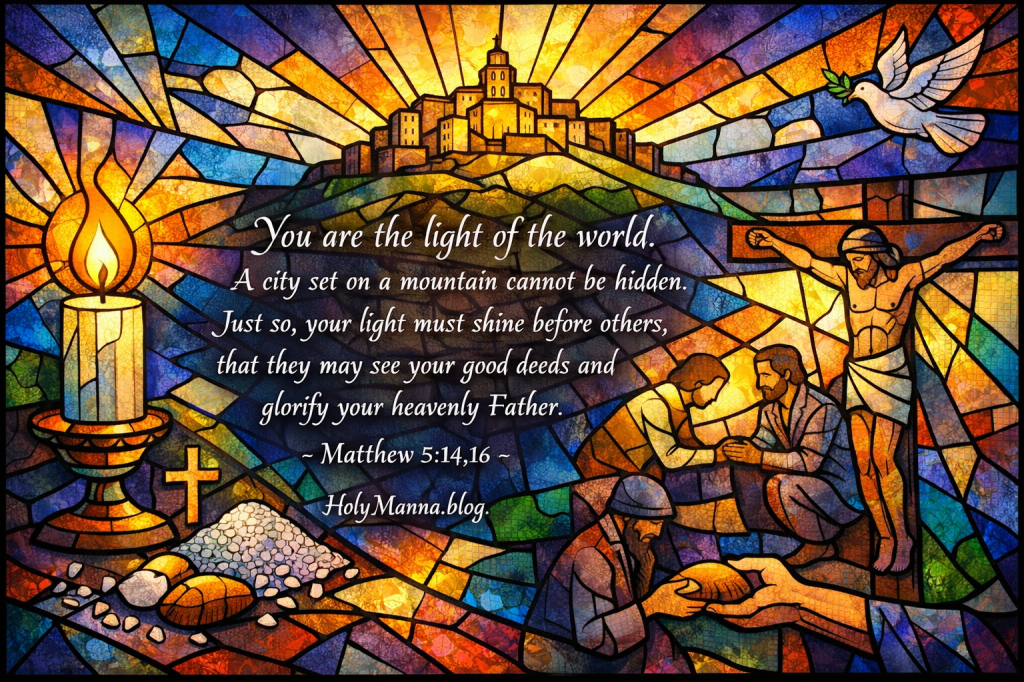
Fifth Sunday in Ordinary Time – Lectionary: 73
Salt, Light, and the Crucified Lord
There is a certain kind of faith that stays safely inside the walls of a church, speaks the right words, and still leaves the world mostly unchanged. Today’s Mass readings refuse to let discipleship remain private or performative. The central theme tying everything together is simple and demanding: Christ makes His people a visible sign of God’s presence by uniting them to the Cross and sending them into the world with concrete mercy. When charity becomes real, the disciple becomes unmistakable, and God’s light breaks into places that have grown dark.
This is why Isaiah 58:7-10 hits with such force. In a religious culture where fasting and public acts of devotion could be worn like a badge, the Lord exposes hypocrisy and calls His people back to covenant love that costs something. The hungry, the afflicted, and the homeless are not interruptions to holiness. They are where holiness is proved. God’s promise is not vague comfort, but a dramatic reversal: “Then your light shall break forth like the dawn… Then you shall call, and the Lord will answer… ‘Here I am!’” Is 58:8-9. The Church has always recognized this as the beating heart of authentic religion, because the corporal works of mercy are not optional side projects, but the shape of love in action, as taught in CCC 2447.
That same light returns in Psalm 112:4-9, where the “upright” are described as gracious, steadfast, and generous, not because life is easy, but because their hearts are anchored in the Lord. In a world addicted to fear and self-protection, the Psalm paints a different kind of strength, the steady courage of someone who trusts God enough to give. Then 1 Corinthians 2:1-5 adds a surprising twist. In a Greco-Roman city that admired eloquence, status, and impressive speech, St. Paul refuses to build the Church on personality or polish. He chooses the scandal and humility of the Cross, insisting that faith must rest on God’s power, not on human cleverness. The Gospel brings it all to a head with Christ’s identity statement over His disciples: “You are the salt of the earth… You are the light of the world.” Mt 5:13-14. This is not a compliment meant to inflate egos. It is a mission that demands conversion, because salt that goes bland and light that gets hidden both fail their purpose.
If people looked at an ordinary week, would they see a faith that comforts the comfortable, or a faith that feeds the hungry and points hearts toward the Father? Today’s readings prepare the soul to hear one clear call: stay close to Christ crucified, live mercy without excuses, and let good deeds shine in such a way that God gets the glory.
First Reading – Isaiah 58:7-10
The kind of faith God can see in the dark
Isaiah speaks into a moment that feels uncomfortably familiar. God’s people knew how to “look religious,” but too many were trying to separate worship from daily life. In this part of Isaiah, the Lord corrects a distorted spirituality that treated fasting and prayer as a substitute for conversion. The prophet insists that covenant fidelity always spills into real love for real people, especially the poor, the afflicted, and the vulnerable. That is why this reading fits perfectly with today’s theme of salt and light. When mercy becomes concrete, light becomes visible, and the world starts to see the Father’s goodness through the lives of His people.
Isaiah 58:7-10 – New American Bible (Revised Edition)
7 Is it not sharing your bread with the hungry,
bringing the afflicted and the homeless into your house;
Clothing the naked when you see them,
and not turning your back on your own flesh?
8 Then your light shall break forth like the dawn,
and your wound shall quickly be healed;
Your vindication shall go before you,
and the glory of the Lord shall be your rear guard.
9 Then you shall call, and the Lord will answer,
you shall cry for help, and he will say: “Here I am!”
If you remove the yoke from among you,
the accusing finger, and malicious speech;
10 If you lavish your food on the hungry
and satisfy the afflicted;
Then your light shall rise in the darkness,
and your gloom shall become like midday;
Detailed Exegesis
Verse 7 “Is it not sharing your bread with the hungry, bringing the afflicted and the homeless into your house; Clothing the naked when you see them, and not turning your back on your own flesh?”
God does not describe an abstract compassion. God names ordinary acts that cost time, attention, money, and comfort. “Your own flesh” is a sober reminder that the suffering neighbor is not an outsider to ignore, but family in the human sense, and in an even deeper way, a person made in God’s image. This verse confronts the temptation to reduce religion to words while allowing the weak to carry burdens alone.
Verse 8 “Then your light shall break forth like the dawn, and your wound shall quickly be healed; Your vindication shall go before you, and the glory of the Lord shall be your rear guard.”
God attaches a promise to mercy, and it is bigger than personal improvement. When charity becomes real, “light” breaks into darkness, and healing begins where sin and selfishness had left wounds. The image of the Lord as “rear guard” evokes God’s protecting presence, like a shepherd guarding the flock from behind. Mercy does not just bless the recipient. Mercy reforms the giver and draws the giver back under the shelter of God’s glory.
Verse 9 “Then you shall call, and the Lord will answer, you shall cry for help, and he will say: ‘Here I am!’ If you remove the yoke from among you, the accusing finger, and malicious speech;”
One of the most startling lines in the Old Testament is God’s response: “Here I am!” This is the language of closeness, like a Father answering immediately because the child finally came home. Then the prophet tightens the lesson. Mercy is not only about money and food, because injustice can be carried in the tongue and in the heart. “The accusing finger” and “malicious speech” expose a spiritual disease that loves blame, contempt, and cruelty. A community cannot become light if it keeps feeding darkness through its words.
Verse 10 “If you lavish your food on the hungry and satisfy the afflicted; Then your light shall rise in the darkness, and your gloom shall become like midday;”
God repeats the call to generosity, but this time with a word that challenges half-heartedness: “lavish.” The Lord is not forming minimalists who give only what does not affect them. The promise is equally strong. Even if life feels like “gloom,” mercy becomes a doorway for God to turn the lights on. Darkness does not get the last word when charity becomes the disciple’s habit.
Teachings
This reading teaches that authentic worship cannot be separated from love of neighbor. It is not a political slogan, and it is not a sentimental mood. It is the fruit of conversion, the evidence that the heart has turned back to God. The Church calls these concrete acts “works of mercy,” and it describes them as part of the ordinary shape of Christian life: “The works of mercy are charitable actions by which we come to the aid of our neighbor in his spiritual and bodily necessities.” CCC 2447.
Isaiah 58 also reveals something easy to miss. God is not only concerned that the hungry get fed. God is also concerned that the disciple becomes whole. Sin fractures the soul into compartments, where prayer sounds holy but life stays unchanged. Mercy reunifies the person, because love is what the human heart was made for. This is why the “light” in the reading is not just public reputation. It is the radiance of a healed life. When the disciple’s choices match the disciple’s prayers, the result is clarity, peace, and a heart that can actually call on God without hiding.
There is also a warning here for any age that loves outrage. The prophet pairs generosity with repentance from “the accusing finger” and “malicious speech.” God is not impressed by religious talk that wounds people. A Christian cannot claim to be light while using words to scorch and destroy. Holiness includes the tongue, the tone, and the hidden intentions behind what gets said.
Reflection
This reading invites a serious, simple examination of daily life. It asks whether faith has become a weekend identity or a weekday mission. It also offers a hopeful path forward, because the Lord does not merely accuse. The Lord promises healing, guidance, and closeness to anyone who turns back through mercy.
A practical way to live this is to choose one act of concrete charity that actually costs something, and to make it consistent rather than occasional. Feeding the hungry can look like paying for groceries for a struggling family, keeping gift cards ready for someone in need, or supporting a local ministry with a faithful monthly offering. Clothing the naked can look like giving away good clothing that could have been sold, not just what feels like junk. Welcoming the afflicted can begin with something as basic as noticing the lonely person who gets ignored and treating that person with patient attention and dignity.
This reading also calls for a fast that many people avoid because it is harder than skipping a meal. It is the fast from contempt. It is the fast from the accusing finger. It is the fast from malicious speech that feels justified because someone else “started it.”
Where has comfort become more important than mercy, even in small ways that add up over time?
Who is hungry, afflicted, or burdened close enough to be considered “your own flesh,” and yet easy to overlook?
What would change in a home, a workplace, or a parish if speech became cleaner, kinder, and more truthful at the same time?
When the disciple takes these questions seriously, today’s theme stops being a religious idea and becomes a visible light. That is when the world starts to see what God is like, because God’s love has finally taken flesh in ordinary life.
Responsorial Psalm – Psalm 112:4-9
The quiet strength of a man who trusts God
Psalm 112 reads like a portrait hung on the wall for every generation to study. In Israel’s worship, the Psalms trained hearts to see the world the way God sees it, not the way fear sees it. This particular Psalm belongs to the tradition of wisdom prayer, describing what an upright life looks like when it is rooted in reverence for the Lord and expressed through justice, courage, and generosity. That is why it fits so cleanly into today’s theme. Isaiah insists that true worship becomes concrete mercy, and the Gospel says disciples must be salt and light. Psalm 112 shows what that “light” looks like in a human life: steady, compassionate, and unshaken, even when the world gets loud.
Psalm 112:4-9 – New American Bible (Revised Edition)
4 Light shines through the darkness for the upright;
gracious, compassionate, and righteous.
5 It is good for the man gracious in lending,
who conducts his affairs with justice.
6 For he shall never be shaken;
the righteous shall be remembered forever.
7 He shall not fear an ill report;
his heart is steadfast, trusting the Lord.
8 His heart is tranquil, without fear,
till at last he looks down on his foes.
9 Lavishly he gives to the poor;
his righteousness shall endure forever;
his horn shall be exalted in honor.
Detailed Exegesis
Verse 4 “Light shines through the darkness for the upright; gracious, compassionate, and righteous.”
This verse describes more than a good mood. “Light” here is the visible fruit of communion with God, the kind of clarity and warmth that shows up in how a person treats others. The upright man is not simply correct, because righteousness in Scripture is covenant faithfulness lived out in real choices. The three qualities named are not soft virtues. They are strength under control, the kind of strength that makes room for compassion instead of crushing people.
Verse 5 “It is good for the man gracious in lending, who conducts his affairs with justice.”
In the ancient world, lending could be a tool of mercy or a weapon of domination. This verse assumes a moral economy, where the righteous man does not use advantage to exploit weakness. He is “gracious” and also “just,” which means he is not careless with truth or boundaries. He does business and family life in a way that can stand in the light of day, because his integrity is not negotiable.
Verse 6 “For he shall never be shaken; the righteous shall be remembered forever.”
This is not a promise that the righteous will never suffer. It is a promise that suffering will not define him or destroy him. The “unshaken” heart is stable because it is anchored in God, not in headlines, opinions, or fluctuating comfort. To be “remembered forever” is not merely human fame. In biblical language, it points toward lasting honor that God Himself safeguards, because God does not forget the faithful.
Verse 7 “He shall not fear an ill report; his heart is steadfast, trusting the Lord.”
An “ill report” can mean accusation, slander, bad news, or the kind of talk that rattles communities. The righteous man refuses to be ruled by rumor or fear. His heart is “steadfast,” meaning he does not live like a reed in the wind. He trusts the Lord, and that trust becomes emotional stability and moral consistency, even when circumstances feel unstable.
Verse 8 “His heart is tranquil, without fear, till at last he looks down on his foes.”
Tranquility here is not apathy. It is the calm that comes from knowing God governs history. The mention of “foes” does not authorize vengeance or cruelty. It points to the reality that evil exists, opposition exists, and yet the faithful need not panic. In God’s time, the righteous will see that wickedness does not win forever.
Verse 9 “Lavishly he gives to the poor; his righteousness shall endure forever; his horn shall be exalted in honor.”
This is the climax of the portrait. The righteous man gives, and he gives “lavishly,” which means his generosity is not performative and not minimal. In biblical imagery, the “horn” symbolizes strength and honor. The Psalm is saying that the man who fears the Lord is strengthened, not diminished, by mercy. His righteousness “endures” because it is built on something more solid than ego. It is built on fidelity to God.
Teachings
This Psalm teaches that holiness is not only about avoiding sin. Holiness is a stable pattern of virtue expressed in ordinary life. The upright man is gracious, compassionate, and just, and those are not personality traits. They are virtues, chosen and practiced, shaped by grace.
The Church’s language for this steadiness is clear when it speaks of the moral virtues. About justice, it teaches: “Justice is the moral virtue that consists in the constant and firm will to give their due to God and to neighbor.” CCC 1807. About fortitude, it teaches: “Fortitude is the moral virtue that ensures firmness in difficulties and constancy in the pursuit of the good.” CCC 1808. These two short lines explain why Psalm 112 keeps repeating words like “steadfast,” “tranquil,” and “with justice.” The Psalm is describing a man whose interior life has been trained by God, so his outward life becomes trustworthy.
This also ties directly to today’s Gospel. When Christ calls His disciples salt and light, He is not asking for a flashy personality. He is calling for a recognizable pattern of goodness that withstands pressure and serves others. The Psalm shows how that witness works. A heart that trusts the Lord stops being ruled by fear, stops being addicted to control, and becomes free to give, even “lavishly,” because God is no longer treated like an emergency option. God becomes the foundation.
There is also a quiet warning hidden in the Psalm’s confidence. The righteous man is remembered “forever” because his life is aligned with God’s will. A life built on self-image fades, but a life built on mercy endures, because charity is the one investment that survives death.
Reflection
This Psalm invites a simple but serious question: what kind of presence is being brought into a room, a home, a workplace, or a parish? A fearful presence spreads anxiety. A cynical presence spreads darkness. But a steadfast presence, grounded in trust, becomes a kind of lamp that helps others breathe again.
A practical way to live this Psalm is to practice stability on purpose. The day does not have to be driven by “ill reports,” whether those reports come through news, gossip, group chats, or inner panic. The righteous man does not deny trouble. He refuses to be mastered by it. That begins with prayer that is honest, regular, and humble, because trust grows the same way muscles grow, through repeated use.
Then the Psalm makes generosity non-negotiable. “Lavishly he gives to the poor” is not a vague ideal. It can become concrete through intentional giving that happens before comfort spending, and through acts of mercy that involve actual inconvenience. This is how disciples become light without trying to look like light.
Where does fear currently set the schedule, shape the tone, or control reactions?
What would change if the heart became “steadfast” through daily prayer and simple obedience?
Who is close enough to notice, and poor enough in some way to need mercy, even if that poverty is hidden behind pride or silence?
When this Psalm is lived, it does not produce a loud religion. It produces a believable one. That is exactly what salt and light are supposed to be.
Second Reading – 1st Corinthians 2:1-5
God supplies the power
Corinth was a place that loved polish. It was a bustling Greco Roman city where public speaking, philosophical argument, and social status carried real weight, and where the “smartest voice in the room” often won the crowd. That cultural appetite for impressive rhetoric did not stay outside the Church. It seeped in, tempting believers to treat the Gospel like another school of wisdom, another brand to market, another personality to follow. In today’s passage, St. Paul refuses to build faith on charm, cleverness, or emotional manipulation. He anchors everything in Christ crucified, because only the Cross can make disciples into true salt and light. If the light is real, it will not come from stage skills. It will come from the living God at work in weakness.
1 Corinthians 2:1-5 – New American Bible (Revised Edition)
1 When I came to you, brothers, proclaiming the mystery of God, I did not come with sublimity of words or of wisdom. 2 For I resolved to know nothing while I was with you except Jesus Christ, and him crucified. 3 I came to you in weakness and fear and much trembling, 4 and my message and my proclamation were not with persuasive [words of] wisdom, but with a demonstration of spirit and power, 5 so that your faith might rest not on human wisdom but on the power of God.
Detailed Exegesis
Verse 1 “When I came to you, brothers, proclaiming the mystery of God, I did not come with sublimity of words or of wisdom.”
St. Paul sets the tone immediately. The “mystery of God” is not a puzzle to solve, but God’s saving plan revealed in Jesus Christ, a plan once hidden and now made known. Paul refuses “sublimity of words,” not because truth does not matter, but because the Gospel is not a performance. The heart of Christianity is not a salesman’s pitch. It is a divine revelation received with humility.
Verse 2 “For I resolved to know nothing while I was with you except Jesus Christ, and him crucified.”
This is the center. Paul is not saying that theology is useless or that reason is rejected. He is saying that everything must be measured against the Cross. “Christ, and him crucified” is the wisdom of God that shatters human pride. It also protects the Church from a fake Christianity that wants resurrection glory without repentance, discipleship, or sacrifice.
Verse 3 “I came to you in weakness and fear and much trembling,”
Paul describes the interior experience of mission. Weakness does not disqualify a preacher. Weakness can actually become the stage where God’s strength is displayed. “Fear and trembling” does not mean cowardice. It means reverence and sobriety in the face of a task that no human being can accomplish by talent alone, because conversion is ultimately God’s work.
Verse 4 “and my message and my proclamation were not with persuasive [words of] wisdom, but with a demonstration of spirit and power,”
Paul contrasts two kinds of “persuasion.” One kind is natural, based on technique and human brilliance. The other is supernatural, where the Holy Spirit moves the heart through truth proclaimed with integrity. “Demonstration of spirit and power” points to the Spirit’s interior action that convicts, heals, and strengthens, and at times can include signs, endurance in suffering, and the unmistakable fruit of changed lives.
Verse 5 “so that your faith might rest not on human wisdom but on the power of God.”
Paul gives the reason for everything. If faith is built on human skill, then faith collapses when the speaker fails, disappoints, or gets replaced. If faith rests on God, then it stands even when the messenger is unimpressive. This is also how the Church becomes credible in the world. The light is not the personality. The light is God.
Teachings
This reading teaches that Christian faith is not an opinion chosen because it sounds inspiring. It is a supernatural response to God who reveals Himself, and it is sustained by grace. The Catechism is blunt about the foundation of faith: CCC 156 says, “What moves us to believe is not the fact that revealed truths appear as true and intelligible in the light of our natural reason: we believe ‘because of the authority of God himself who reveals them, who can neither deceive nor be deceived.’” That single paragraph lines up perfectly with Paul’s point that faith must not “rest” on human cleverness.
The Catechism also clarifies the posture of the believer before divine revelation: CCC 143 says, “By faith, man completely submits his intellect and his will to God. With his whole being man gives his assent to God the revealer. Sacred Scripture calls this human response to God, the author of revelation, ‘the obedience of faith.’” Paul’s insistence on Christ crucified is not a tactic. It is an invitation into that obedience, where pride bows and the heart learns to receive.
This passage also explains something important about evangelization. The Church does not win the world by sounding “cool” or by baptizing the world’s values. The Church wins by being faithful, by preaching Christ clearly, and by living in a way that matches the message. Pope St. Paul VI captured this with a line that still lands like a hammer: in Evangelii Nuntiandi 41, he wrote, “Modern man listens more willingly to witnesses than to teachers, and if he does listen to teachers, it is because they are witnesses.” Paul’s “weakness” becomes powerful when it is honest witness, because God loves to work through humility.
Historically, this also speaks to the early Church’s struggle in Corinth with factions and personality followings. The broader context of 1 Corinthians shows believers comparing leaders and forming camps. Paul’s answer is to drag every ego back to the Cross, because the Church is not built on applause. The Church is built on the Crucified and Risen Lord.
Reflection
This reading challenges a very modern temptation: the belief that faith has to be packaged like entertainment in order to be effective. It is easy to chase novelty, to imitate the world’s methods, or to feel discouraged when personal confidence is low. St. Paul offers a different path. The Christian does not need to be impressive. The Christian needs to be faithful. When the message stays centered on Christ crucified, the pressure to perform starts to break, and mission becomes possible again, because the weight is back where it belongs, on God.
A practical way to live this is to simplify the spiritual life around the Cross. That means choosing daily prayer that is steady rather than dramatic, confession that is honest rather than defended, and mercy that is concrete rather than performative. It also means speaking about Christ in a way that is straightforward. The goal is not to win debates. The goal is to bear witness, letting the Spirit do what only the Spirit can do.
This passage also calls for humility about personal weakness. Weakness is often treated like an embarrassment that must be hidden. Paul treats it like a place where God can act. That is not an excuse to stay immature. It is a reason to stop pretending.
Where has the desire to sound impressive replaced the desire to be faithful?
What would change if daily life became centered on Jesus Christ crucified, instead of centered on comfort, reputation, or control?
When people see the way speech, work, and relationships are handled, do they see “human wisdom,” or do they see the quiet strength that can only come from God?
When faith rests on God’s power, salt stays salty and light stays bright, because the source is no longer the self. The source is Christ.
Holy Gospel – Matthew 5:13-16
The disciple who stays close to Christ cannot help but change the room
This Gospel comes right on the heels of the Beatitudes, where Jesus describes the strange strength of His Kingdom. In the world of first century Judea, many people expected the Messiah to win by force, by spectacle, or by political dominance. Jesus does something very different. He forms disciples from the inside out, then tells them plainly what they are meant to be in public. He does not call them fans, commentators, or anonymous believers who keep religion locked away as a private hobby. He calls them salt and light, because God’s holiness is meant to spill into ordinary life in a way that preserves, heals, and guides. That is the same thread running through today’s readings. Isaiah insists that mercy must become concrete, Psalm 112 describes the steady generosity of the upright, and St. Paul refuses to build faith on human flash, choosing Christ crucified instead. Here, Jesus explains what happens when that kind of faith is real. It becomes visible, not for ego, but so that others may glorify the Father.
Matthew 5:13-16 – New American Bible (Revised Edition)
13 “You are the salt of the earth. But if salt loses its taste, with what can it be seasoned? It is no longer good for anything but to be thrown out and trampled underfoot. 14 You are the light of the world. A city set on a mountain cannot be hidden. 15 Nor do they light a lamp and then put it under a bushel basket; it is set on a lampstand, where it gives light to all in the house. 16 Just so, your light must shine before others, that they may see your good deeds and glorify your heavenly Father.
Detailed Exegesis
Verse 13 “You are the salt of the earth. But if salt loses its taste, with what can it be seasoned? It is no longer good for anything but to be thrown out and trampled underfoot.”
Salt in the ancient world was not a casual seasoning. It preserved food, it purified, and it signaled fidelity. In Israel’s worship, salt appeared in offerings as a sign of covenant permanence, which made it a fitting image for discipleship that does not rot with compromise. Jesus says “you are,” not “you might be,” because baptismal identity is a real calling, not a motivational poster. Then comes the warning. Salt that becomes useless is salt that can no longer do what it was made to do. In the same way, a disciple who blends into the world by making peace with sin, resentment, dishonesty, or cowardice loses the ability to preserve what is good and to season the world with truth. The tragedy is not that the world becomes dark. The tragedy is that the lamp was there and got hidden, and the salt was there and got diluted.
Verse 14 “You are the light of the world. A city set on a mountain cannot be hidden.”
Light is a public reality. It reveals what is true, it guides travelers, and it comforts those who stumble in the dark. Jesus does not describe a private glow meant only for personal inspiration. He describes a visibility that cannot be avoided, like a city on a hill that is impossible to miss. This is not permission for pride. It is a reminder that discipleship always has consequences that others can see, for good or for bad. When a Christian forgives, serves, speaks honestly, and suffers with hope, people notice. When a Christian becomes cynical, harsh, and compromised, people notice that too.
Verse 15 “Nor do they light a lamp and then put it under a bushel basket; it is set on a lampstand, where it gives light to all in the house.”
In a small household, a single oil lamp could illuminate an entire room when placed on a stand. Hiding it under a basket would be absurd, because it defeats the point of lighting it in the first place. Jesus is exposing a common temptation. Many people want the comfort of faith without the cost of witness. They want the label without the lifestyle. They want a lamp they can turn on when life gets scary, then hide again when obedience becomes inconvenient. Christ does not speak like a life coach here. He speaks like a King giving a mission. The lamp belongs on the stand.
Verse 16 “Just so, your light must shine before others, that they may see your good deeds and glorify your heavenly Father.”
Jesus clarifies the purpose of visibility. The goal is not attention. The goal is worship. Good deeds are meant to be seen in a way that points beyond the disciple to the Father. This verse also holds together two truths that people often separate. Faith is not reduced to good deeds, because faith is a gift and a relationship with God. At the same time, faith without lived charity becomes a contradiction. Jesus expects good deeds to be real, frequent, and recognizable, because the Father’s glory is at stake.
Teachings
This Gospel teaches that Christian identity is missionary by nature. To be a disciple is to be sent, even if the “sending” happens through ordinary work, ordinary family life, and ordinary friendships. The light that Christ describes is not mainly the result of a loud personality. It is the fruit of holiness, expressed in concrete charity. That is why the Church speaks so directly about mercy as part of the Christian life. The Catechism teaches: “The works of mercy are charitable actions by which we come to the aid of our neighbor in his spiritual and bodily necessities.” CCC 2447. When those works become normal, the light is no longer theoretical. It becomes visible.
This Gospel also teaches that witness is not optional. The disciple is not meant to hide Christ out of fear of judgment, fear of rejection, or fear of being called extreme. If a person truly believes that Jesus is Lord, then hiding that truth forever would be like locking up medicine while the house is sick. The Church describes the Christian vocation of witness with clarity. The Catechism teaches: “The disciple of Christ must not only keep the faith and live on it, but also profess it, confidently bear witness to it, and spread it.” CCC 1816. That witness is not always loud, but it is always real.
Saints and Fathers often emphasized how serious these images are. St. John Chrysostom preached that Christ does not call His disciples salt and light because they are meant to improve only their own private corner of life. He calls them that because they are responsible, by grace, for the good of others, and because their lives inevitably influence the world around them. The point is not self importance. The point is responsibility. When salt is missing, decay spreads. When light is hidden, people stumble.
This also fits the larger background of Matthew’s Gospel. Jesus is forming a people who will fulfill Israel’s calling to be a light to the nations, not by political conquest, but by holiness that can survive suffering. That is why today’s Second Reading matters. St. Paul anchors everything in Christ crucified, because the brightest Christian light often shines through humility, sacrifice, and fidelity that does not quit when it gets uncomfortable.
Reflection
This Gospel brings the day’s theme into the street, into the kitchen, into the group chat, and into the workplace. Salt and light are not special effects. They are the normal output of a Christian who stays close to Christ and stops making peace with darkness.
A practical way to respond is to ask what is currently making the salt bland. Sometimes it is obvious sin, the kind that slowly numbs the conscience. Sometimes it is subtle compromise, like living for comfort, being addicted to approval, or refusing to forgive. Sometimes it is a steady drip of contempt, where sarcasm becomes a personality and anger becomes the default setting. Salt stays salty when repentance becomes normal, confession is taken seriously, prayer is steady, and the Eucharist is received with a real desire to change.
Then light has to be placed on the stand through visible good deeds. That can look like acts of mercy done consistently, not just when emotion hits. It can look like speaking with clean lips when everyone else is sharpening knives. It can look like being the one who shows up for the lonely person, the struggling coworker, the overwhelmed spouse, or the forgotten neighbor. It can look like refusing to laugh at what is filthy and refusing to join conversations that feed cruelty.
The deepest question in the Gospel is the simplest one. Jesus says people should see good deeds and glorify the Father. That means the Christian life should be explainable, not as self righteousness, but as gratitude to God.
Where is the lamp currently being hidden under fear, comfort, or the desire to blend in?
What good deed could be done this week that is concrete enough to be seen and humble enough to give God the credit?
If the people closest to you described your influence, would they say it preserves what is good and brightens what is dark, or would they say it has quietly gone bland?
When the disciple takes those questions seriously, this Gospel stops sounding like poetry and starts sounding like a mission. Salt belongs in the world. Light belongs on the stand. And when mercy is real, the Father’s glory becomes hard to miss.
Let the Light Be Real
Today’s readings land like a single, steady message delivered from four angles. God is not looking for a faith that stays impressive on the surface while the heart remains untouched. God is forming disciples whose lives become salt and light because they have been converted from the inside out.
Isaiah makes it impossible to hide behind religious language. God names the poor, the afflicted, the homeless, and the naked, and He calls mercy what it is: real love expressed in real sacrifice. Then God attaches a promise that sounds almost too good to be true, but it is repeated with confidence: “Then your light shall break forth like the dawn… Then you shall call, and the Lord will answer… ‘Here I am!’” Is 58:8-9. The Psalm steps in like a living example of what that looks like, describing the upright person whose heart is steady, whose fear is not in control, and whose generosity becomes a recognizable habit. St. Paul then pulls the plug on every temptation to build faith on personality, polish, or cleverness. He places the foundation where it belongs: “Jesus Christ, and him crucified” 1 Cor 2:2, so that faith can rest on God’s power rather than human strength. Finally, Jesus speaks the mission clearly and personally: “You are the salt of the earth… You are the light of the world” Mt 5:13-14. The disciple does not exist for private comfort. The disciple exists so that the Father’s goodness becomes visible through good deeds that are humble, concrete, and consistent.
The call to action is simple enough to remember and strong enough to change a week. Stay close to Christ crucified, because the Cross purifies motives and gives courage when witness feels costly. Choose one act of mercy that involves real sacrifice, and do it quietly and faithfully. Refuse malicious speech and the accusing finger, because darkness spreads through words faster than most people realize. Then place the lamp on the stand by letting goodness be visible in daily life, so that when someone notices, the glory goes to God and not to ego.
What would change if the next seven days were shaped by one decision: to be salt that preserves, and light that guides, because Christ is loved and His people are loved? That is how ordinary life becomes an offering. That is how the Gospel stops being a theory. That is how a curious world begins to believe that the Father is real, because it has finally seen His love in action.
Engage with Us!
Please share your reflections in the comments below, because faith grows when it is spoken out loud and practiced in real life, not kept locked away in private thoughts. These questions are meant to help each reading sink in deeper, so that God’s Word can shape the week with clarity, courage, and mercy.
- First Reading, Isaiah 58:7-10: Where is God inviting a more concrete work of mercy right now, and what practical sacrifice would make that mercy real instead of theoretical?
- Responsorial Psalm, Psalm 112:4-9: What “ill report” or fear tends to shake the heart, and what daily prayer habit could help build a steadier trust in the Lord?
- Second Reading, 1 Corinthians 2:1-5: In what area of life has confidence in personal strength replaced dependence on Christ crucified, and what would it look like to let faith rest on God’s power instead?
- Holy Gospel, Matthew 5:13-16: Where is the lamp being hidden, and what visible good deed could be done this week so that others may glorify the heavenly Father rather than notice the ego?
Keep walking forward with confidence, because God is not asking for perfection overnight. God is asking for a faithful heart that keeps returning to Jesus, choosing mercy over comfort, truth over compromise, and love over fear, so that everything done each day can reflect the compassion and courage Jesus taught His people.
Sacred Heart of Jesus, we trust in You!
Immaculate Heart of Mary, pray for us!
Saint Michael the Archangel, defend us in battle!
Follow us on YouTube, Instagram and Facebook for more insights and reflections on living a faith-filled life.

 Holy Manna!
Leave a comment