A Father Whose Holiness Echoed Across Europe
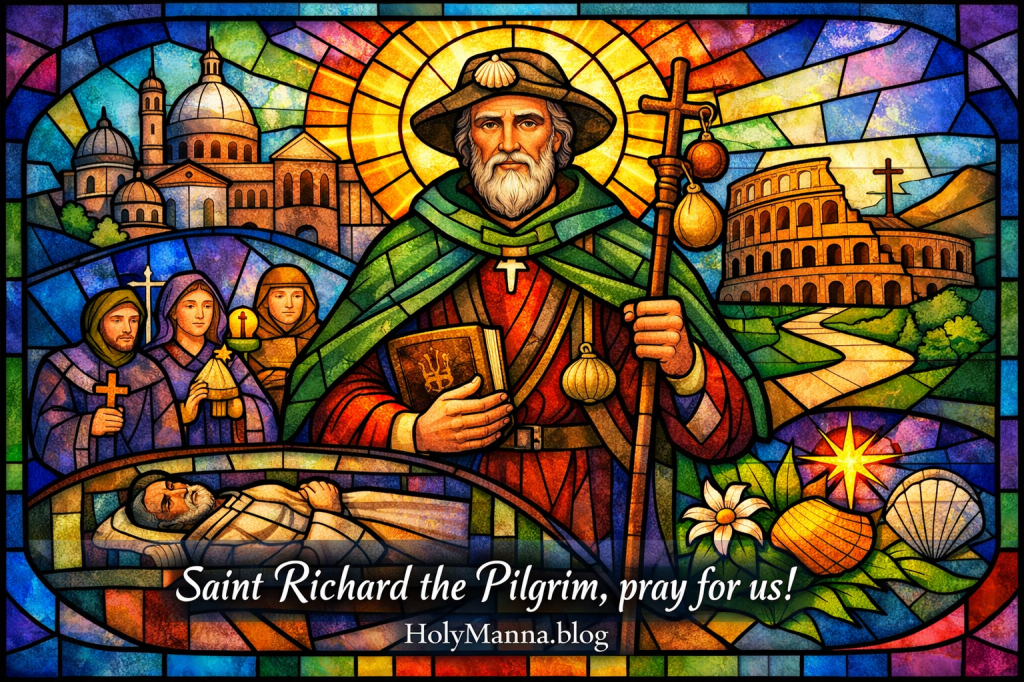
Saint Richard the Pilgrim is one of those saints whose greatness is easy to miss because it looks so ordinary. He was not a famous preacher, and no verified quotations from his own mouth have come down to the Church with reliable certainty. Yet the Church still venerates him, because his life quietly produced an entire legacy of holiness. He is remembered as an English Christian of noble background, sometimes even described with royal language in later tradition, who set out on pilgrimage toward Rome and died in Lucca along the way.
What makes Saint Richard stand out is not a dramatic public career, but the kind of father he was. Catholic tradition consistently honors him as the father of three saints: Saint Willibald, Saint Winnebald, and Saint Walburga, whose missionary work strengthened the Church in Europe during the eighth century. Their holiness did not appear out of thin air, and it did not come from worldly comfort. It grew from a home where faith was treated as real, prayer was treated as necessary, and sacrifice was treated as normal.
This is why Saint Richard matters today. His story reminds Catholics that sanctity is not reserved for monks and martyrs alone. God also makes saints through faithful parents, steady daily discipline, and families that choose Christ over convenience.
Wessex Roots and a Home Built for Heaven
The earliest accounts connected to Saint Richard do not preserve many personal details about his youth, and careful Catholic sources admit that later centuries expanded parts of his biography. Still, Catholic tradition places him in Wessex and remembers him as a man of standing who lived with a pilgrim’s heart. Even when later devotion calls him a king, the deeper truth remains the same: he was a man who believed that the Church was worth everything. His life shows that status means little if it does not serve holiness.
Catholic tradition also preserves the memory of his wife, often named Winna or Wuna, and connects her to Saint Boniface’s missionary circle. Whether described as close kin or extended relation in different Catholic references, the point is consistent: this family belonged to the same spiritual world that fueled the great missionary renewal of that age. That connection helps explain why Richard’s children later stepped into evangelization so naturally, as if it had already been planted in their bones. A household that breathes the Church eventually produces adults who can suffer for the Church.
One of the most revealing details is how he provided for his daughter’s spiritual formation. Tradition holds that Walburga was entrusted to the abbess at Wimborne for years of careful religious formation, which shows a father who planned for his child’s soul, not just her future comfort. In a time when many parents are tempted to outsource faith, Saint Richard’s example is a direct challenge. He treated a child’s spiritual environment as one of the most important decisions a parent can make.
The Pilgrim Road That Formed Saints
Saint Richard is called “the Pilgrim” because the Church remembers him through a journey that shaped everyone who walked it with him. Catholic tradition describes him leaving England with his sons on pilgrimage toward Rome, and the wider tradition connects their desire for pilgrimage with the holy places beyond Rome as well. This was not a casual trip, and it was not a quest for novelty. It was a penitential, prayerful movement toward the heart of the Church and toward the places made sacred by Christ’s saving work.
Pilgrimage in the Catholic imagination is never only about distance. It is about conversion, detachment, and learning to trust God when the road is uncertain. That is why The Catechism speaks so clearly about pilgrimages, calling them special moments of renewal in prayer. It says “Pilgrimages evoke our earthly journey toward heaven and are traditionally very special occasions for renewal in prayer.” CCC 2691. Saint Richard lived like a man who believed life itself is a pilgrimage, and he taught his children that the Christian does not drift through the world. The Christian walks with intention toward God.
Catholic hagiography also preserves a cherished tradition that young Willibald once faced grave illness and recovered in a way attributed to prayer and trust in the Lord. Whether one hears the story in full or only in summary, the spiritual lesson fits Saint Richard’s family with perfect clarity. This was a household trained to turn to Christ first, not last, and to hope even when fear tried to take over. In the end, one of the most striking “miracles” associated with Saint Richard’s life is the fruit of his fatherhood itself, because raising saints requires more than good luck. It requires grace embraced through daily faithfulness.
The Final Miles and the Cross of Illness
Pilgrimage in the eighth century was demanding in a way most modern people can barely imagine. The road was long, travel was hazardous, illness was common, and comfort was scarce. Saint Richard’s hardships were not mainly political persecutions or public trials, but the grinding sacrifice of the pilgrim’s life itself. His suffering shows a kind of holiness that does not seek attention, but still carries the weight of the cross.
Catholic tradition holds that Saint Richard reached Lucca in Tuscany and fell seriously ill. After only a short time, he died there, and his sons buried him before continuing their pilgrimage. That detail matters, because it shows a father who had already taught them the meaning of perseverance. A saintly parent does not only teach children how to begin holy things. A saintly parent teaches children how to finish holy things.
This was not martyrdom in the strict sense, because he was not executed for professing the faith. Yet his death still resembles the pattern of Christian sacrifice, because he died in the act of seeking God and honoring the Church. In a culture that often treats discomfort like a crisis, Saint Richard’s final miles preach a quiet sermon. He shows that suffering accepted in faith can become a real offering, and that the road to God is worth the cost.
Lucca’s Shrine and the Grace Flowing After Death
After Saint Richard’s death, Catholic devotion did not forget him. It gathered around his burial place in Lucca, where his relics are venerated at the Basilica of San Frediano. Catholic sources consistently describe Lucca as the center of his cult, and they note that miracles were reported through his intercession, helping spread devotion. Even when specific miracle stories are not preserved in one famous, universally repeated narrative, the pattern is clear: the faithful prayed, favors were received, and gratitude deepened the Church’s memory.
The Church has always understood that relics and shrines are not magical objects. They are tangible reminders that God works through His saints and that the body matters in Christian faith, because the Word became flesh. That is why The Catechism speaks of authentic popular piety and explicitly names practices like pilgrimages, shrines, and relics as part of Catholic devotional life. It includes “the veneration of relics, visits to sanctuaries, pilgrimages” among the expressions that have accompanied the faith of the Christian people. CCC 1674. Properly lived, this devotion does not distract from Jesus. It directs the heart back to Jesus by honoring what His grace has accomplished in His friends.
Saint Richard’s memory also spread beyond Italy, especially through the missionary work of his children. Catholic tradition notes that devotion and relic veneration connected to him appeared in places linked to his sons’ ministry, including German lands shaped by Saint Willibald. This “after death” legacy is not merely sentimental. It is a reminder that one holy family can ripple outward through history, blessing places the parents never lived to see.
Living Like a Pilgrim in the Middle of Ordinary Life
Saint Richard’s life becomes truly powerful when it is applied to daily Christian living. His story teaches that fathers and mothers shape souls primarily through consistency, not speeches. A home grows holy when prayer is normal, the sacraments are prioritized, and children see that God is loved more than comfort. That is the kind of formation that can produce saints, whether those saints become missionaries on foreign soil or quiet faithful Catholics in an ordinary neighborhood.
His life also corrects a modern temptation to treat the faith as a hobby rather than a path. A pilgrim does not wander aimlessly, and a Catholic should not either. Saint Richard’s pilgrimage points directly to the deeper truth that life is moving toward judgment and mercy, toward death and resurrection, toward heaven or away from it. How would daily decisions change if everything was measured by whether it leads closer to Christ and His Church?
Finally, Saint Richard invites Catholics to lean into the communion of saints with confidence. The saints are not distant legends, but living members of Christ’s Body who pray for the Church. The Catechism teaches this plainly when it says “They do not cease to intercede with the Father for us.” CCC 956. Asking for Saint Richard’s intercession is especially fitting for families, fathers, and anyone preparing for a difficult journey, because his life was shaped by fatherhood and sanctified by pilgrimage. What would happen if families asked the saints for help as naturally as they ask friends to pray?
Engage with Us!
Share your thoughts and reflections in the comments below. Saint Richard’s life looks simple at first, but it carries a strong message for families trying to live the faith with courage and clarity. His story invites honest self-examination, because it shows how much holiness can grow from steady daily choices. This is a saint worth sitting with slowly, especially for anyone trying to build a home that points toward heaven.
- What is one concrete way to strengthen the domestic church at home this week, especially through prayer and consistency?
- What is one comfort or distraction that has softened spiritual discipline, and what small sacrifice could help restore focus on Christ?
- If pilgrimage is renewal in prayer, what would a realistic mini pilgrimage look like this month, such as a reverent visit to a church for quiet prayer and thanksgiving?
- Which person in the family most needs grace right now, and how can Saint Richard be asked to intercede with trust and perseverance?
May Saint Richard pray for every father who feels stretched thin, for every family trying to stay faithful, and for every soul that needs direction. Keep walking with Christ, stay close to the sacraments, and do everything with the love and mercy Jesus taught us.
Saint Richard the Pilgrim, pray for us!
Follow us on YouTube, Instagram and Facebook for more insights and reflections on living a faith-filled life.

 Holy Manna!
Leave a comment