The Beggar Who Made Naples Feel Loved Again
Saint Giles Mary of Saint Joseph is the kind of saint who quietly exposes a lie most people believe. The lie says holiness needs a stage, a title, or a dramatic life story. His life proves the opposite. He was a Franciscan lay brother, not a priest, and his mission field was not a foreign country. It was the noisy streets of Naples, the cramped homes of the working poor, and the weary hearts of people who felt unseen.
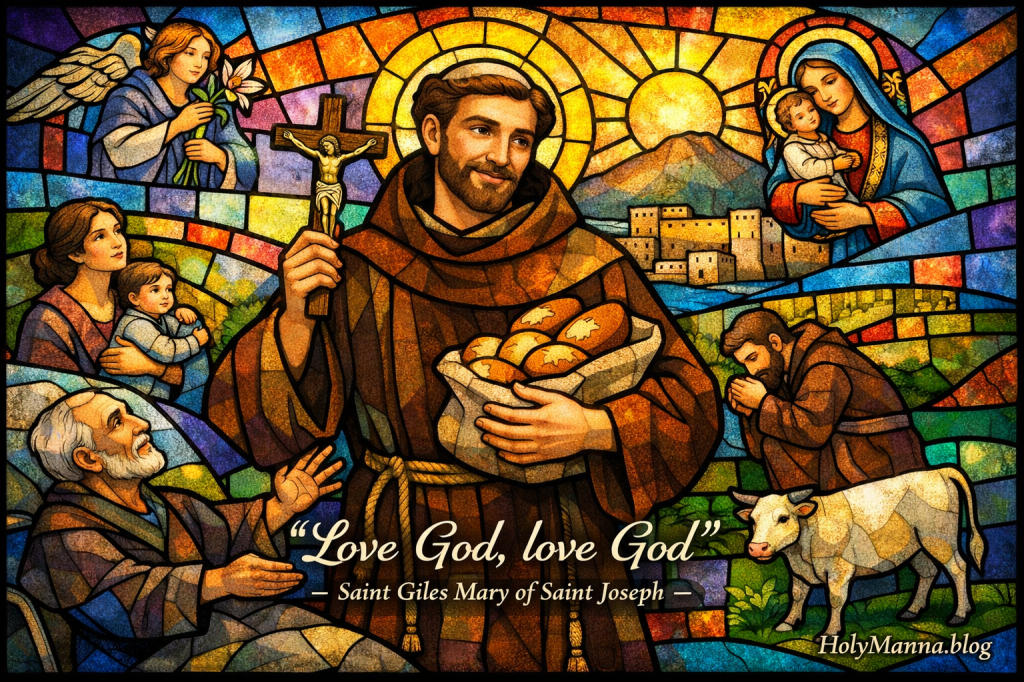
People called him the Consoler of Naples because he did not treat charity like a transaction. He treated every encounter like a moment where Christ wanted to love somebody personally. That is why the crowds looked for him, why the sick waited for him, and why even educated and influential people sought him out. Catholic tradition preserves his most famous refrain: “Love God, love God.”
Taranto, Work, and a Slow Conversion
He was born Francesco Antonio Pontillo in Taranto in 1729, and he grew up in real poverty. Before he ever wore a Franciscan habit, he learned honest work with tough hands, including the trade of rope making. When his father died, he did not run away from responsibility. He stepped up and became the main support for his family while continuing to deepen a serious prayer life.
His conversion was not a single lightning bolt moment. It was a steady surrender, a growing desire to belong completely to God, and a deeper commitment to prayer and devotion. Only after years of doing what was right for his family did he enter the Franciscan Alcantarine reform in February 1754 as a lay brother. He made profession in 1755, embracing a hidden life that would never be glamorous, but would be powerfully fruitful.
Naples: A Walking Work of Mercy
In 1759 he was sent to Naples, to the Franciscan convent of San Pasquale a Chiaia, and he stayed there for more than fifty years. His assignments shifted over time, but they all pushed him toward the same kind of holiness. He served as cook, then as doorkeeper, and then as the brother who went out daily to seek alms. In a proud world, that job could crush a man. In him, it became a doorway to grace.
He walked through neighborhoods where many people lived in small ground level dwellings, the kind of places the comfortable rarely entered. Catholic devotion remembers him as a saint of the poor quarters, a man who could step into misery without flinching, because he believed Christ was already there. He gathered food and offerings for the friary, but he also gathered stories, wounds, regrets, and fears. He listened like a father and encouraged like a brother, all while carrying suffering back to the convent and turning it into prayer.
This is where his life becomes a living page from “Whatever you did for one of these least brothers of mine, you did for me.” The Gospel of Matthew 25:40. The Church teaches that the works of mercy are not side projects for extra holy people. They are the ordinary shape of Christian love. The Catechism calls the works of mercy charitable actions that come to the aid of neighbor in bodily and spiritual needs. CCC 2447.
Catholic accounts connected to his cause also attribute extraordinary signs to his life, including healings, moments of prophecy, and help that seemed to arrive through prayer at the exact moment it was needed. The most famous story remembered in popular devotion is the restoration of a stolen calf named Catarinella. The story is told as a moral miracle, calling a wrongdoer back to justice, repentance, and restitution through a sign that pointed to God’s mercy.
Trials, Courage, and a Hidden Suffering
Saint Giles lived through years of political instability and foreign occupation, when Naples was tense and unpredictable. Crowds gathered around him, and Catholic tradition says authorities sometimes watched him closely because his influence among ordinary people was obvious. He did not seek conflict, but he also did not fear speaking truth when it mattered.
One surprising story often repeated in Catholic tradition places him before Joseph Bonaparte during the French period. The account says he predicted that the ruler’s hold on Naples would not last long. That kind of boldness is not the swagger of a rebel. It is the calm confidence of a man who fears God more than man.
His deepest hardship, though, was not public persecution. It was the daily weight of the suffering he encountered. Consoling the poor is not romantic when it is constant. It costs sleep, patience, and emotional strength. He carried that cost into prayer, returning again and again to the Blessed Sacrament and to the Mother of God for strength.
Toward the end of his life, his body began to collapse under illness, and his suffering became more intense. He died in Naples on February 7, 1812, mourned widely because the people knew they had lost a spiritual father. The saint who had spent his life carrying other people’s burdens now entrusted his own life completely to the mercy of Jesus.
Heaven’s Answer Through a Humble Saint
After his death, devotion to Saint Giles did not fade. It grew. People continued to seek his intercession because they believed the mercy they had encountered through him was still available in Christ. The Church eventually confirmed his sanctity through the careful process that recognizes heroic virtue and authentic intercession.
A major miracle associated with his canonization was the healing of Angela Mignogna in 1937 from uterine choriocarcinoma, a healing attributed to his intercession. He was canonized in 1996, held up as a model of humble Franciscan holiness for the modern world. His veneration remains especially strong in Naples at San Pasquale a Chiaia, where he lived and served, and in Taranto, where he was born and where he is honored with deep local devotion.
Living the Gospel in Work Boots
Saint Giles Mary of Saint Joseph is a needed saint for modern life because he makes holiness feel possible. He was not famous because he chased attention. He became known because love has a way of becoming visible. His life teaches that spiritual depth is not proven by emotional experiences, but by steady charity rooted in prayer.
The lesson is practical and demanding. Love for the poor cannot stay theoretical. The Church teaches that love for the poor is a demand of the Gospel and belongs to the Church’s constant tradition. CCC 2443-2444. Saint Giles shows what that looks like in real streets with real problems. It looks like listening without rushing, giving without humiliating, and praying with such faith that discouragement does not get the final word.
Catholic tradition preserves his simple words, and they still cut through excuses because they are not complicated: “Love God, love God.” How does that simple command challenge the way faith is lived day to day? When God is loved first, prayer becomes less like a chore and more like a lifeline. Mercy becomes less like a theory and more like a habit. A person starts to see Christ in the neighbor who is hard to love, and that is where conversion becomes real.
Engage with Us!
Share your thoughts and reflections in the comments below. Saint Giles reminds the Church that simple holiness can change a whole city, and that the most powerful evangelists are often the ones the world barely notices.
- Where in daily life is God inviting a deeper conversion that looks less like a dramatic moment and more like steady faithfulness?
- Who is one person right now who needs consolation, and what would it look like to bring them the kindness of Christ in a concrete way?
- How can Eucharistic devotion and prayer become more than a routine, so that it actually fuels mercy and patience in relationships?
- What is one work of mercy that can be practiced this week with joy instead of reluctance?
May Saint Giles Mary of Saint Joseph teach hearts to love God first, love neighbor sincerely, and live every day with the same love and mercy Jesus taught, even when nobody is watching.
Saint Giles Mary of Saint Joseph, pray for us!
Follow us on YouTube, Instagram and Facebook for more insights and reflections on living a faith-filled life.

 Holy Manna!
Leave a comment