Saturday of the Fourth Week in Ordinary Time – Lectionary: 328
When God Gives the Gift of a Listening Heart
Some days feel like a flood of voices, choices, and demands, as if the soul is being pulled in five directions at once. Today’s Mass readings step right into that noise and reveal something surprisingly simple and strong: God does not begin by handing out shortcuts or winning strategies. God begins by forming the heart, because a heart that can truly listen becomes capable of discernment, real rest, and steady compassion.
The central theme tying these passages together is the grace of interior formation. In 1 Kings 3:4-13, Solomon stands at the beginning of his reign, surrounded by the weight of responsibility, and he asks for the one gift that can hold everything else in place: “Give your servant… a listening heart… to distinguish between good and evil.” In Psalm 119:9-14, that same interior focus becomes personal and practical, because the heart stays clean not by luck, but by clinging to the Word: “In my heart I treasure your promise, that I may not sin against you.” Then The Gospel of Mark 6:30-34 shows what this looks like in the flesh: Jesus draws His apostles away to rest, but when the crowd appears, He responds not with irritation but with shepherding mercy, because “his heart was moved with pity for them, for they were like sheep without a shepherd; and he began to teach them many things.”
There is also a quiet historical thread running through the whole day. Solomon’s prayer rises from Israel’s life of worship, offered at Gibeon, a major sanctuary before the Temple was built in Jerusalem. The people are learning what it means to be governed not merely by human strength but by covenant fidelity. Centuries later in the Gospel, Israel is still longing for true leadership, and Mark paints the crowd as sheep who need a shepherd, echoing the Old Testament story again and again. In other words, the longing in Solomon’s kingdom and the hunger in Galilee are not random. They are the same human need seen in two different moments: the need for God to guide His people from the inside out, through wisdom, through Word, and through a Shepherd who teaches because He loves.
Taken together, today’s readings prepare the heart for a very Catholic kind of prayer. The request is not merely for new circumstances, but for a renewed interior life. It is the kind of prayer that asks God to tune the conscience, to steady the desires, and to teach the soul how to rest in Him, so that love can become patient and strong. How might life change if the first request in every season, whether busy or quiet, became a true “listening heart” formed by God’s Word and shaped by the compassion of Christ?
First Reading – 1 Kings 3:4-13
A King Who Asked for the One Thing That Keeps a Soul Honest
Solomon is standing at the beginning of something enormous. David is gone, the throne is his, and Israel is not a small family business. It is a covenant people with a real history of miracles, sin, repentance, and mercy. In the ancient world, kings usually asked their gods for dominance, long life, and enemies crushed into dust. Solomon is young, inexperienced, and painfully aware of the weight on his shoulders, so he does something that sounds almost too humble for a royal court. He asks the Lord for wisdom that begins with listening.
This moment takes place at Gibeon, a major high place of worship before the Temple is built in Jerusalem. Israel is still living in that “in between” time, when the promise is clear but the structures are still forming. That background matters because today’s theme is not about being impressive. It is about being rightly ordered inside. A listening heart is the foundation for discernment, for rest that actually restores, and for the kind of shepherding compassion seen in The Gospel of Mark 6:30-34. God is shaping leaders and disciples the same way in every age: not by inflating the ego, but by forming the conscience.
1 Kings 3:4-13 – New American Bible (Revised Edition)
4 The king went to Gibeon to sacrifice there, because that was the great high place. Upon its altar Solomon sacrificed a thousand burnt offerings. 5 In Gibeon the Lord appeared to Solomon in a dream at night. God said: Whatever you ask I shall give you. 6 Solomon answered: “You have shown great kindness to your servant, David my father, because he walked before you with fidelity, justice, and an upright heart; and you have continued this great kindness toward him today, giving him a son to sit upon his throne. 7 Now, Lord, my God, you have made me, your servant, king to succeed David my father; but I am a mere youth, not knowing at all how to act— 8 I, your servant, among the people you have chosen, a people so vast that it cannot be numbered or counted. 9 Give your servant, therefore, a listening heart to judge your people and to distinguish between good and evil. For who is able to give judgment for this vast people of yours?”
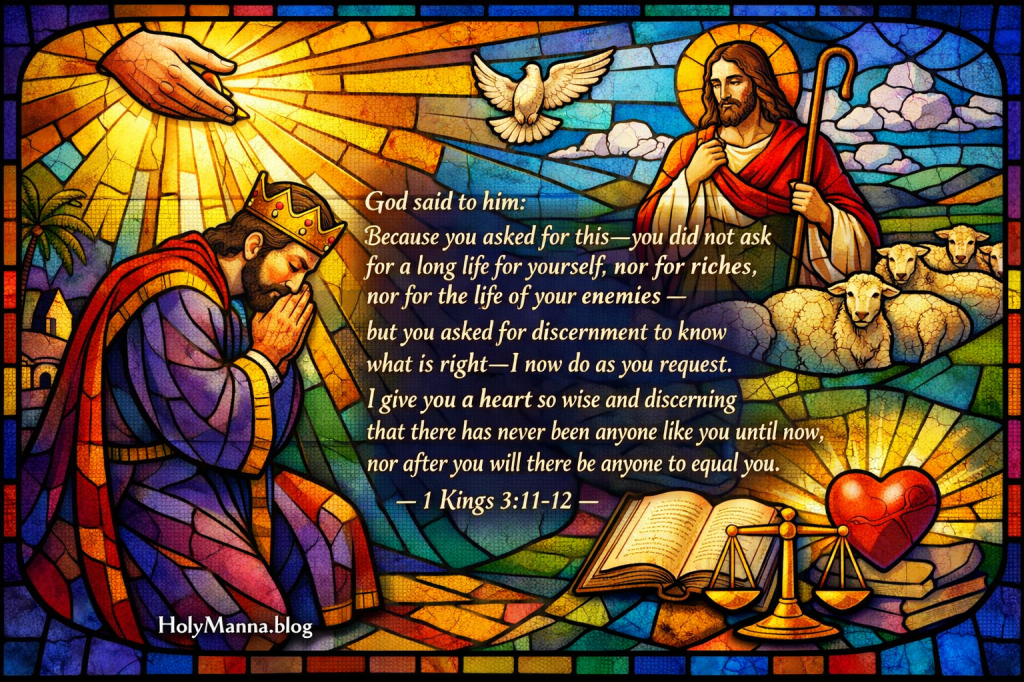
10 The Lord was pleased by Solomon’s request. 11 So God said to him: Because you asked for this—you did not ask for a long life for yourself, nor for riches, nor for the life of your enemies—but you asked for discernment to know what is right— 12 I now do as you request. I give you a heart so wise and discerning that there has never been anyone like you until now, nor after you will there be anyone to equal you. 13 In addition, I give you what you have not asked for: I give you such riches and glory that among kings there will be no one like you all your days.
Detailed Exegesis
Verse 4 “The king went to Gibeon to sacrifice there, because that was the great high place. Upon its altar Solomon sacrificed a thousand burnt offerings.”
Solomon begins with worship, and worship costs him something. The “thousand burnt offerings” expresses extravagant devotion, but it also reveals a young king trying to honor the Lord publicly at a place recognized for sacrifice. Even before Solomon knows what to ask, he shows that God is not an accessory to leadership. God is the center.
Verse 5 “In Gibeon the Lord appeared to Solomon in a dream at night. God said: Whatever you ask I shall give you.”
God initiates. Solomon’s wisdom does not come from raw talent or political tutoring. It comes from revelation and grace. In Scripture, dreams often signal God’s personal guidance, reminding the reader that the Lord is not distant. The Lord speaks, and the heart must learn how to hear.
Verse 6 “Solomon answered: ‘You have shown great kindness to your servant, David my father, because he walked before you with fidelity, justice, and an upright heart; and you have continued this great kindness toward him today, giving him a son to sit upon his throne.’”
Solomon begins by remembering mercy. This is not flattery. This is theology. He recognizes covenant faithfulness as the real source of stability. He also roots his reign in gratitude, not entitlement. That posture of thanksgiving is already the beginning of wisdom because it keeps the soul grounded in reality.
Verse 7 “Now, Lord, my God, you have made me, your servant, king to succeed David my father; but I am a mere youth, not knowing at all how to act”
Solomon admits weakness out loud. A culture that worships confidence will call this “insecurity,” but Scripture calls it truth. Spiritual maturity begins when a person stops pretending. Solomon names his limits before God, which is exactly where God can begin to form him.
Verse 8 “I, your servant, among the people you have chosen, a people so vast that it cannot be numbered or counted.”
Solomon sees the people as chosen, not owned. That is an important correction for any leader, parent, manager, priest, or teacher. The people belong to God first. The king is a steward. When leadership forgets this, it becomes domination. When leadership remembers it, it becomes service.
Verse 9 “Give your servant, therefore, a listening heart to judge your people and to distinguish between good and evil. For who is able to give judgment for this vast people of yours?”
This is the heart of the reading and the heart of today’s theme. Solomon asks for a “listening heart,” not merely a clever mind. He wants discernment that can distinguish good from evil, which means he wants a conscience tuned to truth. He knows that judgment without listening becomes tyranny, and decisions without moral clarity become chaos.
Verse 10 “The Lord was pleased by Solomon’s request.”
God delights in requests that are ordered toward love and justice. Solomon’s prayer is not selfish. It is aimed at serving the people well. It is a model of petition that does not revolve around comfort, but around holiness.
Verse 11 “So God said to him: Because you asked for this, you did not ask for a long life for yourself, nor for riches, nor for the life of your enemies, but you asked for discernment to know what is right”
God names the usual temptations of power: longevity, wealth, vengeance. Solomon refuses them, and God praises the ordering of his desire. The request is not a vague desire to “be wise.” It is discernment “to know what is right,” which means wisdom has a moral spine.
Verse 12 “I now do as you request. I give you a heart so wise and discerning that there has never been anyone like you until now, nor after you will there be anyone to equal you.”
God grants a unique gift, and notice the language again: God gives a “heart” that is wise, not only a mind that is sharp. Biblical wisdom is not merely information. It is a way of seeing, choosing, and living in harmony with God’s order.
Verse 13 “In addition, I give you what you have not asked for: I give you such riches and glory that among kings there will be no one like you all your days.”
God’s generosity overflows. When Solomon seeks the right thing first, God provides other goods as well. This is not a blank check for materialism. It is a lesson in providence. The Lord is not outdone in generosity, and He is able to supply what is needed when the heart is rightly aligned.
Teachings
Solomon’s “listening heart” belongs right in the Catholic understanding of conscience and prudence. The Church does not treat conscience as a mood or a personal preference. Conscience is where the person hears a call to the good and must respond with obedience. The Catechism describes the interior place where this discernment happens with striking clarity: CCC 1776 teaches, “Deep within his conscience man discovers a law which he has not laid upon himself but which he must obey. Its voice, ever calling him to love and to do what is good and to avoid evil, sounds in his heart at the right moment.” That is exactly what Solomon asks for, because he knows leadership without that interior law becomes corruption with a crown.
Wisdom is also deeply connected to prudence, which is often misunderstood as mere caution. Prudence is the virtue that makes holiness practical. It is the grace trained into habits. The Catechism explains this in a way that fits Solomon’s request almost word for word. CCC 1806 teaches, “Prudence is the virtue that disposes practical reason to discern our true good in every circumstance and to choose the right means of achieving it.” Solomon is not asking to look impressive. He is asking to judge rightly, to choose rightly, and to govern in a way that reflects God’s justice.
This reading also points to the Holy Spirit’s work. Scripture presents wisdom as a gift from God, not merely a human achievement. The Church teaches that the Holy Spirit perfects the virtues through His gifts, strengthening the soul for real discernment and fidelity. CCC 1831 teaches, “The seven gifts of the Holy Spirit are wisdom, understanding, counsel, fortitude, knowledge, piety, and fear of the Lord.” Solomon’s prayer is, in a very real sense, a prayer for the Spirit’s gifts to govern his actions, especially wisdom and counsel.
The saints consistently echo this logic. St. Gregory the Great warned that authority is dangerous when it is not rooted in humility and fear of the Lord, because leadership can become a stage for the self instead of a service for the flock. Solomon’s prayer models the opposite spirit: a king who fears God more than he craves control. This is why the Church has always insisted that wisdom is proved not by how fast someone speaks, but by how faithfully someone listens, especially to God.
Reflection
Solomon’s prayer still feels modern because it names what so many people feel but rarely admit. Life gets big quickly. Responsibilities multiply. Choices stack up. The soul can start reacting instead of discerning. This reading offers a different path, and it begins with an uncomfortable but freeing truth: it is normal to feel inadequate, but it is dangerous to pretend otherwise. Solomon’s strength is not that he has everything figured out. Solomon’s strength is that he brings his confusion to God and asks for the one gift that can steady everything else.
A listening heart grows in ordinary ways. It grows when prayer is treated as a priority instead of an emergency button. It grows when Scripture is not only read but received, so that God’s Word becomes the standard by which good and evil are measured. It grows when confession is approached with honesty, because sin clouds discernment and grace clears it. It also grows when the day includes real silence, because a heart cannot listen if it never stops talking or never stops consuming noise.
What decision right now feels too heavy to carry without God’s wisdom?
What would change if the first request in prayer became Solomon’s request, asking not for comfort or control, but for a listening heart that can distinguish good from evil?
Where has the desire for riches, praise, or winning an argument started to crowd out the desire to be holy?
Solomon shows that God is pleased when the heart seeks the right thing first. The Lord still answers that kind of prayer. The Lord still forms consciences, strengthens prudence, and gives wisdom to souls that are willing to listen.
Responsorial Psalm – Psalm 119:9-14
How a Heart Stays Clean When the World Is Loud
Psalm 119 is not a quick inspirational poem. It is the longest psalm in Scripture, built like a carefully crafted meditation on the beauty of God’s law. In Israel’s worship, this psalm shaped the imagination of the faithful by teaching them that the Lord’s commandments are not chains, but a path to freedom. That background matters today because Solomon’s request for a listening heart is not an isolated moment of wisdom. It is the same spiritual posture the psalm teaches: a life guided by God’s Word from the inside out.
In a culture that often treats morality as personal preference, this psalm insists that the heart needs formation. The psalmist speaks like someone who has learned that sin does not begin with a sudden disaster. Sin usually begins with drifting. So the psalm keeps returning to the same remedy: seek the Lord, treasure His promise, learn His statutes, and rejoice in His testimonies more than riches. This fits today’s theme perfectly because a listening heart is not only requested once, like Solomon asked at Gibeon. A listening heart is also trained daily, like disciples who return to Christ again and again to be taught, corrected, and renewed.
Psalm 119:9-14 – New American Bible (Revised Edition)
9 How can the young keep his way without fault?
Only by observing your words.
10 With all my heart I seek you;
do not let me stray from your commandments.
11 In my heart I treasure your promise,
that I may not sin against you.
12 Blessed are you, O Lord;
teach me your statutes.
13 With my lips I recite
all the judgments you have spoken.
14 I find joy in the way of your testimonies
more than in all riches.
Detailed Exegesis
Verse 9 “How can the young keep his way without fault? Only by observing your words.”
The psalm begins with a real question about purity and integrity, especially for the young, but it is not limited to youth. It is about anyone who wants to walk straight when temptation pulls sideways. The answer is not vague optimism. The answer is obedience shaped by God’s Word. Scripture is presented as a guardrail for the soul, not because God is controlling, but because God is truthful. When the Word is ignored, the heart starts rewriting good and evil to fit desire.
Verse 10 “With all my heart I seek you; do not let me stray from your commandments.”
This verse links seeking God with staying faithful. The psalmist is not pretending to be strong. He is praying like someone who knows how easy it is to wander. That humility is a sign of spiritual maturity. The heart seeks, but it also asks to be held steady, because desire without guidance can become self-deception. A listening heart is not passive. A listening heart is focused, intentional, and dependent on grace.
Verse 11 “In my heart I treasure your promise, that I may not sin against you.”
This is the interior battleground. The Word is not only read with the eyes. It is stored in the heart. The psalmist treats God’s promise like treasure because he knows what is at stake. Sin is not merely breaking a rule. Sin is wounding a relationship with the living God. Treasuring the Word is not sentimental. It is spiritual warfare. When temptation comes, the heart reaches for what it has stored.
Verse 12 “Blessed are you, O Lord; teach me your statutes.”
The psalm turns into prayer. God is praised, and then God is asked to teach. This is the posture of a disciple. It is also deeply Catholic. Faith is received. Holiness is learned. The psalmist is not trying to invent a moral system. He is asking to be instructed by the Lord who is blessed, good, and trustworthy.
Verse 13 “With my lips I recite all the judgments you have spoken.”
The Word moves from heart to mouth. This is how Israel remembered. This is how worship formed identity. Reciting the judgments is not cold legalism. It is a way of keeping truth present, especially when lies feel persuasive. It also hints at the communal dimension of faith. The Word is proclaimed, taught, and handed on. A listening heart does not hoard truth. A listening heart speaks it with reverence.
Verse 14 “I find joy in the way of your testimonies more than in all riches.”
This is the climax. The psalmist compares God’s testimonies to wealth and says the Word wins. That line echoes Solomon, who refused to ask for riches and instead asked for discernment. The psalm reveals a mature joy that the world cannot imitate. Riches can excite, but they cannot purify. Riches can distract, but they cannot shepherd a soul. The Word of God gives a joy that is stable because it is rooted in truth.
Teachings
This psalm is a masterclass in how God forms a person. It assumes something the Church has always taught: the moral life is not built on feelings. The moral life is built on truth received and lived. That is why the Church speaks so strongly about conscience needing formation. The Catechism teaches that conscience is not automatically reliable unless it is educated in truth. CCC 1783 states, “Conscience must be informed and moral judgment enlightened. A well formed conscience is upright and truthful. It formulates its judgments according to reason, in conformity with the true good willed by the wisdom of the Creator.” The psalm is doing exactly that. It is forming conscience by teaching the heart to treasure God’s Word.
The psalm also reflects the Church’s insistence that Scripture is not merely information but living speech from God meant to become prayer. The Catechism teaches, CCC 2653, “The Church forcefully and specifically exhorts all the Christian faithful to learn the surpassing knowledge of Jesus Christ, by frequent reading of the divine Scriptures. ‘Ignorance of the Scriptures is ignorance of Christ.’ Prayer should accompany the reading of Sacred Scripture, so that a dialogue takes place between God and man, for ‘we speak to him when we pray; we listen to him when we read the divine oracles.’” A listening heart is not built by scrolling. A listening heart is built by this kind of dialogue.
Saints have always echoed this same truth with blunt clarity. St. Jerome famously warned that separation from Scripture leads to separation from Christ, and the Church quotes him to underline the point. The psalmist would agree, because he treats the Word as treasure precisely so he will not sin. The more the Word is stored in the heart, the more temptation meets resistance. The more the Word is proclaimed with the lips, the more the mind remembers what is true when emotions surge.
Historically, Israel’s faith survived exile, persecution, and compromise because the Word was memorized, recited, and prayed in the home and in worship. The psalm assumes that kind of living tradition. It is not a private hobby. It is a way of life that holds a people together.
Reflection
This psalm speaks to anyone trying to stay faithful in a distracted age. The question in verse 9 still hits home because temptation has not gotten weaker. It has gotten more available. It follows people around in their pockets. The psalm does not respond with panic or shame. It responds with a plan that is both spiritual and practical: observe the Word, seek God with the whole heart, store His promise, ask to be taught, recite truth, and choose joy in God over riches.
A person does not drift into holiness. Holiness is chosen, protected, and practiced. The heart becomes what it repeatedly takes in. When the heart constantly consumes outrage, lust, vanity, and noise, it will eventually speak that language. When the heart treasures God’s promise, it gains a new instinct. It begins to recognize sin faster, resist temptation sooner, and return to prayer more naturally. That is how a listening heart becomes stable, and that stability is exactly what makes real compassion possible. A heart that is constantly compromised will struggle to shepherd anyone with clarity. A heart rooted in the Word can love with patience and truth.
What has been stored in the heart lately, the Word of God or the words of the world?
When temptation shows up, what does the mind reach for first, a favorite excuse or a treasured promise?
If God’s testimonies are truly more valuable than riches, what daily habit would change to reflect that belief?
This psalm offers hope because it assumes God is willing to teach. The Lord is not stingy with wisdom. The Lord forms the heart that seeks Him, and He does it through His Word, patiently, day after day, until the soul learns to walk without drifting.
Holy Gospel – Mark 6:30-34
When Christ Calls His Friends to Rest
This scene unfolds in the middle of a demanding stretch of Jesus’ public ministry in Galilee. The apostles have been sent out to preach and heal, and they return full of reports, exhaustion, and adrenaline. It is also a tense chapter in Mark’s Gospel because the shadow of violence is already present. John the Baptist has been killed, and the cost of preaching the truth is no longer theoretical. In that setting, Jesus does something deeply revealing. He does not treat His apostles like spiritual machines. He calls them to step away, to breathe, and to let their hearts be restored.
That call to rest fits perfectly with today’s theme of a listening heart. Solomon asked the Lord for discernment, not for trophies. Psalm 119:9-14 showed how the Word is treasured so the soul does not drift into sin. Here in Mark 6:30-34, Jesus forms His disciples in the same way. He draws them into quiet so they can remain rooted in Him. Then, when the crowd rushes in like a wave, He shows them what a formed heart looks like in action: “his heart was moved with pity for them, for they were like sheep without a shepherd; and he began to teach them many things.” Rest leads to compassion, and compassion expresses itself through truth lovingly taught.
Mark 6:30-34 – New American Bible (Revised Edition)
The Return of the Twelve. 30 The apostles gathered together with Jesus and reported all they had done and taught. 31 He said to them, “Come away by yourselves to a deserted place and rest a while.” People were coming and going in great numbers, and they had no opportunity even to eat. 32 So they went off in the boat by themselves to a deserted place. 33 People saw them leaving and many came to know about it. They hastened there on foot from all the towns and arrived at the place before them.
The Feeding of the Five Thousand. 34 When he disembarked and saw the vast crowd, his heart was moved with pity for them, for they were like sheep without a shepherd; and he began to teach them many things.
Detailed Exegesis
Verse 30 “The apostles gathered together with Jesus and reported all they had done and taught.”
The apostles return to Jesus because mission is never meant to be independent. Their first instinct is not self-congratulation but communion. They “report” to Him, which shows a pattern of accountability and humility. Ministry is meant to remain connected to the Lord, or it turns into ego, burnout, or both. This verse quietly suggests that a listening heart does not only listen to God in prayer. It also listens through obedience, spiritual direction, and honest evaluation of what has been done and taught.
Verse 31 “He said to them, ‘Come away by yourselves to a deserted place and rest a while.’ People were coming and going in great numbers, and they had no opportunity even to eat.”
Jesus notices the human limit and honors it. He does not shame them for needing rest. He commands it, almost like a spiritual medicine. The detail about not even having time to eat shows the intensity of their apostolic labor and the danger of living on constant urgency. A disciple who never rests will eventually stop listening, because a tired soul becomes reactive, impatient, and easily tempted. Christ’s invitation is not an escape from love. It is the way love is sustained.
Verse 32 “So they went off in the boat by themselves to a deserted place.”
The apostles obey. The boat becomes a kind of moving cloister, a passage into silence. In Mark’s Gospel, boats often function as places of transition, where Jesus forms His followers away from the noise. The deserted place echoes Israel’s history as well, because the wilderness is where God speaks, purifies, and renews covenant love. A listening heart is frequently formed in “deserted” spaces, not because God hates the world, but because the world’s volume can drown out grace.
Verse 33 “People saw them leaving and many came to know about it. They hastened there on foot from all the towns and arrived at the place before them.”
The crowd is hungry, restless, and determined. They do not have perfect theology yet, but they have a real instinct that Jesus is the answer to something. Their urgency also reveals a deeper spiritual condition. When sheep do not have a shepherd, they scatter, scramble, and run on anxiety. This verse sets up the next line, where Jesus reads the crowd correctly and responds with mercy rather than annoyance.
Verse 34 “When he disembarked and saw the vast crowd, his heart was moved with pity for them, for they were like sheep without a shepherd; and he began to teach them many things.”
This is one of the clearest windows into the Heart of Christ. He sees. He is moved. He acts. The shepherd image draws on Israel’s Scriptures, where God condemns false shepherds and promises to shepherd His people Himself, as in Ezekiel 34, and where Moses begs for a leader so the people will not be scattered, as in Numbers 27:17. Jesus is not only a teacher with good advice. He is the Shepherd God promised. Notice what He does first. He teaches. Compassion is not mere sentiment. Compassion gives truth, guidance, and direction, because sheep without a shepherd do not only need comfort. They need a path.
Teachings
This Gospel reveals a Catholic balance that the modern world constantly tries to split apart. On the one hand, Christ commands rest. On the other hand, Christ pours Himself out for the needy. The point is not to choose one or the other. The point is that authentic charity flows from communion with God. Rest with Jesus is not laziness. It is the soil where mercy grows.
The Church’s wisdom about rest is grounded in creation itself. The Catechism teaches that human beings are built for rhythm, not for endless output. CCC 2184 states, “Just as God ‘rested on the seventh day from all his work which he had done,’ human life has a rhythm of work and rest.” When Jesus tells the apostles to rest, He is not lowering the spiritual bar. He is restoring them to the way human life is meant to function under God.
The Gospel also displays the compassion of Christ in a way that is central to Catholic faith. Jesus does not love humanity from a distance. He enters suffering, confusion, hunger, and weakness with a heart that is moved. That compassion is meant to be imitated in the life of the Church, not only through feelings but through concrete mercy. The Catechism describes mercy in a way that fits the whole movement of this passage, from seeing need to acting with love. CCC 2447 states, “The works of mercy are charitable actions by which we come to the aid of our neighbor in his spiritual and bodily necessities.” Jesus’ response to the crowd includes both dimensions. He will feed them in the verses that follow, but here He begins with spiritual mercy: He teaches them, because ignorance and confusion are real forms of poverty.
This scene also quietly teaches something about the apostolic vocation. The apostles are not freelancers. They are friends called into Christ’s own mission, learning His rhythm and His heart. First they return to Him, then they rest with Him, then they watch Him shepherd the crowd. This is formation by proximity. Christ is shaping their inner life so their future leadership will not be harsh, self-protective, or prideful. A listening heart is not only for private holiness. It is meant to become a shepherding heart.
Saint Augustine captured the deep longing underneath this whole scene with a line that still lands like a punch because it is so honest. “You have made us for yourself, and our heart is restless until it rests in you.” The crowd runs, the apostles are exhausted, and Christ stands in the middle as the only true rest for the human soul, and the only true Shepherd for the human heart.
Reflection
This Gospel confronts two common temptations that often masquerade as virtue. One temptation is constant activity that slowly turns prayer into a luxury. The other temptation is self-protection that hardens into indifference. Jesus refuses both. He calls His apostles to rest, and then He shows them how to respond with compassion when the needy interrupt the plan.
A Catholic life that is actually sustainable learns the rhythm Christ teaches here. Work and service are offered, then the soul returns to Jesus for silence, prayer, and renewal. That rest is not a reward for finishing everything. It is fuel for loving rightly. Without it, the heart becomes brittle, and brittle hearts tend to treat people like problems instead of persons.
This passage also invites a serious examination of how irritation shows up in daily life. The crowd is inconvenient. They arrive early. They disrupt the schedule. Jesus does not deny that it is a lot. He simply allows compassion to lead. The measure of a formed heart is not how perfectly life is organized. The measure is whether the heart still moves toward others with mercy and truth.
Where has constant busyness been silently stealing the ability to pray, listen, and rest with Christ?
When interruptions appear, does the heart move toward compassion, or does it immediately look for someone to blame?
Who feels like “sheep without a shepherd” in daily life, and how can Christ’s guidance be shared with patience, clarity, and charity?
Christ still calls His friends to come away and rest. Christ still looks at the wandering crowd with pity. Christ still teaches many things. A disciple who learns that rhythm will slowly discover something solid and freeing: the listening heart asked for by Solomon becomes possible, not through sheer willpower, but through staying close to the Shepherd who forms hearts by His presence.

 Holy Manna!
Leave a comment