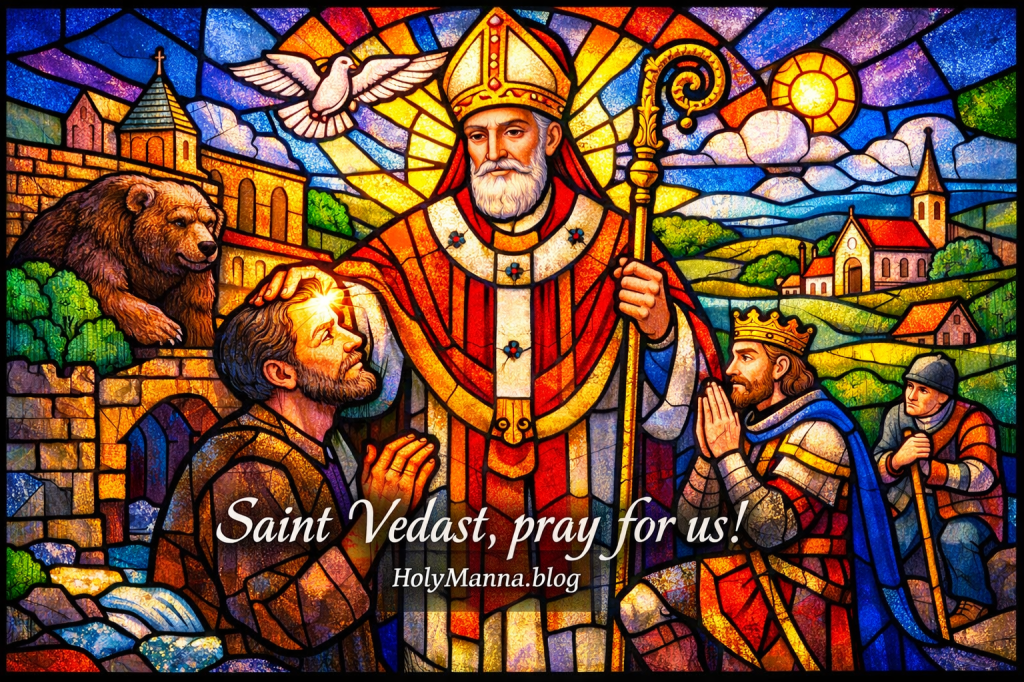
The Bishop Who Rebuilt the Ruins
Saint Vedast, also called Saint Vaast, steps onto the stage of Christian history at a moment when everything feels unstable. The Western Roman world has fractured, towns and villages are recovering from waves of violence, and many people still cling to pagan customs even after hearing the Gospel. In that kind of world, God does not only raise up brilliant thinkers. He raises up steady shepherds. Saint Vedast is remembered as a missionary bishop who helped strengthen the Church in northern Gaul, especially around Arras, and he is closely tied to the conversion era of King Clovis, the Frankish ruler whose baptism helped shape the Christian identity of a whole people.
The Church honors Saint Vedast because his life shows what grace looks like when it is lived faithfully over decades. He did not just preach. He built, he taught, he formed priests, and he stayed with a wounded community long enough to see it begin to heal. This is exactly how the Church understands the saints. They are living signs that holiness is possible in every age, and they continue to intercede for the faithful as members of the communion of saints, just as The Catechism teaches in CCC 956.
A Mission That Shaped a Kingdom
The earliest part of Saint Vedast’s life is remembered with humility, because Catholic tradition itself admits that not every detail can be pinned down with modern precision. What remains consistent is the spiritual pattern. Vedast is described as a man formed by prayer and discipline, spending years in a quieter life near Toul, shaped by solitude and a deep desire to belong entirely to God. Some traditions connect his formation to Saint Urse of Toul, which fits the Church’s long memory that saints often raise up other saints through patient guidance and example.
Then God draws him out of the hidden life and into a decisive mission. Saint Vedast becomes connected with the preparation of King Clovis for baptism, working under Saint Remigius. This was not a political stunt. It was catechesis and conversion, the slow work of bringing a man to the truth. Catholic tradition remembers a miracle on the road, when a blind man cries out for mercy and Saint Vedast prays, and the man receives his sight. That story has endured because it says something real about the Christian life. When Christ is welcomed, eyes open, not only physically, but spiritually. It is the kind of sign that points beyond itself to the Kingdom of God, which The Catechism explains when it teaches that miracles are signs revealing Christ’s saving mission and the coming of the Kingdom, as seen in CCC 547.
A Shepherd Who Rebuilt Churches
After those early missions, Saint Vedast becomes the bishop associated with Arras, and tradition also links his pastoral care to Cambrai. The region he served was not peaceful or stable. It was battered, impoverished, and spiritually uneven. Christian life could flourish when priests were present, and then weaken when fear, habit, and old pagan customs crept back in. That is why his ministry mattered so much. He was not serving an already mature Christian population. He was building Christian life where it still felt new and fragile.
Saint Vedast rebuilt the Church in the most literal sense. Tradition remembers him restoring damaged churches and strengthening communities that had been broken down. He ordained priests and sent them out into the countryside so the Gospel would not stay trapped in the city. That is how the Church has always worked when she is serious about mission. The faith spreads through preaching, sacraments, and steady pastoral care, which reflects the Church’s missionary identity taught in CCC 849. Saint Vedast’s life shows that evangelization is not usually flashy. It is patient and persistent, like planting seed and returning again and again to water it.
Miracles That Pointed Back to Christ
The miracles associated with Saint Vedast are remembered as signs of God’s mercy, and the Church never treats such signs as entertainment. They are meant to point to Christ and to strengthen faith. This is why the Church teaches that miracles reveal the saving power of Christ and invite conversion, as explained in CCC 547.
The healing of the blind man connected with the journey during Clovis’s conversion story remains one of the most famous. A suffering man cries out, Saint Vedast prays, and sight is restored. It is easy to understand why he later became associated with prayers for eye ailments. The story is remembered not only because it is dramatic, but because it expresses the heart of the Gospel. God sees the suffering, and He answers through His servants.
Other traditions speak of Saint Vedast meeting the poor at the gates of Arras, including the blind and the lame. He responds with compassion and prayer, echoing the apostolic spirit found in The Acts of the Apostles. In that same spirit, Christian tradition places on his lips the biblical line “Silver and gold I do not have”, a reminder that the Church’s greatest gift is not money, but Christ Himself. That is not an excuse to ignore material needs. It is a reminder that healing, hope, and salvation come from the Lord.
There is also the well-known local story of Saint Vedast entering a ruined church and driving out a bear that had made its den there. Catholic sources often present this as a symbolic legend, and that framing actually strengthens its message. A sacred place lies in ruins, and something wild has moved in. The saint reclaims it for God. The image is simple, but it hits deep. When Christ returns to a life, what is destructive cannot stay in charge.
The Hidden Cross of Perseverance
Saint Vedast is not remembered as a martyr, but his life still contains a cross. His hardships were the long, stubborn struggles of rebuilding the faith in a region marked by instability and poverty. It takes patience to teach people who are newly Christian and easily pulled back toward old ways. It takes courage to keep preaching when the culture still leans toward superstition and old habits. It takes humility to keep working when progress is slow and setbacks are common.
This is the kind of suffering modern people often underestimate. It is the suffering of endurance. It is the daily offering of self for the sake of souls. It is also a reminder that holiness is rarely a single dramatic moment. Holiness is usually a life of faithful repetition, where a person keeps choosing God again and again. This is the kind of steady grace the Church describes when she teaches that God’s free gift sustains the Christian life and strengthens the soul to persevere, as seen in CCC 1996.
A Saint Who Keeps Working After Death
Catholic faith holds that the saints do not disappear after death. They remain alive in Christ and continue to intercede for the faithful, which The Catechism teaches clearly in CCC 956. Saint Vedast’s legacy after death is strongly connected to devotion in Arras, the veneration of his relics, and the growth of monastic life around his memory. Tradition places his death around 539 or 540, and his reputation for holiness endured in a way that shaped the region for centuries.
His memory is tied to the great abbey that bore his name, which became a spiritual heart for the area and helped anchor Christian life through changing centuries. Traditions also remember that his relics were treated with reverence and, during times of threat, were moved for protection and later returned. This is not mere medieval drama. It reflects a Catholic instinct that the holy should be guarded and honored, not because relics are magical objects, but because the bodies of the saints are signs that grace truly sanctifies real human lives. The Church speaks about this kind of devotion as part of authentic popular piety when it leads people closer to Christ and the sacramental life of the Church, as described in CCC 1674.
One traditional line preserved in the Church’s memory captures the way believers experienced his intercession. “Illustrious by many miracles, both in life and in death.” That short description communicates a distinctly Catholic confidence. God works through His saints, and the saints remain close to the Church as intercessors and companions.
Rebuilding a Life When Everything Feels Like Rubble
Saint Vedast teaches that the faith is not a hobby. It is a foundation. His life shows that rebuilding is possible, but it usually happens through grace and steady effort, not quick fixes. A major lesson from his story is that conversion needs formation. Feelings fade, pressure rises, and old habits return, which is why the Church insists on catechesis and a solid grounding in truth. Another lesson is that the Gospel always includes mercy. Saint Vedast’s ministry consistently turns toward the suffering, the sick, the poor, and the ignored, because that is what Jesus does.
A practical way to follow his example is to rebuild one part of life with intention and perseverance. That might mean returning to confession regularly, protecting Sunday Mass without excuses, and learning the faith deeply through The Catechism so belief becomes sturdy and clear. It might also mean choosing deliberate mercy, seeing the suffering not as interruptions but as neighbors. Saint Vedast’s story is proof that Christ can rebuild a region, and Christ can rebuild a soul, and the same Lord who opened blind eyes can still open hearts today.
Engage with Us!
Share your thoughts and reflections in the comments below. Saint Vedast’s story has a way of sneaking up on the heart, especially for anyone trying to rebuild faith in a world that feels shaky.
- Where is one place in life that feels like a ruin right now, and what would rebuilding with Christ look like this week?
- Who is someone nearby who needs patient guidance in the faith, the way Clovis needed steady instruction?
- What habit keeps pulling the soul back toward old ways, and what concrete step could push that bear out of the house again?
- How can mercy toward the suffering become more intentional, especially toward those who feel ignored or burdensome?
Keep walking forward in faith. Keep rebuilding what sin has damaged. Keep choosing prayer, the sacraments, and mercy. A life lived close to Jesus will never be wasted, and everything done with the love and mercy Jesus taught will bear fruit in ways that last beyond this world.
Saint Vedast, pray for us!
Follow us on YouTube, Instagram and Facebook for more insights and reflections on living a faith-filled life.

 Holy Manna!
Leave a comment