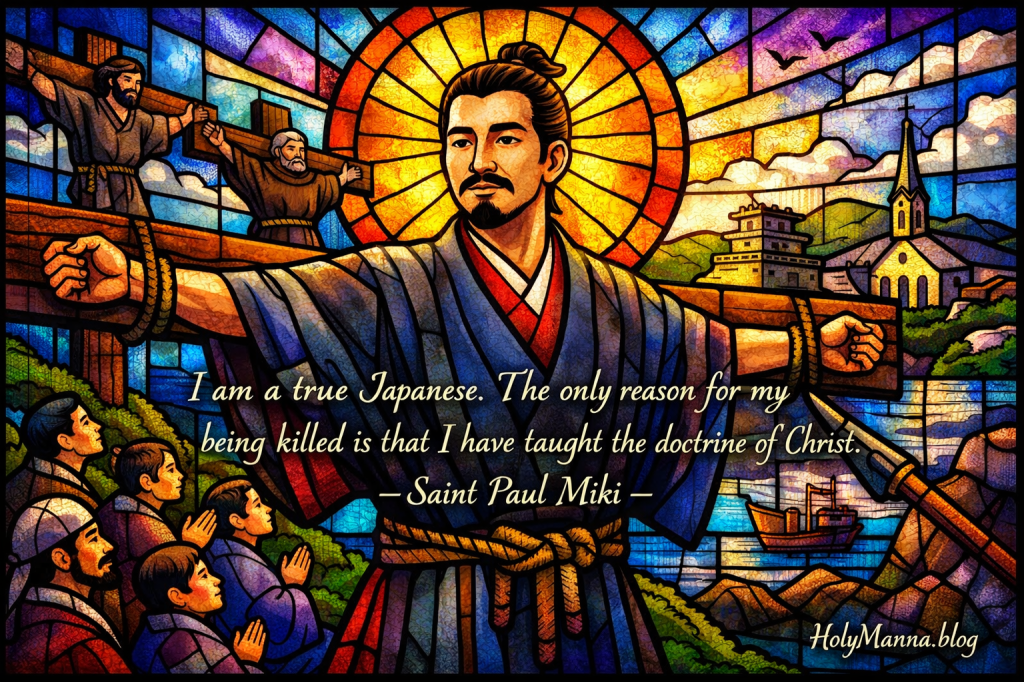
The Cross That Preached to Japan
Saint Paul Miki and his Companions, often called the Twenty-Six Martyrs of Japan, were executed near Nagasaki in 1597 because they refused to stop proclaiming Jesus Christ and His Church. Their witness still grips the heart because it was not limited to one kind of Catholic life. This was priests and religious, missionaries and Japanese lay faithful, adults and even youths, all choosing the same Lord with the same steady courage. The Church honors them because their death was not a defeat, but a proclamation that Christ is worth more than comfort, safety, or reputation.
The Catechism teaches why this matters so much, and it does not speak softly about it. “Martyrdom is the supreme witness given to the truth of the faith.” CCC 2473. That means their story is not just a history lesson. It is a living invitation to take the Gospel seriously, especially when the culture around it gets nervous or hostile.
Formed for the Mission
Paul Miki was born in Japan near Osaka, raised in a Christian family, and educated in the growing Catholic world that had taken root there after the first wave of missionary work. He entered Jesuit formation at a time when the Church in Japan was young but vibrant, full of converts, catechists, and communities hungry for solid teaching. Paul became known for a gift that always matters in evangelization: he could explain the faith clearly and persuasively, especially to people shaped by Buddhist thought. He was still a Jesuit scholastic and not yet ordained when the storm of persecution finally broke over him.
His Companions show how wide the Church already was in Japan. The group included Franciscan missionaries who served openly through preaching and works of mercy, and it included Japanese lay Catholics whose quiet service kept communities alive. Some companions were catechists and helpers who worked behind the scenes, teaching children and supporting priests when public Christian life became risky. Their presence makes a simple point that needs repeating: sanctity is not reserved for the spotlight, and courage is not limited to the clergy.
Holiness Before the Spotlight
Not every saint is remembered for dramatic public miracles, and that is not a problem. Sometimes the most striking “miracle” is the kind of faith that stays faithful when nobody is applauding. Paul Miki’s life was marked by preaching, formation, and steady fidelity long before anyone nailed a cross into the ground for him. That steady fidelity is often the way God prepares a soul for extraordinary trials.
The Franciscan missionaries were also remembered for the very Catholic instinct to care for both body and soul. Works of charity, teaching, and formation were not optional extras, because the Gospel always touches the whole person. The Japanese lay faithful in this group were proof that holiness grows in families, workplaces, and ordinary routines. Their lives quietly preached that Jesus is not a weekend hobby, and the Church is not a club for the comfortable.
The Road of Shame
Japan’s political climate shifted, and suspicion grew that Christianity was tied to foreign influence or social instability. In that fear, leaders chose to make an example of Catholics, and the crackdown turned public and brutal. Paul and the others were arrested, imprisoned, and humiliated to discourage anyone else from following Christ openly. Their suffering was meant to silence the Church, but it became a louder sermon than any government order.
They were marked with public mutilation and forced into a harsh winter march toward Nagasaki. Crowds mocked them along the route, and the whole journey was designed to break their spirits before the execution even happened. Instead, Catholic tradition remembers them praying and encouraging one another, clinging to Christ like men and women who knew where eternity really begins. That kind of steadiness is not natural optimism. It is grace at work in souls that have been trained through prayer, sacrifice, and love.
A Sermon Above the Spear
When they reached the hill outside Nagasaki, crosses were waiting, and the end was no secret. They were bound to the crosses, and the execution was carried out by spears. The world expected screams and curses, because that is what fear usually produces when it is cornered. Instead, the Church remembers a strange and holy calm, the kind that shows up when a Christian finally believes that the Cross leads to Resurrection.
Paul Miki did what he had always done. He preached, even from the cross, and his final words have echoed for centuries because they are both bold and merciful. “I am a true Japanese. The only reason for my being killed is that I have taught the doctrine of Christ.” These words matter because he refused the lie that the Gospel could not truly belong in Japan.
His final witness also carried the unmistakable mark of Christ: forgiveness. Paul’s attitude mirrored the prayer of Jesus Himself in The Gospel of Luke. “Father, forgive them.” The Gospel of Luke 23:34. This was not a sentimental line spoken from a safe distance. This was mercy spoken with blood in the mouth, and it proved that the Gospel is real.
Fruit After the Blood
The Church later beatified and canonized Paul Miki and his Companions, and their memory became a pillar for Japanese Catholics. The most astonishing part of their legacy is how their witness helped strengthen believers through later waves of persecution. For generations, many Christians had to practice the faith in secrecy, passing down prayers and devotion quietly, often without priests, because public Catholic life could cost everything. Their survival as a people of faith is a living sign that martyrdom is not wasted.
Pilgrimage and public memory have also kept this witness visible. Martyrs’ Hill in Nagasaki remains a place where Catholics remember that faith is not an abstract idea, but a lived commitment. When Pope Francis prayed there, he spoke of the martyrs in the language of Easter, insisting that death does not get the final word. “The last word belongs not to death but to life.” Pope Francis, Homage to the Martyrs, Nagasaki (2019). That is exactly why the Church keeps telling this story, because it is meant to make believers more courageous and more hopeful.
Living the Martyrs’ Courage
Most Catholics will never face a literal cross, but every Catholic faces daily moments where truth and comfort collide. The witness of Paul Miki and his Companions teaches that courage does not have to be loud to be real. It can look like steady prayer when it is dry, confession when pride wants to hide, Sunday Mass when exhaustion begs for excuses, and charity when it costs time and convenience. That kind of ordinary fidelity is how the Church becomes strong in any age.
Their story also teaches that forgiveness is not weakness, and mercy is not compromise. Paul did not pretend evil was good, and he did not excuse persecution as “just politics.” He chose mercy because Jesus chose mercy, and because the Christian battle is never merely against people, but against the darkness that enslaves hearts. A practical way to honor these martyrs is to speak the truth without cruelty, to refuse compromise without becoming self righteous, and to pray for those who mock the Church without turning bitter.
Engage with Us!
Share your thoughts and reflections in the comments below. What part of Saint Paul Miki and Companions’ witness stands out most right now, and why?
- Where is faith being treated like something private in daily life, and how can it be lived more openly and calmly?
- What is one situation where forgiveness feels impossible, and what would it look like to ask Jesus for the grace to forgive anyway?
- If someone asked, “Why are you Catholic?” what is one clear sentence you could say without embarrassment or hesitation?
- What comfort, habit, or approval is most tempting to choose over Christ, and what is one concrete step to resist that pull this week?
May Saint Paul Miki and his Companions pray for a steady, masculine courage that does not need approval and does not fear rejection. Keep walking with Jesus even when it costs something, because the Gospel is still true when it is unpopular. Do everything with the love and mercy Jesus taught, and let that love become the clearest preaching in daily life.
Saint Paul Miki and Companions, pray for us!
Follow us on YouTube, Instagram and Facebook for more insights and reflections on living a faith-filled life.

 Holy Manna!
Leave a comment