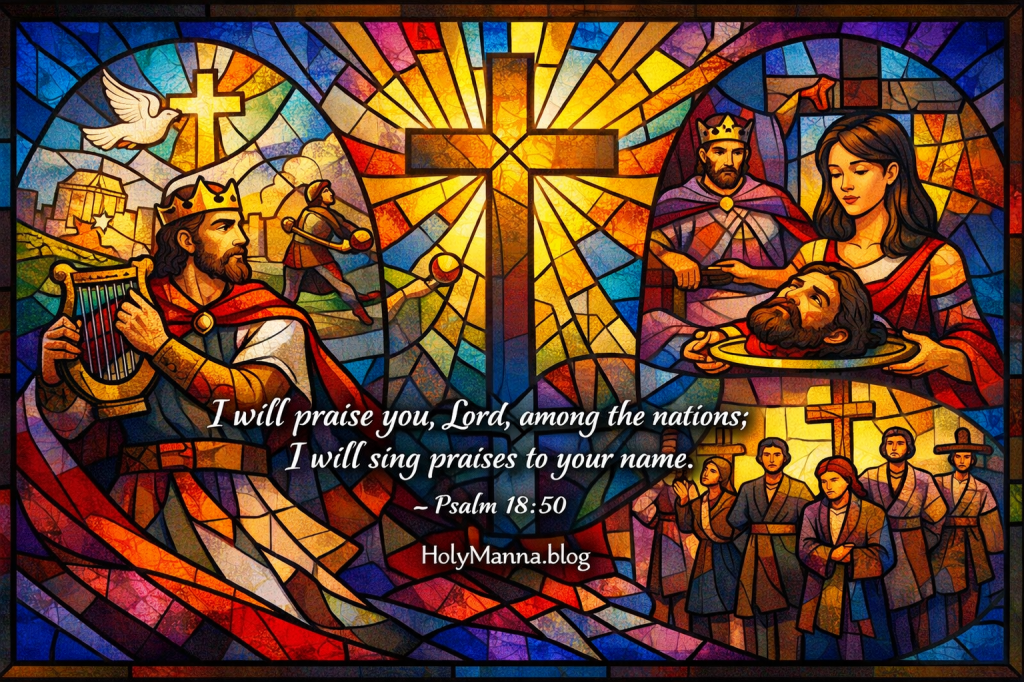
Memorial of Saint Paul Miki and Companions, Martyrs – Lectionary: 327
When Praise Becomes Courage
There are days when the Church seems to hold up two banquets and asks which one will shape a life. One banquet is holy, filled with song before the altar and gratitude rising like incense. The other is loud, crowded, and driven by ego, where a ruler trades conscience for applause. Today’s readings sit right on that fault line and they ask a simple but piercing question. What kind of worship forms a heart strong enough to live the truth when it costs something?
The central theme tying everything together is this: true worship forms true courage. In Sirach 47:2-11, David is remembered not only as a warrior who overcame Goliath, but as a king who loved his Maker with his whole heart and filled the sanctuary with praise. That worship did not erase his sins, but it did teach him how to return to God, and it is why mercy could rebuild what pride had damaged. The Responsorial Psalm, Psalm 18:31, 47, 50, 51, continues the story by naming God as the Rock and Shield, the One whose promise is refined, the One who gives victory and shows mercy to his anointed. It is the song of someone who has learned that strength is not self-made, but received from the living God.
Then the Holy Gospel, Mark 6:14-29, shows what happens when a heart is not anchored in worship but in reputation. Herod is not portrayed as an atheist who hates holiness. He recognizes John the Baptist as righteous and holy, and he even likes to listen, but he is trapped by fear of public opinion, by a web of lust, pride, and rash oaths. In that palace setting, truth becomes inconvenient, and a prophet’s head becomes party entertainment. That story lands with special force on today’s memorial of Saint Paul Miki and Companions, Martyrs, because it reminds the Church that discipleship has always included the possibility of witness unto death, and that courage comes from belonging to God more than to the crowd.
So this introduction sets the stage for a choice that runs through every era, from the courts of Israel to the palaces of Galilee to the hills of Nagasaki. One path sings God’s praises and becomes brave enough to repent, obey, and endure. The other path plays with the truth, enjoys it from a safe distance, and then sacrifices it when the room gets uncomfortable. Which table is forming the heart today, the altar where God is praised, or the banquet where people must be pleased?
First Reading – Sirach 47:2-11
The King Who Taught a Nation How to Pray
The Book of Sirach is written like a wise elder telling the next generation, “Do not forget where you came from.” In the later chapters, Sirach praises Israel’s heroes, not to flatter them, but to show how God works through real people with real weaknesses. That is why David is remembered here in a way that feels almost like a liturgy. Yes, he fought lions, bears, and giants, but the heart of the passage is worship. David is portrayed as the king whose courage sprang from calling on the Most High, and whose greatness was expressed in gratitude, sacred music, and the ordering of feasts around the Holy Name. That fits perfectly with today’s theme, because true worship forms true courage. A heart trained in praise is harder to intimidate, easier to correct, and quicker to return to God when sin has made a mess of things.
Sirach 47:2-11 – New American Bible (Revised Edition)
2 Like the choice fat of sacred offerings,
so was David in Israel.
3 He played with lions as though they were young goats,
and with bears, like lambs of the flock.
4 As a youth he struck down the giant
and wiped out the people’s disgrace;
His hand let fly the slingstone
that shattered the pride of Goliath.
5 For he had called upon the Most High God,
who gave strength to his right arm
To defeat the skilled warrior
and establish the might of his people.
6 Therefore the women sang his praises
and honored him for “the tens of thousands.”
When he received the royal crown, he battled
7 and subdued the enemy on every side.
He campaigned against the hostile Philistines
and shattered their power till our own day.
8 With his every deed he offered thanks
to God Most High, in words of praise.
With his whole heart he loved his Maker
9 and daily had his praises sung;With string music before the altar,
providing sweet melody for the psalms
10 He added beauty to the feasts
and solemnized the seasons of each year
So that when the Holy Name was praised,
before daybreak the sanctuary would resound.
11 The Lord forgave him his sins
and exalted his strength forever;
He conferred on him the rights of royalty
and established his throne in Israel.
Detailed Exegesis
Verse 2: “Like the choice fat of sacred offerings, so was David in Israel.”
This opening image is vivid and intentionally religious. The “choice fat” of offerings was considered the best portion, set apart for God. David is being described as a kind of “choice portion” for the people, not because he was flawless, but because God chose him and set him apart for a mission. The point is not celebrity but consecration. David’s life belongs to God in a public way, which is why his choices matter for the whole nation.
Verse 3: “He played with lions as though they were young goats, and with bears, like lambs of the flock.”
This is heroic language, but it is not mere mythology. It echoes David’s shepherd story from Israel’s memory, where he defends the flock with fearless confidence. Spiritually, it shows that God often trains leaders in hidden places before they ever appear on a public stage. David’s strength is not first a throne strength. It is a shepherd strength, learned through responsibility and risk.
Verse 4: “As a youth he struck down the giant and wiped out the people’s disgrace; His hand let fly the slingstone that shattered the pride of Goliath.”
The emphasis here is not only victory but deliverance from shame. Goliath is not just a big opponent. He is the public humiliation of Israel, the living symbol of fear that makes God’s people feel small. David’s slingstone “shatters pride,” because the victory exposes the lie that God’s people must measure themselves by worldly power. In today’s wider theme, this verse quietly preaches that courage is not bravado. It is obedience to God when fear is loud.
Verse 5: “For he had called upon the Most High God, who gave strength to his right arm To defeat the skilled warrior and establish the might of his people.”
This verse names the source of David’s courage. David does not win because he is naturally superior, but because he calls upon God and receives strength. The “right arm” language is classic biblical imagery for power, but it is power that is gifted. It is the opposite of self-salvation. This is also the moral dividing line between David and figures like Herod in the Gospel. One man relies on God and is strengthened. The other man relies on reputation and is enslaved.
Verse 6: “Therefore the women sang his praises and honored him for ‘the tens of thousands.’ When he received the royal crown, he battled”
Public praise follows victory, and Sirach is honest about that. People celebrate visible courage. Yet the verse also pivots quickly to responsibility. The crown is not a trophy. It is a burden. David’s battles are not only personal achievements but defense of the people entrusted to him.
Verse 7: “and subdued the enemy on every side. He campaigned against the hostile Philistines and shattered their power till our own day.”
The Philistines were a constant threat in Israel’s early monarchy. Sirach is summarizing David’s role in stabilizing the nation. Spiritually, it reinforces that God’s gifts are not given for private comfort. They are given for service, protection, and the building up of God’s people.
Verse 8: “With his every deed he offered thanks to God Most High, in words of praise. With his whole heart he loved his Maker”
This is the spiritual center of the whole reading. David’s defining trait is gratitude and wholehearted love for God. The line “with his whole heart” matters because it signals integrity. David is not divided between two masters. He is not perfect, but he is oriented. He returns. He praises. He loves God as God. That is what makes repentance possible and what makes worship powerful.
Verse 9: “and daily had his praises sung; With string music before the altar, providing sweet melody for the psalms”
David is remembered as a patron of sacred music and psalmody. Israel’s worship is not treated as an optional accessory to national life, but as its heartbeat. “Before the altar” keeps everything grounded in sacrifice and covenant. Music is not entertainment here. It is ordered praise, offered to God, shaping the people’s memory and desires day after day.
Verse 10: “He added beauty to the feasts and solemnized the seasons of each year So that when the Holy Name was praised, before daybreak the sanctuary would resound.”
This verse highlights something modern readers often miss. In biblical religion, time itself is meant to be consecrated. Feasts and seasons teach the people how to live with God at the center, not only in private prayer but in public rhythm. The mention of praising the Holy Name “before daybreak” gives the sense of a community whose day begins with God, not with the world’s noise. That is how worship forms courage. It forms a people who remember who they are before anyone else tells them.
Verse 11: “The Lord forgave him his sins and exalted his strength forever; He conferred on him the rights of royalty and established his throne in Israel.”
The reading ends with mercy, and it is not sentimental. David’s sins were real and serious, yet God’s forgiveness is also real and transformative. Forgiveness does not erase consequences, but it restores covenant relationship and allows God’s plan to move forward. David’s strength is “exalted” not because sin is ignored, but because repentance and mercy reveal God’s faithfulness. This is a quiet promise for anyone trying to live the faith with honesty. The story is not “never fall.” The story is “return quickly, love God wholly, and let mercy rebuild what sin tried to ruin.”
Teachings
This passage presents David as a model of worship that shapes the heart, which is a deeply Catholic instinct. The spiritual life is not only about avoiding sin. It is about becoming the kind of person who loves God with an undivided heart and orders life around praise. Sacred music, the sanctification of time, and reverent worship are not decorative extras. They are formation. When the heart is trained to bless the Holy Name before daybreak, it becomes less vulnerable to the day’s temptations, pressures, and humiliations.
The Church has always seen David as a key figure in salvation history because he points forward to Christ. The covenant with David becomes a backbone of biblical hope, preparing for the Messiah, the true King, whose reign is not built on fear but on truth and holiness. That matters today because the Gospel shows what counterfeit kingship looks like. Herod’s “throne” cannot produce freedom, because it is built on compromise and the need to be admired. David’s kingship, at its best, produces worship, and worship produces courage.
There is also an important moral realism here. David is honored, yet the reading refuses to pretend he was sinless. The closing line about forgiveness is a doorway into the Catholic understanding of mercy. God’s mercy is not permission to remain in darkness. It is power to return, to be purified, and to continue the mission with humility. A person who learns to repent becomes harder to manipulate with shame, because shame no longer owns the story.
Finally, this reading helps explain why the martyrs are never merely remembered as tragic victims. Martyrs, like Saint Paul Miki and his companions, are formed by worship into fearless witnesses. The same God who strengthened David’s arm strengthens ordinary believers to confess Christ publicly. The continuity is striking. Praise is not an escape from battle. Praise is training for battle, especially the battle to remain faithful when the crowd demands compromise.
Reflection
A story like David’s can sound distant until it becomes personal. Plenty of modern life still feels like standing in front of a giant, whether that giant is anxiety, lust, addiction, people-pleasing, bitterness, or the constant pressure to curate an image. This reading quietly insists that the first battle is not fought with willpower alone. It is fought by learning to call upon the Most High, and by building a life where praise is normal, daily, and embodied.
One practical step is to treat the beginning of the day like a doorway. When the first voice heard is God’s, the rest of the day tends to fall into order. A simple habit like praying a psalm, even briefly, begins to reshape the imagination. Another step is to practice gratitude as a form of spiritual honesty. David offered thanks “with his every deed,” which means ordinary work can become worship when it is offered, not merely endured. A third step is to become quick to repent. The reading ends with forgiveness for a reason. Delayed repentance hardens the heart, but quick repentance keeps the heart soft, and a soft heart is easier for God to strengthen.
What “giant” has been shouting the loudest lately, and what would it look like to call upon the Most High instead of arguing with fear? Is the daily schedule forming a heart that praises God “before daybreak,” or is it forming a heart that starts the day already rushed and reactive? If David’s greatness included being forgiven, what kind of freedom might open up through a more honest return to God this week, especially through prayer and the Sacraments?
Responsorial Psalm – Psalm 18:31, 47, 50-51
A Battle Hymn That Turns Into a Missionary Song
This Responsorial Psalm comes from a royal thanksgiving psalm attributed to David, a prayer that rises out of real conflict and real deliverance. In Israel’s worship, psalms like this were not private poems tucked away in a journal. They were sung so the whole people could remember what God is like when danger is close and the odds look impossible. That is why today’s verses sound so confident and so public. God is not described as a vague spiritual comfort, but as a shield, a rock, and the living Savior who gives victory.
In the flow of today’s readings, this psalm is the bridge between David’s worship in Sirach 47:2-11 and the Gospel’s warning about a weak ruler who feared the opinions of his guests more than the voice of God. The central theme comes into focus again here: true worship forms true courage. When the heart learns to praise God as Rock and Refuge, fear loses its grip, and faith becomes bold enough to go “among the nations,” which is exactly the kind of courage seen in martyrs like Saint Paul Miki and his companions.
Psalm 18:31, 47, 50-51 – New American Bible (Revised Edition)
31 God’s way is unerring;
the Lord’s promise is refined;
he is a shield for all who take refuge in him.47 The Lord lives! Blessed be my rock!
Exalted be God, my savior!50 Thus I will praise you, Lord, among the nations;
I will sing praises to your name.51 You have given great victories to your king,
and shown mercy to his anointed,
to David and his posterity forever.
Detailed Exegesis
Verse 31: “God’s way is unerring; the Lord’s promise is refined; he is a shield for all who take refuge in him.”
This verse begins with trust in God’s character. “God’s way is unerring” means the Lord does not mislead his people, even when the path is hard. “The Lord’s promise is refined” evokes the image of metal purified by fire. God’s word is not flimsy, and it does not collapse under pressure. The final line gives the posture of a faithful heart: refuge. A shield does not remove the battle, but it changes what the battle can do. Spiritually, this is the opposite of Herod’s insecurity. Herod seeks a shield in reputation and power, but David teaches that refuge is found in God alone.
Verse 47: “The Lord lives! Blessed be my rock! Exalted be God, my savior!”
This is praise in its purest form, and it is intentionally personal without being self-centered. “The Lord lives” is not a motivational phrase. It is a confession of reality. Israel’s God is not an idea, not an idol, not a memory, but the living Lord who acts in history. Calling God “my rock” speaks of stability, protection, and a foundation that cannot be shaken. In a world where emotions rise and fall and public opinion shifts by the hour, a rock is exactly what the soul needs. This is worship that forms courage because it anchors the heart in Someone stronger than fear.
Verse 50: “Thus I will praise you, Lord, among the nations; I will sing praises to your name.”
Here the psalm widens from personal deliverance to public witness. Praise becomes missionary. David’s song refuses to stay inside the boundaries of comfort or tribe. The nations are not merely an audience, but part of God’s plan. This line is so important that Saint Paul later uses it to show that God’s saving work reaches the Gentiles, not as an afterthought, but as fulfillment. The verse also fits today’s memorial in a striking way. Martyrs are not simply brave people who endure pain. Martyrs are witnesses who praise God “among the nations,” even when the nation itself turns hostile.
Verse 51: “You have given great victories to your king, and shown mercy to his anointed, to David and his posterity forever.”
This verse ties victory to mercy, which is a very biblical pairing. God’s victories are not only military or political. They are covenant victories, victories that preserve God’s promises. The mention of the “anointed” points to the Davidic line, the royal covenant, and ultimately to the Messiah. “Posterity forever” signals that God is doing more than helping David win a few battles. God is preparing the way for the King whose reign has no end. In Catholic faith, that “forever” finds its fullness in Jesus Christ, the Son of David, the true Anointed One. This is why the psalm can be prayed by the Church with confidence, because it points beyond David to the living Lord who reigns.
Teachings
The Church has always treated the psalms as a school of prayer, because they teach the faithful how to speak to God with honesty, reverence, and confidence. The Catechism describes the psalms as the prayerbook of God’s people in worship: “The Psalms both nourished and expressed the prayer of the People of God, gathered for the great feasts in Jerusalem and every Sabbath in the synagogues.” CCC 2586. This matters for today’s theme because courage does not appear out of nowhere. Courage is formed by habits, and the psalms are one of God’s primary tools for forming the habit of praise.
This psalm also shows the Catholic balance between God’s power and God’s mercy. Verse 51 does not say God only gives victory. It says God shows mercy to his anointed. That is the pattern seen in David’s life and in Sirach 47:2-11. David is not remembered as a flawless hero, but as a forgiven man whose heart was trained in worship. Worship keeps the heart from despair after sin, and it keeps the heart from pride after success.
The Fathers of the Church frequently read the “rock” language through a Christ-centered lens. When Scripture teaches the faithful to take refuge in the Lord, the Church hears an invitation to cling to Christ, the firm foundation who does not move. This is not a poetic exaggeration. It is the lived experience of saints and martyrs. When the world becomes unstable, the soul needs a Rock that is not made of human approval. That is why this psalm belongs so naturally beside the Gospel’s story of Herod. Herod had a palace, a crown, and an audience, but he did not have a rock. John the Baptist had none of those things, but he had the truth and the strength to speak it.
Finally, verse 50 hints at the Church’s global mission. Praise “among the nations” is not a modern slogan. It is embedded in the prayer of Israel and fulfilled in the Church’s proclamation of Christ to every people. That is why the memorial of Saint Paul Miki and companions feels like a living echo of the psalm. Their witness in Japan is what this verse looks like when it becomes flesh and blood.
Reflection
This psalm invites a decision about where refuge will be taken when life gets loud. A heart that lives off human approval will eventually face a Herod moment, a moment when doing the right thing risks embarrassment, conflict, or loss. A heart that practices praise learns a different reflex. Instead of scrambling to protect an image, it runs to God as shield. Instead of panicking when pressure rises, it stands on the Rock.
A practical way to live this is to make praise a first response rather than a last resort. When anxiety spikes, it helps to speak the truth out loud with the psalm’s own words, because the soul often follows what the mouth confesses. Another concrete step is to examine what “refuge” looks like in daily habits. If refuge is constantly sought in distraction, comfort, or validation, then the heart is being trained for fear. If refuge is sought in prayer, the sacraments, and honest repentance, then the heart is being trained for courage.
When pressure hits, where does the heart instinctively run for refuge, and what does that reveal about what has become its “rock”? If praise is meant to be sung “among the nations,” what would it look like to be quietly unashamed of Christ in ordinary conversations, decisions, and boundaries this week? How might life change if the day began with the confession, “The Lord lives! Blessed be my rock!” and ended with gratitude instead of self-criticism or scrolling?
Holy Gospel – Mark 6:14-29
When a Man Fears the Crowd More Than God
This Gospel drops readers into the court of Herod Antipas, a ruler with real power but a fractured conscience. In first century Galilee, Herod’s household was a political machine, and marriage alliances were rarely just personal choices. Still, John the Baptist speaks with the clarity of a prophet formed by God, not by public opinion. He names Herod’s union with Herodias as unlawful, and that truth lands like a thunderclap in a palace built on image, indulgence, and fragile pride.
This passage fits today’s theme with almost painful precision. True worship forms true courage, but counterfeit worship forms cowardice. David’s world was shaped by praise before the altar, while Herod’s world is shaped by a birthday banquet where reputation matters more than righteousness. In that setting, John becomes a living icon of fearless truth, and his martyrdom echoes the witness celebrated today in Saint Paul Miki and his companions. The Gospel is not simply a tragedy. It is a warning and an invitation, showing what happens when a heart refuses to take refuge in God, and what happens when a prophet refuses to soften the truth.
Mark 6:14-29 – New American Bible (Revised Edition)
14 King Herod heard about it, for his fame had become widespread, and people were saying, “John the Baptist has been raised from the dead; that is why mighty powers are at work in him.” 15 Others were saying, “He is Elijah”; still others, “He is a prophet like any of the prophets.” 16 But when Herod learned of it, he said, “It is John whom I beheaded. He has been raised up.”
The Death of John the Baptist. 17 Herod was the one who had John arrested and bound in prison on account of Herodias, the wife of his brother Philip, whom he had married. 18 John had said to Herod, “It is not lawful for you to have your brother’s wife.” 19 Herodias harbored a grudge against him and wanted to kill him but was unable to do so. 20 Herod feared John, knowing him to be a righteous and holy man, and kept him in custody. When he heard him speak he was very much perplexed, yet he liked to listen to him. 21 She had an opportunity one day when Herod, on his birthday, gave a banquet for his courtiers, his military officers, and the leading men of Galilee. 22 Herodias’s own daughter came in and performed a dance that delighted Herod and his guests. The king said to the girl, “Ask of me whatever you wish and I will grant it to you.” 23 He even swore [many things] to her, “I will grant you whatever you ask of me, even to half of my kingdom.” 24 She went out and said to her mother, “What shall I ask for?” She replied, “The head of John the Baptist.” 25 The girl hurried back to the king’s presence and made her request, “I want you to give me at once on a platter the head of John the Baptist.” 26 The king was deeply distressed, but because of his oaths and the guests he did not wish to break his word to her. 27 So he promptly dispatched an executioner with orders to bring back his head. He went off and beheaded him in the prison. 28 He brought in the head on a platter and gave it to the girl. The girl in turn gave it to her mother. 29 When his disciples heard about it, they came and took his body and laid it in a tomb.
Detailed Exegesis
Verse 14: “King Herod heard about it, for his fame had become widespread, and people were saying, ‘John the Baptist has been raised from the dead; that is why mighty powers are at work in him.’”
Herod hears about Jesus and immediately gets swept into rumors. The “mighty powers” language shows people grasping for an explanation, but it also reveals something deeper. A guilty conscience tends to interpret holiness as a threat.
Verse 15: “Others were saying, ‘He is Elijah’; still others, ‘He is a prophet like any of the prophets.’”
Israel’s memory of Elijah and the prophets is alive here. People sense that God is acting again, and they reach for familiar categories. The tragedy is that Herod hears the same talk, but he hears it through fear rather than faith.
Verse 16: “But when Herod learned of it, he said, ‘It is John whom I beheaded. He has been raised up.’”
This is the voice of a haunted man. Herod’s power cannot silence the moral weight of what he has done. Sin has a way of echoing back when the soul least wants to hear it.
Verse 17: “Herod was the one who had John arrested and bound in prison on account of Herodias, the wife of his brother Philip, whom he had married.”
The Gospel makes the motive plain. John is imprisoned because truth disrupts a sinful arrangement protected by influence and force. The kingdom of God collides with the palace.
Verse 18: “John had said to Herod, ‘It is not lawful for you to have your brother’s wife.’”
John’s rebuke is direct, not cruel. He speaks as a prophet guarding God’s law, especially the sanctity of marriage. This is not personal insult. It is moral witness, offered for Herod’s salvation and for the people who are watching.
Verse 19: “Herodias harbored a grudge against him and wanted to kill him but was unable to do so.”
Truth often provokes hatred when it touches a cherished sin. Herodias embodies resentment that hardens into murder. The Gospel shows how quickly offense can become vengeance when pride is enthroned.
Verse 20: “Herod feared John, knowing him to be a righteous and holy man, and kept him in custody. When he heard him speak he was very much perplexed, yet he liked to listen to him.”
Herod’s inner conflict is exposed. He recognizes holiness and even enjoys hearing John, but he refuses conversion. This is the danger of treating truth like entertainment. Listening without obedience trains the heart to admire holiness while remaining enslaved.
Verse 21: “She had an opportunity one day when Herod, on his birthday, gave a banquet for his courtiers, his military officers, and the leading men of Galilee.”
The setting matters. This is a public stage with powerful witnesses. Herod is not simply hosting dinner. He is performing status, and the presence of elites increases the pressure to look strong.
Verse 22: “Herodias’s own daughter came in and performed a dance that delighted Herod and his guests. The king said to the girl, ‘Ask of me whatever you wish and I will grant it to you.’”
The atmosphere is sensual and impulsive. Herod’s delight becomes a doorway to reckless speech. When desire leads, judgment follows, and the king begins bargaining with power like a man who has forgotten he will answer to God.
Verse 23: “He even swore many things to her, ‘I will grant you whatever you ask of me, even to half of my kingdom.’”
This is a rash oath, spoken to impress the room. The line echoes ancient royal language, but here it becomes pure vanity. Herod is not acting like a steward of authority. He is acting like an insecure performer.
Verse 24: “She went out and said to her mother, ‘What shall I ask for?’ She replied, ‘The head of John the Baptist.’”
Herodias turns the moment into an execution order. This is how manipulative evil works. It waits for the right opening, then uses another person’s weakness as the weapon.
Verse 25: “The girl hurried back to the king’s presence and made her request, ‘I want you to give me at once on a platter the head of John the Baptist.’”
The request is intentionally grotesque and public. The platter turns martyrdom into spectacle. The horror is not only that John will die, but that death is treated as party theater.
Verse 26: “The king was deeply distressed, but because of his oaths and the guests he did not wish to break his word to her.”
Here is the moral collapse. Herod knows it is wrong, and distress proves conscience is still alive. Yet he chooses approval over righteousness. The “guests” become his real master.
Verse 27: “So he promptly dispatched an executioner with orders to bring back his head. He went off and beheaded him in the prison.”
Cowardice becomes violence with frightening speed. Herod does not repent, he accelerates. The prophet dies alone in a cell, but heaven receives a witness formed for truth.
Verse 28: “He brought in the head on a platter and gave it to the girl. The girl in turn gave it to her mother.”
The platter returns, and the chain of complicity is complete. Sin spreads through hands and relationships. The Gospel forces readers to see how evil multiplies when nobody stops it.
Verse 29: “When his disciples heard about it, they came and took his body and laid it in a tomb.”
The disciples’ burial is quiet fidelity. It honors John’s dignity and foreshadows the care shown to Christ’s body after the Crucifixion. Even when rulers abuse power, God preserves the honor of his servants through faithful love.
Teachings
This Gospel teaches that martyrdom is not accidental in the Christian story. John’s death is tied directly to truth, especially truth about marriage and moral law, and it reveals that holiness will often confront a culture that prefers comfort. The Church speaks clearly about John’s unique place in salvation history. The Catechism describes him as the forerunner who completes the prophets and prepares the way for Christ, and it emphasizes that his mission reaches its summit in his suffering. The Catechism says, “John is ‘more than a prophet.’ In him, the Holy Spirit concludes his speaking through the prophets.” CCC 719. John’s courage is not personality. It is vocation and grace.
The Church also names martyrdom as a supreme act of witness. The Catechism teaches, “Martyrdom is the supreme witness given to the truth of the faith.” CCC 2473. That line shines a light on the whole passage. John does not die because he is stubborn. He dies because truth matters more than survival, and because God is worthy of obedience even when obedience costs everything.
This reading also exposes the moral danger of “half conversion.” Herod “likes to listen,” but he will not change. This is a serious spiritual warning because it is easy to enjoy Catholic teaching, admire saints, and feel moved by truth, while still refusing to surrender a particular sin. That is why the virtue of fortitude is essential. The Catechism defines fortitude in a way that fits John perfectly: “Fortitude is the moral virtue that ensures firmness in difficulties and constancy in the pursuit of the good.” CCC 1808. John lives that firmness without hatred, and Herod lacks it even with a crown.
Finally, the Gospel is a masterclass on disordered fear of man. Herod’s downfall is not ignorance. It is people pleasing. He sacrifices righteousness to avoid embarrassment. That is why this passage pairs so well with the memorial of martyrs. The martyrs show what Herod could not do. They choose God over the crowd, and they demonstrate that real freedom is obedience to truth, not slavery to approval.
Reflection
This Gospel lands close to home because modern life is full of banquets, not always with food, but with audiences, comment sections, workplace politics, and social circles that quietly demand compliance. Herod’s “guests” still exist wherever a person feels pressured to keep an image intact at the expense of conscience. The frightening part is that Herod is not portrayed as a cartoon villain. He is portrayed as a man who senses holiness, feels distressed, and still chooses sin because he cannot bear to disappoint the room.
A sober step forward is to name the real “guests” whose opinions carry too much weight. Another step is to practice small acts of courage before the big tests arrive, because most people do not become brave in the moment. They become brave through habits of worship, truthfulness, and repentance. This is where today’s theme becomes practical. A heart trained in praise, like David’s, is less likely to panic when truth costs something. A heart trained in public approval, like Herod’s, will eventually trade righteousness for peace.
Where does fear of other people’s reactions silence truth in daily life, whether at home, at work, or online? Is there a place where Catholic teaching is enjoyed as something interesting, but resisted as something that must be obeyed? What concrete habit of worship could strengthen the soul this week, so that the next “Herod moment” becomes an opportunity for courage instead of compromise?
From the Sanctuary to the Street, Choose the Rock
Today’s readings trace a clear path from worship to witness. In the First Reading, Sirach 47:2-11 remembers David as more than a fighter who toppled a giant. It remembers him as a man who loved his Maker with a whole heart, who filled God’s house with song, and who learned how mercy can rebuild a life after sin. Then the Responsorial Psalm, Psalm 18:31, 47, 50, 51, gives that spirit a voice, proclaiming that God’s way is unerring, that the Lord is a shield for those who take refuge in him, and that praise is meant to spill out beyond private comfort until it is heard among the nations. Finally, the Holy Gospel, Mark 6:14-29, shows the terrifying opposite, a ruler who “liked to listen” to a holy man but feared the guests at his banquet more than the God who gave him breath. John the Baptist becomes the steady witness, refusing to flatter sin, and accepting suffering rather than betraying the truth.
The key message is simple and sharp. True worship forms true courage. A heart shaped by praise becomes harder to manipulate, quicker to repent, and more willing to stand for what is right. A heart shaped by image and approval becomes fragile, reactive, and capable of terrible compromise. That is why this day’s memorial of Saint Paul Miki and companions matters so much, because martyrs are not born from adrenaline. They are formed by prayer, by truth, and by a love that chooses God over the crowd.
The call to action is not to chase dramatic moments, but to build a faithful life that can carry truth when it gets heavy. Let the day begin with prayer that names God as Rock and Shield, and let the soul learn to run to him before it runs to distraction. Let confession and repentance stay close, because mercy keeps the heart humble and free. Let courage grow through small, consistent acts of obedience, especially when it would be easier to stay quiet. God does not ask for perfection before offering strength. God asks for a heart that returns, a tongue that praises, and a will that chooses the truth even when the room does not applaud.
Engage with Us!
Readers are invited to share reflections in the comments below, especially any moment from today’s readings that stirred the heart, challenged the conscience, or brought fresh hope. These questions are offered to spark a real conversation and help connect God’s Word to everyday life.
- First Reading, Sirach 47:2-11: What part of David’s story stands out most today, his courage, his worship, or the mercy God showed him, and what does that reveal about what God might be shaping in the heart right now?
- Responsorial Psalm, Psalm 18:31, 47, 50, 51: Where is refuge most often sought when pressure rises, and what practical change could help make God, not comfort or approval, the true “rock” and “shield” in daily life?
- Holy Gospel, Mark 6:14-29: Where does fear of other people’s opinions tempt silence or compromise, and what would faithful courage look like in that specific situation this week, even if it feels costly?
Keep walking forward with confidence, because God forms courage through worship, strengthens weakness through mercy, and never wastes a life surrendered to truth. Let every choice today be done with the love, humility, and mercy Jesus taught, so that faith becomes not just something believed, but something lived.
Sacred Heart of Jesus, we trust in You!
Immaculate Heart of Mary, pray for us!
Saint Michael the Archangel, defend us in battle!
Follow us on YouTube, Instagram and Facebook for more insights and reflections on living a faith-filled life.

 Holy Manna!
Leave a comment