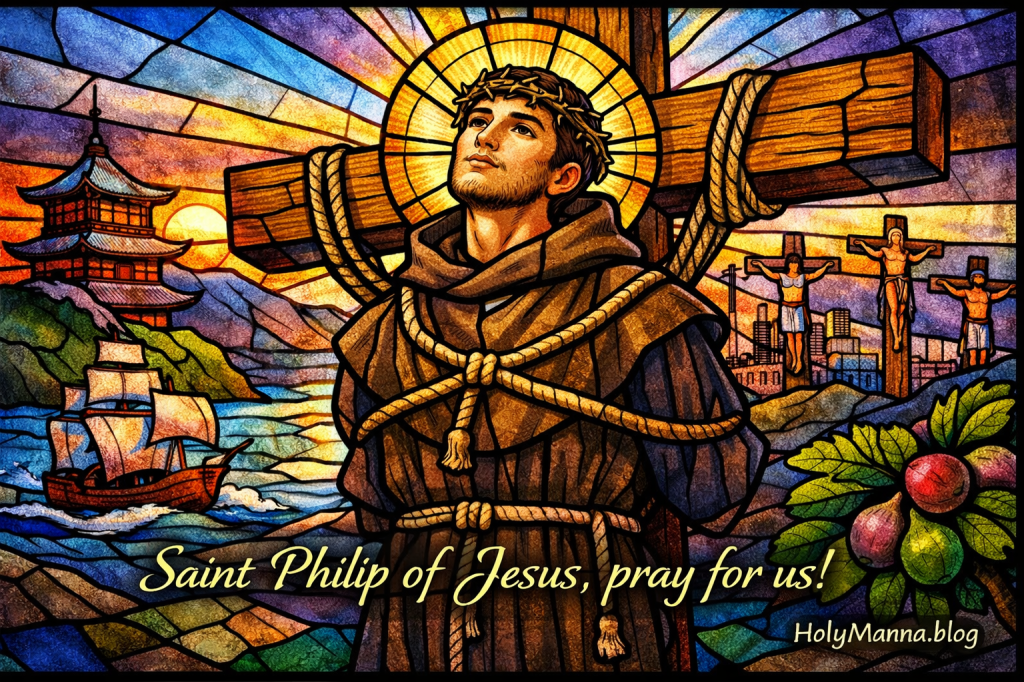
The Saint Who Learned to Say Yes Twice
Saint Philip of Jesus, also known as San Felipe de Jesús, is the first Mexican-born saint and a patron of Mexico City, and his story has a way of pulling in anyone who has ever wondered whether God still calls people after they have messed up. He died in Nagasaki, Japan, on February 5, 1597, as one of the Twenty-Six Martyrs of Japan, a group whose witness still echoes through the Church’s memory. The Church honors martyrs like Philip because martyrdom is not just a tragic ending. It is a public act of love and truth, a final yes to Jesus when the world demands a no.
The Catechism teaches that martyrdom is the supreme witness to the truth of the faith, a testimony offered even to the point of death, and that is exactly what Philip gave when he refused to abandon Christ. His most reliably remembered words were not a long speech or a dramatic prophecy. They were a simple prayer repeated with the stubborn faith of a man who finally understood what matters most. In his final moments, he kept crying “Jesus, Jesus, Jesus.” That prayer is the heart of Catholic life, because when everything else gets stripped away, the Holy Name remains.
A Restless Heart
Philip was born on May 1, 1572, in Mexico City, to Spanish parents living in New Spain, and Catholic tradition remembers him as energetic and restless. He was the kind of young man who wanted life to feel bigger than ordinary, and he was not always patient with the slow work of God. That kind of personality can become fuel for holiness when it is surrendered, but it can also become a reason to run, especially when discipline and sacrifice start pressing in.
As a young man he entered the Franciscans, drawn to the radical simplicity of Saint Francis and the beauty of a life given to Christ, but he did not last long. The demands of the religious life exposed how unprepared he was for obedience and austerity, and he left the order. After that, he returned to ordinary life, worked as a silversmith, and eventually traveled to the Philippines, chasing opportunity and excitement. Catholic accounts describe that season as empty and indulgent, the kind of freedom that promises everything and delivers very little. Then grace caught him in Manila, not through fireworks, but through a quiet awakening, and he returned to the Franciscans with a different kind of strength. He took the name Philip of Jesus, and that second yes became the turning point of his life, because he stopped treating holiness like a mood and started treating it like a covenant.
Quiet Fidelity
Philip’s life as a friar in Manila was not remembered for public wonders, and Catholic sources do not preserve a list of confirmed miracles he performed during his lifetime. That absence is not a weakness in his story, because many saints become saints through ordinary fidelity, and that kind of holiness is often the hardest to live and the easiest to overlook. His greatest miracle was interior, because grace reshaped a scattered heart into a faithful one, and that is a miracle God still works every day in confessionals, at altars, and in quiet acts of repentance.
His superiors later arranged for him to travel back toward Mexico for ordination, and he set sail in 1596 expecting a straightforward path toward priesthood. Instead, storms and circumstances pushed the ship toward Japan, and the detour changed everything. Philip did not go looking for martyrdom, and he did not arrive in Japan as a famous preacher. He arrived as a friar trying to follow God’s will one step at a time, and that is one reason his witness feels so close to ordinary Catholic life. When plans collapse and life shifts without warning, fidelity is revealed, because a disciple either clings to Christ or clings to control.
A Seized Ship and a Winter Road of Suffering
Philip arrived in Japan in a tense era when authorities feared foreign influence, and Christianity was increasingly treated as a political threat. Catholic accounts connect his arrest to suspicion surrounding foreign ships and the fear of invasion, and in that anxious atmosphere missionaries and local Christians became targets. A navigational accident turned into a public warning, and the regime decided that the best way to crush the Church was to terrify the faithful.
Philip was arrested, condemned, and made part of a group whose suffering was meant to send a message. The prisoners were publicly humiliated and mutilated, with part of an ear cut off as a sign of intimidation, and then they were forced on a long winter march to Nagasaki. The march was deliberately public, and it was designed to break the spirit of the Christian community, but it also became a kind of living sermon. The Christian faith is not a fantasy of comfort, because Christ did not save the world from a throne. He saved the world from a Cross, and the saints follow Him by carrying the same pattern into their own lives.
Nishizaka Hill and the Holy Name of Jesus
In Nagasaki the prisoners were taken to Nishizaka Hill, now remembered as the Hill of Martyrs, and there they were bound to crosses and executed by spears. Philip was only twenty four years old, and he was not yet a priest, but sanctity is not measured by how long someone lives or how impressive their résumé looks. Sanctity is measured by whether someone belongs to Christ, and whether they will belong to Him when it costs everything.
Catholic accounts preserve a particularly intense detail of Philip’s suffering, describing how he was restrained with iron rings and how one tightened around his neck, causing him to suffocate as he clung to the Holy Name. His final cry is remembered as a repeated invocation, and it has been passed down because it captures the center of his life at the moment everything else was taken away. In those last moments, his prayer was “Jesus, Jesus, Jesus.” His martyrdom also linked Mexico, the Philippines, and Japan in a single witness, reminding the Church that the Body of Christ crosses borders and centuries, and that the blood of martyrs has always been a seed God uses to strengthen faith across cultures.
A Fig Tree Tradition
After Philip’s death, devotion grew strongly in Mexico, and the Church eventually recognized the holiness of the Nagasaki martyrs through beatification and canonization. Many Catholics in Mexico remember Philip on February 5, the date of his martyrdom, while the liturgy commonly honors the group together on February 6 as Saints Paul Miki and Companions. Even today, his name carries the weight of patronage, especially in Mexico City, where devotion has been anchored for centuries in sacred space and in the veneration of relics.
Popular Catholic tradition in Mexico preserves a striking story connected to his martyrdom, often told as a sign of God’s confirmation. It is said that a withered fig tree associated with his family became green again on the day he died, a symbol that the young man who once seemed spiritually dry had become fruitful through grace. This is best understood as a cherished tradition within devotion, not as a modern medically documented miracle, but it still points to a real spiritual truth. God brings life out of what looks dead, and repentance can bloom into holiness in ways no one expects.
His memory also lives far beyond Mexico. In Japan, Nishizaka remains a place of pilgrimage and remembrance, and it continues to preach without words to tourists, skeptics, and tired Catholics. It says that faith is real, that love is costly, and that the Holy Name is worth more than comfort. That hill still challenges every generation to decide whether Christianity is just a private preference or a real surrender to the Lord who was crucified and rose again.
Living the Second Yes
Saint Philip of Jesus offers a message that feels tailor made for modern life, because he proves that holiness is not only for people who got it right early. He shows that repentance is not a consolation prize. It is a doorway into the joy of belonging fully to Christ. His life also confronts the comfortable version of Christianity that tries to live without a cross. Philip did not choose persecution, but he accepted it rather than betray Christ, and that kind of courage still matters today even when it looks quieter.
For most Catholics the invitation will not be to die on a hill, but to die to sin, pride, and control in the daily grind. It takes courage to confess honestly, to break a hidden habit, to rebuild a sacramental life after drifting, and to live chastely when culture says it is not worth it. It takes courage to forgive when it hurts, to speak truth when it is unpopular, and to keep praying when feelings go cold. Philip’s final prayer also offers a practical pattern for daily battles, because the Holy Name of Jesus is not sentimental. It is powerful, and it can become a real prayer in moments of stress, temptation, fear, and confusion, especially when the heart feels too tired to form anything complicated.
Engage with Us!
Share thoughts and reflections in the comments below. Saint Philip of Jesus has a way of speaking to anyone who has ever needed a second chance, and it would be beautiful to hear how his story lands in the heart today.
- Where has God already offered a second chance, and what would it look like to accept it without excuses?
- What is one area of life where faith gets quiet because comfort gets loud?
- How can the Holy Name of Jesus become a real prayer in daily moments of stress, temptation, or fear?
- If loyalty to Christ cost something this week, what would be the most tempting “escape route,” and how can it be resisted?
Keep walking the path of faith with courage, and keep choosing mercy over shame, truth over comfort, and prayer over distraction. Then do everything with the love and mercy Jesus taught, because the Christian life is not about being flawless. It is about belonging to Christ all the way to the end.
Saint Philip of Jesus, pray for us!
Follow us on YouTube, Instagram and Facebook for more insights and reflections on living a faith-filled life.

 Holy Manna!
Leave a comment