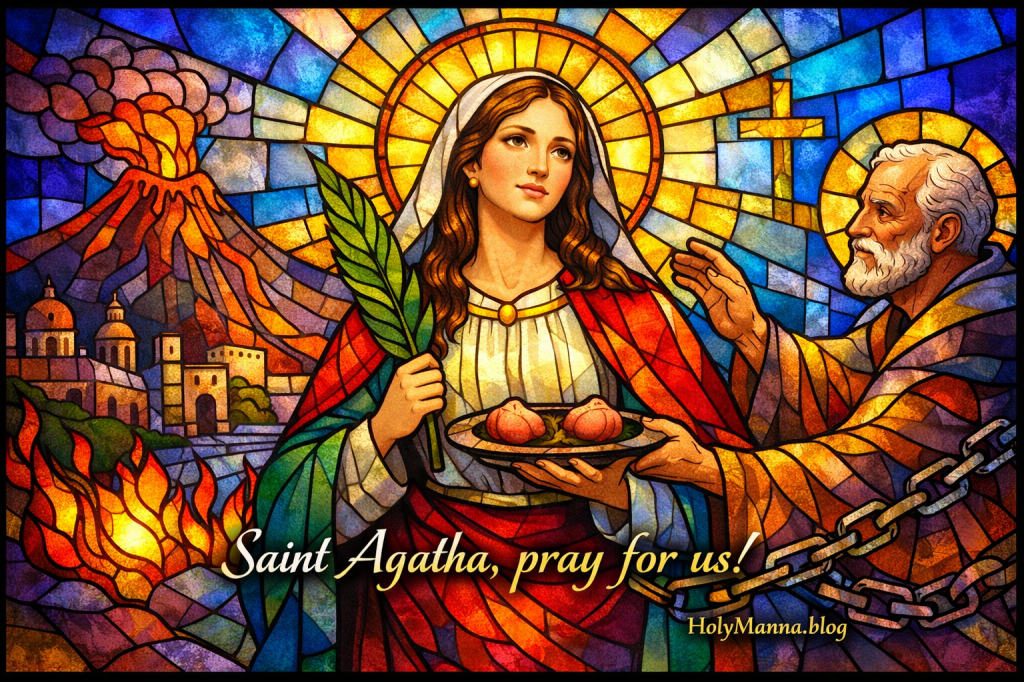
The Veil Before the Flames
Saint Agatha is one of those saints the Church refuses to let the world forget. Her life belongs to the earliest centuries of Christianity, when being Catholic could cost a person everything, and her witness is so deeply honored that her name is spoken in the Roman Canon, the Church’s most ancient Eucharistic Prayer. That detail matters because it means she is not only a local Sicilian devotion. She is part of the Church’s universal memory at the altar, right where heaven touches earth, and her courage still challenges modern hearts that want faith without cost.
Agatha is revered as a virgin and martyr, which means she guarded her faith and her purity even when the powerful tried to claim her as property. She is beloved in Catania, Sicily, and is especially invoked for protection against fire and disaster, and for those suffering illnesses connected to the wounds she endured. Her story is remembered with sobriety and love, because the Church does not celebrate cruelty. The Church celebrates Christ’s victory in His saints, and she holds up Agatha as proof that grace can make a person strong without making them hard.
A Consecrated Heart in a World That Took What It Wanted
The historical record from the third century does not read like a modern biography, but the Church’s ancient tradition is clear about the essentials. Agatha lived in Sicily and is closely tied to Catania. She was a Christian, she embraced a life of consecrated virginity, and she suffered martyrdom rather than deny Christ. Catholic tradition presents her as coming from a family of social standing, which only makes her choice more striking, because she turned away from the usual path of security and advantage to belong completely to the Lord.
In that era, a young woman’s future could be treated like a negotiation, and conscience could be treated like a minor inconvenience. Agatha’s consecration was a quiet revolution. It was her way of saying that the body is not a commodity and that the soul is not a tool of the state. This is where her witness lines up perfectly with Catholic teaching. The Church does not speak of chastity as a negative obsession, but as an inner integration of love, desire, and dignity under God, as taught in CCC 2337. The Church also honors consecrated virginity as a special sign of the Kingdom, as taught in CCC 922–924, and she teaches that martyrdom is the supreme witness to the truth of the faith, as taught in CCC 2473–2474.
Freedom That Would Not Bend
Catholic tradition preserves a line attributed to Agatha that captures the Gospel with clean, fearless clarity: “The greatest freedom and nobility is here: to prove to be Christ’s servants.” That sentence flips the world’s definition of freedom upside down, because the world often calls freedom the ability to do whatever is desired. Agatha calls freedom the ability to belong to Christ even when desire, fear, and pressure try to take over. Her courage was not loud, and it was not performative. It was steady, interior, and rooted in the conviction that Christ is worth everything.
Tradition describes a local official, often named Quintianus, who desired her and tried to force her to abandon both her faith and her purity. When she refused, she was subjected to humiliations designed to break her resolve. Some accounts say she was handed over to the influence of a woman named Aphrodisia, as if temptation could be used like a weapon to corrupt her. The point of the story is not scandal. The point is that Agatha’s heart was not negotiable, her life was not available for purchase, and her conscience was not available for threat.
Catholic tradition also remembers a consoling miracle in the midst of her suffering. It is said that Saint Peter appeared to her in prison and healed her wounds. Even when someone approaches that account as part of the saint’s ancient story, the Catholic message remains the same. God does not abandon His saints. Sometimes He delivers from suffering, and sometimes He strengthens within suffering, which can be an even greater miracle, because it forms a soul that refuses to hate and refuses to lie.
The Martyr’s Peace Under the Tyrant’s Threats
The Church remembers Agatha as a martyr, and that means her faith was tested under persecution in a way most people never face. Catholic sources connect her story to the climate of persecution around the time of Emperor Decius, when Christians were pressured to renounce the faith publicly. Agatha’s trial, in Catholic tradition, is both personal and political. It is personal because a powerful man tried to possess her, and it is political because the state demanded conformity and punished Christian conviction.
The tradition includes severe tortures, and older accounts describe them with a solemn realism because her suffering explains why she is invoked by those who carry bodily wounds and illness, especially women who have endured fear and trauma. The Church does not relish brutality, and she does not retell these details to entertain. She remembers them to proclaim that Christ’s grace can carry a human being through horrors without surrendering to despair. In that sense, Agatha’s martyrdom becomes a living echo of the Gospel truth that love is stronger than violence.
At the end of her life, tradition preserves her prayer in words of surrender. A short excerpt often repeated from her final prayer says: “Lord, my Creator… receive now my soul.” In Catholic spirituality, that is not defeat. That is victory. Martyrdom is not the glorification of death. It is the proclamation that death does not own the Christian, because Christ owns the Christian, and His Resurrection is the final horizon. This is why The Catechism calls martyrdom the supreme witness to the truth of the faith, as taught in CCC 2473–2474.
A Veil Against Fire, a City Held by Prayer
After Agatha’s death, devotion to her spread widely, not only in Sicily but throughout the Church. Her name entered ancient lists of martyrs, and her memory became part of Catholic worship in a way that still shapes the Church’s prayer today. One of the strongest signs of her lasting legacy is that her name is remembered in the Roman Canon. That places her witness at the heart of the Church’s Eucharistic life, where the sacrifice of the Mass makes present the sacrifice of Christ, and where the saints are honored as living members of His Body.
The most famous posthumous story connected to Saint Agatha is the tradition of Mount Etna. Catholic devotion recounts that when the volcano erupted and lava threatened Catania, the faithful went to Agatha’s tomb and brought forth a cloth associated with her, often described as her veil. Tradition says it was placed before the advancing lava and the flow stopped, sparing the city. This story helps explain why she is invoked against fire and catastrophe, and it also reveals something deeply Catholic. When danger comes, the faithful do not only panic. They pray, they repent, and they ask the intercession of the saints, because the Church teaches that the saints are alive in Christ and can pray for the Church on earth, as taught in CCC 956.
Her feast in Catania remains one of the most famous celebrations in the Catholic world, marked by public processions and deep local devotion. Like every authentic Catholic feast, the goal is not spectacle. The goal is remembrance, gratitude, repentance, and renewed faith. The saints are not distant legends. They are living members of the Church, and their stories still form the conscience of communities, calling them back to the sacraments, back to prayer, and back to courage.
A Saint for the Modern Fight
Saint Agatha does not belong only to people who love ancient history. She belongs to anyone trying to live a faithful Catholic life in a culture that pressures compromise and treats purity like a joke. Her witness speaks directly into modern struggles, including the battle for chastity, the temptation to let fear govern decisions, and the constant cultural messaging that bodies are objects and desires are rulers. Agatha teaches that chastity is not weakness and it is not naïveté. It is strength guided by love and truth, and it is freedom that refuses to turn other people into tools for pleasure, attention, or power.
Her example can be lived in concrete ways that actually fit normal life. It can mean returning to confession quickly instead of hiding in shame when someone falls, because mercy is how Christ rebuilds a person from the inside out. It can mean setting boundaries with entertainment and habits that pull the heart toward sin, because the soul cannot stay free while feeding what enslaves it. It can mean praying simply and persistently when temptation rises, because holiness is often built through repeated, humble choices, and grace grows in the person who keeps showing up.
Agatha also teaches something many people need to hear. Suffering does not get the final word. The final word is Christ. The martyr is not someone who loved pain. The martyr is someone who loved Jesus more than fear. What part of life is trying to own the heart right now, and what would it look like to hand that part back to Jesus? Where is the Lord inviting a stronger no to sin, so that a stronger yes to love can grow?
Engage with Us!
Share thoughts and reflections in the comments below. This community grows when people speak honestly about the fight for holiness and the joy of God’s mercy.
- Where is Saint Agatha’s courage most needed in life right now, in relationships, habits, or personal integrity?
- What is one concrete boundary that could protect chastity and peace of heart this week?
- When fear rises, what simple prayer can be repeated like a lifeline, especially in temptation or anxiety?
- How can Saint Agatha’s witness inspire a deeper trust in confession, healing, and starting again?
Live a life of faith with confidence. Choose what is good even when it is costly. Refuse to compromise with sin. Ask the saints for help. Above all, do everything with the love and mercy Jesus taught us, because that love is stronger than fire, stronger than fear, and stronger than death.
Saint Agatha, pray for us!
Follow us on YouTube, Instagram and Facebook for more insights and reflections on living a faith-filled life.

 Holy Manna!
Leave a comment