Memorial of Saint Agatha, Virgin and Martyr – Lectionary: 326
The Kingdom Established Through Faithful Hearts
Some days in the Church’s calendar feel like standing at a crossroads, with one path leading into the past and the other opening straight into the mission of the Gospel. That is the atmosphere of today’s readings, offered on the Memorial of Saint Agatha, a young virgin and martyr whose life proves that God’s Kingdom is not sustained by comfort, control, or applause, but by courage rooted in obedience and trust.
The central theme tying everything together is this: God establishes His Kingdom through covenant fidelity and apostolic mission, and He asks His servants to rely on His strength more than their own resources. In 1 Kgs 2:1-4, 10-12, King David speaks like a father handing his son the keys to a fragile throne, but he makes it clear that the real foundation is not politics, personality, or military power. The foundation is holiness. David’s charge to Solomon is simple and demanding: “Be strong and be a man! Keep the mandate of the Lord, your God, walking in his ways” (1 Kgs 2:2-3). In the ancient world, a king’s last instructions often sounded like a “testament,” a final plea to guard what matters most. Here, the sacred writer is teaching that Israel’s kingship only holds together when it stays under God’s law, because the throne is never truly independent of the covenant.
That is why the response in 1 Chr 29:10-12 is not anxiety, but worship. David blesses the Lord before the whole assembly and confesses the truth every generation forgets when it starts to feel self-made: “For all in heaven and on earth is yours; yours, Lord, is kingship” (1 Chr 29:11). This prayer comes from a moment when Israel is learning, in a very public way, that even its gold, strength, and future belong to God first. The Chronicler’s vision is intensely liturgical, shaping the people to see that praise is not decoration on a strong life, because praise is what keeps a strong life from becoming proud.
Then the Gospel takes that same truth and puts it on sandals. In Mk 6:7-13, Jesus sends the Twelve out two by two, giving them authority over unclean spirits, and telling them to carry almost nothing. The mission is real, the authority is real, and the poverty is real. Christ is forming apostles who trust the Father’s providence, stay rooted in hospitality rather than hustling for comfort, and preach conversion with a steady heart. The Kingdom advances through repentance, deliverance, and healing, not through image management or worldly security. What “second tunic” is being clung to, the backup plan that quietly competes with trust in God?
Saint Agatha stands beside these readings like a living punctuation mark. Her martyrdom belongs to the Church’s memory of Roman persecution, when confessing Christ could mean losing everything, including life itself. She embodies David’s command to be strong, David’s prayer that God is King, and the Apostles’ willingness to go where Christ sends them without bargaining for safety. Today’s passages prepare the heart for a simple realization: God’s Kingdom is established when His people choose fidelity over fear, and when they travel light enough to let His power be seen.
First Reading – First Kings 2:1-4, 10-12
A Dying King Hands On the Secret of a Lasting Kingdom
At the end of First Kings, the scene shifts into something like a sacred “last will and testament.” King David is not simply fading from history as a political figure. He is handing his son Solomon the spiritual logic of Israel’s kingship. In the ancient Near East, dying kings often gave final instructions to secure succession, protect the dynasty, and preserve stability. Scripture does not ignore that human reality, but it goes deeper. David’s final counsel is not mainly about alliances, armies, or public image. It is about covenant fidelity, because Israel’s throne only stands when it remains under the Lord’s kingship.
This moment also carries the weight of the Davidic covenant first announced earlier in Israel’s story, when the Lord promised a lasting dynasty, not as a blank check for kings to do whatever they want, but as a call to live in obedience and faithfulness. That is why David’s words fit today’s theme so cleanly. God establishes His Kingdom through faithful hearts, and He strengthens His people to carry authority without clinging to control. David’s “be strong” is not a pep talk. It is a summons to holiness that becomes the foundation of any truly established kingdom.
1 Kings 2:1-4, 10-12 – New American Bible (Revised Edition)
David’s Last Instructions and Death. 1 When the time of David’s death drew near, he gave these instructions to Solomon his son: 2 “I am going the way of all the earth. Be strong and be a man! 3 Keep the mandate of the Lord, your God, walking in his ways and keeping his statutes, commands, ordinances, and decrees as they are written in the law of Moses, that you may succeed in whatever you do, and wherever you turn, 4 and that the Lord may fulfill the word he spoke concerning me: If your sons so conduct themselves that they walk before me in faithfulness with their whole heart and soul, there shall never be wanting someone of your line on the throne of Israel.
10 David rested with his ancestors and was buried in the City of David. 11 David was king over Israel for forty years: he was king seven years in Hebron and thirty-three years in Jerusalem.
The Kingdom Made Secure. 12 Then Solomon sat on the throne of David his father, and his kingship was established.
Detailed Exegesis
Verse 1 “When the time of David’s death drew near, he gave these instructions to Solomon his son:”
David speaks as a father and as the anointed king. The spiritual lesson begins with mortality. Even the greatest king “goes the way of all the earth,” and that reality forces the question that every generation must face: what will remain when influence, energy, and time run out. Scripture frames David’s last words as instruction, because leadership in God’s plan is never merely personal. It is received, stewarded, and handed on.
Verse 2 “I am going the way of all the earth. Be strong and be a man!”
David names death plainly, then immediately calls Solomon to strength. In biblical language, strength is not swagger. It is moral clarity and steadfastness. David is pressing Solomon toward mature responsibility under God. The phrase is not about machismo. It is about choosing what is right when it would be easier to bend.
Verse 3 “Keep the mandate of the Lord, your God, walking in his ways and keeping his statutes, commands, ordinances, and decrees as they are written in the law of Moses, that you may succeed in whatever you do, and wherever you turn,”
Here the heart of the passage opens up. David points Solomon to the Torah, the “law of Moses,” which is not merely a legal code, but Israel’s covenant way of life. The king is not above the law. The king is under God. David piles up terms such as statutes, commands, ordinances, and decrees to make one point unmistakable: fidelity cannot be selective. The promise of “success” in Scripture is not a guarantee of comfort. It is the fruit of living in alignment with God’s will, which protects the people from tyranny and keeps the king from becoming his own god.
Verse 4 “and that the Lord may fulfill the word he spoke concerning me: If your sons so conduct themselves that they walk before me in faithfulness with their whole heart and soul, there shall never be wanting someone of your line on the throne of Israel.”
David ties obedience to promise, and he ties promise to the heart. The dynasty endures through “faithfulness,” not through image management. The phrase “whole heart and soul” is total. God is not asking for a symbolic nod. He is asking for the interior loyalty that shows itself in concrete decisions. This verse also keeps the reader honest. The covenant promise is real, but it does not cancel human responsibility. Kings can still sin, and sin still fractures a kingdom.
Verse 10 “David rested with his ancestors and was buried in the City of David.”
The text is calm, almost liturgical. David “rests,” a word that suggests more than political retirement. It hints at the larger biblical hope that life is received from God and returned to God. The burial in Jerusalem anchors Israel’s memory in a place that will become central for worship, sacrifice, and later the Temple under Solomon.
Verse 11 “David was king over Israel for forty years: he was king seven years in Hebron and thirty-three years in Jerusalem.”
The number forty often signals a full span in biblical storytelling, a complete season of testing and formation. The mention of Hebron and Jerusalem also reminds the reader that unity was hard won. David’s reign included struggle, repentance, conflict, and consolidation. Scripture does not present him as flawless. It presents him as chosen, humbled, corrected, and ultimately remembered as the model king whose line points forward to the Messiah.
Verse 12 “Then Solomon sat on the throne of David his father, and his kingship was established.”
This closing line sounds simple, but it carries the theme. Establishment is not merely political stability. In the logic of today’s readings, what is “established” is what is rooted in fidelity to God. Solomon’s throne is firm when Solomon’s heart is faithful. The Kingdom stands when the king stands under the Lord.
Teachings
This reading teaches that authority in God’s plan is always stewardship. David does not hand Solomon permission to build his own kingdom. He hands him the charge to serve God’s Kingdom. That is why obedience is central. The king is meant to be a visible sign that Israel belongs to the Lord, and that the people flourish when leaders submit to God’s commands.
This is where the Church’s moral tradition becomes practical. The virtue that David is calling for is fortitude, not as bravado, but as steadfast fidelity in the face of pressure. The Catechism puts it plainly in CCC 1808: “Fortitude is the moral virtue that ensures firmness in difficulties and constancy in the pursuit of the good. It strengthens the resolve to resist temptations and to overcome obstacles in the moral life. The virtue of fortitude enables one to conquer fear, even fear of death, and to face trials and persecutions.” CCC 1808.
David’s insistence on “whole heart and soul” also connects to the Church’s teaching that faith is not a private hobby or a mood. It is a lived commitment that shapes decisions. The story of Israel’s kings makes the lesson unavoidable: when leaders treat God’s commands as optional, everyone suffers, and the kingdom fractures. When leaders submit to God, the people find stability, not because life becomes easy, but because life becomes ordered toward truth.
Finally, David’s passing points toward a deeper fulfillment. The Church reads the Davidic line as a road leading to Christ, the true Son of David, whose Kingdom does not end. David’s throne is established in a partial and imperfect way in Solomon, but in a definitive and eternal way in Jesus Christ, who reigns by obedience unto death and by the victory of the Resurrection.
Reflection
David’s last words land close to home because they sound like what any good father would want for his son, except they are sharper and holier than most advice heard in the world. The message is not complicated, but it is demanding. Strength means obedience. Maturity means submission to God. A life becomes “established” when it is built on fidelity, not on moods, money, or public approval.
This reading invites a simple examination of daily leadership, because leadership shows up everywhere. Leadership shows up in a home, in a workplace, in friendships, and in the private choices nobody sees. The practical step is to stop treating God’s commands like suggestions. A person can choose one area where compromise has become normal, then bring it under the Lord’s mandate with a concrete decision. That could mean returning to regular confession, rebuilding Sunday as truly the Lord’s Day, cutting off a near occasion of sin, or repairing a relationship through a real act of humility.
This reading also encourages a different definition of success. David ties “success” to walking in God’s ways. That means a person can be faithful and still be misunderstood, rejected, or delayed, and still be successful in the only sense that ultimately matters.
Where has the heart learned to negotiate with God instead of obeying Him with a whole heart and soul? What would change if strength were measured by fidelity rather than by control or comfort? If today were the day to hand the faith to someone else, what habits would need to be in place so that the legacy is not merely words, but a life that actually walked in the Lord’s ways?
Responsorial Psalm – First Chronicles 29:10-12
When a King Steps Back and Lets God Be God
Right after hearing David’s last instructions to Solomon, the liturgy lets David speak again, but this time not as a strategist or a statesman. He speaks as a worshipper. 1 Chronicles 29 comes from a moment when David is near the end of his reign and the people have offered generously for the future Temple. In Israel’s life, the Temple was not just a building project. It was the visible center of worship, sacrifice, and covenant identity. In that setting, David does something that is almost shocking for a powerful man. He blesses the Lord publicly and confesses that everything the nation is proud of actually belongs to God first.
This is exactly how today’s theme deepens. The Kingdom is established through faithful hearts and empty hands. David models the interior poverty that makes true authority possible. He shows that the safest place for power, wealth, and success is not in a clenched fist but in worship. When a leader praises God like this, it becomes harder to idolize status, and easier to trust God’s providence, which is the same lesson Jesus presses on the Twelve when He sends them out with almost nothing.
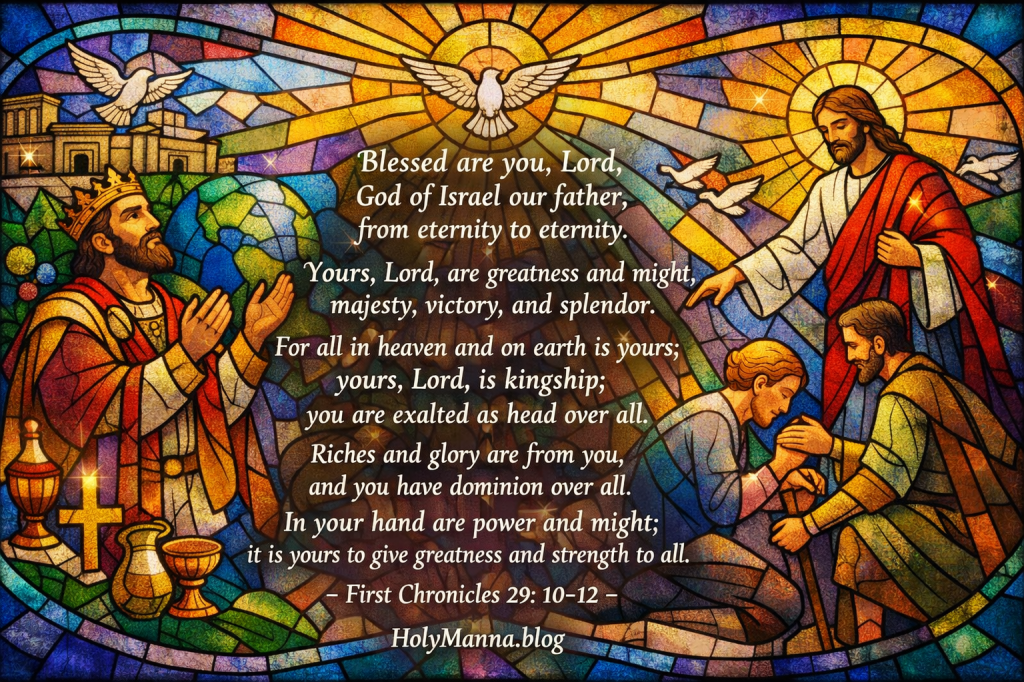
1 Chronicles 29:10-12 – New American Bible (Revised Edition)
David’s Prayer. 10 Then David blessed the Lord in the sight of the whole assembly. David said:
“Blessed are you, Lord,
God of Israel our father,
from eternity to eternity.
11 Yours, Lord, are greatness and might,
majesty, victory, and splendor.
For all in heaven and on earth is yours;
yours, Lord, is kingship;
you are exalted as head over all.
12 Riches and glory are from you,
and you have dominion over all.
In your hand are power and might;
it is yours to give greatness and strength to all.
Detailed Exegesis
Verse 10 “Then David blessed the Lord in the sight of the whole assembly. David said:”
David blesses the Lord publicly, not privately. That detail matters because worship is not only personal devotion. In Scripture, public praise teaches a people how to see reality. David is forming Israel to recognize God as the true source of its life, so that offerings for the Temple do not become a celebration of human greatness. The king is using his influence to lead the nation into humility.
Verse 10 “Blessed are you, Lord, God of Israel our father, from eternity to eternity.”
David anchors Israel’s identity in relationship. God is not an abstract force. He is the Lord, the covenant God of Israel, addressed as Father of the people, which points to intimacy and belonging. The phrase “from eternity to eternity” lifts the heart above politics and economics. David is saying that God’s reign does not rise and fall like dynasties. God is eternal. That is why trusting Him is rational, not naïve.
Verse 11 “Yours, Lord, are greatness and might, majesty, victory, and splendor.”
David lists the things that kings usually claim for themselves. Greatness, might, majesty, victory, and splendor are the very words attached to royal propaganda in the ancient world. David refuses that script. He returns every crown word to God. This is not flattering language for God’s ego. It is truth telling that protects the soul from pride and protects the nation from idolatry of human leaders.
Verse 11 “For all in heaven and on earth is yours; yours, Lord, is kingship; you are exalted as head over all.”
This is the center of the psalm. God is not merely Israel’s tribal deity. He is Lord of all creation. If all in heaven and on earth is His, then the king is never owner, only steward. David also names God’s “kingship,” which ties directly into today’s readings. Solomon’s throne, Israel’s stability, and even the Apostles’ authority in the Gospel are only secure when they remain under the Lord who is “head over all.”
Verse 12 “Riches and glory are from you, and you have dominion over all.”
David does not deny riches and glory exist. He simply refuses to worship them. He names their source. This is the antidote to anxiety and to arrogance. If riches are from God, they are gifts, not trophies. If dominion belongs to God, then human authority is accountable. This verse also prepares the heart for Christ’s mission in Mk 6:7-13, because the disciple who knows God is Lord can travel light without fear.
Verse 12 “In your hand are power and might; it is yours to give greatness and strength to all.”
David ends where every believer needs to end, with dependence. Power is not self-generated. Strength is not finally a personality trait. God gives greatness and strength. That is why David’s earlier command in 1 Kgs 2:2-3 makes sense. Solomon can be strong because God gives strength, but Solomon must remain obedient because strength without submission becomes tyranny.
Teachings
This psalm teaches the spiritual architecture of worship. Praise is not decoration added to life when things are going well. Praise is the act that puts reality back in order, because it restores God to His rightful place and demotes everything else to its proper level. That is why the Church teaches that adoration and worship are foundational acts of the virtue of religion, which belongs to justice, because God is owed what no creature is owed.
The Catechism describes adoration as the first attitude of man acknowledging God as Creator and Lord. It states in CCC 2628: “Adoration is the first attitude of man acknowledging that he is a creature before his Creator. It exalts the greatness of the Lord who made us and the almighty power of the Savior who sets us free from evil. Adoration is homage of the spirit to the ‘King of Glory,’ respectful silence in the presence of the ‘ever greater’ God. Adoration of the thrice-holy and sovereign God of love blends with humility and gives assurance to our supplications.” CCC 2628.
David’s prayer is also a lesson in stewardship and detachment. When David says, “For all in heaven and on earth is yours” (1 Chr 29:11), he is describing the worldview that makes generosity possible and greed irrational. The Church teaches the same moral logic when speaking about property and stewardship. It states in CCC 2402: “In the beginning God entrusted the earth and its resources to the common stewardship of mankind to take care of them, master them by labor, and enjoy their fruits.” CCC 2402. A Christian can own things, but must never act like a god over them, because everything remains under God’s dominion.
Saint John Chrysostom often warned that wealth becomes spiritually lethal when it is treated as security rather than stewardship. His preaching returns again and again to the truth that God is the giver, and that the wealthy are made stewards for the good of others. That instinct lines up perfectly with David’s confession that riches come from God and must return to God through worship and charity.
Historically, this psalm’s setting around offerings for the Temple also matters. The Temple would become the heart of Israel’s sacrificial worship, and later, the place where Jesus teaches and fulfills the meaning of worship in His own Person. For Catholics, the Temple’s logic is fulfilled in Christ’s sacrifice made present in the Holy Eucharist. David’s praise, offered “in the sight of the whole assembly,” echoes the Church’s public worship, where the people of God confess together that everything belongs to the Lord.
Reflection
This psalm invites an honest look at what gets treated like “kingship” in daily life. Many people say God is first, but then live as if money, reputation, comfort, or control is the real head over all. David’s prayer is a reset. It teaches that the heart becomes stable when it stops pretending to be the owner.
A practical step is to speak David’s words before making decisions that usually trigger anxiety. When a budget feels tight, when a job feels uncertain, when plans shift, and when the future feels unclear, this psalm gives language strong enough to hold the moment. God is still God. God is still King. Strength is still in His hand. That truth does not remove responsibility, but it removes panic, because panic is often just worship directed at the wrong thing.
This also connects directly to mission. The disciple who truly believes, “For all in heaven and on earth is yours” (1 Chr 29:11), can obey Christ’s call to travel lighter. The heart that worships like David can give, can go, and can endure rejection without collapsing into resentment.
What is currently being treated like kingship, the thing that receives the most trust and attention? If God is truly “head over all,” what would change about spending, scheduling, and the way time is protected? How would daily life look different if praise became the first response instead of complaint, and gratitude became the habit instead of anxiety?
Holy Gospel – Mark 6:7-13
Christ Sends Ordinary Men With Extraordinary Authority
The scene in The Gospel of Mark feels like a turning point. Jesus does not keep His mission locked up in His own hands. He shares it. He calls the Twelve, sends them out, and gives them real authority in His name. In first century Jewish life, traveling teachers depended on hospitality, and towns were built around tight social networks where welcome or rejection was felt immediately. Into that world, Jesus sends His Apostles with almost no supplies, because their security is not meant to come from money or backup plans. Their security is meant to come from the Lord who sent them.
This Gospel fits perfectly with today’s theme of the Kingdom being established through faithful hearts and empty hands. David told Solomon that strength comes from obedience to God. David’s psalm confessed that everything belongs to the Lord. Now Jesus shows what that looks like on the road. The Apostles travel light, preach repentance, confront evil, and bring healing. On the Memorial of Saint Agatha, the Church quietly reminds every reader that this kind of mission is not theory. It demands courage, purity of heart, and loyalty to Christ even when the world pushes back.
Mark 6:7-13 – New American Bible (Revised Edition)
7 He summoned the Twelve and began to send them out two by two and gave them authority over unclean spirits. 8 He instructed them to take nothing for the journey but a walking stick—no food, no sack, no money in their belts. 9 They were, however, to wear sandals but not a second tunic. 10 He said to them, “Wherever you enter a house, stay there until you leave from there. 11 Whatever place does not welcome you or listen to you, leave there and shake the dust off your feet in testimony against them.” 12 So they went off and preached repentance. 13 They drove out many demons, and they anointed with oil many who were sick and cured them.
Detailed Exegesis
Verse 7 “He summoned the Twelve and began to send them out two by two and gave them authority over unclean spirits.”
Jesus “summons” the Twelve, which shows that mission begins with a call, not with self-appointment. He sends them “two by two,” which echoes the biblical principle of credible witness and also protects them from isolation and pride. The authority over unclean spirits is not motivational energy. It is spiritual authority flowing from Christ Himself. This verse reveals that the Kingdom of God advances by liberation. Where Christ reigns, the tyranny of evil is confronted, not ignored.
Verse 8 “He instructed them to take nothing for the journey but a walking stick, no food, no sack, no money in their belts.”
Jesus intentionally strips away the usual securities. The walking stick allows the road to be walked, but the lack of provisions forces trust in God’s providence and the generosity of those who receive the message. This is not carelessness. It is a training in freedom. The Apostle cannot preach the Father’s care while living like everything depends on control. This verse also exposes a timeless temptation. The heart easily believes it needs God and a pile of guarantees. Jesus insists that reliance must be real.
Verse 9 “They were, however, to wear sandals but not a second tunic.”
Sandals say the mission is urgent and mobile. No second tunic signals simplicity and detachment. In that culture, an extra tunic was not a fashion choice. It was a comfort item and, in some cases, a kind of portable security. Jesus is shaping ministers who look like servants, not like men angling for status. The Kingdom is carried by people who can move without being owned by their comforts.
Verse 10 “He said to them, ‘Wherever you enter a house, stay there until you leave from there.’”
This instruction protects the Apostles from becoming consumers of hospitality. They are not to treat people as stepping stones to better accommodations. They are to receive what is given with gratitude and stability. Spiritually, this creates a bond. The messenger of Christ does not merely pass through a home. He brings peace, prayer, and the nearness of the Kingdom, and he remains long enough for relationships to be real.
Verse 11 “Whatever place does not welcome you or listen to you, leave there and shake the dust off your feet in testimony against them.”
Shaking dust off the feet had a strong cultural meaning. It was a visible sign that a rejection was real and that responsibility had shifted. Jesus is not teaching spite. He is teaching clarity. The Apostles must not beg for approval, and they must not stay trapped in resentment. They are to witness, then move on. The gesture becomes a sober testimony: the hearers truly encountered the message and truly chose to refuse it.
Verse 12 “So they went off and preached repentance.”
The first content of their preaching is repentance. That means the Kingdom is not announced as a vague comfort, but as a call to conversion. Repentance is not humiliation. Repentance is liberation, because sin always shrinks the heart and darkens the mind. The Apostles preach repentance because Christ wants people free, not merely informed.
Verse 13 “They drove out many demons, and they anointed with oil many who were sick and cured them.”
The mission bears fruit in deliverance and healing. Demons are driven out, which confirms that the Kingdom is not merely interior sentiment, but a real invasion of grace into a world wounded by evil. Then the Apostles anoint the sick with oil and many are cured. In the biblical world, oil was associated with healing and strengthening, and here it is used as part of their apostolic action. Catholics also hear in this verse an echo that harmonizes with the Church’s later sacramental practice of anointing the sick, not as magic, but as the Lord’s merciful care expressed through His Church.
Teachings
This Gospel teaches that the Church is missionary by nature. Christ does not only gather disciples to admire Him. He forms Apostles to be sent. Their mission includes proclamation, spiritual battle, and mercy toward the suffering. The Apostles preach repentance because conversion is the doorway into the Kingdom. The Catechism speaks with striking directness about this in CCC 1427: “Jesus calls to conversion. This call is an essential part of the proclamation of the kingdom: ‘The time is fulfilled, and the kingdom of God is at hand; repent, and believe in the gospel.’” CCC 1427. That teaching matches the Gospel’s center of gravity. If repentance is removed, the Kingdom gets reduced to positive feelings, and the Cross becomes optional.
The Church also insists that real conversion is not theater. It begins in the heart. The Catechism clarifies this in CCC 1430: “Jesus’ call to conversion and penance, like that of the prophets before him, does not aim first at outward works, ‘sackcloth and ashes,’ but at the conversion of the heart, interior conversion.” CCC 1430. This keeps the reader honest. The Apostles did not travel to collect applause for religious performance. They traveled to invite hearts back to God.
This passage also teaches something about authority. Jesus “gave them authority over unclean spirits,” which means spiritual authority is not self-generated. It is received from Christ and exercised in obedience. That has consequences for Catholic life. The Church does not claim authority over evil because she is strong on her own. She claims it because Christ is Lord, and He entrusted His mission to the Apostles and their successors.
Saints and Doctors of the Church often point out two details that protect mission from distortion. The first is “two by two,” which shows that mission is meant to be ecclesial, accountable, and grounded in communion rather than ego. The second is the poverty of the road, which exposes whether trust is real. When the messenger clings to comfort, the message gets blurred. When the messenger travels light, Christ becomes easier to see.
Reflection
This Gospel lands on daily life with surprising force because it reveals how easily comfort becomes a hidden master. Many people want the peace of Christ, but also want the control that comes from always having extra money, extra options, and extra insulation from risk. Jesus sends the Twelve without the usual safety nets because He wants them free enough to love, free enough to preach, and free enough to endure rejection without falling apart.
A practical response begins with repentance, because the Apostles began there. Repentance can be lived concretely through an honest examination of conscience, a firm decision to return to confession if it has been delayed, and a refusal to excuse a pet sin as “just how things are.” The next step is missionary simplicity. That does not always mean selling everything, but it does mean cutting attachment. A person can choose one habit that functions like a “second tunic,” something used to avoid dependence on God, and then deliberately loosen its grip through fasting, silence, or almsgiving.
This Gospel also teaches how to handle rejection with dignity. Some doors will close. Some conversations will go cold. Jesus does not tell His Apostles to rage, spiral, or chase validation. He tells them to witness, then move forward. That is a word for anyone trying to live the faith in a skeptical workplace, an extended family that is hostile, or a friend group that mocks virtue.
Where has the heart been relying on a “second tunic,” something clung to for security more than God’s providence? If Christ sent someone into the world with His name, would that person look more like a comfortable consumer or more like a trusted messenger? When rejection happens, does the heart cling to bitterness, or does it leave the dust behind and keep walking in peace?
A Kingdom That Stands When Hearts Stay Faithful
Today’s readings tell one clear story from three angles, and it is the kind of story that can steady a person in an unstable world. In 1 Kgs 2:1-4, 10-12, David stands at the edge of death and gives Solomon the only counsel that can truly establish a life: “Keep the mandate of the Lord, your God, walking in his ways” (1 Kgs 2:3). Strength is not loud confidence or personal force. Strength is obedience that holds steady when shortcuts feel easier.
Then 1 Chr 29:10-12 lifts the eyes higher, so the heart does not confuse success with ownership. David blesses the Lord and confesses the truth that makes peace possible: “For all in heaven and on earth is yours; yours, Lord, is kingship” (1 Chr 29:11). When God is treated as King, anxiety loses oxygen, pride gets humbled, and generosity becomes natural.
Finally, in Mk 6:7-13, Jesus puts that same truth on the road. He sends the Twelve two by two, gives them authority, and tells them to travel light. They preach repentance, drive out demons, and bring healing. The Kingdom moves forward through people who trust God more than comfort, who tell the truth with love, and who keep walking even when a door closes.
This is where the Memorial of Saint Agatha quietly intensifies everything. Her witness reminds the world that the Gospel is not a hobby for safe seasons. It is a real allegiance to Christ that shapes choices, purifies the heart, and gives courage when the cost is high. The same Lord who established Solomon’s kingship is the Lord who sends the Apostles, and He is still establishing His Kingdom in ordinary lives that choose fidelity over compromise.
The call to action is simple, and it is worth taking seriously. Let today become a turning point toward a more undivided heart. Choose one concrete act of obedience that has been delayed and do it with humility. Offer God the “kingship” over one area that has been guarded too tightly, whether it is money, time, comfort, or reputation. Embrace repentance as the doorway to freedom, and let mission begin at home through prayer, charity, and quiet courage. What would change if God were treated as King not only in words, but in the decisions that shape each day?
Engage with Us!
Readers are invited to share reflections in the comments below, because the Word of God comes alive when it is prayed, lived, and spoken about with honesty and hope.
- First Reading, 1 Kgs 2:1-4, 10-12: Where is God calling for obedience with a whole heart and soul, but compromise has started to feel normal? What would “be strong” look like this week if strength meant fidelity rather than control?
- Responsorial Psalm, 1 Chr 29:10-12: What has been treated like “kingship” in daily life, the thing that quietly receives the most trust and attention? How would decisions about money, time, and priorities change if the heart truly believed “For all in heaven and on earth is yours; yours, Lord, is kingship” (1 Chr 29:11)?
- Holy Gospel, Mk 6:7-13: What is the “second tunic” being carried, the comfort or backup plan clung to more than God’s providence? Where is Christ sending mission today through repentance, prayer, and courageous love, even if it risks rejection?
Keep walking forward with faith, keep returning to repentance when the heart drifts, and keep doing everything with the love and mercy Jesus taught, because God establishes His Kingdom through faithful hearts that trust Him enough to obey.
Sacred Heart of Jesus, we trust in You!
Immaculate Heart of Mary, pray for us!
Saint Michael the Archangel, defend us in battle!
Follow us on YouTube, Instagram and Facebook for more insights and reflections on living a faith-filled life.

 Holy Manna!
Leave a comment